
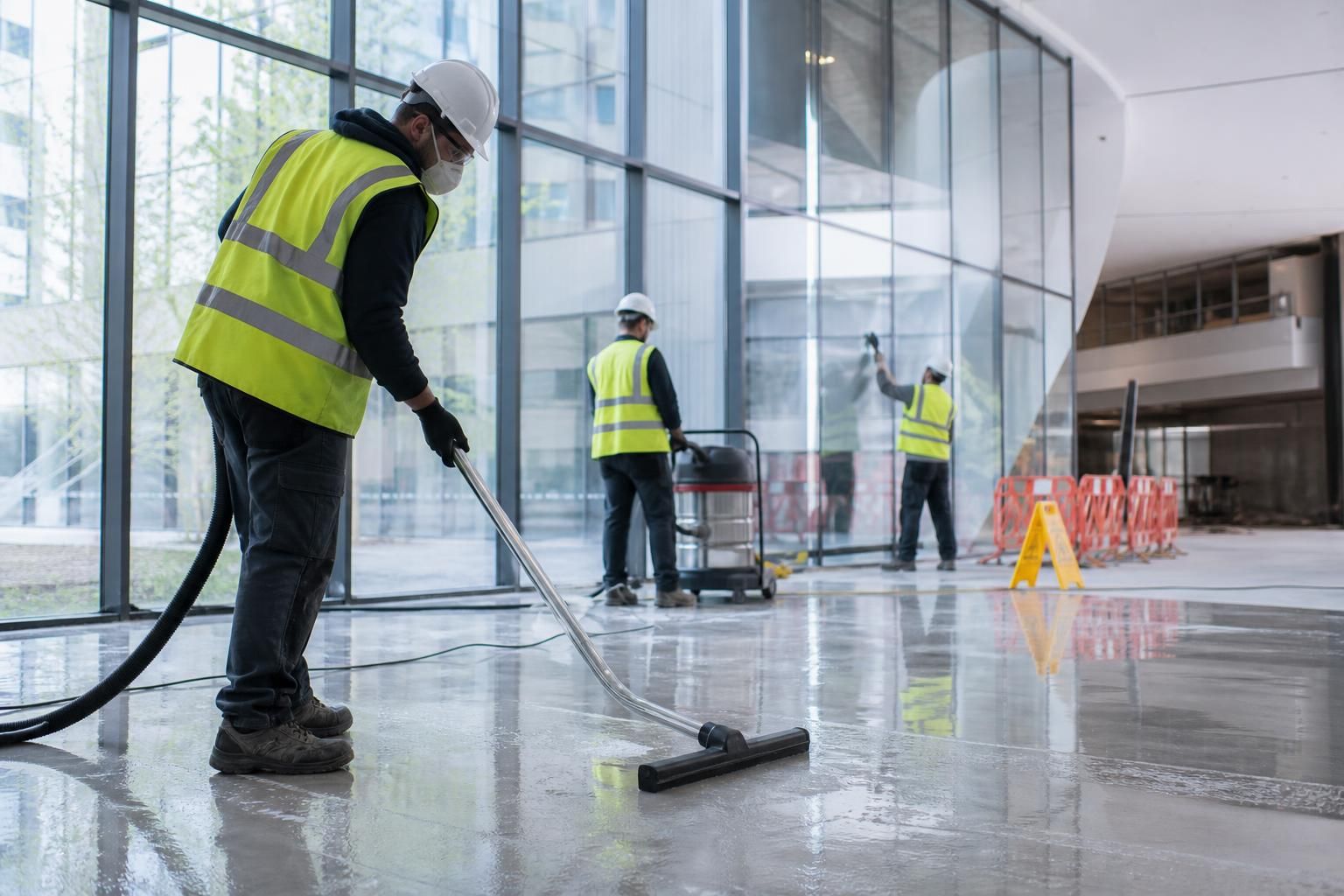
What safety measures are taken during post-construction cleaning to protect workers and site occupants?
Post-construction cleaning is carried out under a task-specific risk assessment and method statement, with controlled access, suitable PPE, safe access equipment, dust and slurry control, and COSHH-compliant handling of cleaning products. Workers and site occupants are protected through clear communication, exclusion zones, equipment checks, and coordination with the principal contractor before, during and after cleaning.
Post-construction cleaning is controlled through a task-specific risk assessment and method statement (RAMS), site coordination, restricted access and suitable protective equipment. These measures identify hazards such as construction dust, cement and grout residues, chemical exposure, wet floors, moving vehicles, fragile surfaces and work at height before cleaning begins. The controls are then explained to the cleaning team and coordinated with the principal contractor, site manager and any occupants.
Site-specific planning and risk assessment
Before work starts, the cleaning requirements and site conditions are reviewed rather than relying on a generic procedure. The assessment considers the building layout, unfinished areas, access routes, other contractors, occupied spaces, surface materials, available water and drainage, electrical installations, plant movements and emergency arrangements. The RAMS sets out the cleaning sequence, equipment, products, required controls and actions to take if conditions change.
Cleaning is postponed or the method is revised if the site is not ready. Examples include incomplete edge protection, unsafe access routes, exposed services, inadequate lighting, blocked drainage or other trades working in the same area. A briefing or toolbox talk ensures that operatives understand the hazards, control measures and reporting arrangements before entering the work zone.
Controlled access and protection of occupants
Work areas are separated from workers, visitors and members of the public using barriers, cones, warning signs and, where necessary, locked or supervised exclusion zones. Access routes are kept clear, and occupants are directed away from areas affected by water, dust, chemicals, noise or falling debris. Cleaning is scheduled to reduce interaction with deliveries, vehicle movements and normal building use.
Where a building is partly occupied, the cleaning team agrees suitable working times, alarm and evacuation procedures, welfare arrangements and communication points with the site contact. Doors, vents and openings may be closed or protected to prevent dust and spray entering adjoining areas. Any change that could affect occupants is communicated promptly rather than leaving people to discover a hazard themselves.
Personal protective equipment
PPE is selected from the risk assessment and is used alongside, not instead of, safer working methods. Depending on the task, this can include protective footwear with suitable slip resistance, gloves compatible with the cleaning product, eye or face protection, hearing protection, hard hats, high-visibility clothing and protective workwear.
Respiratory protective equipment may be required where dust, aerosols or chemical vapours cannot be adequately controlled by other means. It must be suitable for the hazard, correctly fitted and maintained. Operatives are instructed in the limitations, storage and cleaning of their PPE, and damaged or contaminated equipment is removed from use.
Dust, slurry and residue control
Construction dust and dried cement-based residues can irritate the eyes and respiratory system, while some dusts may create a more serious health risk if uncontrolled. Dry sweeping and methods that unnecessarily release dust are avoided where practicable. Suitable vacuum extraction, damp methods or controlled pressure washing are selected according to the surface and the material being removed.
Water and slurry are contained so they do not spread into occupied areas, enter unprotected drains or create a slip hazard. Drain covers, wet vacuums, collection systems and planned disposal routes may be used where appropriate. Operatives monitor overspray and run-off, particularly around electrical equipment, finished interiors, public paths and neighbouring properties.
Safe use of chemicals
Cleaning products are assessed under the Control of Substances Hazardous to Health (COSHH) requirements. The assessment considers the product hazards, dilution, application method, ventilation, contact time, required PPE, first-aid response, storage and disposal. Product labels and safety data sheets are checked, and chemicals are kept in clearly identified containers rather than being transferred into unmarked bottles.
Products are never mixed unless the manufacturer specifically permits it. In particular, incompatible acidic, alkaline or chlorine-based products can create dangerous reactions or harmful vapours. Operatives use the least hazardous effective product and apply it in a controlled manner to limit splashes, mist and unnecessary exposure. Spillages are isolated and dealt with using the planned procedure.
Safe access and work at height
Work at height is planned to avoid it where possible. If high-level façades, roofs, cladding or internal structures must be cleaned, the access method is selected for the task and site conditions. This may include properly positioned mobile access equipment, towers, powered access platforms or other suitable systems operated by trained and authorised personnel.
Access equipment is inspected before use and positioned on an appropriate surface, with controls for overhead obstructions, fragile areas, falling objects, weather and nearby traffic. Edge protection, harness systems or other fall-prevention measures are used where required by the assessment. Tools and hoses are managed to prevent dropped objects, trip hazards and entanglement, and the area below is kept clear.
Equipment, electrical safety and pressure controls
Pressure washers, steam cleaners, vacuums, hoses, extension leads and access equipment are checked before use. Defective equipment is taken out of service and reported. Operatives use equipment in accordance with the manufacturer’s instructions and are trained for the machinery and cleaning method involved.
Water is kept away from electrical installations wherever possible. Residual current protection, suitable cable management and safe connection points are considered where electrical equipment is used. Pressure and steam are adjusted to the surface and task; uncontrolled jetting can cause injection injuries, damage finishes, dislodge materials or propel debris. Operatives maintain a safe stance and never direct a jet towards people, live electrical equipment or unprotected openings.
Slips, trips, falling objects and site traffic
Wet floors, hoses, trailing cables, loose materials and uneven temporary surfaces are managed continuously rather than only at the end of the job. Hoses and cables are routed away from walkways or protected with suitable covers, and wet areas are signed and isolated until safe. Cleaning progresses in a planned sequence so completed areas are not unnecessarily re-contaminated.
Where vehicles, plant or deliveries operate nearby, the cleaning team follows the site traffic management plan. Reversing areas, loading zones and pedestrian routes are kept separate wherever possible. A banksman or other agreed communication system may be needed for vehicle movements. High-level cleaning also requires controls for tools, fragments and wash water falling into areas below.
Protection of surfaces and hidden services
Safety includes preventing damage to the building and its systems. The cleaning method is tested in an inconspicuous area where appropriate, especially when removing cement residue from delicate stone, coated metal, glass, painted surfaces, sealants or newly installed finishes. Pressure, temperature, chemical strength and dwell time are controlled to avoid etching, staining, water ingress or coating failure.
Before wet cleaning, the team identifies vulnerable equipment, sockets, ventilation openings, alarms, sensors, joints and unfinished construction details. These areas are isolated or protected, and the site manager is consulted if a service or material cannot be confirmed as safe to clean.
Monitoring, communication and emergency arrangements
Supervisors monitor conditions throughout the work and stop the task if the controls are no longer effective. Changes in weather, wind, occupancy, access, drainage or other contractors’ activities can create new risks and require the RAMS to be reviewed. Regular communication with the site contact helps resolve issues before they affect workers or occupants.
The team also has clear arrangements for first aid, eye or skin contamination, chemical spills, fire, equipment failure, falls, electrical incidents and evacuation. Emergency contact details and the location of welfare and first-aid facilities are confirmed during mobilisation. Incidents, near misses and defects are reported so corrective action can be taken.
Completion checks and handover
At the end of each work area, residues, waste, barriers and temporary protection are removed or left in place as agreed. Floors and access routes are checked for remaining moisture, slurry, debris and trip hazards. Wastewater, chemical containers and construction residues are handled through the agreed disposal arrangements and are not discharged without confirming that the route is suitable.
The site contact is informed when an area is ready for inspection or reoccupation. Any restrictions, outstanding defects or areas requiring further drying are recorded. This final check ensures that the protection measures continue through handover, not just while cleaning equipment is operating.
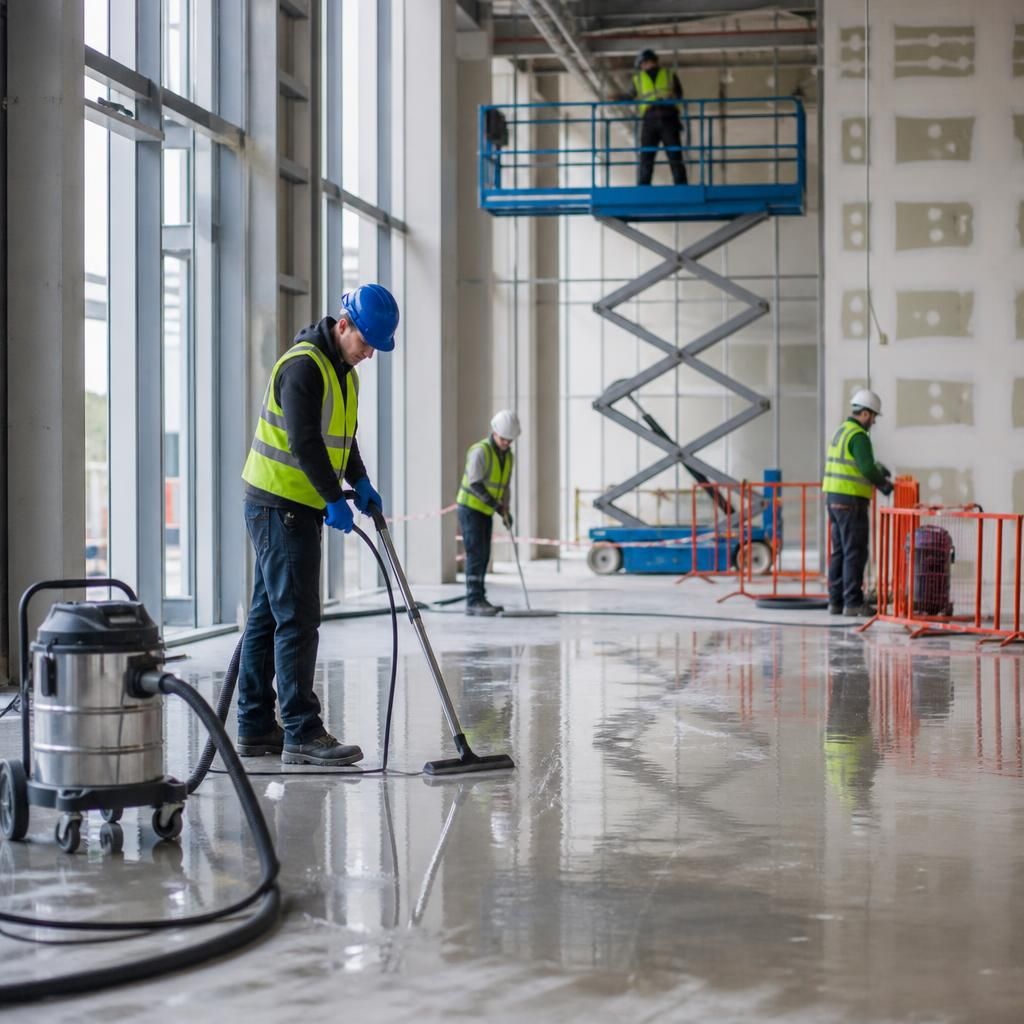
Post-construction cleaning safety is managed through a site-specific risk assessment and method statement (RAMS), supported by controlled access, suitable PPE and regular communication with the principal contractor or site manager.
Before work begins, the cleaning team identifies hazards such as construction dust, wet floors, chemical exposure, moving vehicles, fragile finishes and work at height. Barriers, warning signs and exclusion zones keep occupants and other contractors away from active areas, while equipment, access routes and emergency arrangements are checked. If site conditions change, cleaning is paused and the controls are reviewed before work resumes.