
What factors should be considered when selecting an industrial cleaning and maintenance service provider?
When selecting an industrial cleaning and maintenance service provider, assess their relevant sector experience, health and safety procedures, equipment, environmental practices, insurance and ability to deliver the required scope of work. Reliability, clear method statements, suitable access solutions and a maintenance plan tailored to your site are also essential.
Select an industrial cleaning and maintenance service provider by assessing its relevant experience, safety management, technical capability, equipment, environmental controls, reliability and ability to deliver the full scope of work. The right contractor should understand your site risks and operational requirements, provide a clear method of working, and offer a maintenance approach that protects buildings, equipment, employees and visitors.
Relevant industry and site experience
Experience should be relevant to the type of facility and cleaning required, rather than based solely on the contractor’s time in business. A provider working on warehouses, manufacturing premises, construction sites, retail estates or public buildings should understand the different surfaces, access restrictions, contamination risks and working-hour requirements associated with each environment.
Ask whether the contractor has completed comparable work involving façades, cladding, roofs, loading areas, car parks, industrial floors, plant areas or graffiti removal. Experience with similar materials is important because pressure, heat, chemical concentration and dwell time must be controlled to prevent damage to coatings, joints, seals, drainage systems and sensitive equipment.
Clear assessment of the required work
A competent provider should inspect the site before confirming the work or issuing a final quotation. The assessment should consider:
- the surfaces, materials, levels of soiling and likely causes of contamination;
- the size and layout of the area, including restricted or difficult-to-reach locations;
- vehicle, pedestrian and delivery routes that must remain available;
- water supply, drainage, power and waste-handling arrangements;
- working hours, production schedules and any requirements for phasing the work;
- access requirements, including mobile elevated work platforms, towers, abseiling or other specialist solutions; and
- the standard of finish required and how completion will be checked.
This information should be reflected in a written scope of work. It helps prevent unclear assumptions, unexpected exclusions and unsuitable cleaning methods.
Health and safety competence
Industrial cleaning can involve working at height, pressurised water, steam, chemicals, traffic movements, electrical equipment, confined areas and contaminated surfaces. The contractor should be able to explain how these hazards will be controlled before work starts.
Request suitable risk assessments and method statements for the planned activities. These should cover equipment checks, operator competence, exclusion zones, fall prevention, chemical handling, personal protective equipment, emergency arrangements, weather conditions and protection for members of the public and site employees. Where access equipment is used, confirm that it will be operated by trained personnel and inspected as required.
The provider should also hold appropriate employers’ liability and public liability insurance, and be willing to provide evidence of insurance and relevant qualifications when requested. Site induction, permit-to-work procedures and coordination with your own responsible person may be necessary for higher-risk premises.
Suitable equipment and cleaning methods
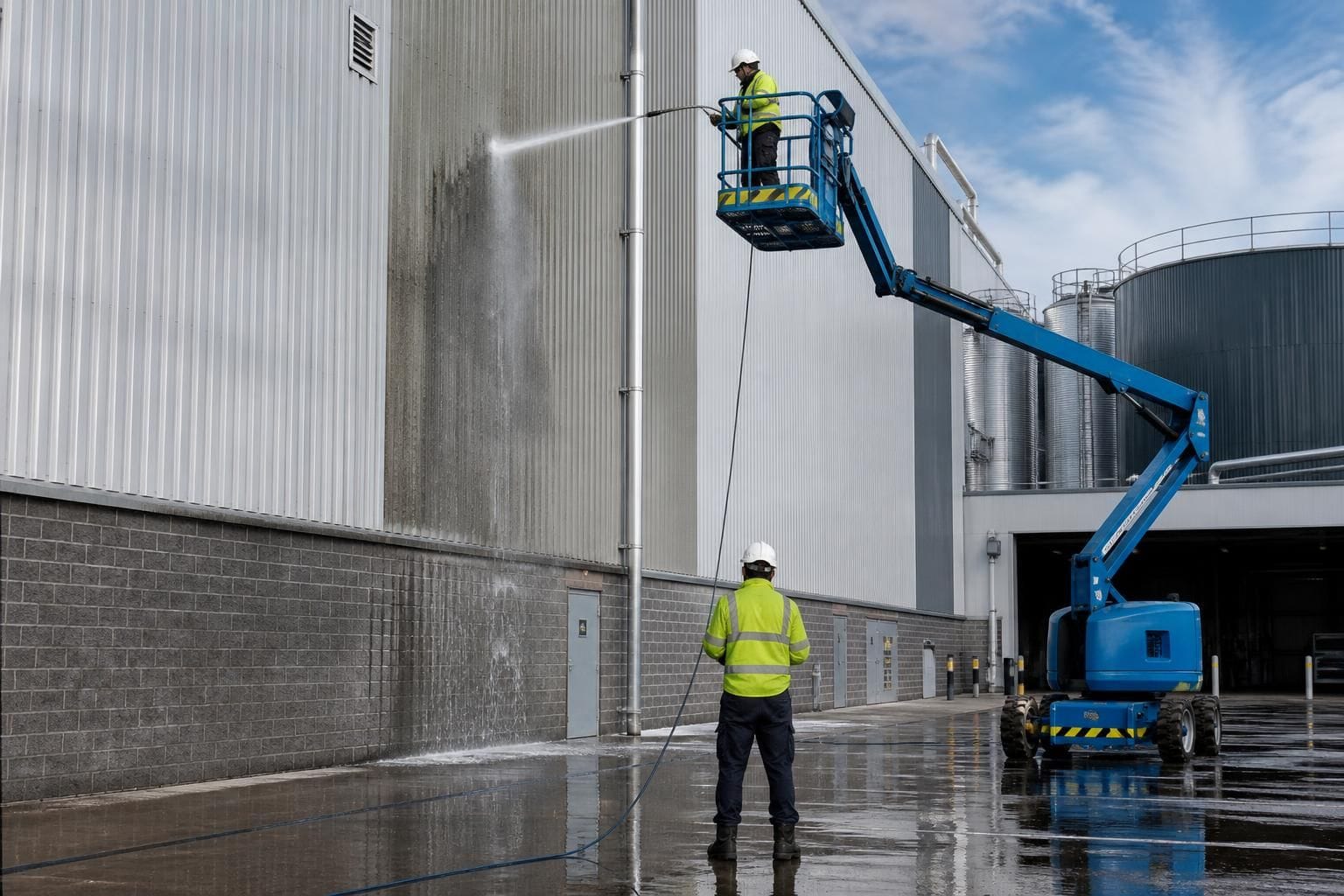
The equipment should match the surface, contamination and access conditions. Pressure washing is effective for many robust external surfaces, but excessive pressure can strip coatings, force water into vulnerable areas or damage pointing. Steam cleaning can be more suitable where lower water use, controlled heat or reduced chemical use is required. Soft washing and carefully selected detergents may be appropriate for biological growth or delicate finishes.
Ask how the contractor will test the proposed method and protect vulnerable features before wider cleaning begins. A competent team should be able to adjust pressure, temperature, flow rate and chemical use rather than applying one process to every surface. Equipment should be maintained, properly transported and suitable for the scale of the site.
Access planning and protection of the site
Large or high-level buildings often require more than ground-based equipment. The provider should identify a safe and efficient access solution and explain how it will protect roofs, landscaping, vehicles, glazing, air intakes, signage and adjacent properties.
Good planning also covers overspray, runoff, noise, water use and the movement of cleaning equipment around the premises. Where cleaning takes place near public areas or active operations, barriers, banksmen, temporary closures or phased work may be needed. These arrangements should be agreed with the site manager before mobilisation.
Environmental and waste controls
Environmental practice should be considered alongside cleaning performance. Ask how the contractor will control water consumption, choose and store chemicals, prevent contaminated runoff and dispose of waste water or removed material. Runoff must not be allowed to enter surface-water drains or surrounding ground where it could cause pollution.
The provider should understand the site’s drainage arrangements and any local or contractual environmental requirements. Where appropriate, methods using less water or fewer chemicals can reduce environmental impact, but they must still be suitable for the material and level of soiling. Environmental claims should be supported by a clear description of the process rather than general statements.
Reliability and operational continuity
For industrial and commercial sites, reliability includes arriving as agreed, communicating changes promptly and completing work without unnecessary disruption. Establish who will manage the contract, how out-of-hours access will be handled and how urgent issues will be reported.
For recurring work, agree a schedule based on the condition and use of the site rather than relying on an identical visit each time. A maintenance plan may include routine façade and cladding cleaning, car park and loading-area cleaning, roof or gutter attention, stain treatment and periodic inspections. The plan should state the tasks included, recommended intervals, response arrangements and any exclusions.
Quality assurance and reporting
Before appointment, agree how the finished work will be assessed. This may include a defined cleanliness standard, inspection of sample areas, photographs, completion records or a joint handover with the site contact. Reporting is particularly useful for large sites where work is phased or carried out across multiple locations.
Records should identify the areas cleaned, methods used, issues found, access limitations and any recommended follow-up work. A provider that documents defects such as damaged cladding, blocked drainage or failed sealant can help you distinguish cleaning requirements from wider maintenance issues without presenting unrelated work as part of the cleaning scope.
Transparent pricing and contract terms
Compare quotations on the basis of the same scope, access assumptions and finish standard. A low initial price may not represent good value if it excludes traffic management, specialist access, water recovery, waste disposal, protection of sensitive areas or return visits.
The quotation should explain what is included, what is excluded, the expected programme, preparation requirements, payment terms and arrangements for variations. For planned maintenance, check how pricing is reviewed, how additional defects are reported and whether the contract can be adjusted when site conditions change.
Questions to ask before appointing a provider
- Have you completed comparable work on the same or similar surfaces?
- What site information do you need before preparing the method and quotation?
- Which cleaning process and access equipment do you propose, and why?
- How will you control risks to people, vehicles, buildings, drainage and equipment?
- What evidence can you provide of insurance, training, equipment checks and competent supervision?
- How will water, chemicals, runoff and waste be managed?
- Who will coordinate the work and provide progress or completion records?
- What is included in the price, and how will variations be authorised?
Before work begins, provide the contractor with accurate information about site hazards, restricted areas, operating hours, drainage and any known defects. Selecting a provider on documented competence, a detailed site-specific plan and dependable communication gives you a stronger basis for safe, compliant and consistently maintained premises than comparing headline prices alone.
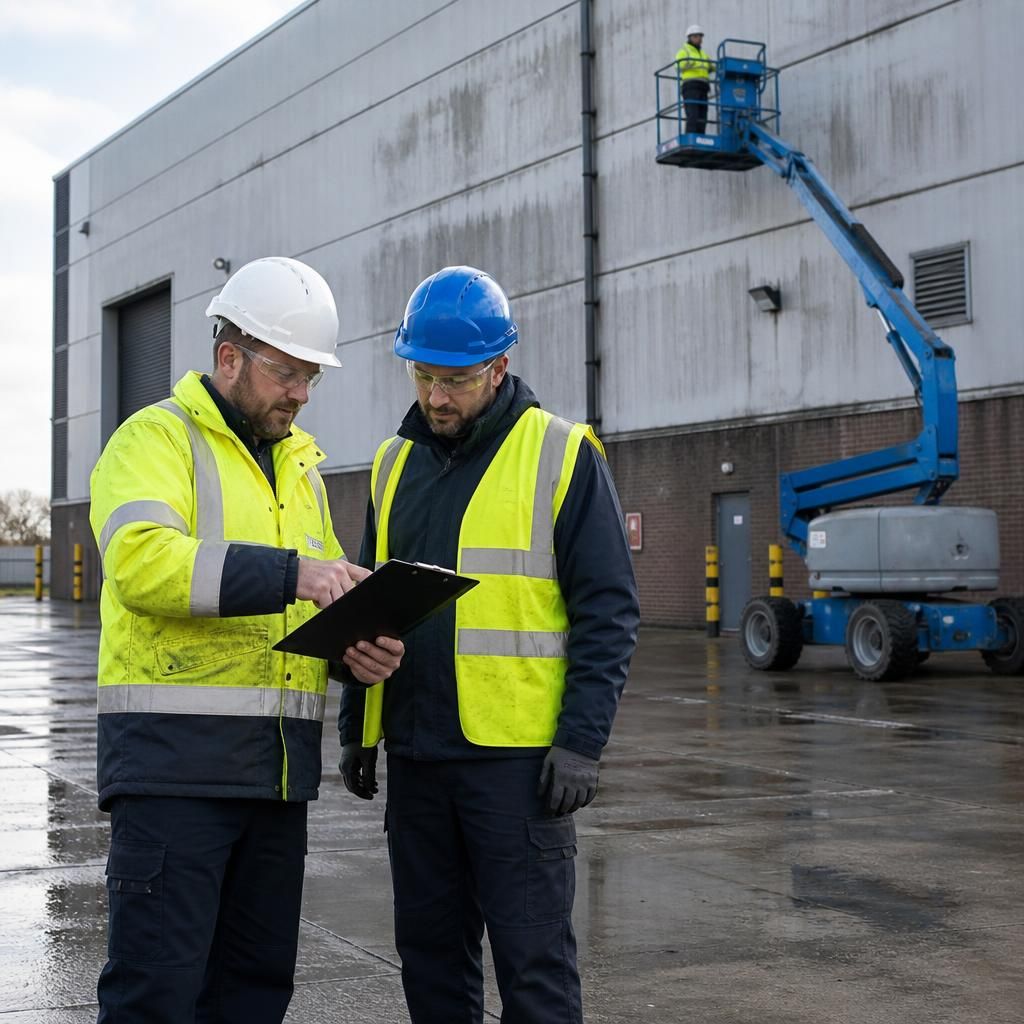
A site-specific assessment is one of the most important factors when selecting an industrial cleaning and maintenance provider. It allows the contractor to identify surface materials, contamination, access restrictions, drainage arrangements, nearby operations and potential risks before recommending a cleaning method.
The assessment should lead to a written scope of work and method statement explaining:
- which areas and surfaces will be cleaned;
- which equipment, chemicals and access systems will be used;
- how people, vehicles, buildings, equipment and drainage will be protected;
- how wastewater, debris and other waste will be controlled; and
- how completion and any follow-up work will be recorded.
This approach is more reliable than accepting a standard process or a quotation based only on the site’s size. It helps ensure that pressure, heat, water and chemical use are appropriate for the materials, while allowing the work to be planned around deliveries, production, employees and visitors.
Arrange a site assessment for your industrial cleaning requirements
Arrange a site assessment with Encanto Exterior Cleaning to review your surfaces, access requirements, operational constraints and environmental controls. We can then recommend a suitable industrial cleaning and maintenance approach for your premises.