
What are the essential components of an effective industrial cleaning routine?
An effective industrial cleaning routine combines a documented risk assessment, suitable cleaning methods and equipment, trained personnel, clear safety controls, and a planned schedule. It should also include quality checks, waste management, record keeping and periodic reviews so standards remain consistent and the routine adapts to operational changes.
An effective industrial cleaning routine is a documented, risk-based system that defines what must be cleaned, how it will be cleaned, who is responsible, which controls are required and how the results will be checked. It combines planned cleaning with responsive work, using suitable methods and equipment to control contamination, protect assets, maintain safe working conditions and support compliance.
Site assessment and risk identification are the starting points. Before work begins, the facility should be assessed for the types of soil, contamination and hazards present. This may include oil and grease, chemical residues, dust, production waste, biological contamination, bird fouling, mould, algae or embedded dirt. The assessment should also consider machinery, electrical installations, drainage, ventilation, pedestrian routes, vehicle movements, work at height and areas with restricted access.
The findings should be recorded in a suitable risk assessment and method statement. These documents should explain the proposed cleaning process, foreseeable hazards, required controls, personal protective equipment, emergency arrangements and waste-disposal requirements. They must be reviewed when the process, equipment, chemicals, site layout or operating conditions change.
A clear cleaning scope and standard prevent important tasks from being missed. The routine should identify each area, surface and asset requiring attention, including floors, walls, ceilings, façades, cladding, roofs, loading bays, welfare facilities, plant rooms, production areas, car parks and external circulation routes. It should state the required standard for each location rather than relying on general descriptions such as “clean” or “tidy”.
For example, a production floor may require the removal of loose debris, grease and slip hazards, while an external façade may require the controlled removal of staining without damaging coatings or joints. A written scope also helps distinguish routine cleaning from specialist tasks, such as high-level cleaning, graffiti removal, pressure washing, steam cleaning or the treatment of hazardous contamination.
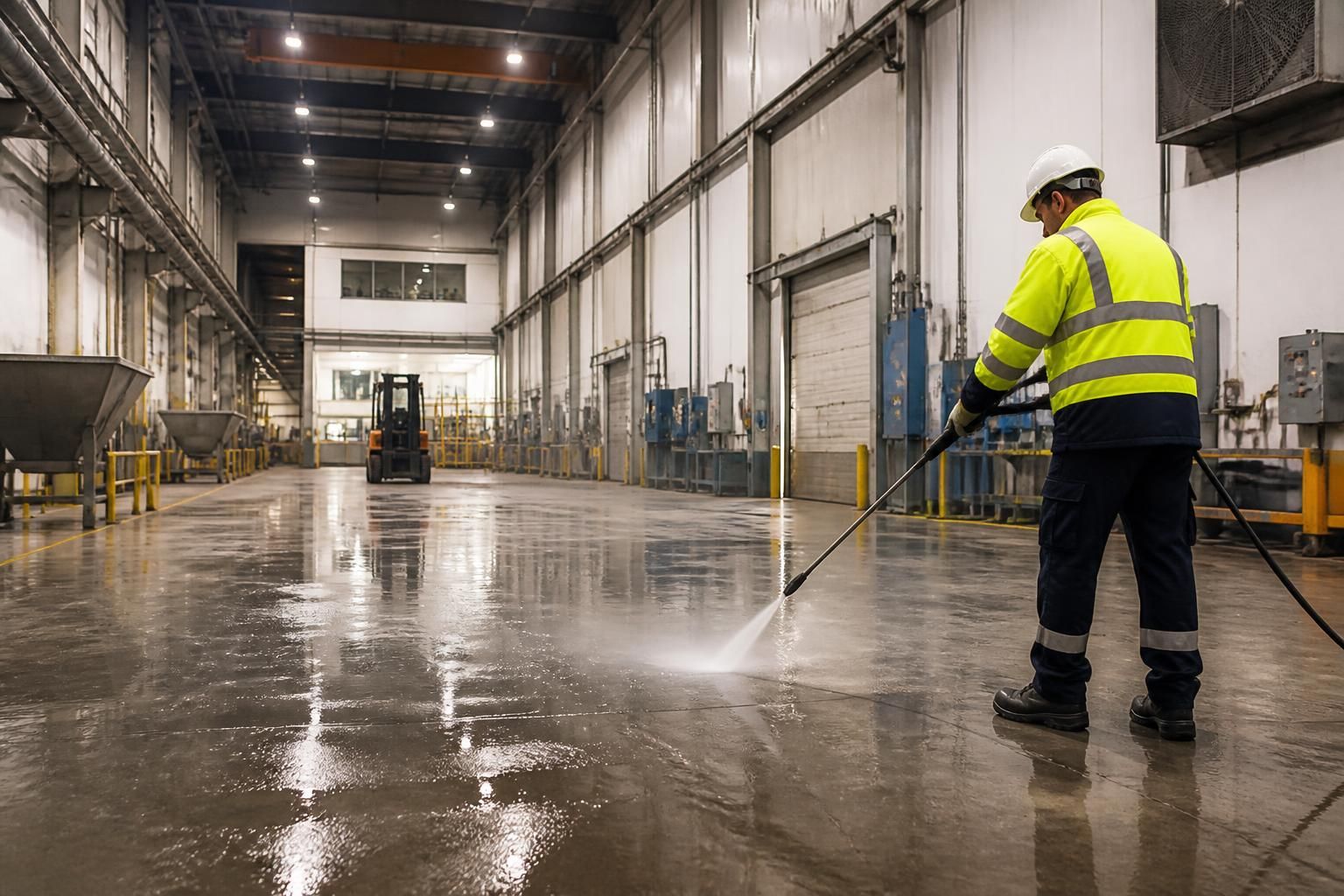
Appropriate cleaning methods and equipment should be selected according to the surface, contamination and operating environment. Pressure washing can be effective for robust external surfaces, yards and hard-standing areas, but water pressure, temperature and runoff must be controlled. Steam cleaning may be more suitable where reduced chemical use, controlled moisture or the removal of grease is important. Manual cleaning, mechanical scrubbing, vacuuming or specialist chemical treatment may be preferable for sensitive surfaces or enclosed areas.
Equipment should be suitable for the task and maintained in safe working order. This may include pressure washers, scrubber dryers, industrial vacuums, steam-cleaning systems, water-recovery equipment, access platforms and fall-protection systems. Operators should understand the limitations of each item and use accessories, detergents and pressure settings appropriate to the surface. Incorrect equipment selection can cause coating failure, surface damage, water ingress, airborne dust or contamination spread.
Competent and suitably trained personnel are essential to a consistent routine. Staff should be trained in the cleaning methods they use, safe equipment operation, chemical handling, manual handling, use of personal protective equipment and site-specific emergency procedures. Additional competence may be required for work at height, confined spaces, traffic management, electrical risks or the handling of hazardous substances.
Training should be supported by clear instructions and supervision, particularly where cleaning takes place around live production, moving vehicles, machinery or members of the public. Contractors should receive relevant site information and understand local rules before starting work. Competence should be checked periodically rather than assumed from previous experience.
Health and safety controls must be built into the routine rather than added after cleaning has started. Typical controls include isolating machinery where necessary, segregating work areas, placing warning signs, controlling access, managing hoses and cables, preventing slips and trips, and maintaining safe distances from pressurised equipment. Wet cleaning should be planned so that floors can dry safely and runoff cannot create hazards elsewhere.
Chemicals should be selected and used in accordance with their safety data sheets and the site’s COSHH arrangements. Containers must be clearly labelled, stored correctly and kept away from incompatible substances. Staff should know the required dilution, contact time, ventilation arrangements, spill response and first-aid measures. Chemicals should not be mixed unless the manufacturer’s instructions specifically permit it.
A planned schedule should combine daily operational controls with periodic deep cleaning and planned maintenance. High-use areas, spill-prone locations, entrances, welfare facilities and production zones may require more frequent attention than low-traffic areas. External surfaces, roofs, façades, cladding, drainage channels and car parks may be managed through seasonal or condition-based programmes.
The schedule should allow for cleaning during suitable production and occupancy windows. It should identify the task, location, responsible person or contractor, required equipment, expected standard and completion record. Reactive cleaning must also be covered, including procedures for spills, flooding, graffiti, unexpected contamination, blocked drainage and weather-related deposits.
Contamination control and waste management are important components of industrial cleaning. Soil should be removed in a way that does not spread it to clean areas, drainage systems, equipment or personnel. Where necessary, work should proceed from cleaner areas towards more contaminated areas, with separate tools or controlled decontamination between zones.
Wastewater, sludge, used absorbents, contaminated cloths, packaging and other waste should be contained, handled and disposed of in accordance with its classification and the site’s environmental procedures. Cleaning methods should prevent uncontrolled discharge to surface water or drainage systems. Where pressure washing is used, runoff may need to be captured, filtered or directed to an approved drainage point.
Inspection and quality assurance confirm whether the routine is achieving the required result. Supervisors or designated site contacts should inspect completed work against the agreed standard. Checks may include visual inspection, confirmation that hazards have been removed, assessment of odour or residue, examination of sensitive surfaces and verification that equipment or access routes have been left safe.
Where hygiene or contamination control is particularly important, additional verification methods may be appropriate. Any defects should be recorded with the location, cause, corrective action and completion status. Repeated failures may indicate that the cleaning frequency, method, equipment, training or scope needs to be changed.
Records and communication provide evidence that the routine is being carried out properly. Useful records include completed schedules, inspection reports, risk assessments, method statements, training records, equipment checks, chemical information, waste-transfer documentation and reports of incidents or defects. Records should be accessible to the people responsible for site management, compliance and contractor oversight.
Communication is particularly important where cleaning overlaps with production, maintenance or construction activity. Changes to access, operating hours, materials, machinery or site hazards should be shared before the next visit. A reliable handover process reduces the risk of missed areas and prevents cleaning activity from conflicting with other work.
Regular review and improvement keep the routine effective over time. The programme should be reviewed after incidents, complaints, audit findings, equipment changes, process alterations or changes in the type of contamination. Seasonal conditions and changes in footfall, vehicle movements or production volume may also justify adjustments.
An effective review asks whether the cleaning standard is appropriate, whether the selected method is damaging any surface, whether workers are adequately protected, whether waste is being controlled and whether the planned frequency reflects actual site conditions. This turns cleaning from a series of isolated tasks into a controlled maintenance process that supports safer operations, better asset condition and more consistent compliance.

Quality checks are an essential component of an industrial cleaning routine because they confirm that the required standard has been achieved, rather than assuming that a task is complete when the work appears finished. Inspections should check for remaining contamination, slip hazards, residue, odour, surface damage and any unsafe conditions created during cleaning.
Completed work should be assessed against the agreed scope for each area or asset. Any defect should be recorded with its location, required corrective action and completion status. Repeated issues may indicate that the cleaning frequency, equipment, method or staff training needs to be reviewed. This inspection process provides useful evidence for site management and helps maintain consistent standards across routine and specialist cleaning work.