
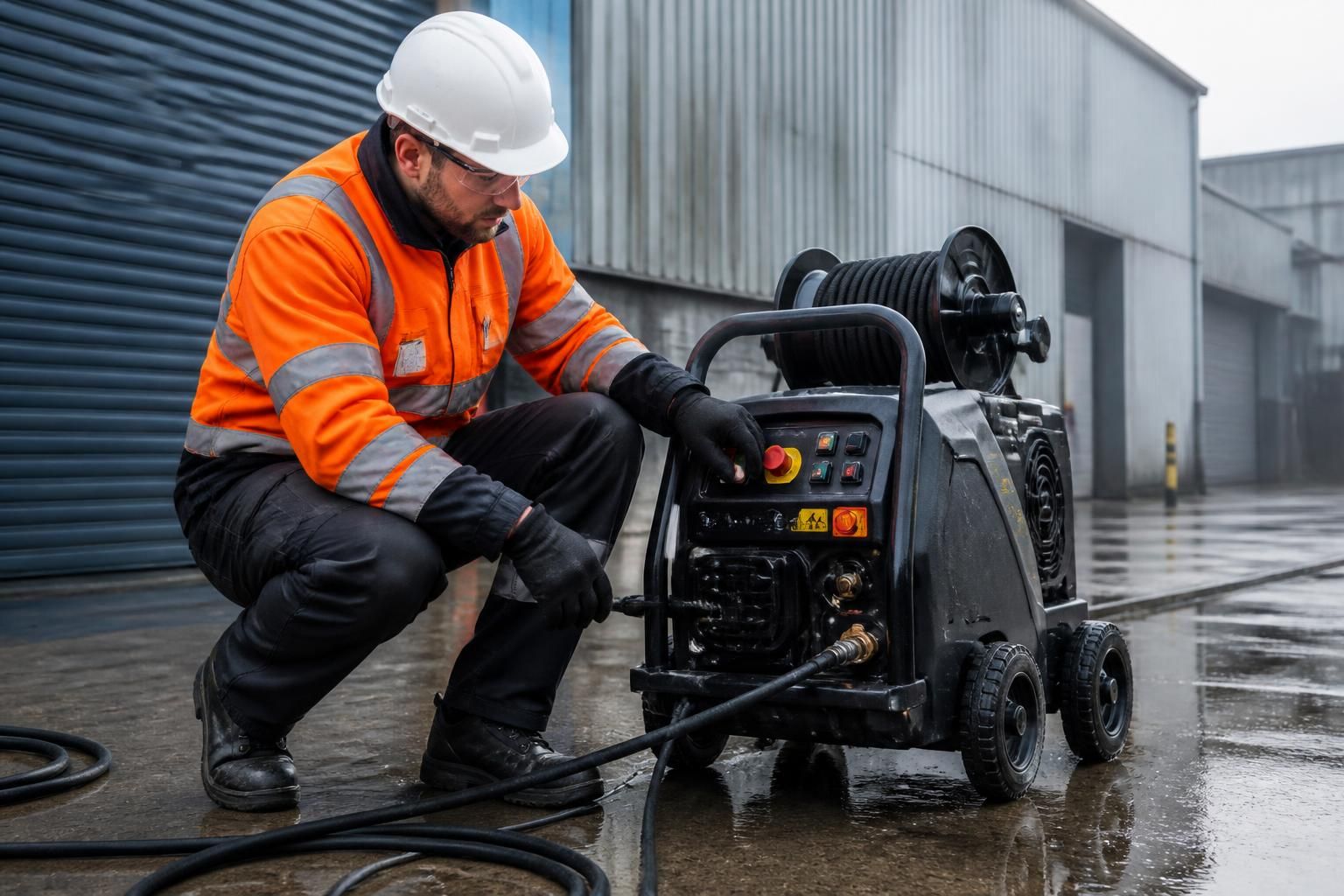
What safety features should I consider when choosing industrial cleaning equipment?
When choosing industrial cleaning equipment, prioritise emergency-stop controls, automatic shut-off systems, pressure and temperature regulation, hose and cable protection, secure guards, and clear operating controls. For equipment used at height or in restricted areas, also check for effective isolation, access controls, stability features, and compatibility with the required personal protective equipment and site risk assessments.
The most important safety features in industrial cleaning equipment are accessible emergency-stop controls, automatic shut-off systems, reliable pressure and temperature regulation, protected moving and electrical parts, secure hose and cable management, and controls that prevent unintended operation. Equipment should also suit the risks of the site, including work at height, restricted access, chemicals, noise, hot water and interaction with vehicles or pedestrians.
Emergency stops and automatic shut-off
An emergency stop should be clearly identified, easy to reach and capable of stopping the relevant hazardous function quickly. This is particularly important where operators may need to react to a burst hose, loss of control or a person entering the work area. An emergency stop should not replace normal isolation procedures, but it provides an immediate response in an incident.
Automatic shut-off systems are also valuable. Depending on the equipment, these may stop the pump when the trigger is released, cut power when a fault is detected, or shut down the machine if it overheats, loses water supply or exceeds safe operating conditions. Check what the system monitors and whether the equipment can restart unexpectedly when power or water is restored.
Pressure, temperature and flow controls
Industrial pressure washers and steam cleaning equipment should have clear controls for adjusting pressure, water flow and temperature. A pressure gauge or digital display helps the operator confirm that the machine is working within the selected range. Pressure relief valves and other over-pressure protection should be fitted, maintained and suitable for the machine’s rated performance.
For hot-water and steam equipment, look for temperature control, thermal cut-outs and protection against over-temperature conditions. Insulated surfaces, heat-resistant handles and suitable hose construction reduce the risk of burns. The operator should be able to lower the pressure or temperature without reaching across hot or moving components.
Guards and protection from moving parts
Fans, belts, couplings, pumps and other moving components should be enclosed by fixed or properly secured guards. Guards must not be easy to remove during ordinary operation, and access panels should not expose hazardous parts when the equipment is running. Do not select a machine solely because it has a high output if essential guards are missing, damaged or difficult to replace.
Controls should be positioned away from spray, heat and moving parts. Clearly marked switches, trigger locks where appropriate and controls that require deliberate operation can help prevent accidental starting or discharge.
Hose, lance, cable and connection protection
High-pressure hoses and couplings must be rated for the pressure, temperature and cleaning chemicals being used. Look for secure fittings, strain relief, anti-whip protection where required, and a design that limits sudden hose movement if a connection fails. Hoses should be routed so they cannot be crushed by vehicles, caught on sharp edges or create a trip hazard.
Electrical cables need equivalent protection. Suitable cable glands, robust plugs, residual current protection and an appropriate ingress protection rating are important where water is present. Cable reels and hose reels should unwind and retract safely without trapping hands or placing excessive strain on the connections. Equipment used outdoors should be suitable for the conditions rather than relying on improvised covers or extension leads.
Stability and access features
Choose equipment with a stable frame, suitable wheels and effective brakes or parking arrangements. It should remain secure on the surfaces where it will be used and should not become unstable when hoses are pulled or accessories are connected. Compact equipment still needs enough stability for the intended working pressure and hose length.
For façade, roof and other elevated cleaning, consider the complete access system rather than the cleaning machine alone. Platforms, mobile access equipment, roof access arrangements and lifting accessories must be suitable for the task, inspected as required and used on a properly assessed surface. Guardrails, gates, toe protection and fall-prevention measures may be necessary. Equipment should not be used as a substitute for a safe access method, and operators should not rely on hose tension or the machine frame for support.
Where equipment is lifted or positioned at height, check lifting points, rated capacities and attachment security. Lifting accessories may fall within the requirements for thorough examination under the Lifting Operations and Lifting Equipment Regulations, while work equipment more generally must be selected and maintained in line with applicable UK requirements such as the Provision and Use of Work Equipment Regulations.
Isolation and access controls
Machines should have a clear means of isolating electrical, hydraulic, pneumatic, water and fuel supplies before cleaning, clearing a blockage or carrying out maintenance. A lockable isolation point is preferable for equipment used by more than one person or in busy operational areas. Where practical, guards and access panels should prevent operation while they are open.
For vehicle-mounted, remotely operated or automated equipment, access controls can help prevent operation while people are inside the exclusion zone. Key switches, coded controls or controlled start procedures may be appropriate, provided they are not bypassed. Emergency isolation should be understood by everyone involved in the work, not just the person operating the machine.
Electrical, fuel and exhaust safety
Electric machines should have suitable earthing or double-insulation arrangements, robust water protection and protection against overload. Fuel-powered equipment requires safe fuel storage, secure caps, ventilation and protection from hot exhaust components. Never use combustion-powered equipment in an enclosed or poorly ventilated area unless the equipment and ventilation arrangements are specifically suitable for that environment.
For work in confined or restricted spaces, consider atmospheric risks, ventilation, remote operation and a rescue plan before choosing the machine. Electrical equipment may be preferable to combustion-powered equipment in some locations, but its electrical supply and protection still need to be assessed.
Chemical dosing and water protection
If the equipment injects detergents, biocides or other cleaning chemicals, it should provide controlled dosing and secure chemical connections. Non-return valves can help prevent contamination of the water supply, while clearly labelled containers and dedicated lines reduce the chance of incorrect connection. Components must be compatible with the chemicals used, including seals, hoses and spray equipment.
Selection should be supported by the chemical’s safety data sheet and a COSHH assessment. The machine should not make it easy for an operator to mix incompatible products, bypass dilution controls or handle concentrated chemicals unnecessarily. Suitable eyewash, spill controls and personal protective equipment should be available where the risk assessment requires them.
Noise, vibration and operator ergonomics
Check the machine’s noise and vibration characteristics, particularly for prolonged use or work near occupied buildings. Controls should be reachable without awkward stretching, handles should provide a secure grip and the lance or accessory should be balanced for the task. Excessive trigger force, recoil or vibration can reduce control and increase fatigue.
Noise information should be considered alongside the site environment and nearby workers. Hearing protection may be needed, but it should not prevent operators from hearing alarms, vehicle movements or instructions. Similarly, gloves and other protective equipment must provide protection without reducing the operator’s ability to control the trigger, couplings or emergency stop.
Site protection and operator awareness
Useful safety features include warning labels, operating instructions, clear pressure and temperature indicators, accessory identification and instructions for safe start-up and shutdown. The equipment should be compatible with barriers, cones, drain covers and other controls used to separate the cleaning activity from pedestrians, vehicles and other contractors.
Before selecting equipment, confirm that its safety features support the site risk assessment and method statement. Consider the surface, water supply, drainage, electrical supply, access route, weather, nearby members of the public, fragile building elements and the possibility of contaminated run-off. A machine with appropriate safety controls can still be unsafe if it is used with the wrong nozzle, hose, chemical, access method or protective equipment.
Documentation, inspection and maintenance
Request operating instructions, technical specifications, inspection requirements and information about compatible accessories. Check that safety devices can be tested and maintained without specialist access being unavailable for long periods. Emergency stops, guards, pressure relief systems, cables, hoses, couplings, wheels and isolation points should form part of routine pre-use checks.
Do not choose equipment with safety features that operators cannot understand or that are likely to be bypassed because they interrupt normal work. The safest choice is equipment whose controls match the task, whose protective systems are easy to verify and whose maintenance arrangements are realistic for the site. For larger commercial and industrial projects, document the checks, brief operators on the controls and remove equipment from service when a safety-critical defect is found.
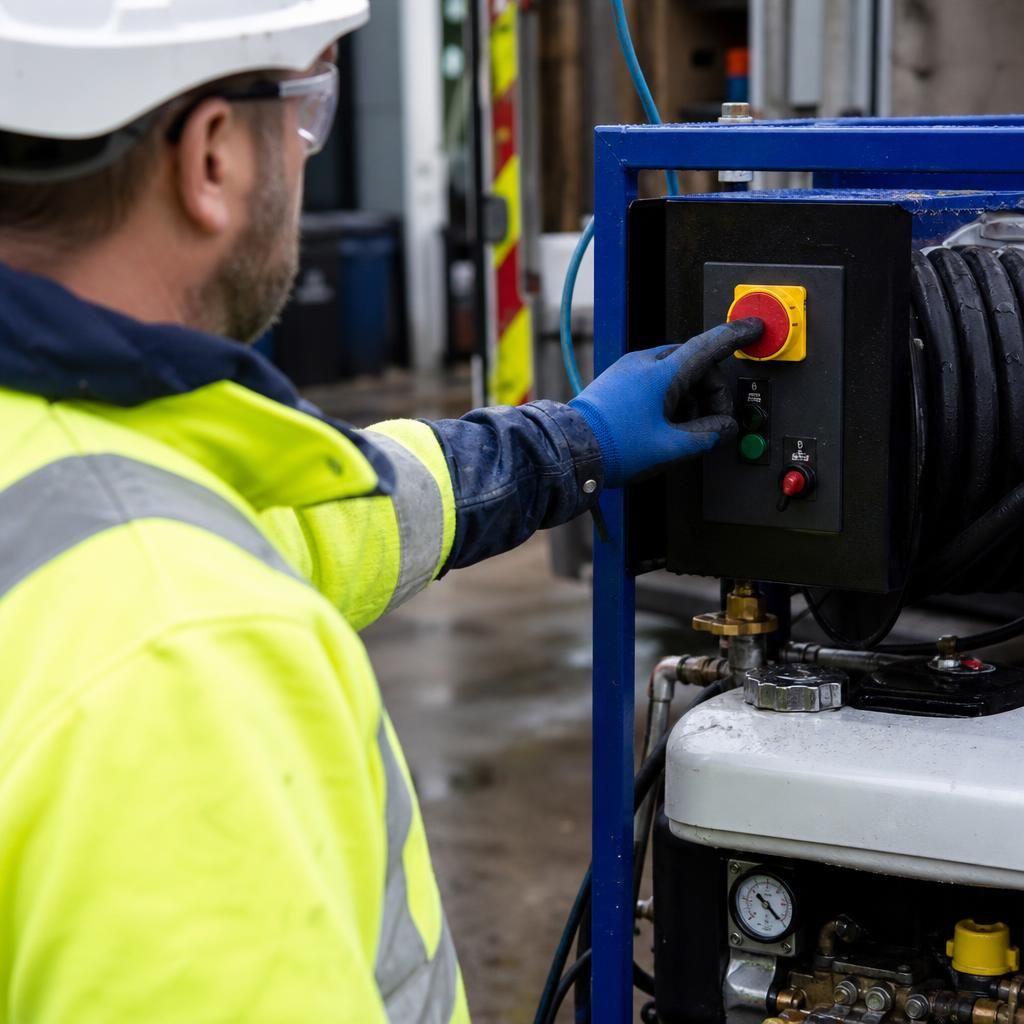
An emergency-stop control is a critical safety feature on industrial cleaning equipment. It should be clearly marked, easy to reach from the operator’s normal position and capable of stopping the relevant hazardous function quickly if a hose fails, control is lost or someone enters the work area.
Automatic shut-off systems provide additional protection by stopping the pump or machine when the trigger is released, overheating occurs, water supply is interrupted or another fault is detected. Check how the equipment prevents an unexpected restart when power or water is restored, and ensure operators understand the difference between emergency stopping and full isolation before maintenance.
Discuss Safe Industrial Cleaning Equipment for Your Site
Discuss your site requirements with our team to identify suitable safety features for the industrial cleaning equipment you need. We can help assess access, pressure, temperature, electrical, chemical and operator-safety considerations before work begins.