
What safety features should be considered when using industrial cleaning equipment?
Industrial cleaning equipment should include emergency-stop controls, guarded moving parts, pressure and temperature limits, dead-man triggers, secure access controls and electrical protection such as RCDs. Operators should also verify that safety interlocks, hose connections, warning systems and isolation procedures are suitable for the equipment, cleaning method and work environment.
Industrial cleaning equipment should have safety features that control its main risks: high pressure, heat, moving parts, electricity, chemicals, noise and unintended operation. Essential features include clearly accessible emergency stops, dead-man controls, guarded components, pressure and temperature limits, secure hose connections, electrical protection, safety interlocks and reliable isolation controls. These features must be suitable for the equipment, cleaning method, surface and working environment, and must be supported by trained operators and documented checks.
Emergency stops and automatic shut-off
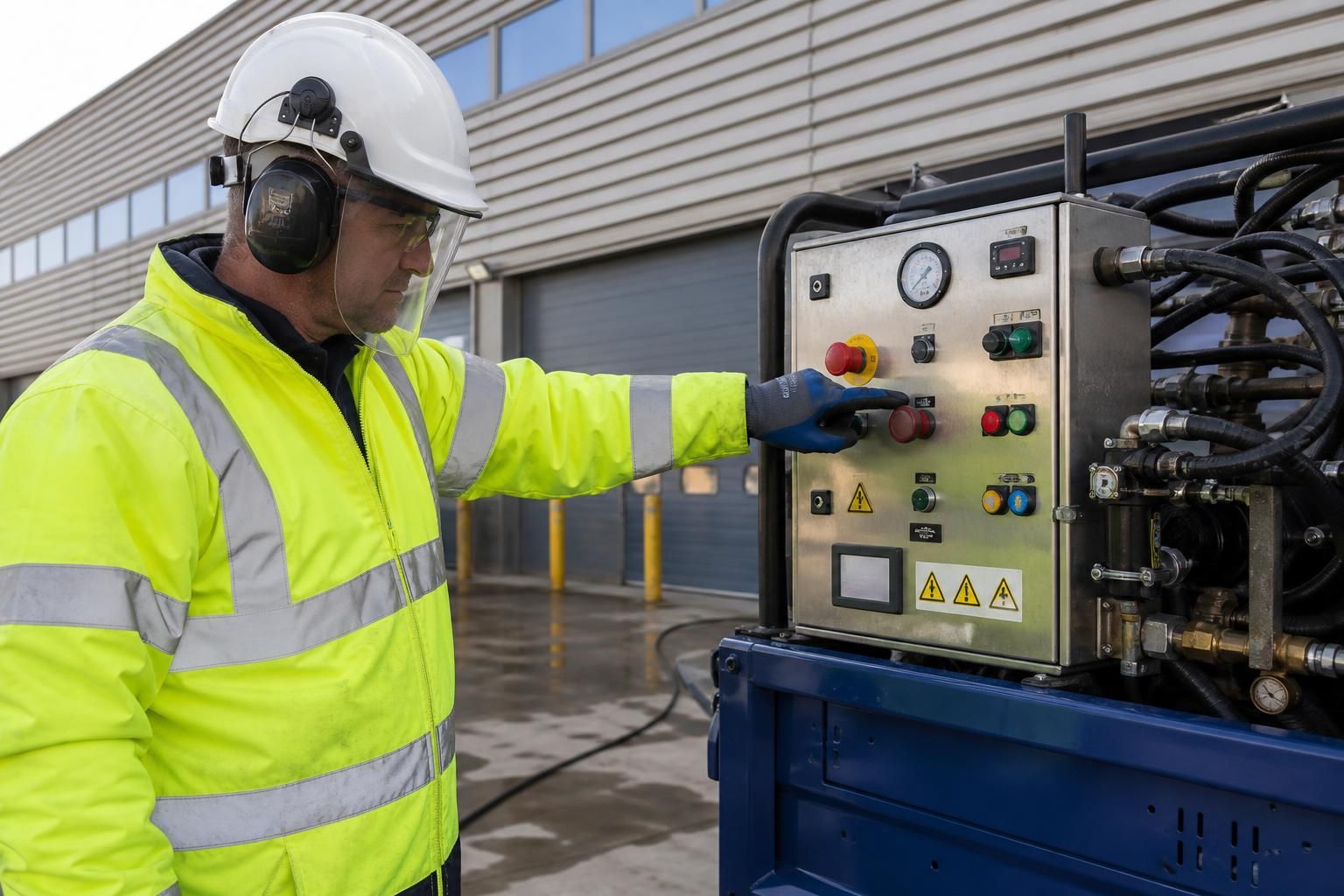
An emergency-stop button or control should be easy to identify and reach without placing the operator in further danger. It should stop the hazardous function quickly, such as the pump, drive system, rotating brush or heating element. Equipment may also need automatic shut-off when the trigger is released, water flow is interrupted, the motor overheats or a fault is detected. An emergency stop is not a substitute for normal switching-off and isolation, but it provides an additional control when something goes wrong.
Dead-man controls and controlled start-up
Pressure washers, steam cleaners and other powered equipment should use a dead-man trigger or similar hold-to-run control where appropriate. The machine should operate only while the operator deliberately holds the control, stopping when it is released. Controls should prevent accidental starting, particularly after a power interruption, when changing attachments or when the operator is moving between areas. Start-up controls should be clearly marked and positioned away from areas where a hose, lance or moving component could cause injury.
Pressure, flow and temperature protection
High-pressure water can cut skin, damage building materials and propel debris. Equipment should therefore have a pressure regulator, pressure relief valve or equivalent protection that prevents the system exceeding its safe working pressure. A pressure gauge should be visible and suitable for the operating range, while a thermal relief valve may be required where trapped water could heat up inside a pump or hose.
Steam and hot-water equipment should include accurate temperature controls, over-temperature cut-outs and suitable insulation around hot surfaces. Operators should be able to identify when the equipment has reached a hazardous temperature, and the machine should not continue heating if water supply, ventilation or another essential condition is lost. Pressure and temperature settings must remain within the limits of the machine, hose, lance, nozzle and surface being cleaned.
Guarding and protection from moving parts
Fans, belts, couplings, rotating brushes, pumps and other moving components should be enclosed or guarded to prevent contact during normal use. Guards should be secure, difficult to remove unintentionally and designed so that routine inspection and maintenance can be carried out safely. A guard should never be bypassed to make cleaning, adjustment or access easier. Where removing a guard is necessary, the equipment should be switched off, isolated and secured against restart first.
Electrical safety
Electrical cleaning equipment used outdoors or in damp areas should have suitable protection against water ingress and accidental contact. Depending on the equipment and site arrangement, this may include an RCD, correctly rated plugs and cables, earthing, insulated controls and an isolator that can be locked off. Cables should be protected from traffic, sharp edges, heat, water pooling and the cleaning jet. Battery-powered equipment still requires safe charging, storage and inspection, including checks for damaged casings, leads and connectors.
Electrical equipment should not be used if the casing, cable, plug, extension lead or control is damaged. The supply should be isolated before cleaning, clearing blockages or carrying out maintenance. On commercial sites, equipment and temporary electrical supplies should be checked against the site’s electrical arrangements rather than connected on an assumption that a standard domestic supply is adequate.
Hoses, lances, couplings and nozzle controls
Hoses and connections must be rated for the pressure, temperature and cleaning chemicals in use. Useful safety features include locking couplings, whip checks or restraint systems where appropriate, strain relief at connection points and trigger controls that prevent an unsecured lance from operating. Hoses should be routed to reduce trip and vehicle-traffic risks and inspected for cuts, bulges, abrasion, crushed sections and damaged fittings.
Nozzles and accessories should be securely attached and selected for the machine’s operating conditions. A blocked nozzle must not be cleared while the equipment is pressurised. The operator should stop the machine, isolate the supply and release residual pressure before inspecting or changing it. Adjustable pressure controls can help prevent excessive force being applied to façades, cladding, roof coverings, joints and other vulnerable surfaces.
Safety interlocks and fault indicators
Interlocks can prevent operation when a cover is open, a tank is empty, a component is incorrectly fitted or a required safety condition has not been met. Visual or audible warning systems should identify low water, overheating, loss of pressure, electrical faults, blocked filters and other conditions that could make continued operation unsafe. Fault indicators should be understood by the operator and acted on promptly; repeatedly resetting a fault without finding its cause can create a greater hazard.
Safe chemical and fuel systems
Where detergents, biocides, solvents or fuels are used, tanks, pumps and seals should be compatible with the substance. Equipment should have secure caps, clearly labelled containers and controlled dosing to reduce splashing, leaks and over-application. Chemical injection systems should prevent backflow into the water supply, and spill containment may be necessary for storage and filling areas. Operators need access to the relevant safety data, suitable gloves and eye or face protection, and should follow the control measures required by the product assessment.
Fuel-powered machines also require safe fuel storage, leak prevention, ventilation and protection from hot exhausts. They should not be operated where exhaust gases could accumulate, including enclosed or poorly ventilated areas, unless suitable controls are in place.
Access equipment and stability controls
Cleaning façades, roofs and elevated structures may involve mobile elevating work platforms, scaffold systems, towers or other access equipment. Relevant safety features can include guardrails, toe boards, self-closing gates, stabilisers, level indicators, emergency lowering systems, overload protection and platform controls that prevent unintended movement. The equipment must be suitable for the ground conditions, reach, load and cleaning reaction forces. High-pressure hoses can pull or destabilise an operator, so hose management and restraint are important when working at height.
Access equipment should be inspected before use and operated only by people with the required training and authorisation. A rescue and recovery arrangement is also needed where an operator could become stranded or incapacitated at height. Equipment safety features do not remove the need to follow work-at-height controls and site-specific risk assessments.
Noise, vibration and visibility controls
Industrial pumps, vacuums and powered tools can create harmful noise and hand-arm vibration. Lower-vibration handles, vibration isolation, balanced accessories and controls that limit unnecessary running can reduce exposure. Noise enclosures or suitable hearing protection may be needed where engineering controls do not reduce levels sufficiently. Clear control markings, warning lights and adequate task lighting also help operators identify hazards, especially in plant rooms, car parks and poorly lit service areas.
Isolation, inspection and maintenance
Every machine should have a clearly identified means of isolating electrical, hydraulic, pneumatic, water, steam and chemical energy. Isolation points should be accessible, labelled and capable of being secured where several people are working on the equipment. Before maintenance, operators should stop the machine, disconnect supplies, release stored pressure, allow hot components to cool and verify that movement or flow has stopped.
Before each use, check the emergency stop, trigger, guards, cables, hoses, couplings, gauges, warning indicators, wheels, handles and access equipment. Records of inspections, servicing, faults and repairs help demonstrate that the equipment is being kept in safe working order. Work equipment used by employees must be managed in line with applicable UK requirements, including the Provision and Use of Work Equipment Regulations, while lifting accessories and powered access equipment may require additional inspection arrangements under relevant lifting and work-at-height requirements.
The safest selection is therefore not simply the machine with the highest pressure, temperature or output. It is equipment with controls that match the site hazards, can be isolated and maintained properly, and can be used without defeating its protective systems. A pre-start check, task-specific risk assessment, correct personal protective equipment and competent supervision remain essential even when the machine has comprehensive built-in safety features.
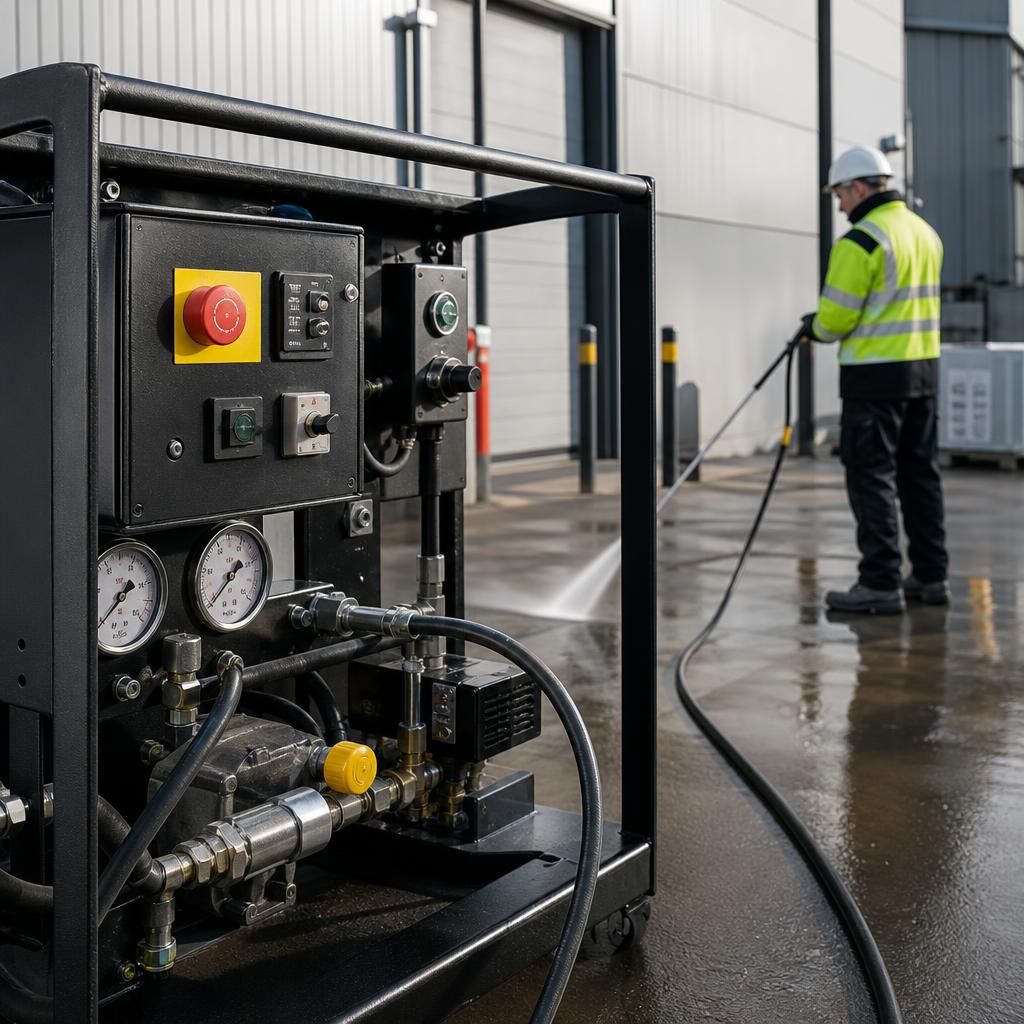
Emergency-stop controls and automatic shut-off systems are essential safeguards on industrial cleaning equipment. They allow the hazardous function to be stopped quickly if a hose fails, a person enters the work area, the machine overheats or the operator loses control.
The emergency stop should be clearly marked, easy to reach and positioned so it can be used without moving towards the hazard. A dead-man trigger can provide additional protection by stopping pressure, steam or mechanical movement when the operator releases the control. These systems must be tested during pre-use checks and must not be bypassed; normal isolation and pressure-release procedures are still required before clearing blockages or carrying out maintenance.