
What factors should I consider when selecting industrial cleaning equipment for large-scale projects?
When selecting industrial cleaning equipment for large-scale projects, assess the surface type, cleaning power, water and energy requirements, access limitations, safety features, environmental controls and expected workload. The equipment should deliver consistent results across the site while remaining practical to transport, operate and maintain, with running costs and project timescales considered from the outset.
Selecting industrial cleaning equipment for a large-scale project requires a balance between cleaning performance, site conditions, operator safety, environmental controls and total operating cost. The most powerful machine is not automatically the best choice. Equipment must be suitable for the surface, available water and power supplies, access arrangements, working hours, waste controls and the volume of cleaning required. Choosing against these practical factors helps deliver consistent results without causing damage, avoidable delays or excessive resource use.
Assess the surfaces and contaminants first. Building exteriors may include brickwork, concrete, render, stone, metal cladding, glass, roofs, paving and painted finishes. Each material has a different tolerance to pressure, heat, moisture and chemical treatment. Loose dirt, algae, oil, traffic film, mortar residue, paint and graffiti may also require different cleaning methods. A pressure washer may be effective for robust masonry and hard-standing areas, while steam cleaning or a lower-impact process may be more appropriate for delicate finishes, sensitive coatings or areas where water use must be controlled.
Equipment should be selected only after identifying vulnerable features such as joints, sealants, membranes, vents, electrical fittings, drainage points and previously repaired areas. A test clean in an inconspicuous location can confirm whether the chosen pressure, temperature, nozzle, detergent and working distance are suitable. This is particularly important where the substrate has weathered unevenly or where aggressive cleaning could expose defects rather than resolve them.
Match cleaning power to the scale and type of work. Pressure and water flow both affect productivity, but they perform different functions. Pressure helps break the bond between the surface and the contaminant, while water flow carries loosened material away and rinses the area. A machine with excessive pressure may damage a surface, whereas insufficient flow can make rinsing slow and leave residues behind. For large façades, car parks and extensive paved areas, the specification should therefore consider the combined performance of the machine, hose, lance, nozzle and any surface-cleaning attachment.
Variable pressure and flow controls are useful when the project includes several surface types. They allow operators to use a more controlled setting on rendered or coated areas and a stronger setting on suitable concrete or hard-standing. Adjustable nozzles, rotary surface cleaners and extension equipment can also improve coverage and reduce operator fatigue, provided they are compatible with the machine and the substrate.
Consider whether heat, steam or detergents are needed. Heated water can improve the removal of grease, oil, traffic film and biological contamination, reducing the need for prolonged mechanical action. Steam cleaning uses heat and comparatively low water volumes, making it useful where controlled moisture application is important or where residues need to be softened rather than blasted away. Cold-water pressure washing may remain the most practical option for general dirt on robust exterior surfaces.
Where detergents or biocides are required, check that they are suitable for the material and compatible with the equipment. The selection should account for dwell time, rinsing requirements, runoff, nearby planting, watercourses and the possibility of staining. Chemical application equipment should provide controlled dosing rather than uncontrolled overspray, and products must be handled in accordance with their safety information and site procedures.
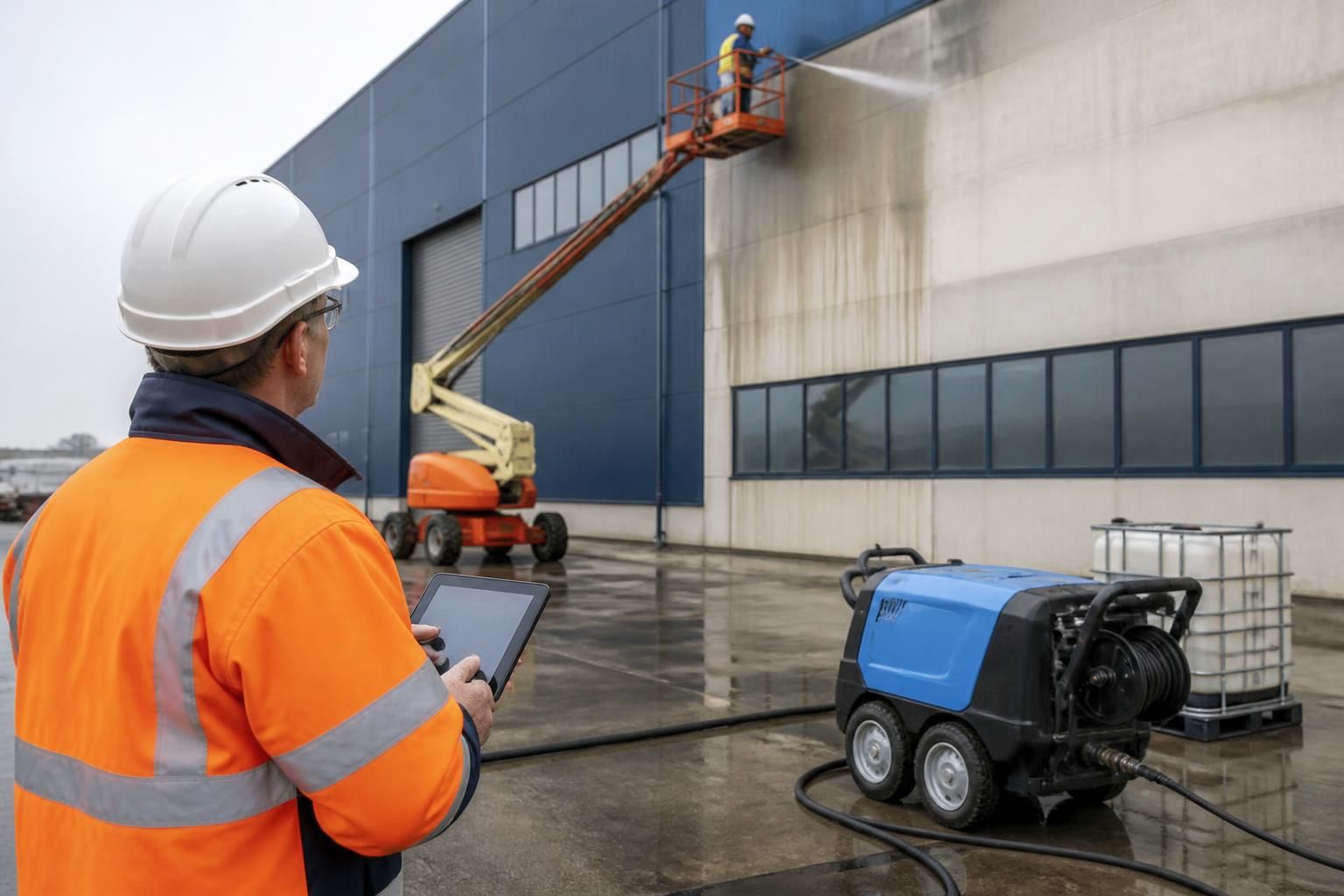
Review access, reach and site layout. Large projects often include elevated façades, roofs, restricted courtyards, service yards, car parks and areas where vehicles or pedestrians must continue to move. Equipment may need to work from the ground, from a mobile elevating work platform, from scaffolding or through specialist access arrangements. The cleaning system must be compatible with the available access method and should not create excessive hose runs, trip hazards or obstruction to other contractors.
Consider the machine’s size, weight, manoeuvrability, lifting requirements and transport arrangements before it arrives on site. Long hose runs can reduce practical performance and complicate control, while limited access may favour compact equipment or remote cleaning attachments. Where work takes place at height, the equipment plan should also account for secure hose management, wind conditions, falling-object risks and a safe method for moving tools and materials.
Check water supply, drainage and recovery arrangements. Industrial cleaning can require a reliable water source with adequate capacity and connection points. If the site supply is restricted, equipment may need a storage tank or a configuration designed for controlled water consumption. The plan should also identify where used water, silt, oils, cleaning agents and removed coatings will go. Discharging contaminated water into surface drains without approval can create environmental and compliance problems.
For car parks, loading areas and industrial sites, recovery equipment may be necessary to collect wastewater before it reaches drainage systems. Bunding, drain covers, silt separation and approved disposal arrangements may form part of the equipment selection. These controls should be agreed during the planning stage rather than added after cleaning has started.
Confirm the available power and fuel arrangements. Industrial electric power washers can offer consistent operation and may be suitable where reliable electrical infrastructure is available. They can also be preferable in enclosed or noise-sensitive areas because they do not produce engine exhaust at the point of use. Petrol or diesel-powered equipment may provide greater independence from the site’s electrical supply, but it requires suitable ventilation, fuel storage, exhaust controls and additional noise consideration.
Check electrical load, cable routing, socket protection, generator compatibility and the distance between the supply and the working area. Equipment should never be connected through unsuitable extension arrangements, particularly in wet conditions. Where several machines will operate at once, confirm that the supply can support the combined demand without nuisance tripping or unsafe improvisation.
Prioritise safety features and operator controls. Suitable equipment should include accessible emergency stops, secure hose and lance connections, effective trigger controls, pressure regulation and protection against overheating or loss of water supply. Electrical equipment must be appropriate for the conditions in which it will be used, with suitable protection from water ingress and a properly inspected supply system. Operators also need clear instructions, suitable personal protective equipment and training for the specific machine and attachment.
The risk assessment should cover high-pressure injection injuries, flying debris, slips, noise, vibration, chemical exposure, electrical hazards, vehicle movements, work at height and contact with members of the public. Equipment selection should support the control measures rather than undermine them. For example, a surface-cleaning attachment may reduce spray and improve control, while a telescopic lance may reduce the need for direct exposure at height, but neither removes the requirement for proper planning and supervision.
Evaluate productivity against the expected workload. Estimate the area to be cleaned, the severity of contamination, the number of shifts, the available working hours and any restrictions imposed by the client or occupiers. A machine that is suitable for a small isolated task may be inefficient for a full site programme. Conversely, an oversized system can increase transport, setup, water and energy costs without improving the result on sensitive surfaces.
Compare the complete working system rather than the machine alone. Include hoses, reels, lances, nozzles, surface cleaners, tanks, recovery units, access equipment, detergents and spare parts. Setup and dismantling time, movement between work zones, refill requirements and cleaning around obstructions all affect the actual production rate. Trialling the proposed method on representative areas can reveal whether the specification is realistic.
Allow for maintenance, reliability and support. Large projects depend on equipment remaining available throughout the programme. Check access to filters, pumps, hoses, seals, nozzles and other wear parts, as well as the inspection and servicing requirements set by the manufacturer. Equipment should be cleaned down after use, protected from freezing, drained or stored correctly and checked for leaks, damaged cables, worn fittings and irregular pressure.
It is sensible to plan for backup equipment or replacement components where a failure could stop the work. The decision should consider hire availability, service support, operator familiarity and the consequences of downtime. A lower purchase or hire cost may not represent good value if the equipment consumes more water or fuel, requires frequent repairs, works slowly or cannot be maintained safely on site.
Finally, document the selection and confirm that the equipment meets the project’s method statement, environmental requirements, access plan and client expectations. The best specification is the one that achieves the required finish with controlled pressure, water, energy and chemical use, while allowing trained operators to work safely and maintain the equipment throughout the project.
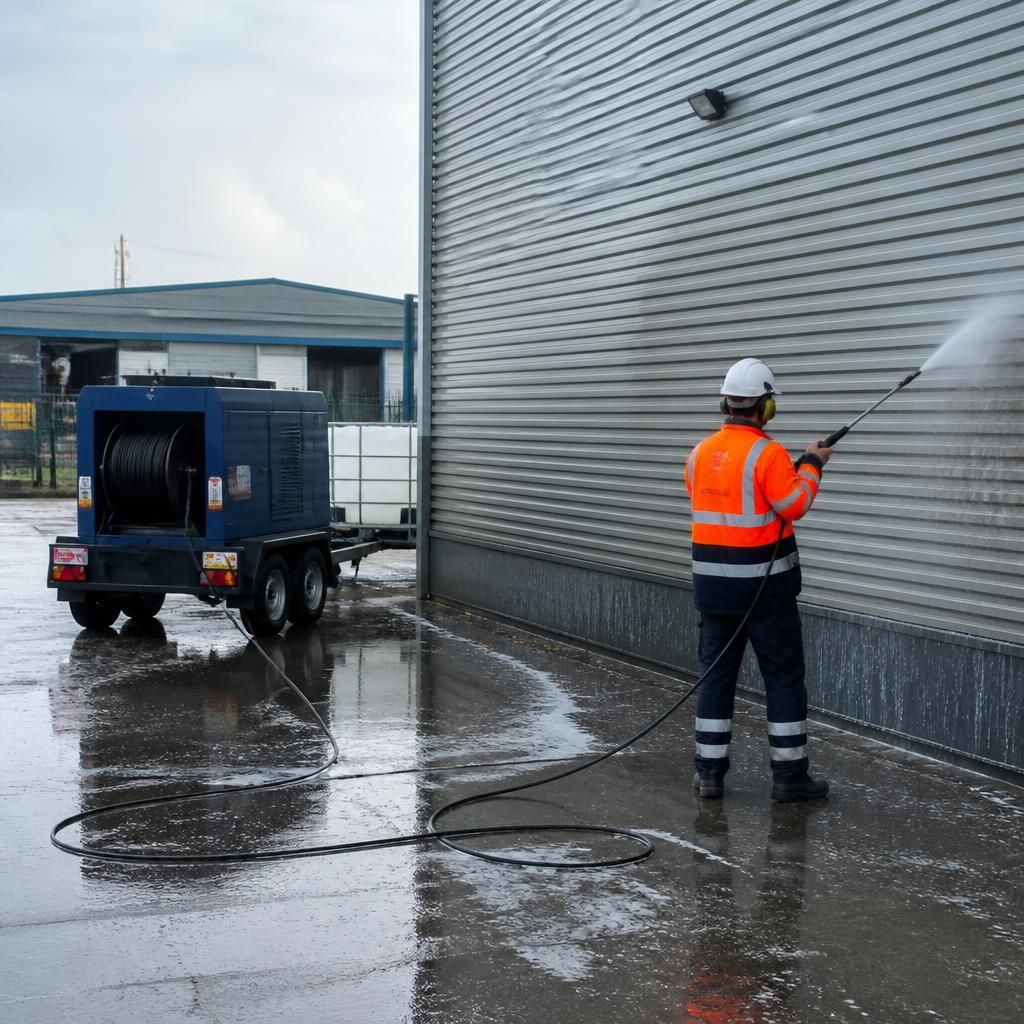
For large-scale projects, industrial cleaning equipment should be selected as a complete working system rather than as a pressure washer alone. The specification may need to include hoses, reels, lances, nozzles, surface-cleaning attachments, water tanks, recovery equipment and access equipment, depending on the surfaces and site conditions.
Check how the system will operate across each work area. Long hose runs, restricted access, frequent equipment moves, refill requirements and wastewater recovery can all affect the actual working rate. A compact setup may be more practical for confined areas, while high-capacity equipment can improve productivity across extensive façades, car parks and hard-standing.
Trial the proposed equipment on representative surfaces before the main programme begins. This confirms that the pressure, flow, temperature, attachments and cleaning products deliver the required finish without damaging the substrate or creating avoidable water, chemical or handling issues.