
How do industrial cleaning services ensure compliance with health and safety regulations?
Industrial cleaning services support health and safety compliance by completing site-specific risk assessments, method statements and COSHH assessments before work begins, then using trained staff, suitable PPE, controlled equipment and agreed safe systems of work. They also coordinate with site managers, control access and hazards during cleaning, and document inspections, waste handling and completed work to provide an auditable record of compliance.
Industrial cleaning services support compliance with health and safety regulations by planning the work, assessing site-specific risks, controlling exposure to hazardous substances, using suitable equipment and PPE, and keeping clear records. A competent contractor should agree safe systems of work with the site contact before cleaning begins, monitor conditions during the task and provide evidence that the work was completed in accordance with the agreed controls.
Cleaning does not remove the legal duties of the premises owner, occupier or principal contractor. The client remains responsible for providing relevant information about the site, processes and hazards, while the cleaning contractor is responsible for managing the risks created by its own activities and staff. Effective compliance therefore depends on cooperation, clear communication and defined responsibilities.
Site assessment and method statements
Before attending, the contractor should gather information about the building, access routes, production activities, stored materials, restricted areas and any known hazards. A site visit may be required where conditions are complex or the work involves heights, confined spaces, heavy contamination or specialist access equipment.
The findings are recorded in a risk assessment and method statement. These documents should describe:
- the surfaces, residues and areas to be cleaned;
- the hazards affecting workers, visitors, members of the public and site operations;
- the cleaning method, equipment and substances to be used;
- the control measures and required PPE;
- access, isolation, exclusion and emergency arrangements;
- the process for stopping work if conditions become unsafe; and
- inspection, sign-off and reporting requirements.
Generic paperwork is not sufficient where the site or task presents unusual risks. The assessment should reflect the actual building, contamination, weather, access arrangements and interaction with the client’s operations.
Control of hazardous substances
Industrial cleaning can involve detergents, degreasers, disinfectants, solvents, chemical residues, dusts and contaminated wash water. The Control of Substances Hazardous to Health Regulations require employers to assess exposure and prevent or adequately control it. Contractors normally do this through COSHH assessments, product safety data, suitable dilution procedures, ventilation, restricted access and appropriate PPE.
Where possible, the safest approach is to remove the hazard or choose a less hazardous product or process. For example, controlled steam cleaning or water-based methods may reduce the need for aggressive chemicals, although the suitability of each method depends on the residue, surface and site conditions. Chemicals must be labelled, stored securely, transported safely and used only by staff who understand the relevant instructions. Spill response and first-aid arrangements should be agreed before work starts.
Cleaning chemicals must not be mixed unless the method specifically permits it. Particular care is needed around confined or poorly ventilated spaces, food production areas, drainage systems and surfaces that may react with the cleaning product.
Safe use of machinery and access equipment
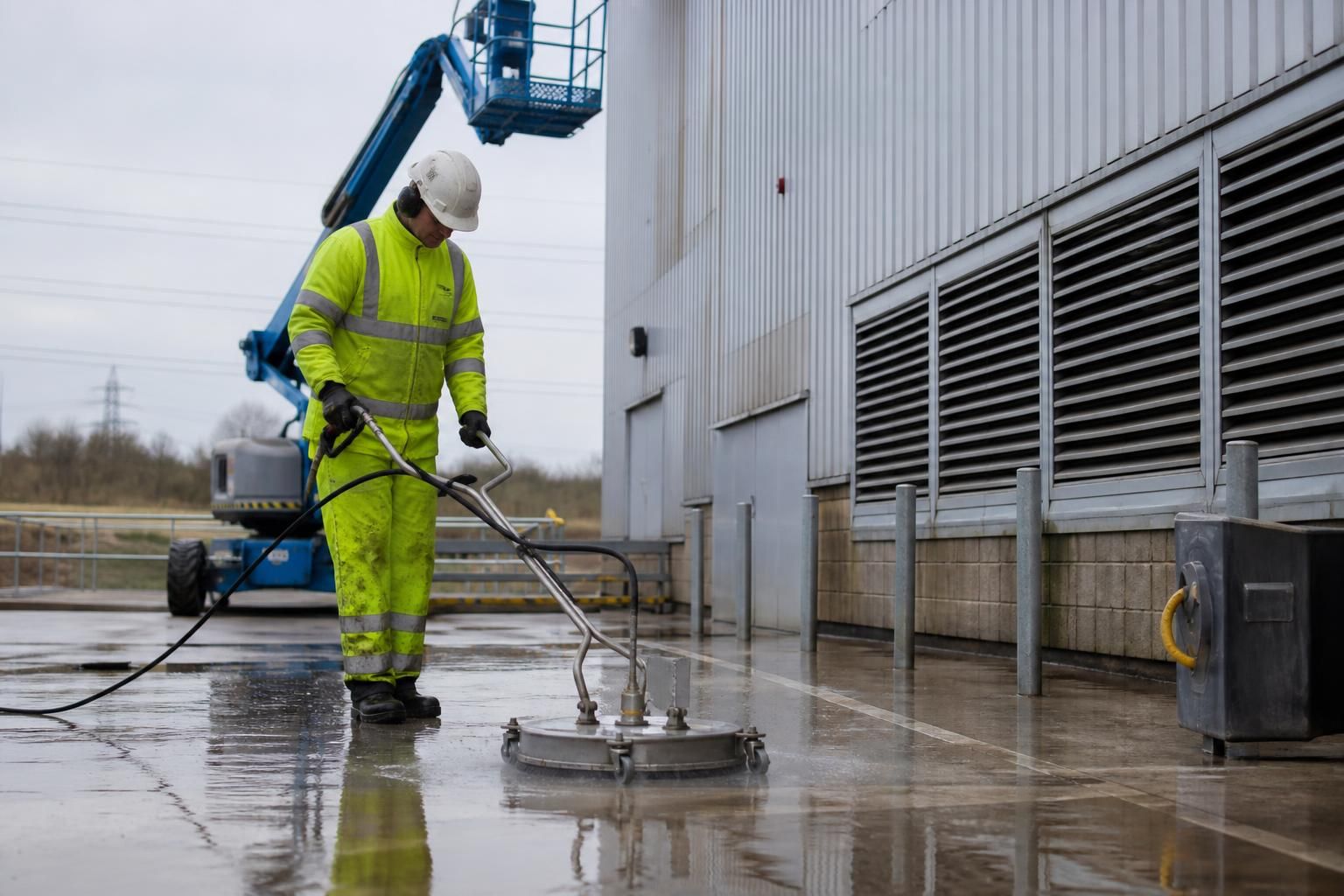
Pressure washers, steam cleaners, vacuum systems, powered scrubbers and other equipment can create risks from high-pressure water, heat, electricity, noise, vibration, moving parts and flying debris. Equipment should be selected for the task, maintained in good condition and checked before use. Guards, hoses, cables, plugs and emergency controls should be inspected, and defects should be reported and taken out of service where necessary.
The Provision and Use of Work Equipment Regulations cover the suitability, maintenance, inspection and use of work equipment. Where lifting equipment is used, relevant inspection and examination requirements under the Lifting Operations and Lifting Equipment Regulations may also apply. Staff should be trained and authorised for the equipment they operate, with training covering safe start-up, shut-down, pressure control, chemical use, manual handling and fault reporting.
Work at height must be planned and carried out in accordance with the Work at Height Regulations. The preferred order of control is to avoid working at height where possible, use collective protection such as suitable platforms or edge protection, and use personal fall protection only where appropriate. Access equipment must be positioned on stable ground, inspected and used within its rated limits. A rescue plan is necessary where a fall-arrest system or other equipment could leave a worker suspended or stranded.
Isolation and control of the work area
Cleaning must be coordinated with production, deliveries, vehicle movements, maintenance and other contractors. Depending on the site, controls may include:
- isolating machinery, electrical supplies or process lines before cleaning;
- confirming that pressure, heat, chemicals and stored energy have been made safe;
- using barriers, signage and supervised exclusion zones;
- separating pedestrians from vehicles and operating plant;
- preventing unauthorised access to wet, contaminated or recently treated surfaces; and
- maintaining safe routes for emergency access and evacuation.
Lockout and isolation arrangements must be agreed with the person in control of the site. Cleaning operatives should never assume that machinery, electrical equipment or process systems are safe simply because they appear to be switched off.
Training, competence and supervision
A compliant service depends on people being competent for the work assigned to them. Induction should cover site rules, emergency procedures, reporting arrangements, welfare facilities and restricted areas. Task-specific training may be needed for high-pressure cleaning, chemical handling, powered equipment, manual handling, work at height, confined spaces or the use of respiratory protective equipment.
Supervisors should check that the method statement is understood and followed, that PPE is being used correctly and that changing conditions are addressed. Workers must be given a practical way to report hazards, near misses, damaged equipment and unsafe instructions without continuing the task until the issue has been resolved.
Personal protective equipment and welfare
PPE is the final layer of protection and should not replace better controls such as isolation, ventilation or guarding. Depending on the task, it may include protective footwear, gloves, eye or face protection, hearing protection, waterproof clothing, respiratory protective equipment, head protection and fall-protection equipment.
PPE must be compatible with the chemicals and equipment in use, correctly fitted, maintained and replaced when damaged or contaminated. Where tight-fitting respiratory protection is required, the wearer must be suitable for the equipment and it must be properly fitted. The contractor should also provide access to suitable washing, changing, rest and welfare arrangements in agreement with the client.
Confined spaces and specialist hazards
Tanks, pits, ducts, silos, chambers and other enclosed areas may present risks from toxic or oxygen-deficient atmospheres, engulfment, fire, restricted movement and difficult rescue. Entry should be avoided where an effective external cleaning method is available. If entry is necessary, it requires a specific assessment, permit-to-work arrangements where appropriate, atmospheric testing, trained personnel, communication, suitable equipment and a documented rescue plan.
Other specialist hazards may include asbestos-containing materials, biological contamination, lead, combustible dust, fragile roofs and contaminated land. Cleaning staff should not disturb or clean suspected hazardous materials without the appropriate specialist assessment and controls. Work should be stopped and referred to the responsible site contact where the contamination is outside the agreed scope.
Environmental controls that also protect health and safety
Wash water, sludge, chemical residues, packaging and contaminated materials must be contained, handled and disposed of through appropriate routes. Drainage should be protected from unauthorised discharge, and waste should be correctly described and transferred to an authorised recipient where required. These controls reduce the risk of exposure, slips, blocked drainage and pollution as well as supporting environmental compliance.
Cleaning methods should be selected with regard to overspray, runoff, noise, dust and neighbouring activities. On external sites, weather conditions such as wind, rain, ice or poor visibility may require the work to be postponed or revised.
Inspection, incident reporting and records
Good records provide an auditable account of how the work was controlled. Depending on the project, records may include risk assessments, method statements, COSHH assessments, training and competence evidence, equipment checks, access-equipment inspections, permits, site briefings, waste transfer documentation, photographs, inspection reports and completion certificates.
Accidents, dangerous occurrences and certain work-related illnesses may need to be reported under the Reporting of Injuries, Diseases and Dangerous Occurrences Regulations. The contractor and client should agree who will report incidents, investigate near misses and preserve relevant evidence. Reviewing these records helps identify recurring hazards and improve future cleaning plans.
What customers should expect from a compliant contractor
- A clear scope of work and confirmation of site information required before attendance.
- Task- and site-specific risk assessments, method statements and COSHH controls.
- Competent operatives with appropriate training, supervision and PPE.
- Maintained equipment and inspection records relevant to the task.
- Agreed isolation, access, exclusion-zone and emergency arrangements.
- Evidence of responsible waste and contaminated-water management.
- A documented process for reporting incidents, changes and incomplete work.
- Clear communication with the site manager before, during and after cleaning.
For commercial and industrial premises, compliance is therefore an ongoing process rather than a document produced once. The cleaning plan should be reviewed when the method, chemicals, equipment, work area or site conditions change. This approach helps ensure that cleaning improves site safety without introducing uncontrolled risks to employees, visitors, production processes or the surrounding environment.
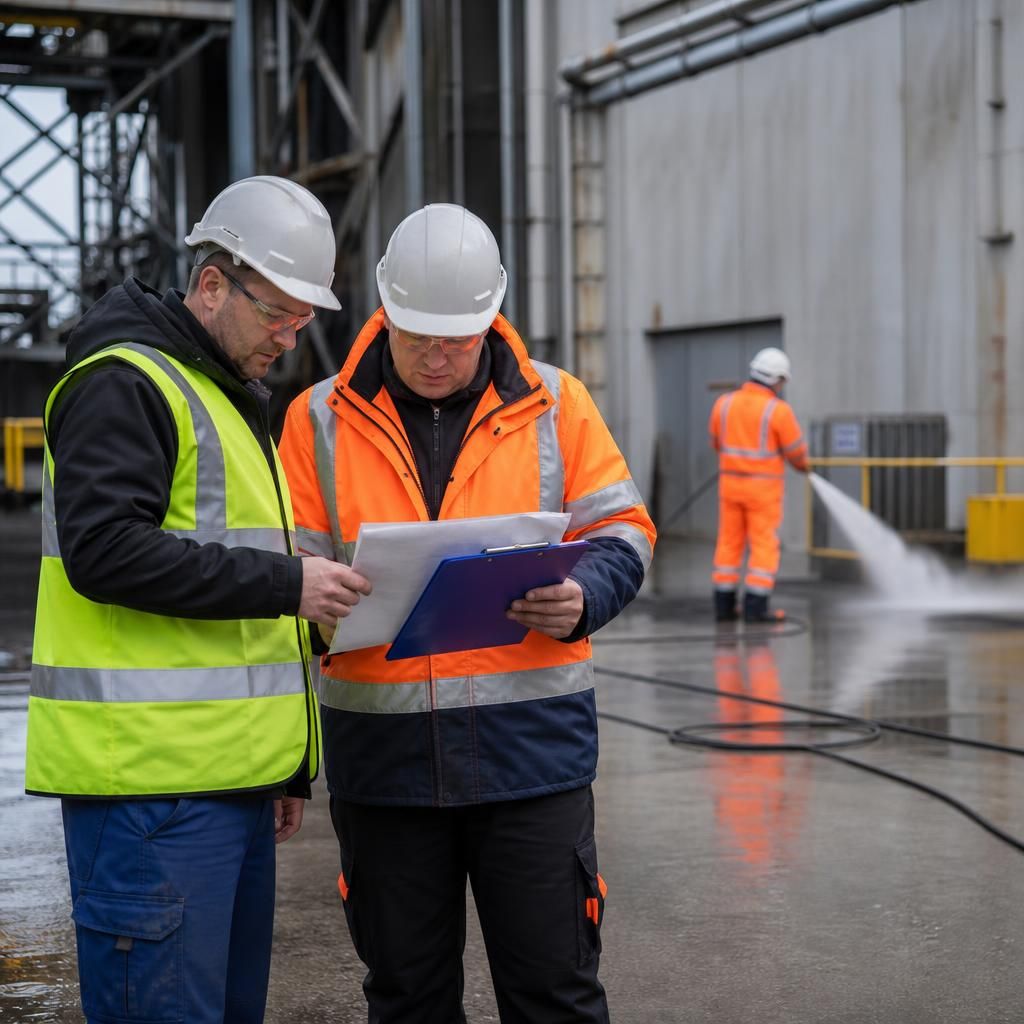
Industrial cleaning services support health and safety compliance by using documented, site-specific controls before work begins. A competent contractor should assess the surfaces, contaminants, access arrangements and nearby activities, then prepare suitable risk assessments, method statements and COSHH assessments for the planned cleaning process.
These controls should explain how risks from chemicals, high-pressure water, heat, machinery, work at height, overspray and contaminated waste will be managed. The cleaning team should also agree access restrictions, equipment isolation, exclusion zones, emergency procedures and reporting arrangements with the site contact.
Following the work, records such as equipment checks, staff briefings, permits, waste documentation and completion reports provide evidence that the agreed controls were followed. Documentation must reflect actual site conditions rather than relying on generic paperwork, and it should be reviewed whenever the cleaning method, equipment, substances or working environment changes.