
What safety measures are in place during factory and warehouse cleaning?
Factory and warehouse cleaning is managed through site-specific risk assessments, method statements, controlled access and suitably trained operatives. Measures can include isolating equipment where necessary, using appropriate PPE and signage, selecting safe access equipment, controlling water and chemical use, and coordinating work around vehicles, machinery and ongoing operations.
Factory and warehouse cleaning should be controlled through a site-specific risk assessment, method statement and clear communication with the client’s team. These arrangements identify hazards before work begins and set out how operatives, employees, visitors, vehicles, machinery, stock and building surfaces will be protected throughout the cleaning activity.
Site assessment and method statement
Before cleaning starts, the contractor should inspect the areas involved and confirm the scope of work with the responsible site contact. The assessment should consider the building layout, working heights, roof or façade condition, access points, floor surfaces, drainage, electrical installations, stored materials, production processes, vehicle movements and any restricted or hazardous areas.
The resulting method statement should explain the planned cleaning sequence, equipment, chemicals, access arrangements, exclusion zones, emergency procedures and waste or wastewater controls. It should also identify who is responsible for isolations, access to restricted areas and communication with the site team. If conditions change, the assessment should be reviewed rather than relying on the original plan.
Controlled access and separation from operations
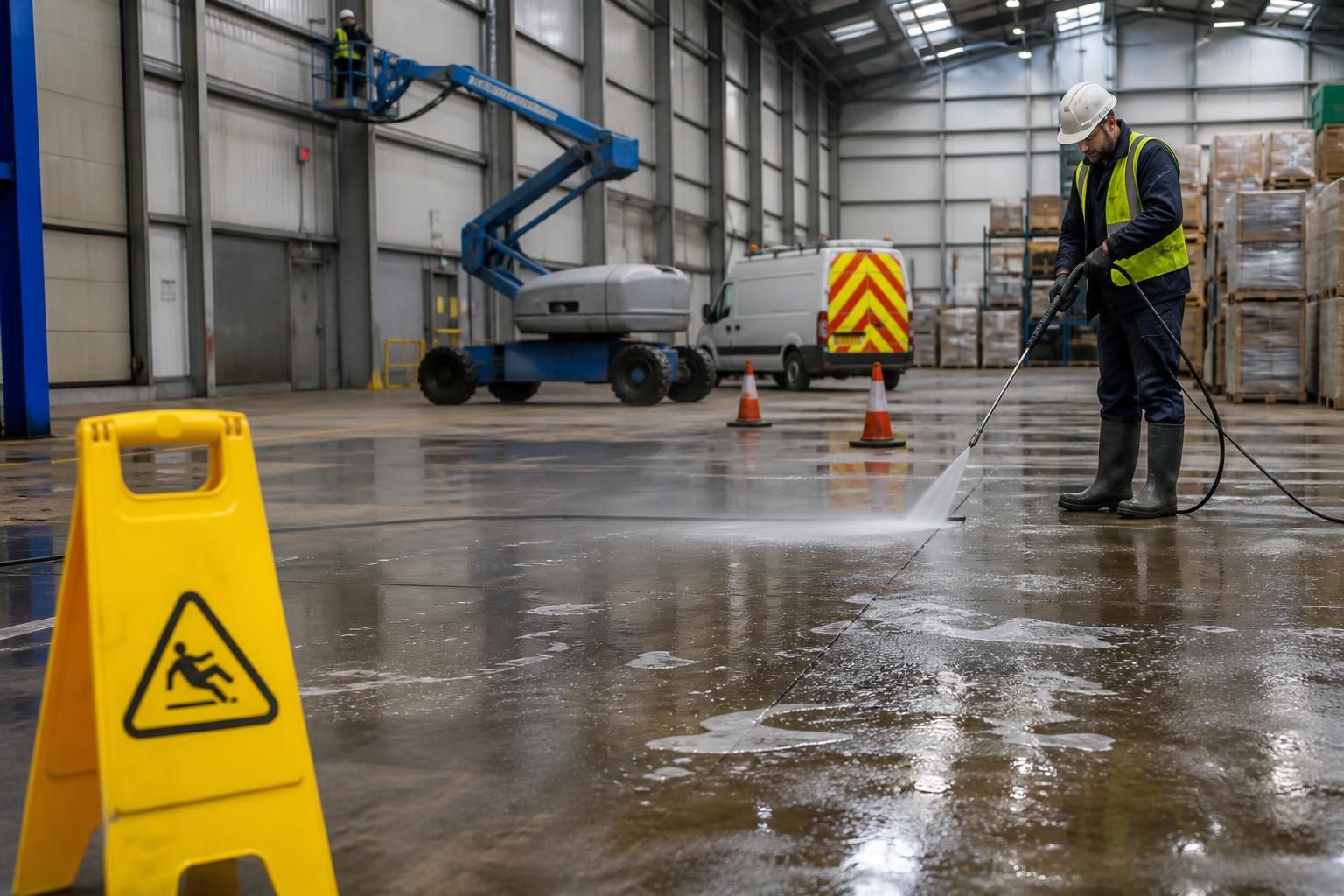
Cleaning areas should be separated from staff, visitors, forklift trucks, delivery vehicles and other moving equipment wherever practicable. Suitable measures may include barriers, cones, warning signs, temporary closure of walkways, a banksman or agreed vehicle-control arrangements. Work is often scheduled during quieter periods, planned shutdowns or agreed production breaks when this reduces the risk of interaction with ongoing operations.
Access routes, fire exits and emergency equipment must not be obstructed. Wet areas should be clearly identified and kept under control until surfaces are safe to use. Where cleaning takes place near loading bays or vehicle routes, the work plan should account for reversing movements, changing delivery schedules and limited visibility caused by spray, steam or equipment.
Isolation of machinery and services
Cleaning around conveyors, compactors, production lines, electrical equipment and other machinery requires coordination with the site operator. Machinery may need to be stopped, isolated or locked off by an authorised person before cleaning begins. The cleaning team should not assume that equipment is safe simply because it is switched off.
Electrical risks must be considered when using water, steam or pressure-washing equipment. Sensitive components should be protected or excluded from the cleaning method, and water should not be directed at live electrical installations, control panels, motors or unsealed connections. Any required isolation of power, gas, compressed air or other services should be agreed with the person responsible for the premises.
Safe work at height
High-level cleaning of roofs, façades, cladding, beams, racking and warehouse structures should be planned under the hierarchy for work at height. Ground-based methods are preferred where they can achieve the required result safely. Where access at height is necessary, the contractor should select suitable equipment, such as mobile elevating work platforms, access towers or other specialist systems, based on the height, reach, surface, duration and surrounding hazards.
Operatives using access equipment should be trained and authorised for the equipment provided. Pre-use checks, stable positioning, suitable ground conditions, overhead clearance and protection from falling objects are all important. Exclusion zones should be established below elevated work, particularly where tools, debris, cleaning solution or contaminated water could fall. Ladders should not be used as a substitute for a more suitable access system where the task requires prolonged work, force or sideways reach.
Work near roof edges, fragile roof materials, skylights, overhead services and open voids requires additional controls. Roof access should only take place where the surface and access arrangements have been assessed, with suitable fall-prevention or fall-protection measures in place.
Personal protective equipment
Personal protective equipment is selected according to the hazards identified rather than issued as a substitute for safer planning. Depending on the work, this may include safety footwear with suitable slip resistance, gloves, eye or face protection, hearing protection, protective clothing, hard hats and respiratory protection.
Pressure washing and steam cleaning can create splash, flying debris, contaminated mist and high noise levels. Operatives should use equipment appropriate to the pressure, temperature and substance being removed. Respiratory protection, where required, must be suitable for the specific airborne hazard and correctly managed, including fit and maintenance requirements.
Chemical and contamination controls
Cleaning products should be selected for the surface, soil and operating environment, with preference given to the least hazardous effective option. Product labels and safety data should be reviewed before use, and controls should comply with the requirements for hazardous substances under COSHH. Chemicals must be stored, diluted, labelled and transported correctly, and incompatible products must not be mixed.
Operatives should understand the risks of detergents, degreasers, disinfectants, solvents and other products used on the site. Spill procedures, suitable gloves and eye protection, ventilation requirements and first-aid arrangements should be established in advance. Where residues may affect production areas, food-related environments, packaging or stored goods, the cleaning method and rinsing requirements should be agreed with the client before work begins.
Contaminated dust, oils, biological material, bird fouling, mould, chemicals or production residues may require additional containment and disposal arrangements. Cleaning should avoid spreading contamination from one area to another, and waste or wastewater should be managed in accordance with the material removed and the site’s drainage requirements.
Equipment checks and competent operatives
Pressure washers, steam cleaners, vacuum systems, generators, hoses, pumps and access equipment should be appropriate for the task and maintained in safe working order. Hoses and cables should be routed to reduce trip hazards, protected from vehicle damage and kept away from unsafe edges or standing water where necessary.
Equipment should be checked before use, including leads, plugs, guards, hoses, couplings, pressure controls and emergency shut-off arrangements. Work equipment should be operated by people who have been trained and are competent for the task. Equipment used for lifting or access must also be inspected and managed in accordance with the relevant UK requirements, including PUWER and, where applicable, LOLER.
Slip, trip and falling-object prevention
Water, detergent, mud, oil and loosened deposits can create immediate slip hazards. The work area should be controlled while cleaning takes place, with excess water removed or directed safely towards suitable drainage. Operatives should avoid allowing dirty water to flow into occupied areas, pedestrian routes, electrical zones or traffic paths.
Tools, hoses, poles and other equipment should be stored so that they do not obstruct access routes. Loose debris should be collected progressively, rather than left until the end of the job. Where high-level cleaning is being carried out, materials and equipment should be secured and people below kept outside the exclusion zone.
Environmental and drainage protection
Run-off should be considered before pressure washing or chemical cleaning begins. Drains may need to be protected, blocked or connected to an approved collection system, depending on the substance being removed and the site’s drainage arrangements. Oily water, chemical residues, silt and contaminated debris should not be allowed to enter surface-water drains or surrounding land without suitable control.
Water use, chemical dilution and wastewater collection should be planned to prevent unnecessary discharge and to protect neighbouring areas. Any waste generated during the work should be segregated, contained and removed through an appropriate route agreed with the site.
Communication, supervision and emergency arrangements
A site induction or pre-start briefing should cover the cleaning plan, local hazards, restricted areas, welfare facilities, alarm procedures, first-aid arrangements, emergency contacts and reporting requirements. The cleaning supervisor should maintain communication with the client’s nominated contact, particularly when work is close to production, deliveries or other contractors.
Emergency arrangements should address chemical splashes, equipment failure, loss of stability, falls, fire, spills, exposure to contamination and injury from moving plant. Operatives should know how to stop work safely, raise the alarm, obtain first aid and report an incident or near miss. If the agreed controls cannot be maintained, work should pause until the risk is reassessed.
For a factory or warehouse cleaning project, the most important safeguard is coordination between the cleaning contractor and the person responsible for the site. Providing accurate information about machinery, substances, access restrictions, delivery movements and operational changes allows the risk assessment and method statement to reflect actual conditions, helping the work proceed safely without unnecessary disruption.
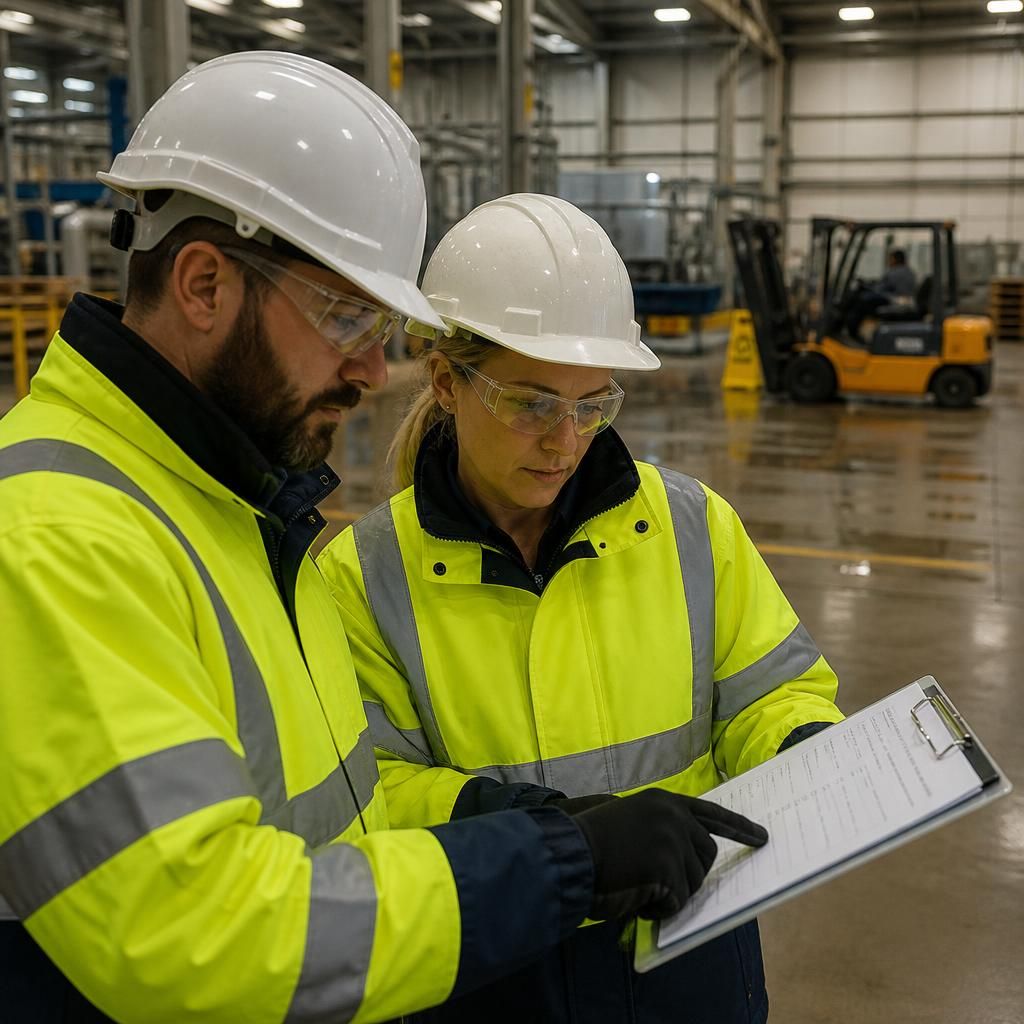
A site-specific risk assessment and method statement (RAMS) is the foundation of safe factory and warehouse cleaning. Before work begins, the cleaning team reviews access routes, machinery, vehicle movements, electrical installations, working heights, floor conditions, stored goods and any substances or contamination present. The method statement then explains the agreed cleaning sequence, equipment, exclusion zones, required PPE, emergency arrangements and wastewater controls.
These controls are reviewed if site conditions change, such as an altered delivery route, new production activity or unexpected surface damage. Cleaning should pause if the agreed safeguards cannot be maintained, allowing the site contact and supervisor to reassess the work before it resumes.