
What equipment and techniques are used in factory and warehouse cleaning?
Professional factory and warehouse cleaning uses pressure washers, steam-cleaning systems, industrial scrubber-driers, vacuums and specialist access equipment to remove dirt, grease, dust and buildup from floors, façades, cladding, roofs and high-level structures. Techniques are selected according to the surface, contamination, working height and site requirements, with controlled water pressure, steam, detergents and safe access methods used to achieve thorough cleaning without disrupting operations.
Professional factory and warehouse cleaning combines pressure washing, steam cleaning, industrial vacuuming, scrubber-drying and specialist access equipment. The equipment and technique are selected according to the surface, type of contamination, working height, drainage arrangements, production activity and required finish. This allows floors, façades, cladding, roofs, loading areas and high-level structures to be cleaned effectively while controlling water, waste and disruption.
Pressure washing is used to remove ingrained dirt, mud, algae, traffic film, loose coatings and other deposits from robust external surfaces. Adjustable pressure and flow settings help match the cleaning method to the material. Hard concrete yards, loading bays, kerbs and some masonry can usually tolerate a more intensive approach, while painted surfaces, joints, fragile finishes and building details require lower pressure and greater control. Flat-surface cleaning attachments can improve consistency and help contain spray when cleaning large areas.
Pressure washing is not simply a matter of applying the highest available pressure. Excessive force can damage mortar joints, coatings, sealants, cladding finishes or surface treatments. Operators assess the material first, test a discreet area where appropriate, and use the lowest effective pressure. Detergents or degreasers may be introduced when water alone cannot break down oil, grease or organic contamination, with suitable dwell time and rinsing applied according to the surface and product requirements.
Steam cleaning uses heated water vapour or low-volume hot-water systems to loosen grease, oil, food residue, soot and other stubborn deposits. It can be useful around machinery areas, service yards, walls, doors, beams and surfaces where limiting water volume is important. Heat helps soften contamination so it can be removed with less mechanical force, which may reduce the risk of damaging sensitive finishes. Steam cleaning still requires careful assessment: heat and moisture must be kept away from vulnerable electrical equipment, unsealed components and materials that may react badly to temperature changes.
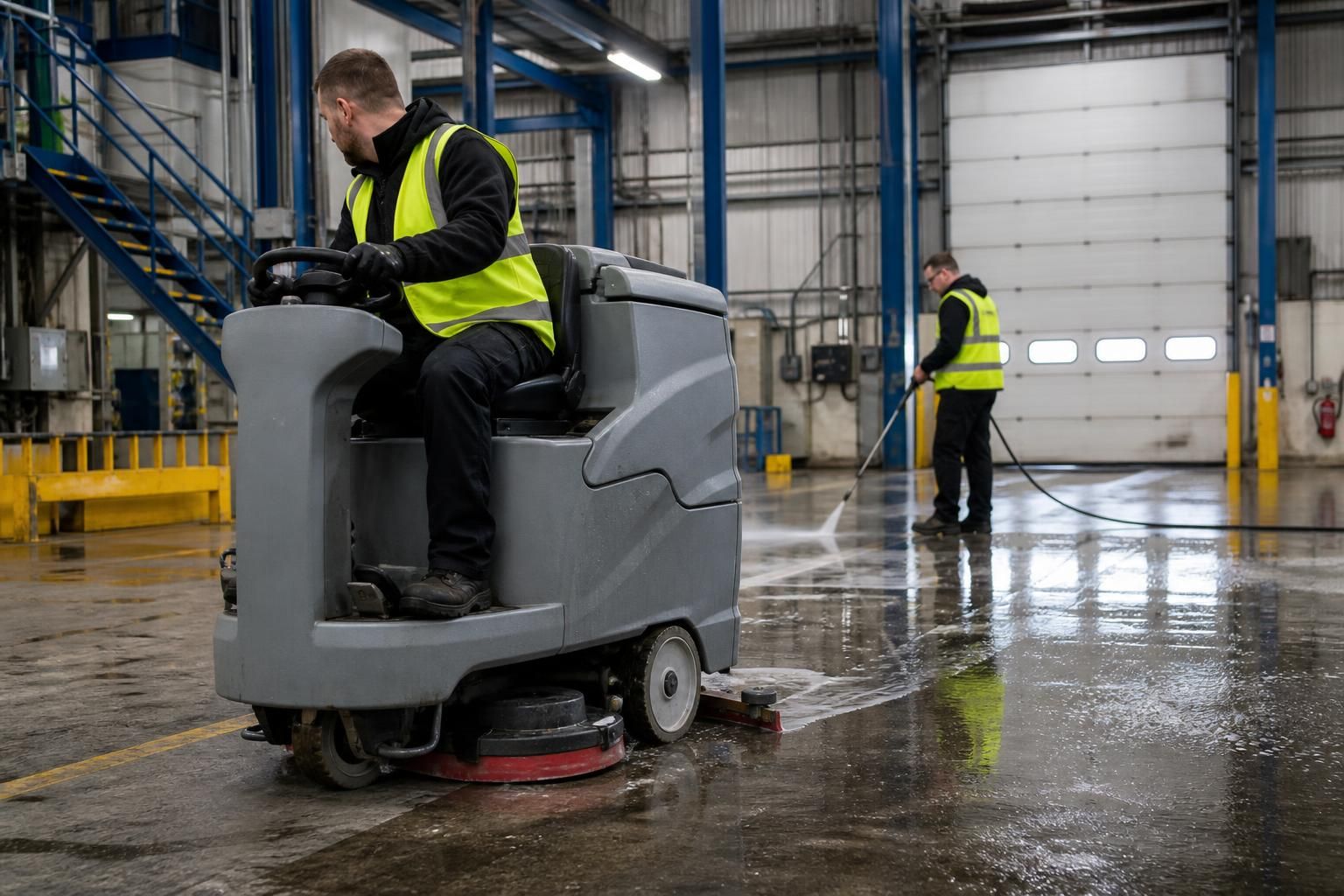
Industrial scrubber-driers are used on warehouse and factory floors to agitate dirt with rotating brushes or pads, apply cleaning solution and recover the resulting wastewater in the same pass. They are particularly suitable for large, relatively open floors made from concrete, resin, epoxy or other hard-wearing finishes. Brush type, pad selection, solution strength and machine settings are adjusted to the floor coating and level of soiling. Recovery of the dirty water helps leave the floor safer and reduces the risk of spreading contamination across operational areas.
For edges, narrow aisles, steps, ramps and areas obstructed by stock or equipment, operators may use compact scrubber-driers, rotary machines, manual agitation and controlled rinsing. A rotary machine can provide additional mechanical action on heavily soiled sections, but it must be used carefully on coated or uneven floors. Cleaning normally progresses from less contaminated areas towards more heavily soiled sections, with clean equipment and solution used where hygiene or cross-contamination controls require it.
Industrial vacuum systems remove dust, powders, debris, cobwebs and loose material before wet cleaning begins. High-capacity wet and dry vacuums can collect slurry and standing water, while specialist filtration may be required for fine or hazardous dust. Pre-vacuuming prevents loose contamination from becoming a paste when water is introduced and reduces the amount of wastewater produced. Where dust could affect products, machinery or air quality, extraction is planned to avoid simply redistributing particles around the building.
Soft washing and controlled chemical cleaning may be appropriate for façades, render, cladding and other areas where aggressive pressure could cause damage. A suitable cleaning solution is applied at a controlled concentration, allowed to break down biological or atmospheric deposits, and then rinsed using a carefully selected pressure. The method depends on the substrate, coating condition and type of contamination. Chemical use is controlled to prevent damage to vegetation, drainage systems, painted surfaces and nearby operations, and residues are managed in accordance with the site requirements.
Specialist access equipment enables safe cleaning of high-level façades, roof areas, beams, signs, canopies, warehouse elevations and overhead structures. Depending on the building and work area, this can include water-fed poles, telescopic cleaning systems, mobile elevated work platforms, towers, scissor lifts, boom lifts or rope-access methods. Access is selected through a site assessment that considers ground conditions, overhead obstructions, traffic routes, roof strength, working height and the need to keep emergency routes clear.
Access equipment is used alongside formal planning and competent operation. The cleaning team considers exclusion zones, equipment positioning, fall protection, weather conditions, overhead services and the movement of vehicles or pedestrians. Where powered access equipment is required, the surface must be suitable for the equipment and the working area must be controlled. High-level cleaning should not be attempted from improvised platforms or by stretching beyond a safe operating position.
Surface preparation and cleaning sequence are as important as the machinery itself. A typical process involves:
- Reviewing the site, surfaces, contamination, drainage, access restrictions and operational risks.
- Removing loose waste, dust and debris by brushing or industrial vacuuming.
- Protecting sensitive equipment, stock, door seals, electrical points, vegetation and nearby surfaces.
- Pre-treating grease, oil, algae, traffic film or other deposits where required.
- Agitating or rinsing the contamination using an appropriate pressure, temperature, brush, pad or steam setting.
- Recovering wastewater and removing remaining debris rather than allowing contaminated water to enter uncontrolled drainage.
- Inspecting the finished area and carrying out spot cleaning, edge work or a further rinse where necessary.
- Leaving floors, access routes and work areas in a condition suitable for safe handover.
Water and wastewater control is an important part of industrial cleaning. Before work starts, drainage points and discharge arrangements should be identified. Slurry containing oil, chemicals, heavy sediment or other contaminants may need to be contained, collected and disposed of through an approved route rather than discharged to surface-water drains. Vacuum recovery, drain covers, bunding and temporary collection methods can be used where the site assessment indicates a risk of uncontrolled run-off.
Cleaning around active operations requires the method to be adapted to the working environment. Cleaning may be phased around deliveries, shifts, vehicle movements, production activities or planned shutdowns. Low-water or low-splash methods can be considered near stock and equipment, while barriers and clearly defined work zones help separate cleaning activities from pedestrians and vehicles. Where water, steam, detergents or wet floors create a temporary hazard, the area is controlled until it is safe to reopen.
The most effective equipment is therefore not necessarily the most powerful equipment. A professional approach matches pressure, heat, water volume, chemical action, mechanical agitation, extraction and access arrangements to the building and its use. This protects surfaces, limits operational disruption, supports safe working and produces a more consistent result across large factory and warehouse environments.
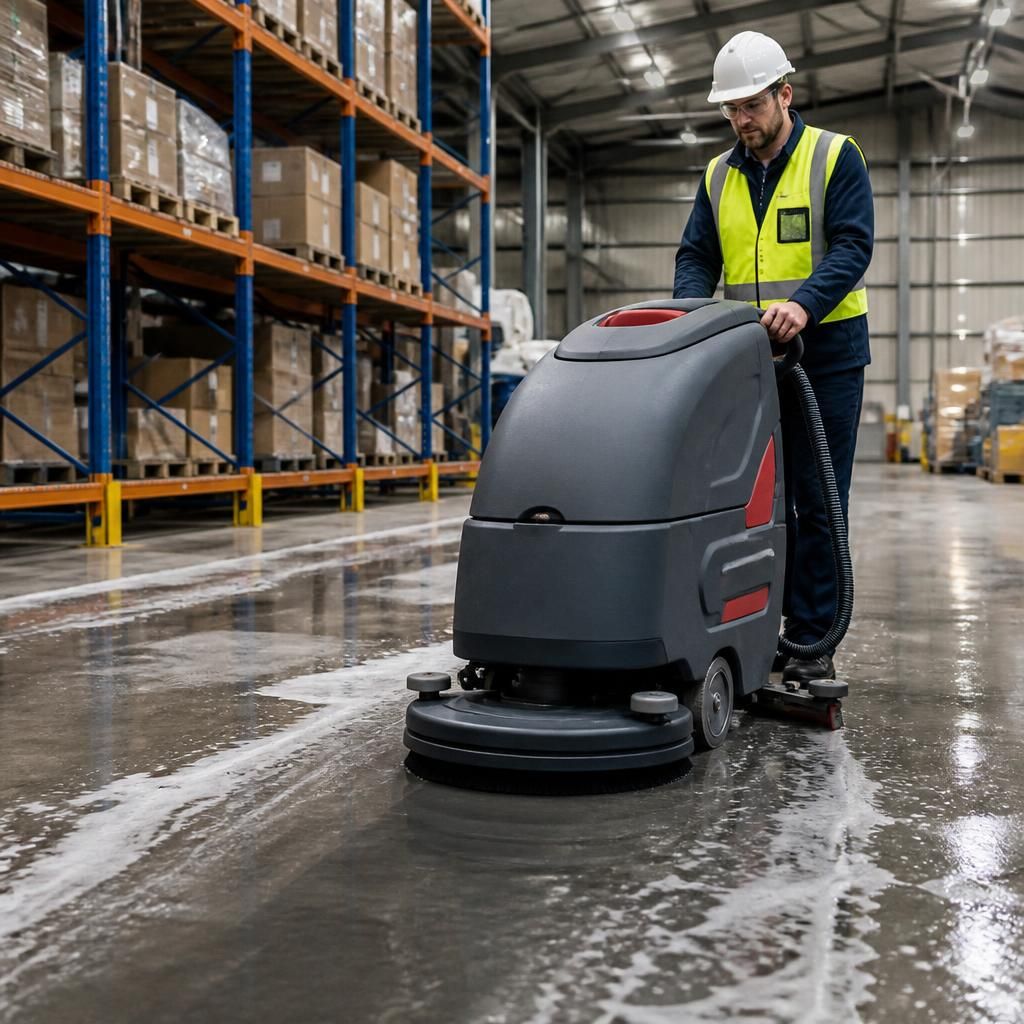
Industrial scrubber-driers are particularly effective for large factory and warehouse floors because they combine mechanical brushing, cleaning solution and wastewater recovery in one controlled process. The machine loosens ingrained dirt from concrete, resin and hard-wearing coated floors, then collects the dirty water to reduce spreading contamination and leave the surface safer for handover.
Brushes, pads, detergent strength and machine settings should be selected according to the floor finish and level of soiling. Compact machines or rotary equipment can be used around edges, narrow aisles and obstructed areas, while industrial vacuum systems remove loose dust and debris before wet cleaning begins.