
What factors should be considered when choosing a graffiti removal company for industrial sites?
When choosing a graffiti removal company for an industrial site, assess its experience with large commercial properties, ability to select surface-safe cleaning methods, and competence in managing access, health and safety, waste water and environmental controls. Also check that it provides clear surveys and quotations, appropriate insurance and risk assessments, reliable response times, and a practical plan for protecting the surface and reducing repeat vandalism.
The right graffiti removal company for an industrial site should combine proven experience on commercial premises with surface-safe cleaning methods, competent access and health and safety controls, environmental management, and dependable project communication. The lowest quotation is not necessarily the most suitable option: poor chemical selection, excessive pressure or inadequate containment can damage cladding, coatings, masonry and drainage systems, creating greater costs than the original graffiti.
Before appointing a contractor, assess the following factors.
Experience with industrial and commercial sites
Industrial graffiti removal is different from cleaning a small residential wall. Sites may include warehouses, factories, distribution centres, rail or transport infrastructure, car parks, plant rooms, boundary walls and occupied commercial units. A suitable contractor should understand how to work around vehicles, production areas, deliveries, members of the public and other contractors without disrupting normal operations.
Ask whether the company has experience cleaning the specific surfaces found on the site, such as:
- Powder-coated, painted or profiled metal cladding
- Brickwork, concrete and blockwork
- Render, stone and architectural façades
- Roller shutters, doors, fencing and signage
- Roofing materials, plant enclosures and service areas
- Tarmac, concrete and other hard-standing surfaces
Relevant experience matters because the same paint or marker product can respond differently depending on the age, porosity, coating and condition of the underlying surface.
Ability to identify the surface and select the correct method
A professional contractor should inspect the graffiti and substrate before starting, rather than applying one standard treatment to every area. The assessment should consider whether the marking is aerosol paint, masonry paint, marker ink, adhesive residue or another substance, as well as how long it has been present and whether previous cleaning has altered the surface.
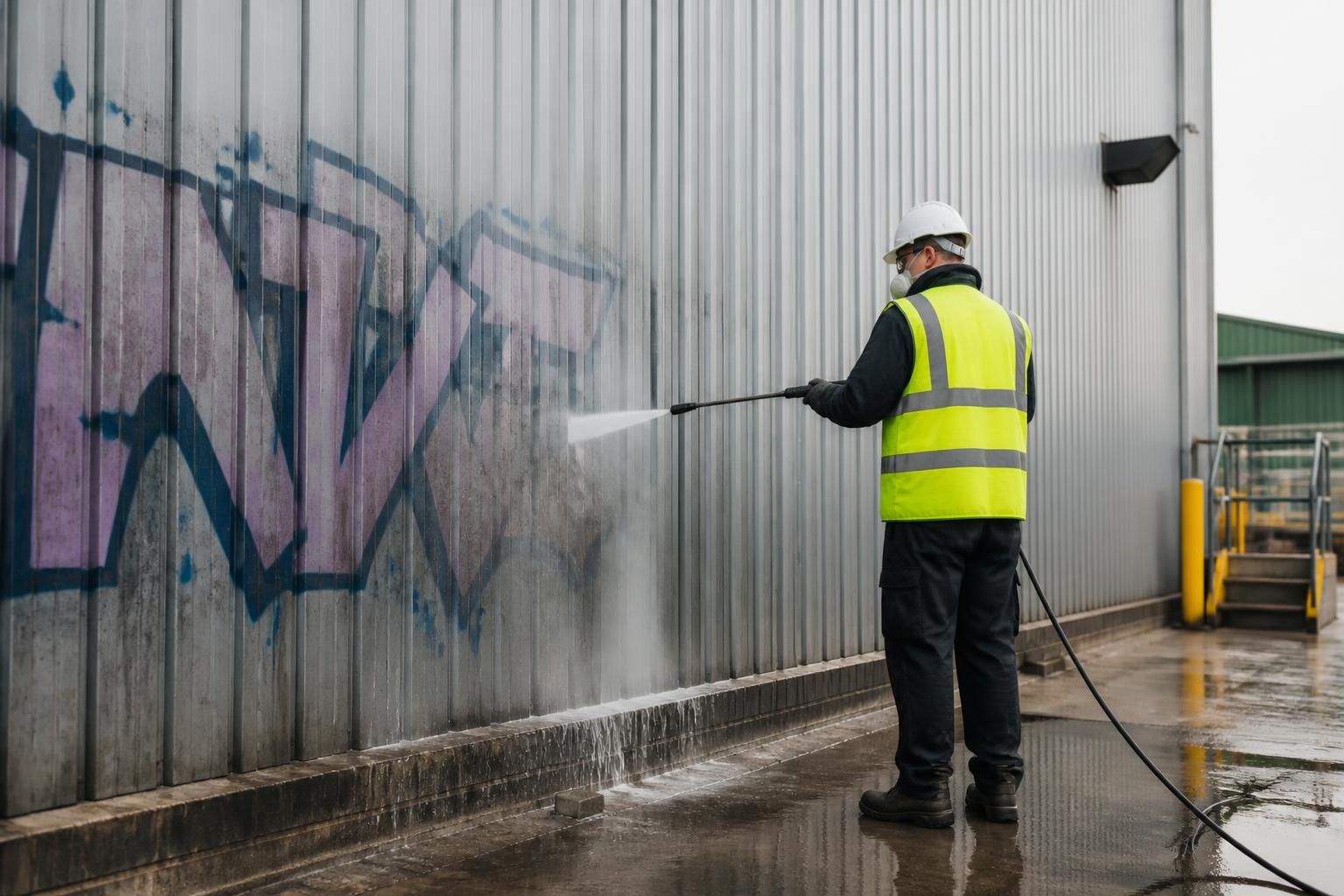
Possible methods include controlled pressure washing, steam cleaning, specialist chemical treatment, soft washing or a combination of techniques. The correct choice depends on the material and the required finish. High pressure may be appropriate for robust concrete in some circumstances but unsuitable for friable brick, weathered coatings or jointed masonry. Chemical products may help remove deeply embedded paint, but they must be compatible with the surface and handled in accordance with the product’s instructions.
Where the risk of damage is material, the contractor should carry out a small test area in an inconspicuous location. The test should assess cleaning effectiveness, colour change, coating adhesion, surface texture and the likely appearance of any remaining shadow or staining. A competent company will explain where complete removal may not be possible without also removing part of the original coating or surface.
Quality of the initial survey and quotation
A useful survey should record the location and extent of the graffiti, the affected materials, access restrictions, nearby drainage, operational constraints and any hazards. Photographs and clear notes help establish the agreed scope of work and provide a reference for checking the finished result.
The quotation should state what is included rather than simply giving a price for “graffiti removal”. Check whether it covers preparation, protection of adjacent areas, access equipment, wastewater control, final rinsing, waste disposal, making good and any anti-graffiti treatment. It should also identify assumptions, exclusions and conditions that could affect the final cost, such as concealed damage, difficult access or additional areas discovered after mobilisation.
Health and safety competence
Industrial cleaning can involve wet surfaces, chemicals, pressurised equipment, work at height, moving vehicles, electrical installations and interaction with site personnel. The contractor should be able to provide suitable risk assessments and method statements and should explain how these will be coordinated with the site’s own procedures.
Consider whether the proposed plan addresses:
- Segregation of the work area from pedestrians, vehicles and operating machinery
- Safe use of ladders, towers, powered access or other access equipment
- Personal protective equipment and chemical handling
- Slip, trip and fall hazards caused by water, hoses and debris
- Protection of electrical equipment, ventilation openings and sensitive plant
- Emergency arrangements and communication with the responsible site contact
For higher or difficult-to-reach areas, verify that the contractor has appropriate training, equipment and planning arrangements. Access should never be improvised simply to reduce the quoted price.
Environmental and wastewater controls
Graffiti removal can produce paint residue, contaminated water and chemical waste. A responsible contractor should explain how runoff will be prevented from entering surface-water drains, watercourses or unprotected ground. Depending on the site and method, this may involve drain covers, bunding, collection, filtration, vacuum recovery or controlled disposal.
Ask which cleaning products will be used, how they will be stored and diluted, and how residues and used materials will be disposed of. The contractor should distinguish between foul-water and surface-water drainage and should not assume that dirty wash water can simply be discharged. Environmental controls should be proportionate to the site and documented within the work plan.
Insurance, training and documentation
Check that the company holds appropriate public liability insurance and, where relevant, employers’ liability cover and insurance for the equipment or access methods being used. You should also be able to verify that operatives are trained for the tasks involved and that equipment is inspected and maintained.
For industrial work, retain the relevant paperwork, which may include risk assessments, method statements, product information, site induction records, waste transfer documentation and completion photographs. Good records support site compliance, future maintenance and any investigation into damage or recurring vandalism.
Reliability and communication
Graffiti can affect the appearance of a customer-facing building, create concerns about security and interfere with site standards. Evaluate how the contractor receives reports, confirms attendance, handles urgent work and communicates delays or changes to the scope. A reliable service should provide a clear contact route and a named person responsible for coordinating the work.
For sites requiring ongoing maintenance, ask whether the contractor can provide a planned inspection and removal schedule rather than treating every incident as an isolated emergency. Prompt removal can also make future cleaning easier because paint and marker residue have had less opportunity to weather into porous materials, although the appropriate response still depends on the substrate and marking.
Quality of the finished work and future protection
Agree how the completed work will be inspected. The acceptance criteria may include removal of visible paint, cleaning of associated drips and overspray, protection of adjacent finishes and safe reinstatement of the area. Some staining or “ghosting” may remain where pigment has penetrated a porous material; this should be explained before work begins rather than treated as an unexpected defect.
Where suitable, the contractor may recommend an anti-graffiti coating or another preventative treatment. Its suitability depends on the surface, appearance requirements, cleaning regime and exposure to weather or traffic. Prevention should be considered separately from removal: a coating that is appropriate for smooth cladding may not be suitable for historic masonry or a heavily trafficked hard-standing area.
Finally, compare contractors on technical judgement, safety, environmental controls, documentation, communication and the clarity of the proposed result, not price alone. A detailed survey and method statement usually provide a stronger basis for a safe, durable outcome than a brief quotation based only on photographs.
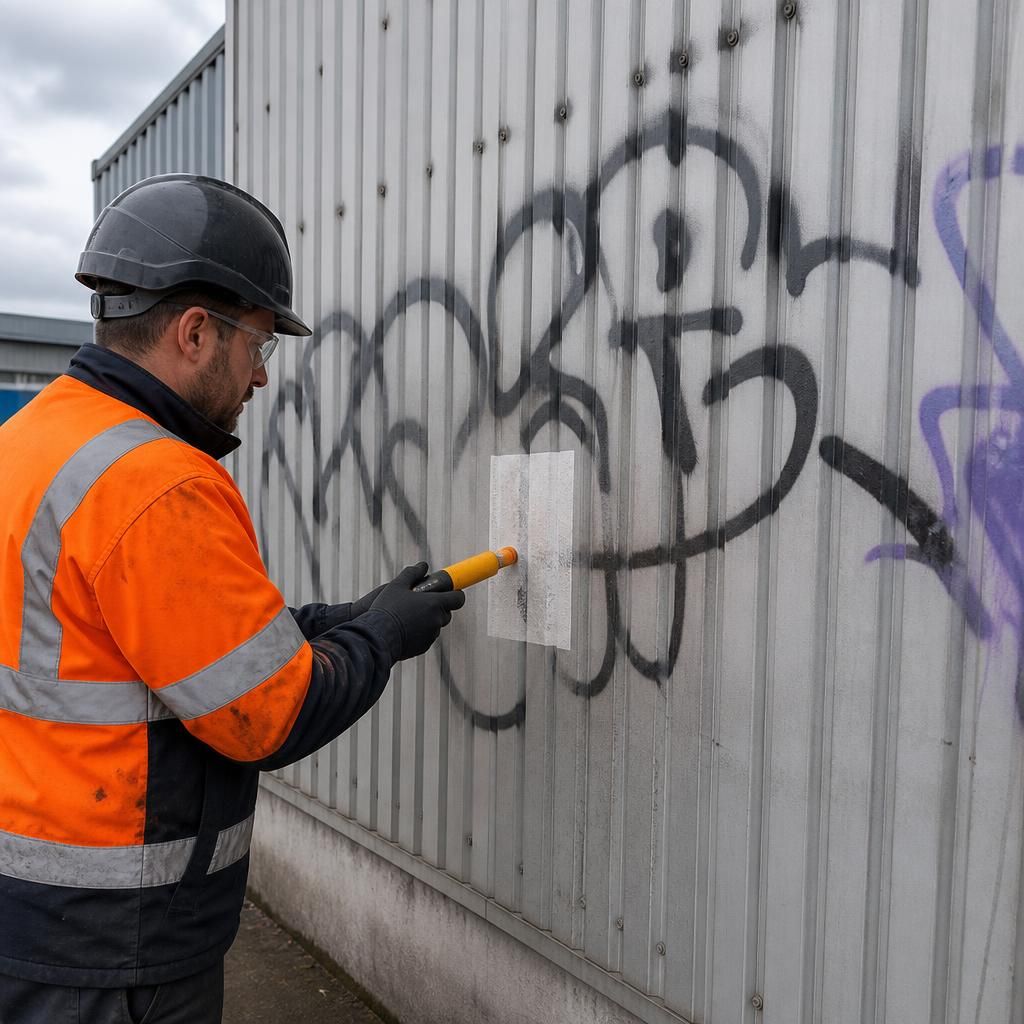
A suitable graffiti removal company should inspect and test the affected surface before choosing a cleaning method. Paint on powder-coated cladding, porous brickwork, concrete and painted metal can require different combinations of pressure washing, steam cleaning or specialist chemical treatment.
A small test area helps confirm whether the proposed process removes the marking without lifting coatings, altering colour or damaging the substrate. The contractor should also explain if permanent shadowing may remain where pigment has penetrated the surface, and include protection for nearby finishes, drainage and site equipment in the work plan.
Arrange an Industrial Graffiti Removal Survey
Arrange an industrial graffiti removal survey with Encanto Exterior Cleaning to assess the affected surfaces, access requirements and wastewater controls before work begins. We can then recommend a suitable removal method and provide a clear quotation for your Birmingham, West Midlands or UK site.