
What factors should be considered when selecting a graffiti removal method for government sites?
Selecting a graffiti removal method for a government site requires assessing the surface and its finish, the graffiti medium, the site’s sensitivity, access requirements, environmental controls and the risk of disrupting public services. The chosen technique should remove the marking effectively while preserving the substrate, meeting health and environmental obligations, controlling run-off and waste, and providing a practical balance of safety, cost and lasting results.
The correct graffiti removal method for a government site is determined by the substrate, the graffiti medium, the condition and significance of the surface, environmental controls, access, safety requirements and the need to keep public services operating. The objective is not simply to remove the marking; it is to achieve a clean, even result without damaging the building, creating additional hazards or breaching site procedures.
Assess the surface first
Different materials tolerate very different cleaning pressures, temperatures and chemicals. A method that is suitable for robust concrete may permanently damage natural stone, painted render, powder-coated metal, plastics or glazed finishes. The assessment should consider:
- Whether the surface is porous, non-porous, polished, textured, coated or already weathered.
- The age and condition of masonry, including loose mortar, cracks, failed pointing and previous repairs.
- Existing paint, protective coatings, sealants, anti-graffiti treatments and surface treatments that must be retained.
- Whether the material is historically important, listed, architecturally detailed or subject to conservation requirements.
- Whether water, cleaning agents or abrasive media could enter joints, cavities, drainage channels or building interiors.
Porous materials can absorb paint and solvent, allowing the marking to spread or reappear if the process is poorly controlled. Delicate or friable surfaces may need a low-impact approach, while sound, hard surfaces may tolerate controlled pressure washing or steam cleaning.
Identify the graffiti medium and its condition
The type of marking affects the choice and dwell time of any cleaning product. Aerosol paint, permanent marker, bitumen, adhesive residue, chalk, shoe polish and other substances do not respond in the same way. The age of the graffiti also matters: fresh paint may be removed with a milder treatment, whereas older, weathered markings may have bonded more firmly to the substrate.
Multiple layers should be treated carefully. Removing the upper marking may expose an earlier coating, repair patch or different substrate, so operatives should avoid assuming that a stronger chemical or higher pressure will produce the best result. A controlled test helps establish whether the marking can be lifted without stripping the underlying finish.
Match the technique to the level of surface sensitivity
Common options include low-pressure washing, hot-water or steam cleaning, specialist chemical treatment, gentle abrasive cleaning and combinations of these methods. Each has a different risk profile:
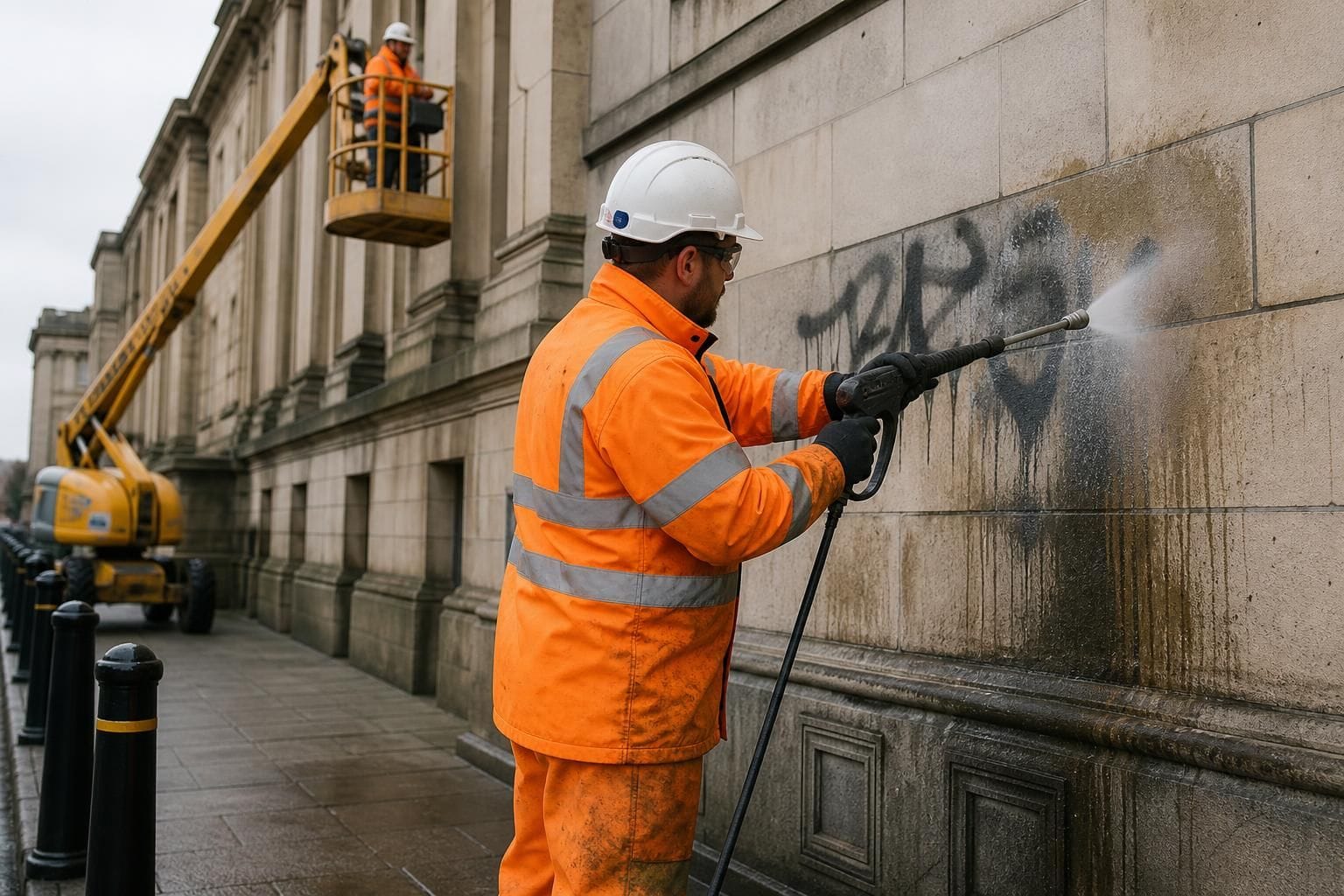
- Low-pressure washing can be suitable for robust, stable surfaces where water and run-off can be contained. Pressure must be controlled to prevent etching, mortar loss and water penetration.
- Steam cleaning uses heat and relatively low mechanical force, making it useful where reducing abrasive action is important. It still requires care around vulnerable coatings, joints and moisture-sensitive areas.
- Specialist chemical removers can soften paint or marker residue that water alone cannot remove. The product must be compatible with the substrate, correctly controlled and thoroughly removed so that residues do not remain in the surface or drainage system.
- Gentle abrasive cleaning may remove firmly bonded coatings from suitable, durable materials. It is not automatically appropriate for historic stone, decorative finishes or surfaces where a change in texture would be unacceptable.
- Manual detailing may be needed around architectural features, signage, windows, joints and service fittings. It often forms part of a wider method rather than replacing it entirely.
The least aggressive method capable of achieving the required result is generally preferred. However, “least aggressive” does not mean using the same low-impact process on every surface; an ineffective method may require repeated treatment and cause more disruption overall.
Consider heritage, appearance and the required finish
Government sites can include listed buildings, memorials, civic façades and historic masonry. On these surfaces, the decision should account for the original material, its patina and the visual effect of partial cleaning. Over-cleaning one area can leave a noticeable patch or alter the character of the façade. Historic work may require approval from the relevant conservation authority, a written method statement and a trial panel that can be reviewed before wider cleaning begins.
Where an exact return to the original appearance is not possible, the required finish should be agreed in advance. This is particularly important when the graffiti has already stained a porous surface or when removing it completely would cause more damage than retaining a faint shadow.
Check the site’s operational sensitivity
Government premises may contain public counters, offices, transport facilities, courts, schools, secure areas, emergency services or critical infrastructure. The method should therefore be selected alongside an operational plan. Factors include:
- Noise, steam, spray, odour and visibility during the work.
- Pedestrian, vehicle and staff movements around the cleaning area.
- Access restrictions, security screening, permits and escort requirements.
- The need to work outside public opening hours or in carefully managed phases.
- Protection of entrances, alarms, cameras, vents, signage, electrical equipment and sensitive internal spaces.
- Safe positioning of access equipment and the effect of hoses, cables and collection systems on walkways.
A method that appears technically effective may be unsuitable if it creates excessive overspray, blocks an entrance or produces fumes near occupied areas. Site managers should be told what will be used, how long the work is expected to take, what controls will be in place and what access arrangements are required.
Evaluate environmental and drainage controls
Water, chemical residues, paint particles and removed debris must be prevented from entering surface-water drains, soil or watercourses. The selected process should reflect the site’s drainage layout and the available means of containing, collecting and disposing of waste. This may involve drain covers, bunding, vacuum recovery, controlled rinsing and disposal through an appropriate waste route.
Product selection should also take account of hazard information, storage, handling, ventilation and the potential effect on nearby planting, wildlife, finishes and occupants. A method using less water is not automatically the most environmentally suitable if it creates hazardous dust or requires a more aggressive chemical. The overall impact of the process, including collection and disposal, should be considered.
Build health and safety into the decision
Risk assessment should cover the cleaning product, equipment, work at height, electrical systems, traffic, public access, slips, airborne particles and contact with contaminated run-off. Operatives need suitable training, personal protective equipment and clear controls for isolating or protecting nearby services.
Where chemicals are proposed, the assessment should address exposure, compatibility, dilution, dwell time, rinsing and emergency procedures. Where pressure, steam or abrasive media are used, it should address injection injuries, burns, flying debris, noise and respiratory exposure. Access equipment should be selected for the façade, ground conditions and site restrictions rather than treated as an afterthought.
Use a test area before committing to the full method
A discreet test patch or agreed sample panel is one of the most useful safeguards. It can show whether the method removes the graffiti, whether the original finish is affected, how much rinsing is needed and whether a visible difference remains between cleaned and uncleaned areas. The test should reflect the actual surface, graffiti type and proposed equipment, because a laboratory assumption or a test on a different material may not represent site conditions.
Results should be reviewed by the responsible site contact and, where relevant, a conservation or facilities representative. The agreed method statement can then specify equipment settings, products, protection measures, run-off controls, access arrangements and acceptance criteria.
Balance cost against durability and future maintenance
The lowest initial price is not necessarily the lowest-cost solution. A method that damages a coating, leaves a shadow, requires repeated passes or creates a need for repainting can increase the total cost. The assessment should include labour, access equipment, protection, waste handling, traffic management, reinstatement and any future maintenance requirements.
For locations that experience repeated tagging, a compatible anti-graffiti coating may make future removal faster and less disruptive. Its suitability depends on the substrate, appearance, conservation requirements and expected maintenance regime. It should never be applied without confirming that it will not trap moisture, alter the finish or conflict with existing treatments.
Document and review the decision
For a government site, the final choice should be recorded in a method statement supported by the surface assessment, test results, risk assessment, product information, waste arrangements and site coordination plan. Before work starts, confirm who can approve changes if the graffiti proves more firmly bonded than expected or if the substrate reacts differently from the test area.
In practice, the best method is the one that removes the marking to the agreed standard while preserving the substrate, controlling exposure and run-off, meeting site requirements and causing minimal interruption. A professional assessment and controlled trial provide a more reliable basis for that decision than choosing a technique solely because it is fast, powerful or commonly used elsewhere.
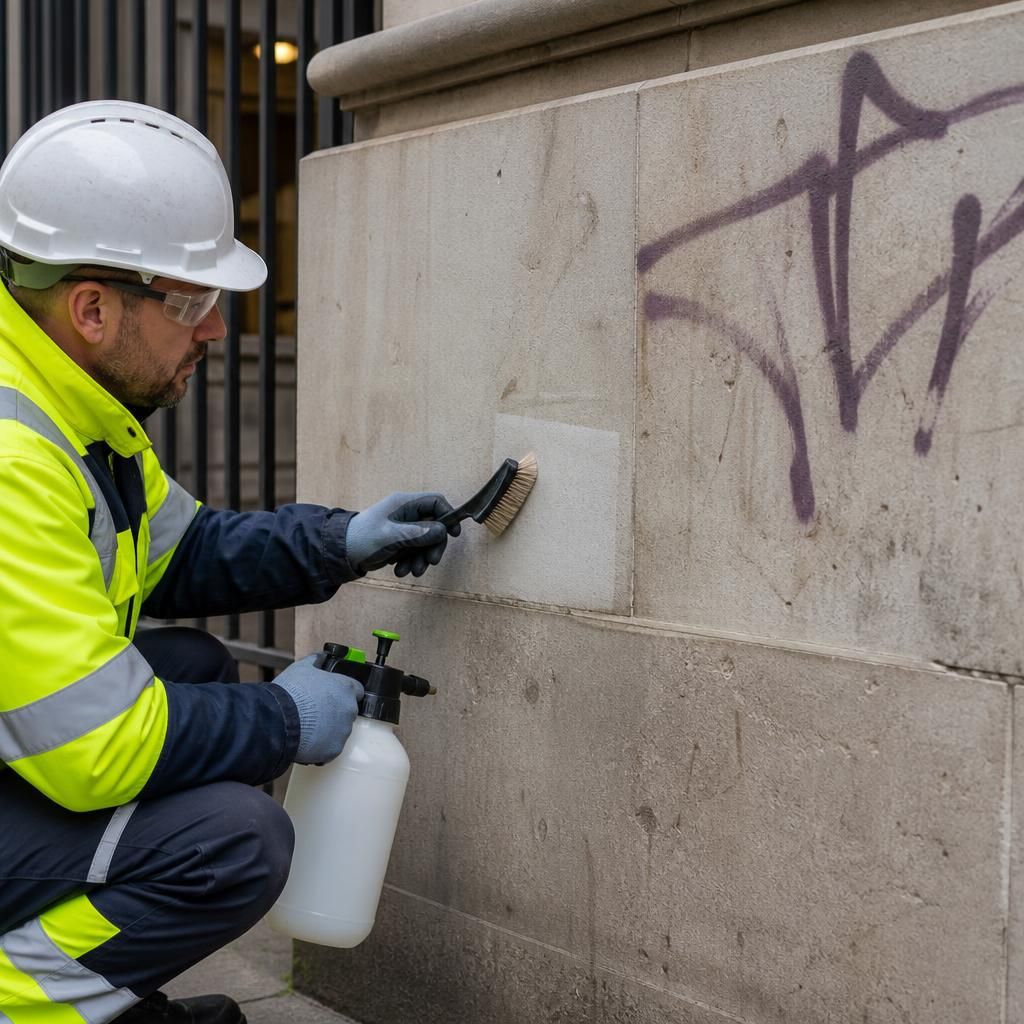
A discreet test area is essential before selecting a graffiti removal method for a government site. It confirms whether the proposed pressure, temperature, abrasive media or chemical treatment will remove the marking without changing the colour, texture or protective finish beneath it.
The test should use the same surface and graffiti type found across the affected area, with the results checked by the responsible site contact. This allows the final method statement to specify suitable equipment settings, dwell times, rinsing, run-off controls and acceptance criteria before full cleaning begins.