
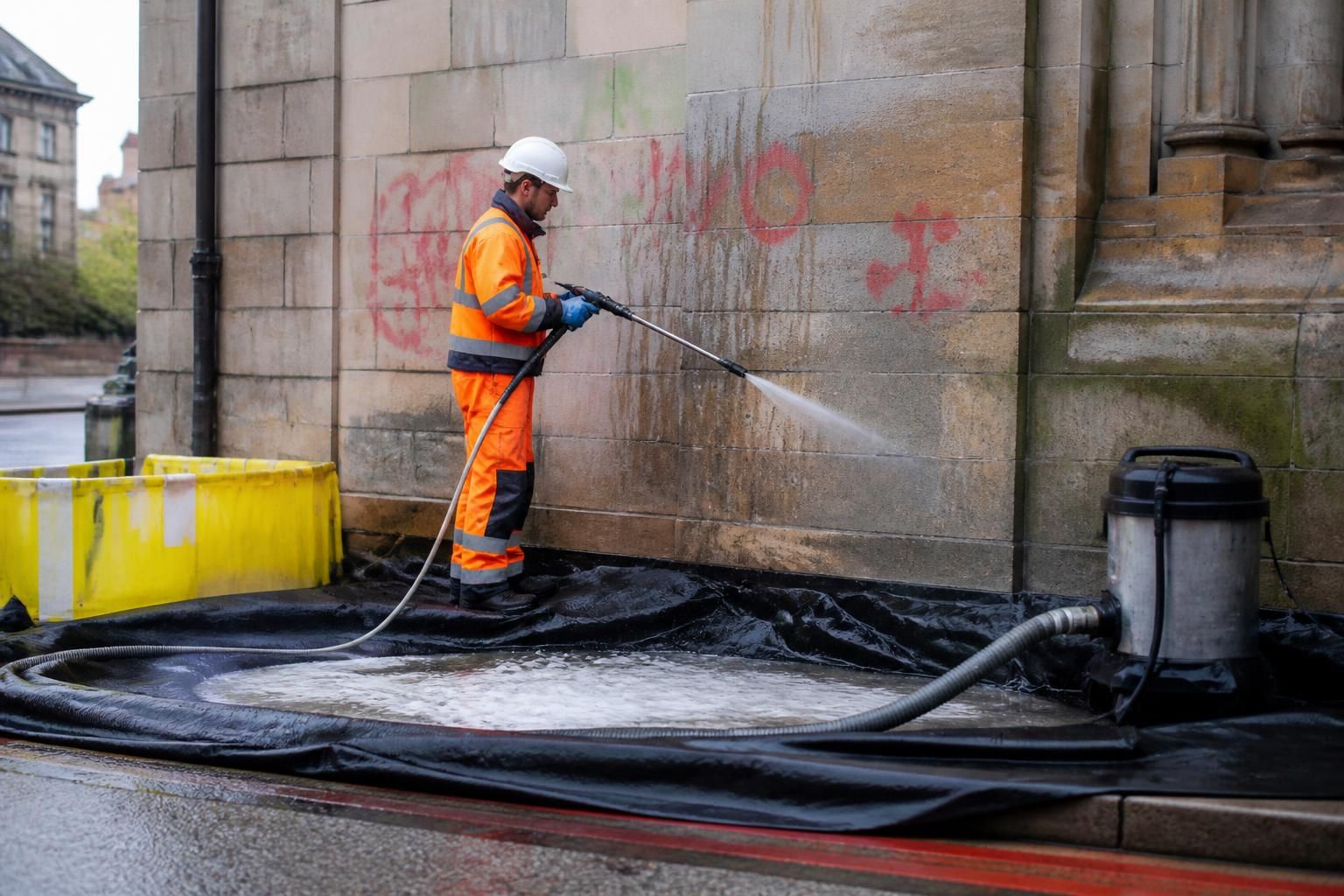
What safety precautions do professionals take during graffiti clean up and restorations?
Professionals use site-specific risk assessments, appropriate PPE, controlled access and suitable cleaning methods to protect people, surrounding property and the underlying surface during graffiti clean up and restoration. They also manage chemicals, water run-off, access equipment and waste in line with UK health, safety and environmental requirements.
Professional graffiti clean up and restoration begins with a site-specific risk assessment, a suitable method statement and controlled working area. The team identifies risks to people, the building, surrounding surfaces, traffic, vegetation and drainage before selecting equipment, chemicals and access methods. This planning helps prevent injury, pollution, surface damage and the spread of contamination during removal.
Site assessment and work planning
- Inspect the substrate, coating, age and condition before cleaning. Brick, stone, render, painted surfaces, cladding, glass and masonry each require different levels of pressure, temperature and chemical treatment.
- Check for loose materials, unstable façades, fragile fixtures, overhead services, restricted access and other hazards that may affect the work.
- Prepare a risk assessment and method statement covering the cleaning process, access arrangements, equipment, substances, public protection, waste handling and emergency procedures.
- Confirm whether permissions, traffic management or coordination with a property manager, local authority or other contractor are needed.
Personal protective equipment
Operatives select PPE according to the cleaning method and the hazards identified. This may include protective gloves, safety footwear, eye or face protection, hearing protection, suitable coveralls and respiratory protective equipment where spray, vapour, dust or solvent exposure is possible. PPE is used alongside safer working methods and local ventilation; it is not treated as a replacement for proper control measures.
Where chemical removers are used, the team follows the product safety data sheet and the control measures required under the Control of Substances Hazardous to Health (COSHH) Regulations. Chemicals are labelled, stored securely, kept away from incompatible materials and handled only by operatives who understand the associated risks.
Protecting the public and nearby property
- Set up barriers, cones, warning signs or temporary exclusion zones to keep pedestrians, vehicles and unauthorised workers away from the cleaning area.
- Use controlled access arrangements where work is near entrances, pavements, roads, loading areas or occupied premises, maintaining safe routes wherever possible.
- Protect doors, windows, vents, lighting, signage, vehicles, planted areas and adjacent finishes from spray, run-off and overspray.
- Coordinate noisy, wet or disruptive work with the building’s occupants and other contractors to reduce avoidable exposure to hazards.
Where the work affects a public footpath or roadway, additional controls may be required. These can include temporary pedestrian diversions, banksmen, vehicle exclusion measures or a planned working window. The exact arrangement depends on the site and local requirements.
Safe use of pressure, steam and chemical treatments
Cleaning pressure is matched to the surface rather than selected simply for maximum power. Excessive pressure can remove pointing, erode masonry, lift coatings, damage sealants or force water into the building. Operatives normally test a discreet area first and adjust pressure, nozzle selection, temperature, dwell time and distance from the surface before proceeding.
- Keep the lance under firm control and direct spray away from people, electrical equipment, openings and vulnerable details.
- Use low-pressure or more precise techniques where the substrate is soft, weathered, painted or otherwise sensitive.
- Control steam and hot-water equipment to avoid burns, heat damage and unintended spread of softened paint.
- Follow chemical dilution, application and contact-time instructions, avoiding unapproved mixtures that could create harmful reactions or fumes.
- Provide suitable ventilation when working near enclosed areas, air intakes or occupied spaces, and prevent fumes entering the building.
Test patches are particularly important during restoration. They show whether the chosen treatment removes the graffiti without stripping the original finish or creating a visible cleaning contrast with the surrounding surface.
Access equipment and work at height
Where access equipment is needed, the team selects equipment suitable for the ground conditions, height, reach and working space. Platforms, towers, mobile elevating work platforms and other equipment must be checked before use and operated by appropriately trained personnel. The work area is secured against falling tools, hoses, debris and cleaning materials.
Operatives also consider overhead obstructions, wind, uneven ground, vehicle movements and the effect of water on access equipment. Ladders are not used as a substitute for a safer access system where the task requires prolonged work, forceful cleaning or both hands for equipment control.
Water, run-off and environmental controls
Graffiti residues, detergents, paint particles and contaminated wash water must not be allowed to enter surface-water drains, watercourses, soil or neighbouring property. Depending on the site, precautions may include drain covers, bunding, collection mats, wet vacuum recovery, temporary containment and filtration.
- Identify drainage routes before work starts and protect them where necessary.
- Use only the amount and type of cleaning chemical needed for the surface and graffiti.
- Collect, contain and dispose of contaminated water and solid waste in accordance with site arrangements and applicable waste requirements.
- Prevent residue from being tracked into public areas or carried onto vehicles, landscaping and internal floors.
Environmental controls are planned before washing begins, particularly on large façades, car parks and sites close to watercourses. If conditions make run-off control impractical, the method or timing of the work should be changed rather than proceeding without containment.
Electrical, fire and equipment safety
Water and electrical systems require careful separation. Operatives identify sockets, lighting, chargers, distribution equipment and other electrical installations, isolate or protect them where appropriate and avoid directing water towards them. Hoses and cables are routed to reduce trip hazards, and equipment is inspected for damage before use.
Fuel, solvents and other flammable or hazardous products are stored away from ignition sources and handled in accordance with their safety information. Spill kits and suitable first-aid arrangements should be available, with operatives knowing how to report and respond to a spill, splash, equipment failure or other incident.
Weather and changing site conditions
Wind, rain, frost, heat and poor visibility can affect spray control, chemical performance, access equipment and drying times. Work may need to pause if wind could carry mist or debris beyond the exclusion zone, if surfaces are too wet or icy, or if conditions make access unsafe. The risk assessment should be reviewed when conditions or the work area change.
Final inspection and handover
After cleaning, the team checks the treated area for remaining residue, damage, staining, run-off, slip hazards and impact on adjacent materials. Barriers remain in place until surfaces and access routes are safe. Waste and protective coverings are removed responsibly, drainage protections are checked and the client is advised about any areas requiring further restoration, repainting, sealing or monitoring.
These precautions allow graffiti to be removed while protecting operatives, the public, the building fabric and the wider environment. For complex façades, occupied sites, work at height or sensitive historic materials, the cleaning method should be agreed with the responsible property manager before work starts and reviewed if the substrate behaves differently during testing.
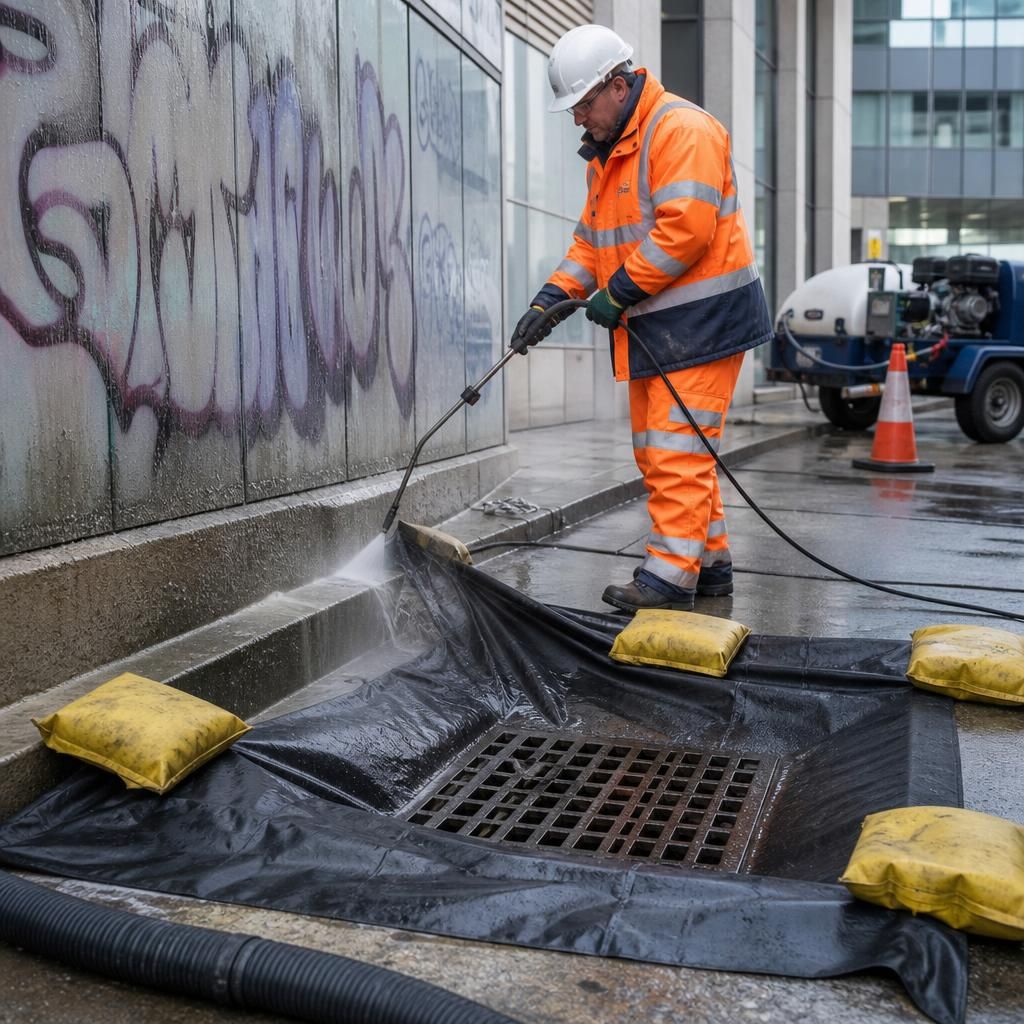
Controlling contaminated run-off is a key safety precaution during graffiti clean up because wash water may contain paint particles, cleaning chemicals and dissolved residues. Professionals identify nearby drains and watercourses before work starts, then prevent dirty water from reaching them or spreading across public areas.
- Protect surface-water drains with suitable covers, bunding or containment mats where required.
- Use controlled application methods to limit spray, overspray and the volume of wash water.
- Recover contaminated water with wet vacuums or other suitable equipment rather than allowing it to flow across the site.
- Keep collected residues and used materials contained for appropriate disposal in accordance with the site’s waste arrangements.
These controls are particularly important on large façades, car parks and properties close to landscaped areas or watercourses. If safe containment cannot be maintained because of weather, drainage or site access conditions, the cleaning method should be altered or postponed.