
What factors should I consider when selecting a provider for graffiti clean up and restoration services?
When selecting a graffiti clean up and restoration provider, assess their experience with your property type and surface, their ability to match removal methods to the substrate, and their use of suitable access equipment and safety controls. Also check that they provide clear surveys and quotations, responsible waste and chemical management, restoration where damage remains, and practical advice to help prevent recurrence.
Select a graffiti clean up and restoration provider by assessing whether they can identify the affected surface, choose a removal method that will not cause further damage, and manage the work safely from survey through to completion. Experience, suitable equipment, documented procedures, transparent pricing, responsible waste handling and the ability to restore damaged finishes are more important than simply offering a fast removal service.
Experience with the relevant property and substrate
Graffiti removal is not a single process. Painted masonry, brick, natural stone, concrete, render, powder-coated cladding, metal, glass, timber and plastic can each react differently to pressure, heat, solvents and abrasive media. Ask whether the provider has worked on similar buildings and surfaces, including older or listed properties where the original finish may be particularly vulnerable.
A competent contractor should inspect the substrate, identify the graffiti medium where possible, and consider previous coatings, weathering, staining and repairs. They should also distinguish between the graffiti itself and damage that may already exist beneath it. This assessment helps prevent unsuitable cleaning that strips paint, opens the surface, spreads pigment or leaves a visible ‘ghost’ image.
A clear survey and method statement
Before work starts, the provider should explain how the area will be assessed and how the proposed method is matched to the surface. A written scope should identify the locations affected, the intended cleaning technique, access requirements, likely limitations and any restoration or recoating that may be needed.
Where the surface or graffiti is difficult to assess visually, a small test area is useful. The test should confirm that the chosen treatment removes or reduces the marking without altering the surrounding finish. It should not be treated as a guarantee that every part of the building will respond identically, particularly where surfaces have different levels of weathering or porosity.
Appropriate equipment and technical capability
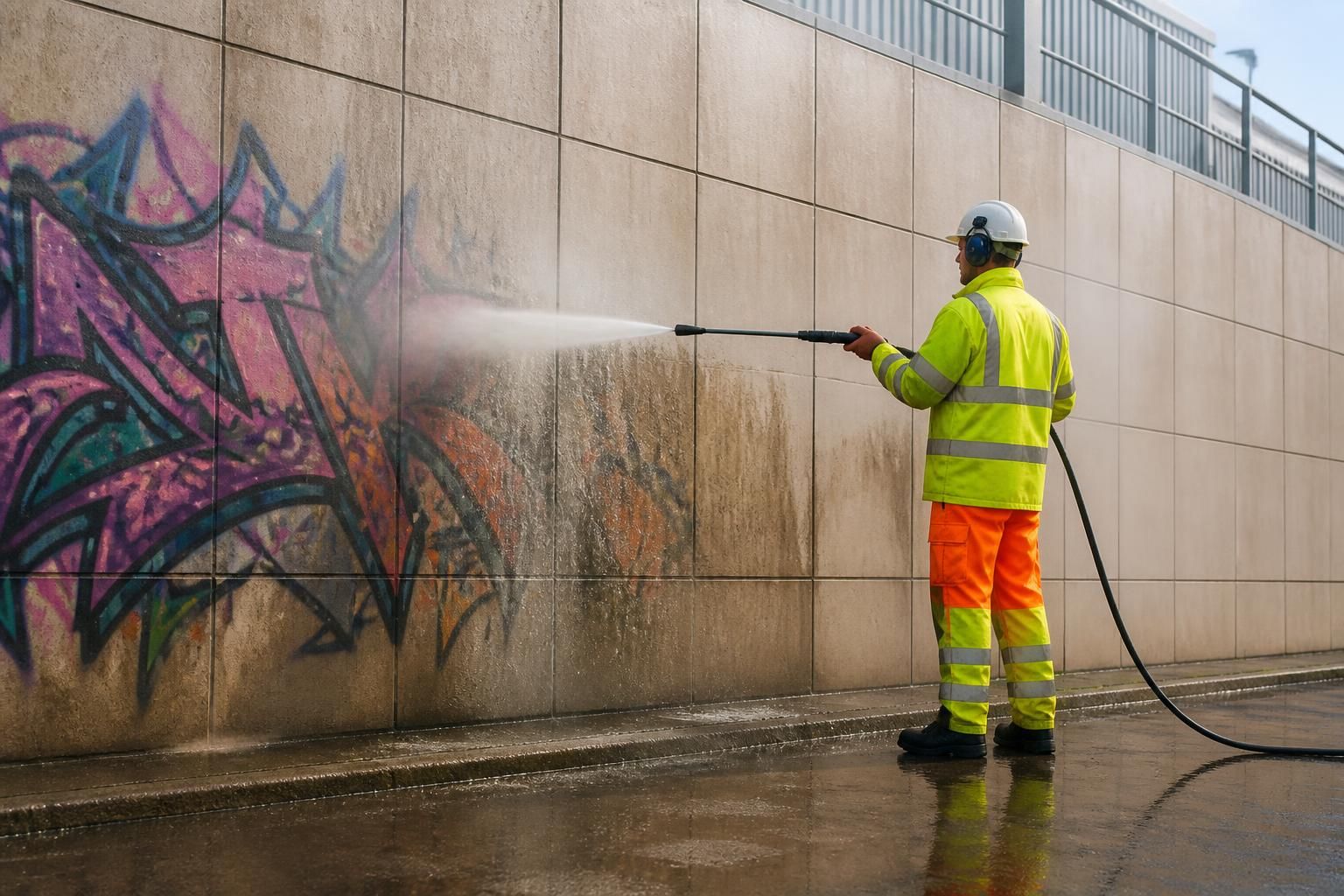
Look for a provider with more than one cleaning option. Depending on the substrate, this may include controlled pressure washing, steam cleaning, specialist chemical treatments, soft washing or carefully selected abrasive techniques. The important point is not the use of the most powerful equipment, but the ability to control pressure, temperature, flow, chemical strength and dwell time.
For high-level or extensive graffiti, check that the contractor can provide suitable access equipment and has the competence to use it. This may include powered access platforms, towers, scaffold or other controlled access systems. Access arrangements should protect pedestrians, vehicles, neighbouring property and building occupants rather than being improvised on site.
Safety arrangements and compliance
Commercial graffiti removal can involve traffic, public access, work at height, electrical equipment, cleaning chemicals, contaminated run-off and unstable surfaces. Ask for evidence that the provider plans these risks through appropriate risk assessments and method statements. Operatives should use suitable personal protective equipment and establish exclusion zones, signage and barriers where necessary.
The contractor should also explain how they will protect doors, vents, glazing, landscaping, vehicles and nearby finishes. If work takes place beside a road, in a car park or at an occupied commercial site, the plan should account for safe segregation and access throughout the operation. Relevant insurance, training and site documentation should be available on request.
Restoration as well as removal
Removal may not return a damaged surface to its original appearance. Porous materials can retain pigment, while aggressive marking or repeated cleaning can leave etching, surface loss, discolouration or a difference in sheen. A suitable provider should explain when cleaning is likely to be sufficient and when restoration is required.
Restoration may involve blending a localised area, repairing a coating, applying a compatible finish or treating the wider elevation so that the cleaned section does not stand out. Ask how colour, texture and sheen will be matched, and whether the proposal includes a final inspection under normal viewing conditions. If complete visual restoration is not technically possible, this limitation should be explained before work begins.
Environmental and waste controls
Cleaning products and contaminated wash water must be managed responsibly. Ask how the provider will prevent run-off entering surface water drains, soil or neighbouring property, and how residues, containers and removed materials will be collected and disposed of. The method should use the least aggressive treatment that is reasonably effective for the surface and graffiti type.
Steam or low-water methods may be appropriate in some locations, while controlled chemical treatment may be more suitable for persistent paint on a compatible substrate. No method is automatically environmentally preferable in every situation; the relevant considerations are chemical selection, water use, containment, recovery and lawful disposal.
Transparent quotations and defined outcomes
A reliable quotation should separate cleaning, access, protection, waste management, restoration, recoating and any planned follow-up work. It should state what is included, what may incur an additional charge and what result can reasonably be expected. Be cautious of a quote based only on photographs where the substrate, access or extent of staining cannot be verified.
The proposed finish should be described accurately. ‘Removal’ may mean complete removal, substantial reduction or cleaning followed by local restoration, depending on the condition of the surface. Clarify whether the quotation includes a return visit for remaining shadowing, a protective coating or advice on future incidents.
Evidence of relevant work
Ask to see examples of comparable graffiti projects rather than only general exterior cleaning work. Useful evidence includes before-and-after photographs showing the same type of substrate, details of the method used, and examples involving high-level façades, public areas, cladding or repeat vandalism.
References or records from property managers, facilities teams, construction organisations or local authorities can help confirm that the provider is accustomed to commercial requirements. The most useful feedback will cover communication, site controls, consistency of finish, documentation and the handling of unexpected surface damage.
Aftercare and prevention advice
Once the marking has been removed, ask whether the provider can recommend a compatible anti-graffiti coating or maintenance approach. Sacrificial coatings can sometimes be removed and renewed with the graffiti, while permanent systems may allow repeated cleaning; suitability depends on the surface, appearance required and expected cleaning regime.
Aftercare should also cover inspection, reporting and response arrangements. A provider who records the cleaned areas, products used, surface limitations and any recommended repairs gives the property team useful information for future incidents. This is particularly important where graffiti is recurring or several contractors maintain the same site.
Questions to ask before appointing a provider
- Have you cleaned this type of substrate and similar graffiti before?
- What method do you propose, and why is it suitable for the surface?
- Will you carry out a test patch before treating the full area?
- How will you protect people, vehicles, landscaping, glazing and adjacent finishes?
- What access equipment, insurance and safety documentation will be used?
- How will contaminated water, chemicals and waste be contained and disposed of?
- Could the graffiti have caused etching, staining or coating failure that requires restoration?
- What is included in the quotation, and what result can reasonably be expected?
- Can you provide relevant project evidence and practical aftercare recommendations?
The strongest choice is therefore the provider that demonstrates a controlled, surface-specific process rather than promising the quickest or most aggressive clean. A proper survey, tested method, safe site plan, responsible waste controls and a clear restoration and aftercare proposal give you a more reliable basis for protecting the appearance and condition of the property.
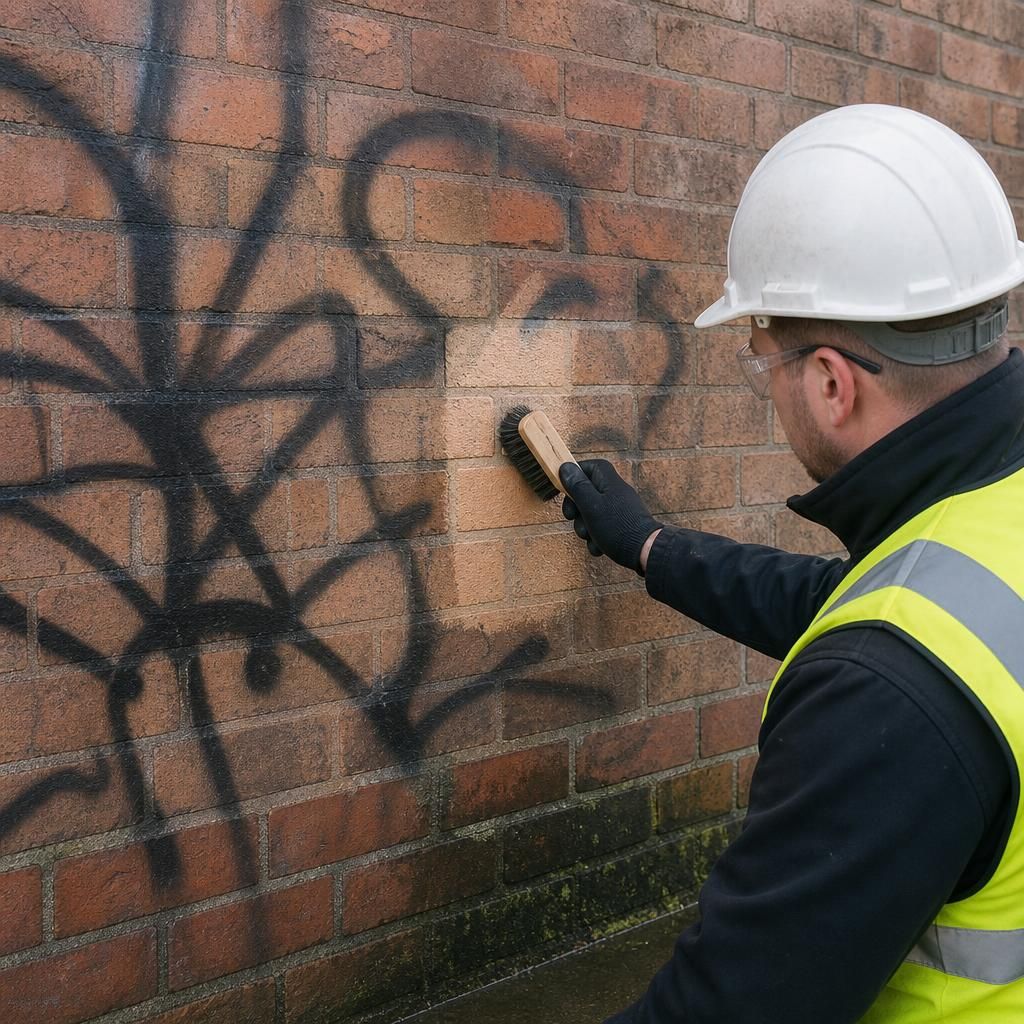
A test patch is a controlled trial of the proposed graffiti removal method on a small, inconspicuous area of the affected surface. It helps confirm whether the treatment removes the marking without causing colour loss, etching, staining, coating failure or a visible change in texture.
The provider should assess the test area after cleaning and compare it with the surrounding finish before proceeding. This is particularly important for porous brick, natural stone, painted surfaces, render and cladding, where pressure, heat and chemical treatments can produce different results. A suitable test should also consider dwell time, water use and any required containment of contaminated run-off.
Ask for the proposed method and expected limitations to be recorded in the quotation or method statement. If the graffiti has penetrated the substrate or previous cleaning has caused damage, complete visual restoration may require coating repair, blending or wider-area treatment rather than removal alone.