
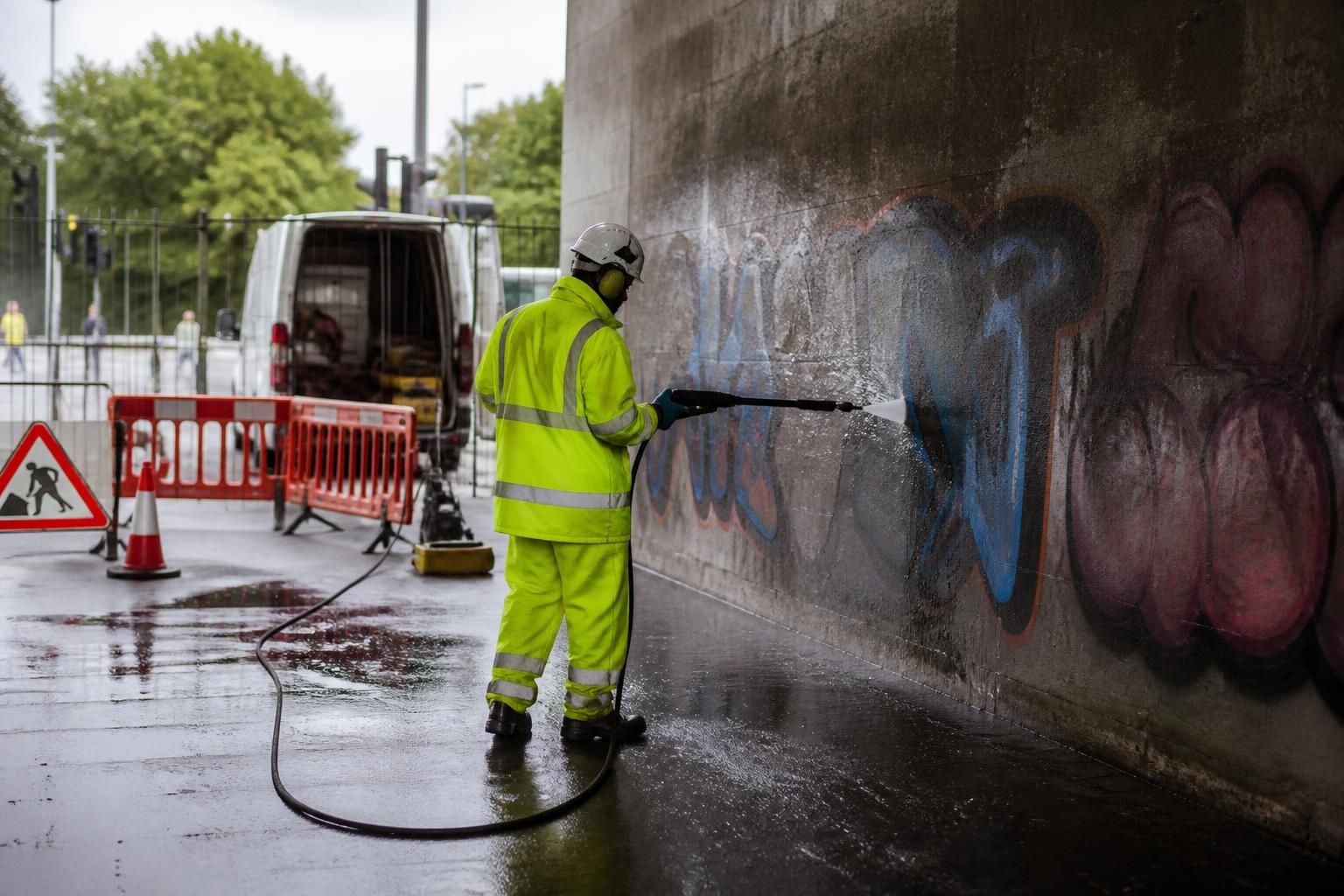
What safety precautions should be taken when removing graffiti and spray paint from surfaces in high-traffic areas?
Graffiti and spray paint removal in high-traffic areas requires a documented risk assessment, controlled work zone, suitable barriers and signage, traffic and pedestrian management, and trained operatives using task-appropriate PPE. Contractors should also select a surface-safe method, contain chemical residues and wastewater, prevent public access to equipment and treated surfaces, and inspect the area before reopening it.
Graffiti and spray paint removal in high-traffic areas must be planned as a controlled construction and cleaning activity, not treated as routine painting work. The essential precautions are a documented risk assessment and method statement, a clearly segregated work zone, suitable traffic and pedestrian management, trained operatives wearing task-appropriate personal protective equipment, and effective control of chemicals, dust, spray, noise, wastewater and access equipment.
Complete a site-specific risk assessment before work starts. The assessment should consider the surface, the graffiti medium, the proposed removal method and the location of the work. It should identify risks from moving vehicles, pedestrians, cyclists, nearby businesses, public transport, overhead services, uneven ground, working at height, electrical equipment, chemical exposure, pressure washing, steam, falling debris and changing weather conditions.
The assessment should also account for vulnerable people who may pass through or occupy the area, including children, older people and those with mobility or visual impairments. Where the work affects a road, footway, car park or other managed route, the contractor should establish whether permission, a highways arrangement, a permit or a traffic management plan is required. The controls should be communicated to every operative before work begins and reviewed if the site conditions change.
Set up a physical exclusion zone. Barriers should prevent the public from entering the treatment area and should be robust enough to remain in position if brushed by a passer-by or exposed to wind. Cones and warning tape alone may be unsuitable where pedestrians can approach the work closely or where spray, debris or contaminated water could escape. The barrier arrangement should account for the equipment, hoses, access platforms and any area needed for safe movement around the surface.
Use clear signs to explain that cleaning is in progress and identify hazards such as wet surfaces, chemical treatment, overhead work or restricted access. Signs should be positioned where people can read them before reaching the diversion or exclusion zone. A safe alternative route should be maintained, with accessible passage wherever reasonably practicable. If a footway cannot remain open, the diversion should be planned rather than created informally around equipment.
Control vehicles, plant and pedestrian movement. In car parks, service yards and loading areas, work should be coordinated with site users so vehicles are held back or redirected while cleaning is under way. Banksmen or other competent traffic marshals may be needed when vehicles are manoeuvring near the work zone, particularly where visibility is restricted. Equipment, hoses and cables should be routed away from vehicle paths and secured to reduce trip and crush risks. Operatives should never rely on drivers or pedestrians seeing them in time to avoid an incident.
Where work takes place beside a live road or public route, traffic management should reflect the speed, volume and type of traffic. Barriers, signs, lighting and vehicle controls should be positioned in accordance with the approved arrangement and checked throughout the job. Work should be paused if the controls are moved, damaged or no longer provide adequate separation.
Select a method that is safe for both the surface and the surroundings. The removal technique should be tested in an inconspicuous area before full treatment. Pressure, steam, abrasive media and chemical products can damage masonry, coatings, render, brick, stone, glass, metal, signage and painted finishes if they are used at the wrong intensity or dwell time. A surface-safe method also reduces the risk of loose fragments, airborne particles and excessive wastewater entering public areas.
Operatives should follow the product label and the relevant COSHH assessment when using chemical removers. Safety data sheets must be available, and incompatible products must not be mixed. Containers should be labelled, kept secure and stored away from public access, drains, heat sources and ignition sources. Decanted products should only be used in suitable, clearly identified containers. Chemical application should be controlled to prevent mist, splash and run-off affecting people, vehicles, vegetation or neighbouring premises.
Wear PPE matched to the task. Depending on the method and assessment, this may include protective gloves, safety footwear with suitable slip resistance, eye or face protection, protective clothing, hearing protection and respiratory protective equipment. Respiratory protection must be selected for the contaminant and the process; a general face covering is not a substitute for suitable RPE. PPE should be compatible when several items are worn together, maintained in good condition and removed without spreading contamination.
Pressure washing and abrasive methods can create spray, fragments or airborne dust. The work zone should therefore be positioned and screened to protect passers-by, nearby workers and building occupants. Doors, windows, air intakes and vulnerable equipment may need to be closed, covered or isolated. Operatives should avoid directing spray towards people, vehicles, electrical installations, glazing or unprotected openings.
Manage work at height and access equipment separately. Ladders should not be used as a default working platform for prolonged or forceful cleaning. Where access equipment is required, it should be suitable for the ground conditions and the working height, operated by trained personnel and inspected in line with the applicable requirements. Mobile elevated work platforms and towers need stable positioning, adequate clearance and protection from vehicle impact. Tools and hoses must be controlled so that nothing can fall into the public area below.
Work at height should be postponed or modified during unsuitable weather. Wind can carry spray, chemical mist and debris beyond the intended work zone, while rain can reduce footing and affect the performance of treatments. The access equipment and exclusion zone should be checked after any weather change.
Prevent pollution and control wastewater. Run-off from graffiti removal may contain paint particles, detergents, chemical residues and contaminants from the substrate. It must not be allowed to enter surface-water drains, watercourses, planted areas or neighbouring property without suitable controls. Drain covers, bunding, wet vacuum recovery, collection systems and other containment measures should be selected according to the site and method. Collected waste should be handled and disposed of through an appropriate route, in accordance with the waste classification and site requirements.
Dry residues, used absorbents, contaminated cloths and spent abrasive media should be collected rather than swept into the public realm. If a spill occurs, stop the activity, protect the area, use the planned spill response and report it through the site procedure. Cleaning should not resume until the source and consequences of the spill have been controlled.
Protect the public during and after treatment. Equipment, hoses, chemicals and power supplies should remain attended or secured. Wet, treated or chemically affected surfaces should stay behind the barrier until they are safe to touch and walk on. Residual odour, slippery deposits, loose paint, staining or discolouration should be checked before the area is reopened. Nearby entrances and business access points should not be returned to use until the responsible site contact has confirmed that the route is clear.
Before demobilising, the operative or supervisor should inspect the surface and surrounding area for remaining debris, pooled water, unremoved barriers, trip hazards, chemical residue, damage and contaminated materials. Drain protection should only be removed once run-off has stopped and the area has been checked. A record of the method used, products applied, waste removed, incidents and any surface defects should be retained for the client.
For complex sites, the safest approach is to coordinate the cleaning plan with the property manager, principal contractor, highways authority or facilities team before attendance. This allows access times, public diversions, shutdowns, delivery movements, emergency routes and post-cleaning inspections to be agreed in advance. If conditions cannot be controlled safely, work should be delayed or the method revised rather than proceeding with an improvised arrangement.
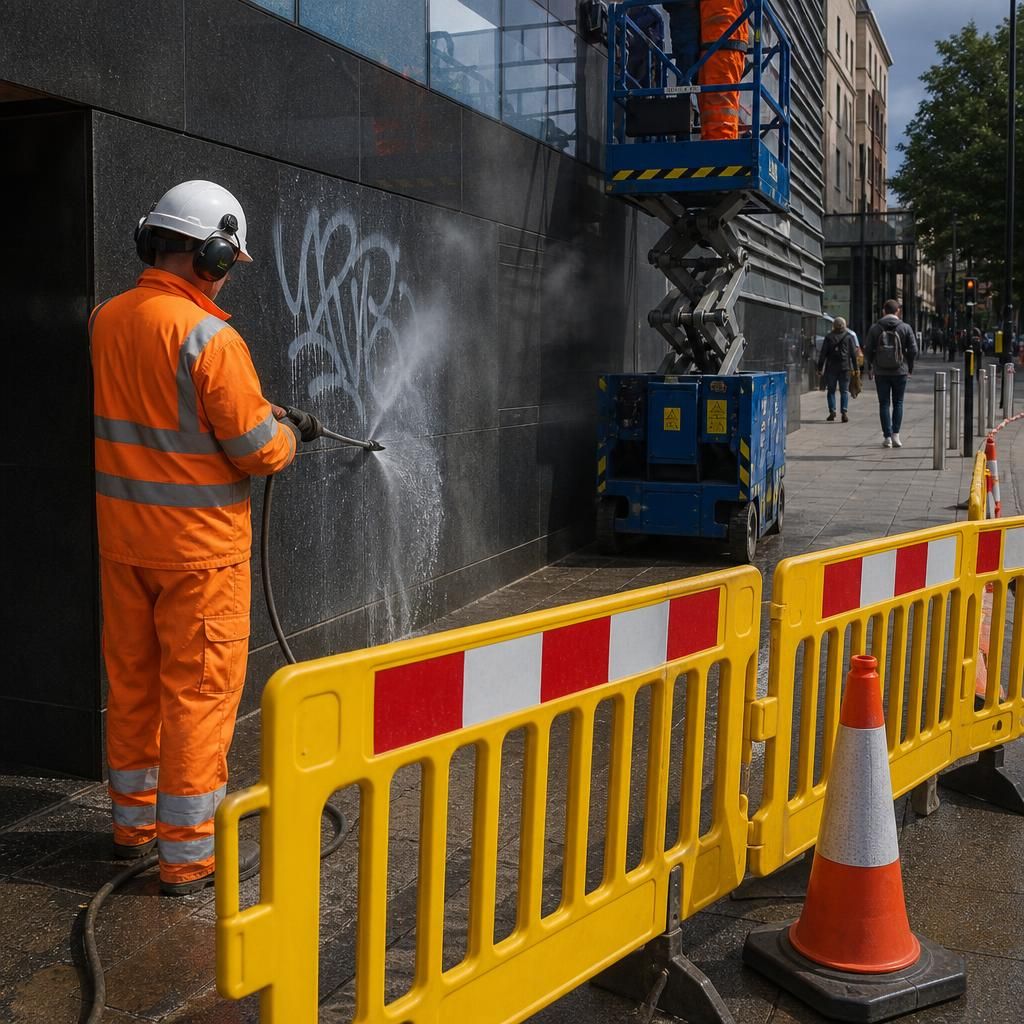
Physical segregation is essential when removing graffiti in a high-traffic area. Barriers should keep pedestrians and vehicles away from spray, debris, hoses, chemicals, access equipment and contaminated run-off. Use clear warning signs before people reach the work zone, maintain a safe accessible route where possible, and arrange a planned diversion if the usual footway or entrance must close. In car parks, service yards and roadside locations, coordinate vehicle movements with the site manager and use a competent traffic marshal where visibility or manoeuvring creates additional risk.
Arrange a Safe Graffiti Removal Assessment
Arrange a site-specific graffiti removal assessment with Encanto Exterior Cleaning to review access, traffic management, surface risks and pollution controls before work begins. We can help agree a safe method and suitable working arrangements for your premises.