
What factors should be considered when selecting a graffiti removal company for commercial properties?
When selecting a graffiti removal company for commercial properties, assess its experience with your surface types and site conditions, the suitability of its cleaning methods, health and safety procedures, environmental controls, insurance and response times. Choose a contractor that can provide a clear scope of work, explain how it will minimise damage and disruption, and offer reliable aftercare or protective treatments where appropriate.
Select a graffiti removal company for a commercial property by assessing its experience with the relevant surfaces and site conditions, proposed cleaning methods, health and safety controls, environmental procedures, insurance, availability and aftercare. The contractor should provide a clear written scope of work, inspect or discuss the affected area before starting, explain how damage and disruption will be minimised, and demonstrate that its operatives and equipment are suitable for the project.
Relevant commercial experience
Graffiti removal on a shopfront, transport facility, industrial unit, public building or multi-storey façade can involve very different risks. Check whether the contractor regularly works on commercial and industrial sites rather than only small domestic jobs. Relevant experience may include cleaning masonry, brick, render, concrete, painted surfaces, metal cladding, glazing, street furniture and coated façades.
Experience should also cover the practical demands of commercial work, such as coordinating with facilities teams, working around employees and members of the public, protecting vehicles and equipment, following site induction procedures, and completing work within agreed access or trading hours. A suitable contractor should be able to explain how it has approached comparable surfaces and access conditions without relying on generic recommendations.
Assessment of the surface and graffiti
Graffiti paint, marker ink and other coatings do not respond identically to removal. The underlying material, its age, porosity, condition and existing protective coating all affect the appropriate treatment. A contractor should consider whether the surface is weathered, cracked, friable, painted, sealed or already affected by previous cleaning.
Ask for an initial survey or sufficiently detailed site assessment. This should identify the graffiti type, the extent of the affected area, nearby sensitive materials, drainage arrangements, access requirements and any hazards. A small test patch in an inconspicuous location is often an important part of the process. It allows the contractor to check whether the proposed chemical, steam, pressure or abrasive approach removes the marking without causing staining, etching, colour loss or texture changes.
Suitability of the removal method
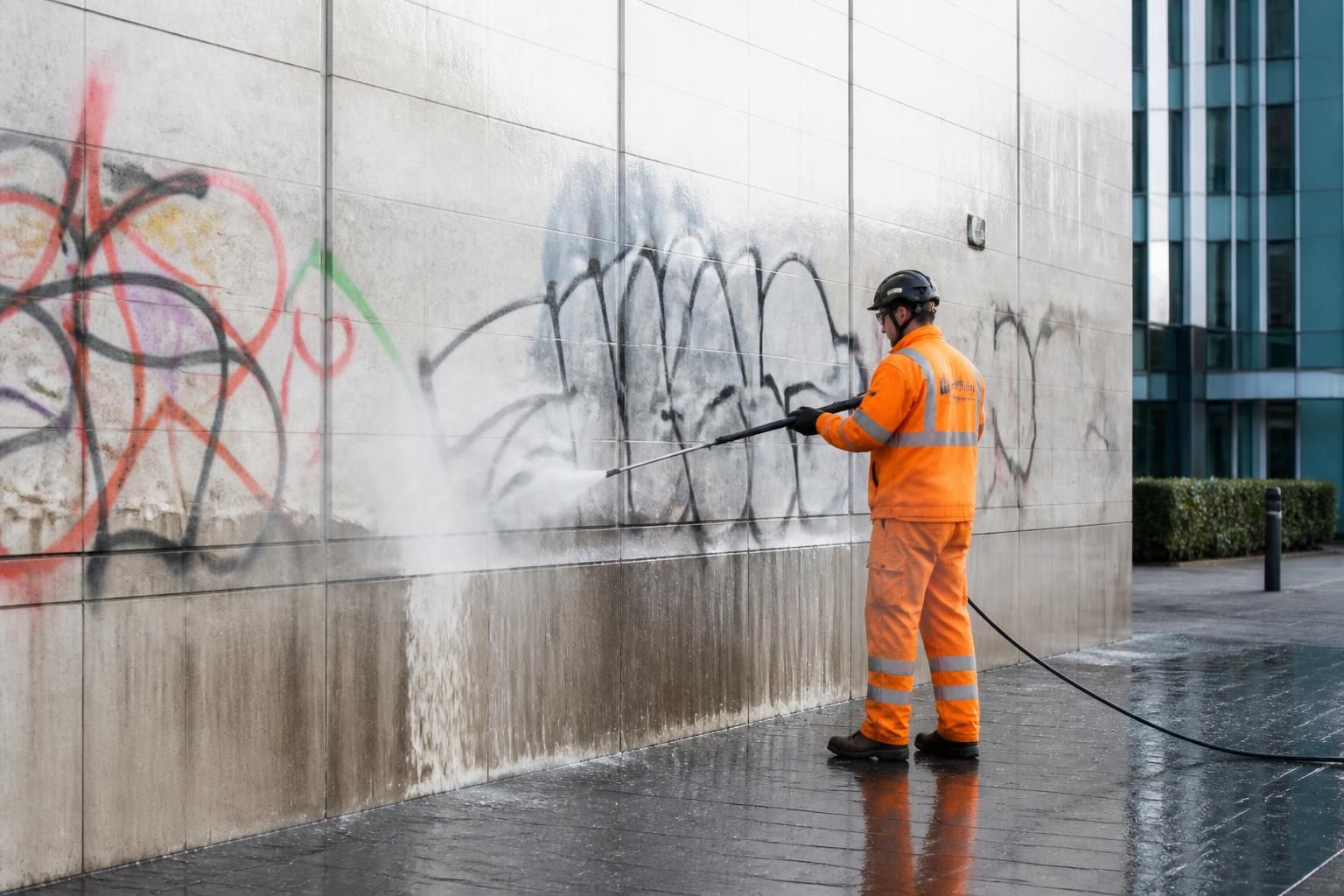
There is no single graffiti removal technique that is appropriate for every commercial surface. Depending on the substrate and coating, the contractor may recommend controlled pressure washing, steam cleaning, a specialist chemical remover, gentle agitation or a combination of methods. The method should be selected according to the least aggressive approach likely to achieve the required result, rather than simply using the fastest or most powerful equipment.
Ask the company to explain:
- Which method and products it proposes to use and why they are suitable for the surface.
- Whether heat, pressure, dwell time or mechanical action will be controlled during the work.
- How it will deal with shadows, staining or paint that has penetrated a porous material.
- What measures will protect adjacent signage, seals, windows, doors, landscaping and painted finishes.
- What result can reasonably be expected if the graffiti has already caused permanent staining or surface damage.
A credible contractor will not guarantee that every mark can be removed without any trace when the substrate has absorbed pigment or has been etched. It should distinguish between removing the graffiti and restoring a damaged surface.
Health and safety arrangements
Commercial graffiti removal often takes place beside roads, entrances, pedestrian routes, loading areas or occupied buildings. Request evidence of a suitable risk assessment and method statement, together with details of how the work will be segregated from the public, staff and vehicles. Controls may include barriers, warning signs, exclusion zones, banksmen, controlled access and suitable timing.
Where chemicals are used, the contractor should provide appropriate control information and ensure that operatives understand safe handling, storage, dilution, spill response and disposal requirements. Personal protective equipment should be selected for the actual task, while pressure washing, steam equipment, ladders, access platforms and other machinery should be used by competent operatives. Ask how the company will manage work at height, electrical risks, traffic movements, water overspray and potential slips.
For larger projects, check that site documentation can be integrated with the principal contractor’s or property manager’s procedures. The contractor should be willing to provide relevant training, competency and insurance information rather than treating safety paperwork as an afterthought.
Environmental controls and wastewater management
Graffiti removal can produce contaminated water, loosened paint particles and chemical residues. A responsible company should explain how it will prevent run-off entering surface-water drains, watercourses, planted areas or neighbouring premises. Depending on the location, this may involve drain protection, bunding, wet vacuum recovery, controlled collection and appropriate disposal.
Ask whether the proposed products are suitable for the setting and whether lower-impact options, such as steam cleaning or biodegradable products, can be used without compromising the substrate. “Eco-friendly” should not be accepted as a sufficient explanation on its own: the contractor should describe how products are handled, how residues are recovered and how wastewater is disposed of. Environmental controls are particularly important at public sites, near waterways and where the work involves extensive façade or paving areas.
Insurance, documentation and professional standards
Confirm that the company holds appropriate public liability insurance and, where relevant, employers’ liability and cover for the equipment and activities involved. Ask for current documentation before work begins, particularly where the contractor will operate on behalf of a managing agent, local authority, construction company or other organisation with formal procurement requirements.
The quotation or proposal should record the areas to be treated, the assumed surface materials, the planned method, access arrangements, preparation and protection, wastewater controls, exclusions, completion standard and any reinstatement work. It should also clarify whether the price includes travel, out-of-hours attendance, access equipment, traffic management, repeat visits or protective coating. A clear scope makes quotations easier to compare and reduces disputes over what constitutes completion.
Availability and response times
For active graffiti, prompt removal can reduce visual impact and may help prevent repeat tagging, but speed should not replace proper assessment. Check whether the contractor offers routine, urgent or out-of-hours attendance and whether it can cover the locations in your portfolio. Establish who will receive an instruction, how photographs and access details should be provided, and when an operative is expected to attend.
For clients managing multiple properties, a contractor should be able to provide a consistent reporting process across sites. This may include photographs before and after cleaning, details of the method used, records of any limitations and recommendations for further treatment. Response arrangements should be realistic and clearly documented rather than based on an unqualified promise of immediate attendance.
Disruption, access and site protection
Consider how the work will affect customers, tenants, staff, deliveries and neighbouring properties. The contractor should explain how it will control noise, overspray, water, odours, pedestrian movements and access equipment. It should also identify whether a cherry picker, scaffold, tower, boom lift or other equipment is necessary and who is responsible for arranging it.
For occupied commercial premises, agree working hours and protection measures in advance. Windows, doors, signs, vehicles, external lighting, air-conditioning equipment, vents and landscaping may require masking or temporary protection. The company should leave the area safe and clean, with no unmanaged residue, pooling water or unsecured equipment.
Protective treatments and aftercare
After the graffiti has been removed, ask whether a suitable sacrificial or permanent anti-graffiti coating is appropriate for the surface. Protective treatments can make future markings easier to remove, but their compatibility, appearance, reapplication requirements and performance on the specific material should be explained. They are not suitable for every façade or finish.
A useful aftercare recommendation will cover inspection, prompt reporting of new graffiti, cleaning intervals and any restrictions on future products or methods. The contractor should also state whether it offers follow-up visits or planned maintenance, and what documentation will be supplied after completion.
Comparing quotations
Do not compare companies on price alone. A lower quotation may exclude access equipment, surface protection, wastewater recovery, out-of-hours working or difficult staining. Compare the proposed method, preparation, safety controls, environmental arrangements, completion standard, response provision and aftercare alongside the total cost.
The strongest choice is the company that can demonstrate relevant commercial experience, assess the surface before treatment, use a controlled method, protect people and property, manage residues responsibly and communicate the scope in writing. Those factors provide a more reliable basis for selecting a graffiti removal contractor than a generic claim of fast cleaning or a price based only on the visible size of the graffiti.
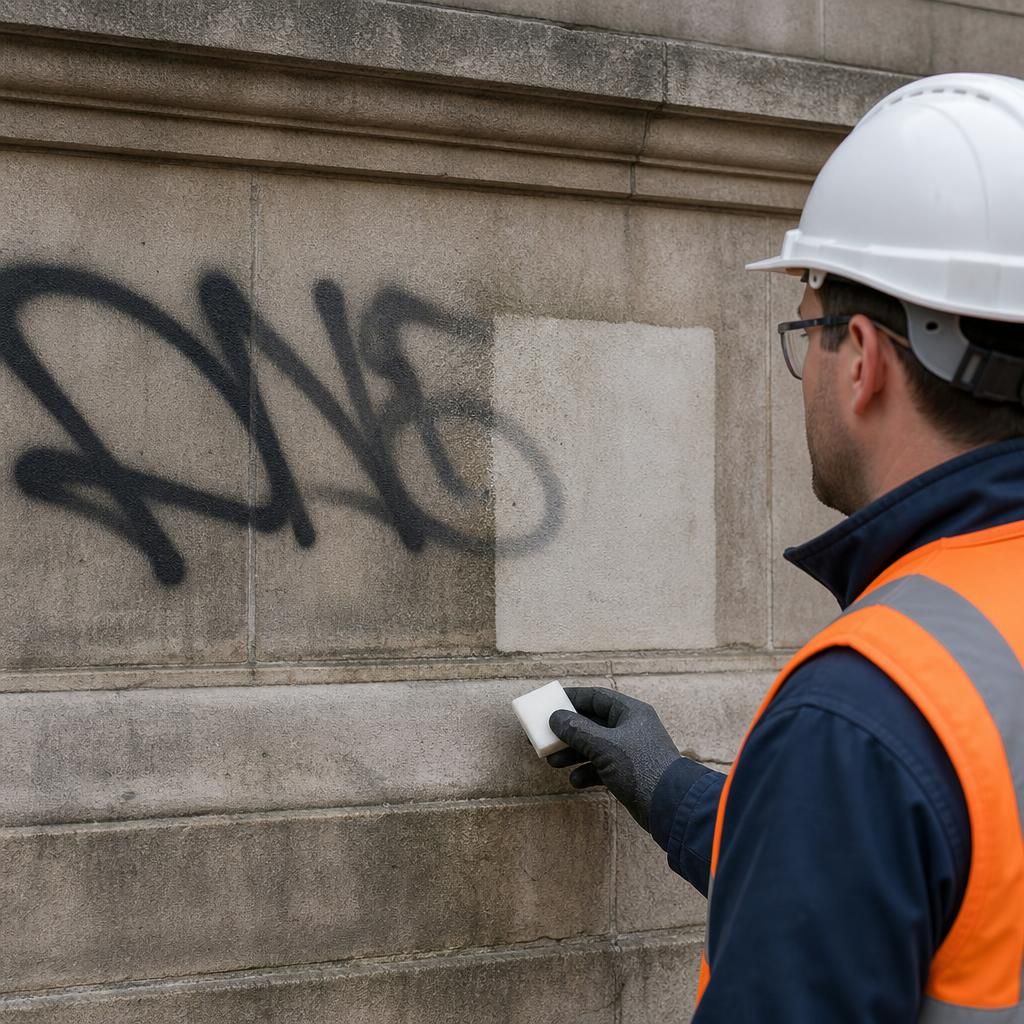
A test patch is a controlled trial of the proposed graffiti removal method on a small, inconspicuous part of the affected surface. It helps confirm that the product, steam, pressure or agitation will remove the marking without causing etching, colour loss, staining or changes to the surface texture.
A suitable commercial contractor should assess the substrate and existing coatings before testing. The result should be checked after cleaning and drying, as porous materials may show lingering shadows or moisture-related changes. The contractor should then explain:
- Which method and product were tested, and why they suit the surface.
- What controls were applied to pressure, heat, chemical dwell time and agitation.
- Whether the same approach can be used safely across the full affected area.
- What limitations remain if the paint has penetrated, or the surface was damaged before cleaning.
This process provides a more reliable basis for approving the work than choosing a contractor solely on price or promises of complete removal.
Request a Commercial Graffiti Removal Assessment
Request a commercial graffiti removal assessment to review the affected surfaces, access requirements, cleaning method, safety controls and expected completion standard. We can provide a clear recommendation and scope of work for your Birmingham, West Midlands or UK site.