
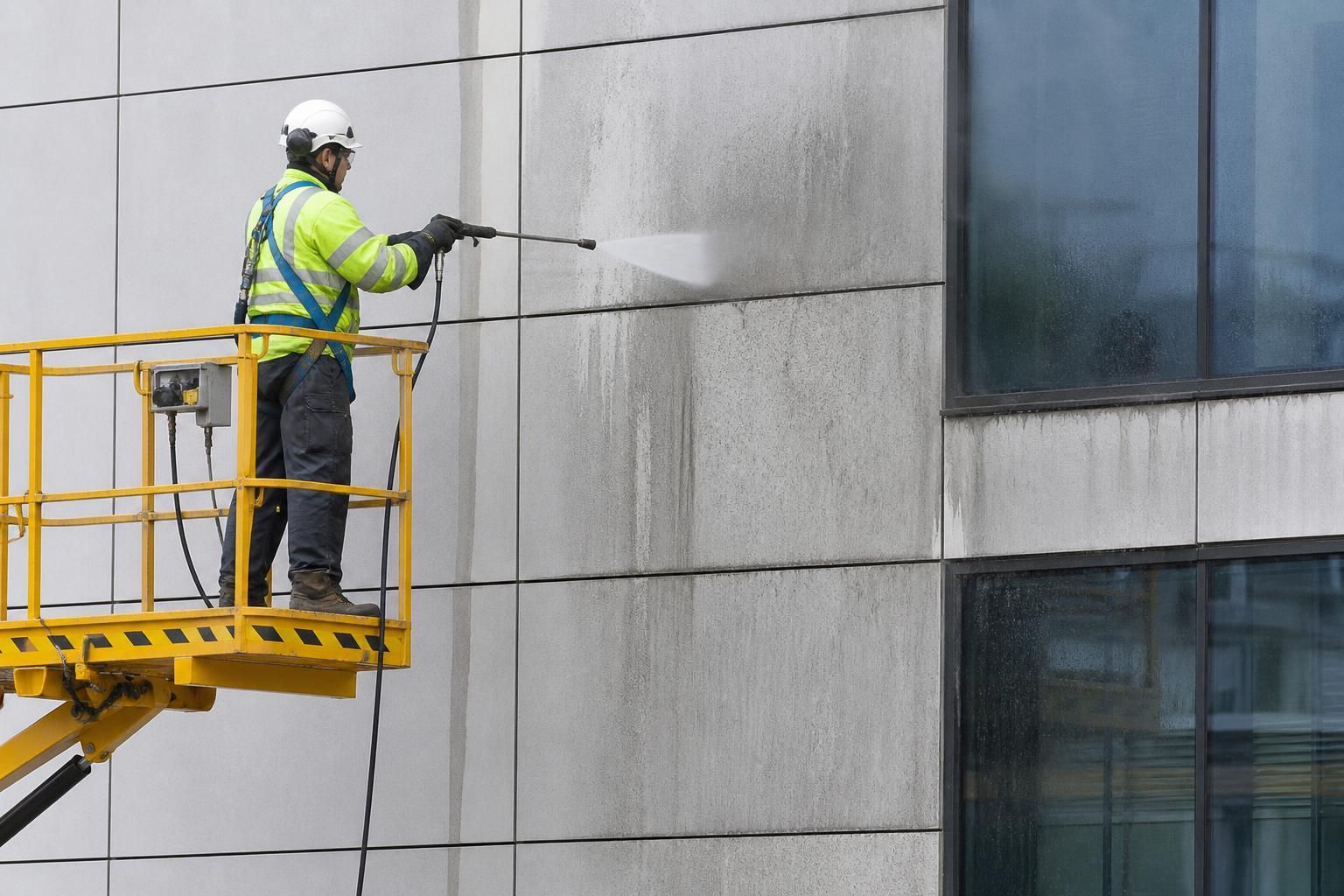
What safety measures should be in place when performing facade, cladding, and render cleaning?
Safe facade, cladding and render cleaning requires a site-specific risk assessment, competent operatives, suitable access equipment, appropriate PPE and controls for work at height, water, chemicals, falling debris and public access. The work area should be secured with exclusion zones, equipment inspected before use, and cleaning methods selected to protect the building, workers and surrounding environment.
Safe facade, cladding and render cleaning depends on a documented, site-specific system of work that controls work at height, access equipment, water, chemicals, falling debris, electrical hazards, fragile surfaces and public access. Before work starts, the contractor should assess the building and its surroundings, select a suitable cleaning method, brief competent operatives and establish controls that protect workers, building users, members of the public and the property itself.
Risk assessment and method statement
A suitable and sufficient risk assessment should identify the hazards presented by the building, the cleaning process and the site. The accompanying method statement should explain how the work will be completed safely, including the sequence of operations, equipment, chemicals, access arrangements, exclusion zones and emergency procedures. It should be reviewed if conditions change, such as altered traffic routes, unexpected surface damage, high winds or the discovery of unstable render.
For commercial and construction environments, the arrangements should be coordinated with the person responsible for the premises and, where relevant, the principal contractor or facilities team. Information about fragile roofs, asbestos-containing materials, hidden services, restricted areas, alarm systems, deliveries and other contractors should be obtained before mobilisation. Cleaning should not begin until responsibilities, access permissions and site rules are clear.
Competent people and site supervision
Operatives should be trained and experienced in the specific cleaning methods and access equipment they will use. Competence includes understanding pressure and steam systems, chemical handling, surface behaviour, manual handling, spill response and the limitations of equipment. Anyone carrying out work at height should have appropriate training and practical experience, with closer supervision where the building is complex or the method presents additional risk.
There should be a site briefing before work starts, covering the risk assessment, method statement, exclusion arrangements, communication procedures, weather limits and emergency plan. Operatives should be able to stop work when conditions become unsafe rather than continuing to meet a programme or access constraint.
Safe access and work at height
Work at height should be avoided where a safe ground-based method is reasonably practicable. Where access at height is necessary, the safest suitable equipment should be selected for the height, reach, duration, surface condition and building layout. Depending on the site, this may include mobile elevated work platforms, scaffold, towers, cradles, rope access systems or telescopic equipment.
- Access equipment should be suitable for the task, used by trained operatives and positioned on a stable surface.
- Equipment should be inspected before use and maintained in accordance with the manufacturer’s instructions and legal requirements.
- Guardrails, gates, harnesses, lanyards and anchor systems should be used as required by the chosen system.
- Harnesses and fall-arrest equipment should be attached to suitable, verified anchor points rather than convenient building features.
- There should be a rescue plan for anyone who could be left suspended or stranded following a fall, equipment failure or loss of power.
- MEWPs and other plant should be kept clear of overhead services, unstable ground, vehicle routes and unprotected edges.
Work at height controls should follow the principles of the Work at Height Regulations. Ladders should not be used as a routine working platform where the task requires prolonged work, significant force, two-handed operation or the handling of heavy hoses and equipment.
Exclusion zones and protection of the public
Cleaning can dislodge dirt, coatings, loose mortar, render fragments and other material. Water and cleaning solutions can also create slip hazards or travel beyond the immediate work area. A clearly marked exclusion zone should therefore be established below and around the work face, with its size determined by the height, method, wind conditions and risk of falling material.
- Use barriers, signs and, where necessary, a banksman to prevent people entering the work area.
- Maintain safe routes for occupants, pedestrians, vehicles and emergency access.
- Protect entrances, windows, vents, signage, vehicles, landscaping and nearby equipment from spray and debris.
- Control hoses and power leads so they do not create trip hazards or obstruct escape routes.
- Pause work when pedestrians, vehicles or other contractors cannot be kept safely outside the exclusion zone.
Where cleaning takes place above an occupied entrance or public footway, additional measures may be required, such as temporary closure, overhead protection, a properly controlled pedestrian diversion or a permit from the relevant authority.
Equipment inspection and operational controls
Pressure washers, steam cleaners, pumps, hoses, lances, access equipment and electrical supplies should be checked before use. Hoses and couplings should be secure and free from damage, with trigger controls and safety devices working correctly. Operatives should never direct a high-pressure jet towards people, unprotected electrical equipment, glazing that is not suitable for the method or areas where water could penetrate the building.
Pressure and temperature should be set according to the substrate and cleaning objective, not simply to achieve the fastest result. A controlled test area should be completed before full cleaning to confirm that the selected pressure, temperature, dwell time and nozzle are safe for the facade, cladding or render. Damaged seals, open joints, cracks and poorly fixed panels should be recorded and protected or repaired before water is introduced.
Chemical safety and personal protective equipment
Any detergent, biocide, solvent, coating remover or other treatment should have an appropriate COSHH assessment and be used in accordance with its safety data sheet. The assessment should cover storage, dilution, application, ventilation, contact hazards, incompatible substances, spill control and disposal. Chemicals should be clearly labelled and kept in secure containers away from unauthorised access, drainage routes and incompatible materials.
Suitable PPE may include protective gloves, eye or face protection, waterproof or chemical-resistant clothing, safety footwear, hearing protection and respiratory protective equipment. The exact selection depends on the product and process. PPE is a final line of defence and must complement safer chemical choices, controlled application and good ventilation. Where respiratory protection is required, it must be suitable for the contaminant and properly managed, including face-fit testing where applicable.
Managing water, drainage and electrical risks
Water should be prevented from entering the building through windows, vents, doors, service openings, roof edges and damaged joints. Sensitive equipment, lighting, alarms and electrical installations should be isolated or protected before cleaning. Electrical tools and temporary supplies should be suitable for wet conditions, protected by appropriate residual current protection and positioned away from standing water.
Run-off should be contained and directed to an approved drainage arrangement. Dirty water, chemical residues, paint fragments, biocides and heavy deposits should not be allowed to enter surface-water drains or neighbouring land without suitable controls. Where run-off could be contaminated, the site plan should specify collection, filtration, treatment or licensed disposal. Local water and drainage requirements should be confirmed before work begins.
Protecting the facade, cladding and render
Safety includes preventing avoidable damage to the building. The pre-clean inspection should identify loose panels, cracked render, failing coatings, corroded fixings, open joints, fragile glazing, defective sealant and areas of biological growth. Unstable material should not be cleaned as though it were sound; it may require isolation, removal or repair by an appropriate specialist first.
Cleaning should proceed from a controlled test area and use the least aggressive effective method. Operatives should monitor for colour change, surface erosion, coating loss, water penetration and movement of panels or render. If unexpected damage appears, work should stop in that area and the finding should be reported before the method is changed.
Weather, environmental and emergency arrangements
Wind, rain, frost, heat and poor visibility can affect access equipment, spray control, chemical performance and surface safety. Work at height and elevated-platform operations should be suspended when weather conditions exceed the equipment or method’s safe limits. Cold conditions can create ice, while strong wind can carry spray and debris beyond the planned exclusion zone.
The site should have arrangements for first aid, emergency communication, fire, chemical exposure, spills, equipment failure, falling objects and rescue from height. Emergency contacts and access points should be known to the team. Incidents, near misses, surface damage and changes to the method should be recorded and reviewed so that controls can be improved during the project and on future maintenance visits.
In practice, the safest facade, cladding and render cleaning programme is one where the risks are assessed before access equipment and chemicals arrive, the work area is controlled throughout the operation, and the method is adjusted to the building rather than forcing the building to suit the equipment. A competent contractor should be able to explain these controls and provide the relevant risk assessment, method statement, COSHH information and inspection records before work starts.
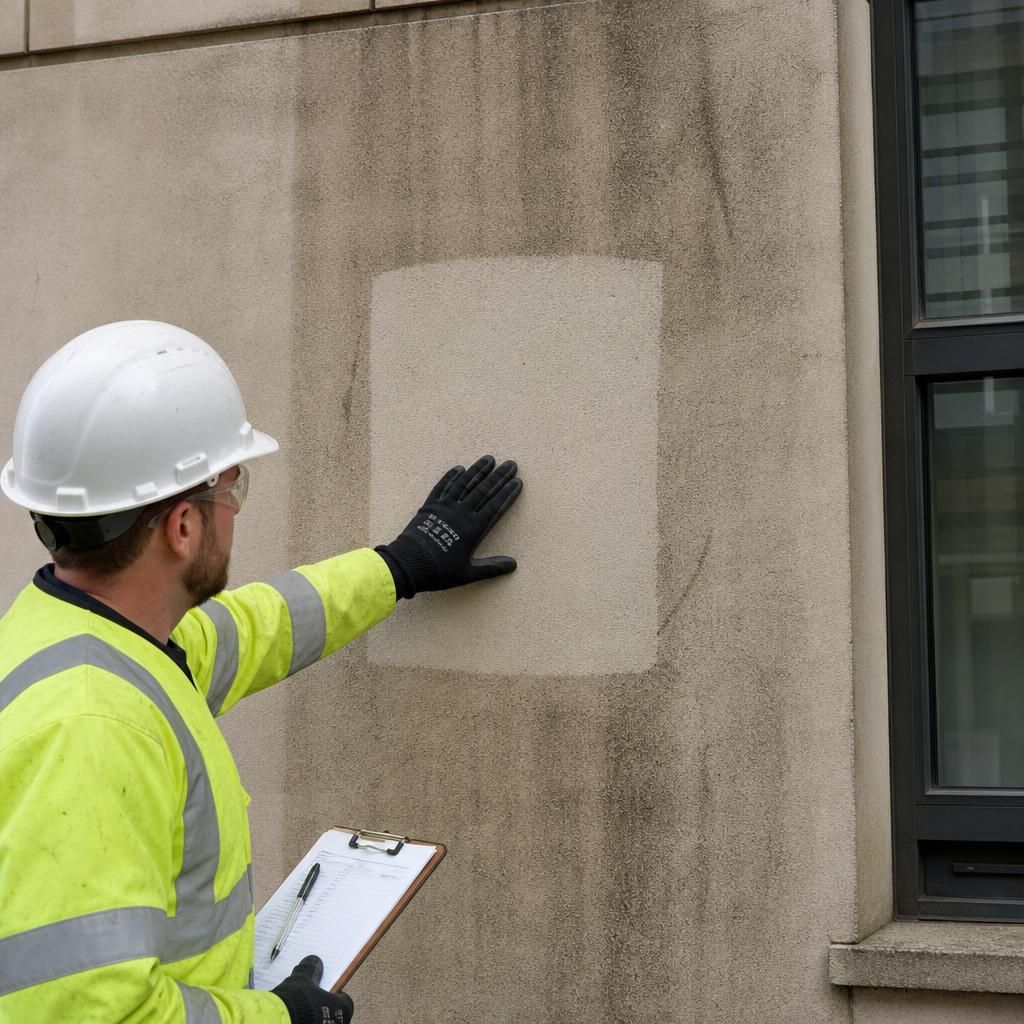
A controlled test area is an essential safety measure before full facade, cladding or render cleaning begins. It confirms that the chosen pressure, temperature, nozzle, chemical and dwell time will remove the deposit without eroding the substrate, lifting coatings, forcing water behind panels or altering the surface appearance.
The test should be carried out on a representative, less prominent section and inspected after rinsing and drying. Operatives should check for colour change, streaking, surface softening, exposed aggregate, coating failure, open joints and water penetration. If the result is unsuitable, the method must be adjusted or stopped before wider cleaning proceeds. This protects the building while providing a clear, evidence-based basis for the method statement.
Arrange a Facade, Cladding and Render Cleaning Assessment
Arrange a facade, cladding and render cleaning assessment to review surface condition, access requirements and the safety controls needed for your site. We can then recommend a suitable cleaning method and provide the relevant documentation before work begins.