
What factors should be considered when choosing a professional render cleaning company?
When choosing a professional render cleaning company, consider its experience with different render and stucco finishes, use of suitable soft washing or low-pressure methods, insurance, safety procedures and evidence of comparable commercial work. A reputable contractor should inspect the surface first, explain the proposed treatment, identify potential risks and provide clear pricing and maintenance advice.
Choosing a professional render cleaning company means assessing whether the contractor can identify the render system, select a safe cleaning method and control the risks associated with chemicals, water, access and fragile finishes. The most suitable company should provide a site inspection, a clear method statement, evidence of comparable work, appropriate insurance and practical advice for ongoing maintenance.
Relevant experience with render and stucco
Render is not a single material. Cement-based render, polymer-modified render, monocouche, silicone render, lime render and painted or textured finishes can react differently to pressure, heat, moisture and cleaning products. Stucco and decorative coatings may also contain delicate textures or repairs that are easily marked. Ask whether the contractor has worked with the specific finish on your building and understands how to distinguish ingrained staining from defects in the render itself.
Experience should include the type and scale of property involved. Cleaning a small residential elevation requires different planning from cleaning a commercial façade, apartment block, school, retail unit or industrial premises. A contractor familiar with larger sites should be able to coordinate access, work around occupants and other trades, protect surrounding areas and maintain safe pedestrian and vehicle routes.
A proper inspection before cleaning
A reliable contractor should inspect the elevations before providing a final recommendation or price. The survey should consider the render type, age, condition, previous repairs, paint or coatings, cracks, hollow areas, failed sealant, biological growth and staining from traffic, pollution, rust or nearby vegetation. It should also identify features such as windows, vents, lighting, signage, cables and drainage points that need protection.
Inspection is particularly important where render is cracked, delaminated or already losing its bond with the substrate. Cleaning will not correct these defects and excessive water or pressure could make them worse. A competent company should explain any limitations, identify repairs that may be needed first and avoid promising that every mark can be removed without affecting the finish.
Appropriate cleaning methods and equipment
For most rendered and stucco surfaces, the method should be based on the condition and composition of the finish rather than on the fastest available equipment. Soft washing, controlled low-pressure cleaning and steam cleaning may all be suitable in different circumstances. The contractor should be able to explain why a particular approach has been selected and how it will remove the relevant contamination without eroding the surface.
High pressure can strip coatings, open fine cracks, drive water behind the render or expose the substrate. Excessive heat can also affect some paints, sealants and synthetic finishes. Suitable equipment should allow the operator to control pressure, temperature, flow and application distance. A professional approach is normally gradual: apply an appropriate treatment, allow it to work where necessary, rinse in a controlled manner and inspect the result before repeating or intensifying the process.
Testing and protection of the surface
Ask whether a discreet test area will be completed before the full clean. Testing helps confirm the likely result, reveals how the render responds to the proposed method and allows adjustments to the chemical concentration, dwell time, pressure or rinsing process. The test should be representative of the most sensitive or heavily stained area, not selected only because it is easy to clean.
The company should also explain how it will protect windows, doors, vents, painted surfaces, landscaping, vehicles and nearby materials. Run-off must be controlled so that dirty water and cleaning products do not enter unsuitable drainage systems or contaminate adjacent areas. Any treatment used should be appropriate for the surface and handled in accordance with its safety and environmental requirements.
Health and safety arrangements
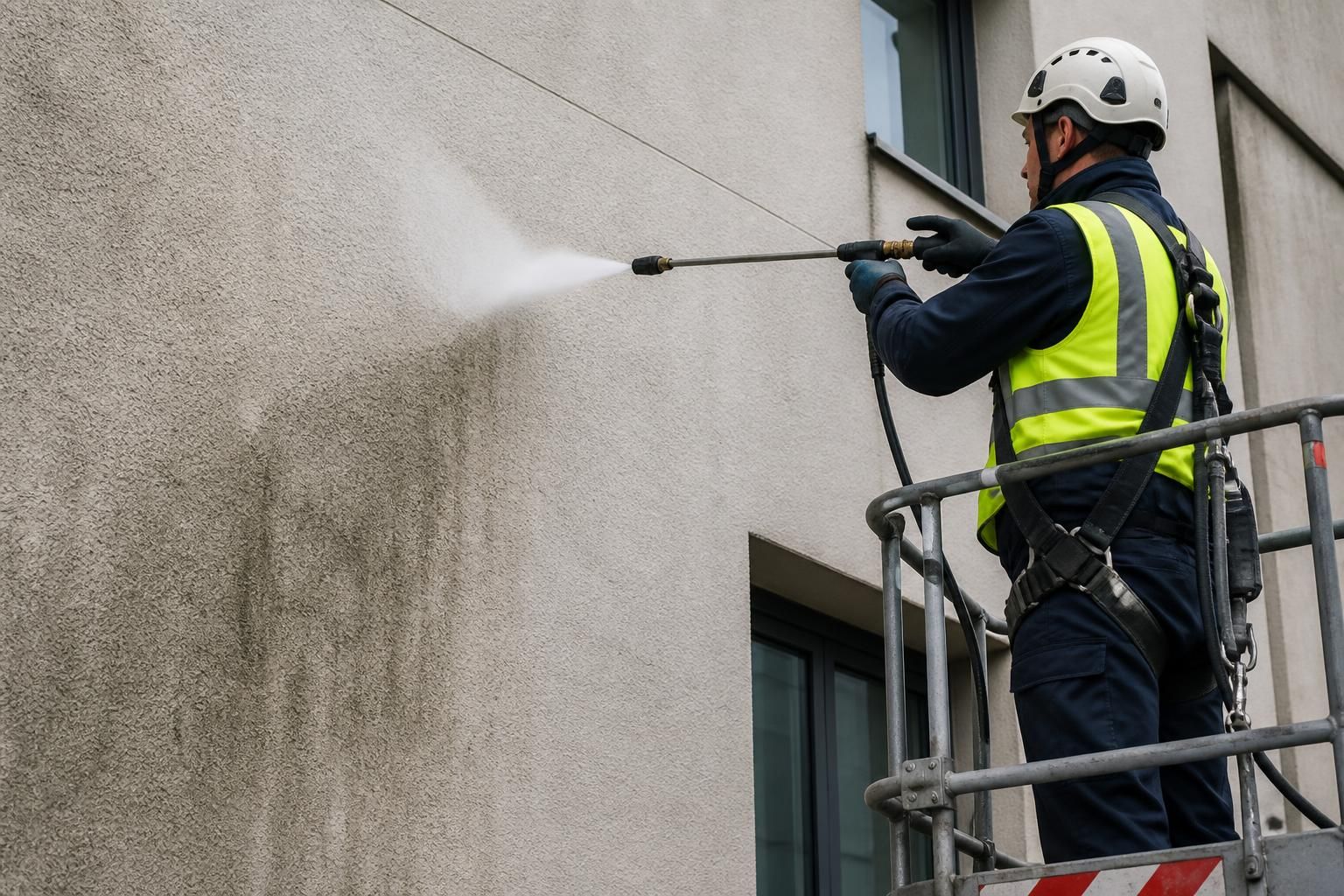
Render cleaning may involve ladders, mobile towers, powered access equipment, roof edges, wet surfaces, chemical handling and work near members of the public. A professional contractor should have documented risk assessments and method statements relevant to the site, together with suitably trained operatives and a clear emergency procedure.
Where access equipment is required, check that it is suitable for the ground conditions, working height and reach, and that operators have the appropriate training. Work planning should cover exclusion zones, overhead hazards, falling debris, electrical equipment, weather conditions and safe access for building users. For occupied commercial premises, the contractor should also agree working hours, noise controls and arrangements for keeping entrances and escape routes available.
Insurance, competence and contractor information
Ask for evidence of suitable public liability insurance and, where relevant, employers’ liability cover and professional or contractors’ insurance appropriate to the work. Insurance does not by itself prove technical competence, but it is an important part of responsible contractor selection.
Useful evidence may include relevant training, trade memberships, equipment competence, documented procedures and references for comparable render or stucco projects. References should relate to the type of property, access requirements and cleaning challenge involved. For commercial work, it is also reasonable to ask who will supervise the project and whether the same information will be available to the site contact throughout the work.
Clear quotation and defined scope
A quotation should state which elevations and surfaces are included, the proposed cleaning method, access arrangements, preparation, rinsing, stain treatment, waste or run-off control and any exclusions. It should distinguish cleaning from repairs, redecoration, sealing or biocidal aftercare, as these are separate services unless specifically included.
Be cautious of a price that is based only on photographs or a broad description of the building where the render has not been inspected. The final cost can be affected by access, surface condition, the number of treatments required, protection of nearby areas and restrictions on working hours. A clear quotation should identify potential additional work and explain how it would be authorised before it takes place.
Understanding the expected result
Cleaning can remove many forms of surface contamination, including algae, moss, lichen, atmospheric soiling and some organic staining. It may not remove permanent discolouration, rust migration, damaged paint, failed render, deep biological staining or marks that have penetrated the finish. A trustworthy contractor should set realistic expectations and explain where a test clean cannot guarantee complete removal.
Where a fungicidal or biocidal treatment is recommended, ask what it is intended to achieve, how it will be applied and whether it needs time to act after the initial clean. Treatment should not be presented as a substitute for repairing moisture ingress, defective gutters, leaking downpipes or vegetation contacting the façade. Addressing the source of contamination is often essential to prolonging the cleaned appearance.
Aftercare and maintenance advice
A good cleaning specification should include practical aftercare rather than ending when the surface looks clean. The contractor should identify conditions that may cause rapid recontamination, such as blocked gutters, persistent dampness, overhanging vegetation, poor drainage or nearby sources of traffic pollution. They should also explain what routine inspections are appropriate and when further cleaning or treatment may be considered.
For commercial and managed properties, ask whether the company can provide a maintenance schedule, photographic records or inspection reports. Planned maintenance can help identify early staining, failed sealants and drainage problems before they contribute to more extensive façade deterioration. Any recommendation should be based on the building’s exposure and condition, not an automatic cleaning interval.
Questions to ask before appointing a contractor
- What type of render or stucco is present, and how was it identified?
- What contamination is being treated, and what result is realistically achievable?
- Which cleaning method, equipment and treatment products are proposed, and why?
- Will a test patch be completed and approved before full-scale work begins?
- How will windows, landscaping, drainage, vehicles and public areas be protected?
- What access equipment, qualifications, risk assessments and site controls are required?
- What insurance and evidence of comparable commercial work can be provided?
- Which repairs, coatings or aftercare services are included or excluded from the quotation?
The strongest choice is not necessarily the contractor offering the lowest initial price. It is the company that can demonstrate sound knowledge of the render, inspect the building properly, use a controlled method, manage site risks and set out the scope and limitations in writing. Comparing quotations on these points helps ensure that the cleaning improves the appearance of the façade without creating avoidable damage or future maintenance problems.
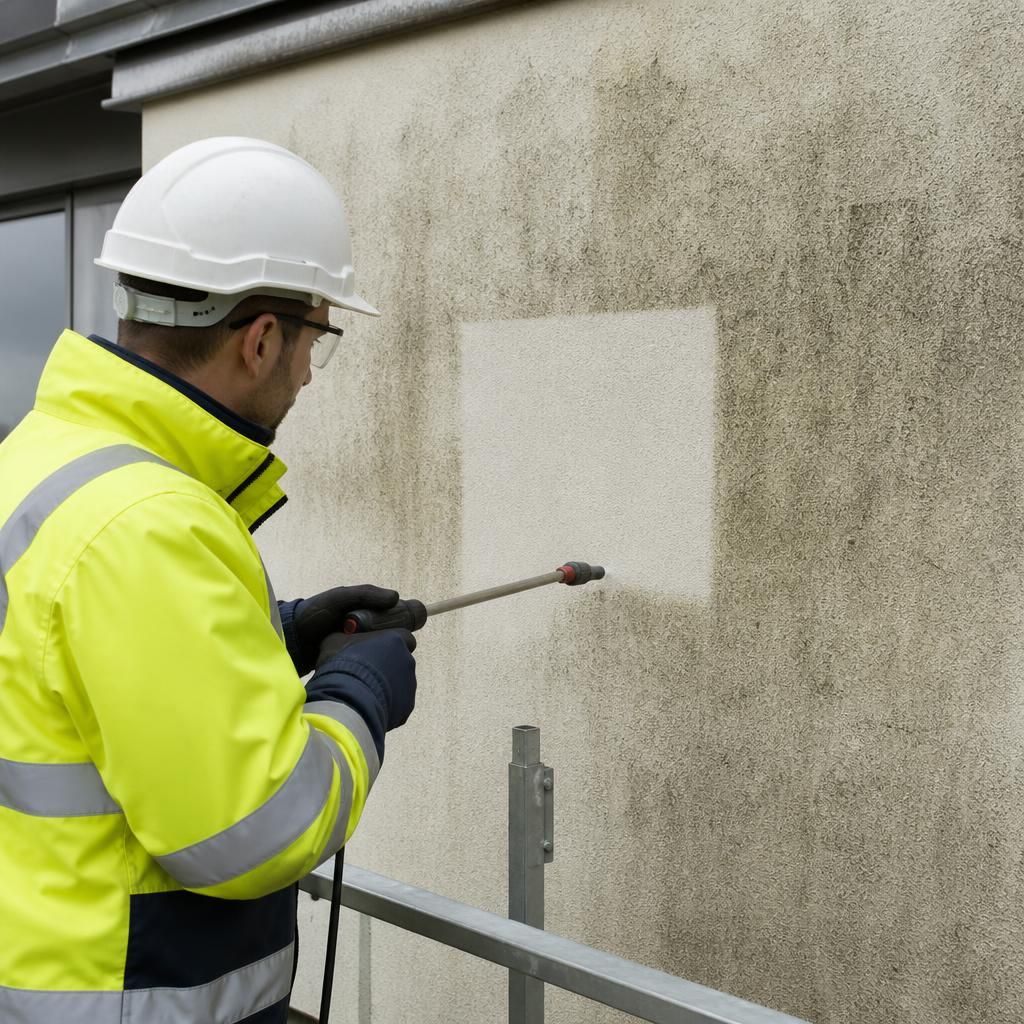
A representative test patch is an important part of professional render cleaning because it shows how the surface responds before the full façade is treated. The contractor can assess whether the proposed soft wash, low-pressure rinse or steam-cleaning process removes the staining without disturbing the render, paint or textured finish.
The test should be carried out in a discreet but suitably sensitive area, with the treatment strength, dwell time, pressure and rinsing method recorded. This allows the cleaning plan to be adjusted and gives the client a realistic indication of the achievable result. It also helps identify permanent discolouration, damaged coatings or underlying render defects that cleaning alone cannot resolve.
Request a Professional Render Cleaning Assessment
Arrange a professional render cleaning assessment with Encanto Exterior Cleaning to identify the render type, assess its condition and determine the safest treatment method. We can provide a clear specification and quotation for your Birmingham, West Midlands or UK property.