
What should I consider when choosing a facade maintenance and restoration service?
When choosing a facade maintenance and restoration service, assess the contractor’s experience with your building materials, inspection and repair methods, health and safety procedures, access capabilities, environmental controls and insurance. A suitable provider should give clear recommendations, explain the proposed process and costs, and demonstrate how the work will protect the facade rather than cause further damage.
Choose a facade maintenance and restoration service by assessing its experience with your building’s materials, the quality of its inspection process, the suitability of its cleaning and repair methods, and its control of health, safety and environmental risks. The contractor should be able to explain what is causing the deterioration, distinguish cleaning from repair or replacement, provide a clearly defined scope of work, and show how the proposed treatment will protect the facade over the long term.
Check relevant experience
Facade work is not a one-method service. A contractor should have practical experience with the specific materials and construction details present on your building, such as brickwork, stone, render, concrete, architectural metalwork, glass, curtain walling, composite panels, terracotta, roofs and cladding. Ask whether they have worked on comparable commercial, industrial, public or multi-occupancy premises, particularly where access, public safety or operational continuity are important.
Relevant experience should include more than the ability to remove surface dirt. Restoration may involve identifying failed coatings, biological growth, staining, corrosion, cracking, open joints, water ingress, damaged sealants or areas affected by previous cleaning. A suitable provider should understand how these issues interact and know when a cleaning treatment is insufficient without associated repair or preventative work.
Expect a proper survey before a quotation
A reliable service should inspect the facade before recommending a treatment. The survey should consider the material, condition, age, previous repairs, likely sources of staining and the surrounding environment. It should also identify fragile areas, loose materials, defective pointing, damaged coatings, failing sealants and features that could be affected by water or pressure.
Where appropriate, the inspection may include close visual assessment, photographic records, moisture investigation, checks of joints and fixings, or access to areas that cannot be assessed from ground level. If the condition cannot be established safely from the ground, the contractor should explain the access method required rather than making unsupported assumptions.
Ask for the findings to be separated into immediate defects, recommended restoration work and routine maintenance. This helps you prioritise safety-critical issues, prevent further deterioration and plan non-essential improvements without confusing them with necessary repairs.
Compare the proposed cleaning and restoration methods
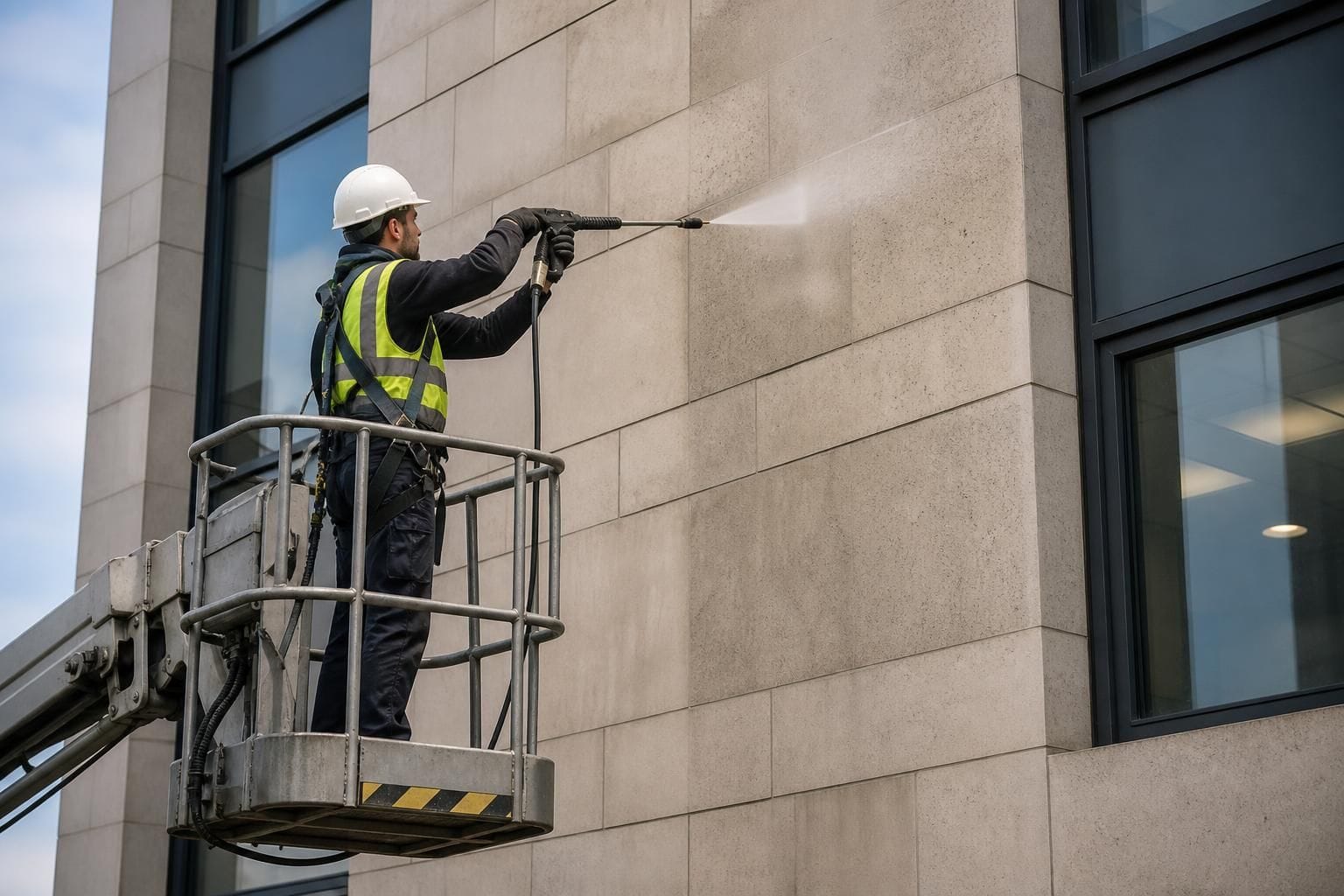
The method should be selected for the substrate and the defect, not simply because it is the contractor’s standard process. Pressure washing can be effective on suitable robust surfaces, but excessive pressure or incorrect nozzle selection can erode mortar, drive water into the building or damage coatings and joints. Steam cleaning may be more appropriate where controlled heat and lower water volumes are beneficial. Soft washing, specialist chemical treatments, abrasive processes or manual methods may also be suitable in particular circumstances, but each requires appropriate controls and material knowledge.
Ask the contractor to explain:
- Why the proposed method is suitable for each facade material.
- What pressure, temperature, chemical treatment or agitation will be used, where relevant.
- How sensitive details such as windows, seals, vents, signage, electrical equipment and painted surfaces will be protected.
- How stains, biological growth, corrosion or old coatings will be treated without spreading the problem.
- Whether a small test area will be completed and approved before full-scale work begins.
- What repairs, repointing, coating renewal or sealant replacement are required after cleaning.
Testing is particularly important on older, listed or previously treated buildings. A test area can reveal colour changes, surface damage, incomplete stain removal or unexpected reactions before the treatment is applied across the whole facade. It should be carried out in a representative location and assessed after the surface has dried where necessary.
Assess safety and access arrangements
Facade maintenance often takes place above ground level and near pedestrians, vehicles, tenants or working operations. The contractor should provide a clear plan for access equipment, exclusion zones, dropped-object prevention, traffic management, emergency arrangements and protection of people who are not involved in the work.
Check that the service provider can select and operate appropriate access equipment, such as mobile elevated work platforms, scaffolding, specialist towers or other systems suited to the building and site conditions. Access arrangements should account for ground conditions, overhead obstructions, restricted areas, loading, public routes and the need to keep entrances or business operations available.
Ask to see evidence of suitable training, competence and site supervision. The contractor should also explain how work will be controlled during poor weather, high winds, restricted visibility or other conditions that could affect access equipment, chemical application or surface drying. A method statement and risk assessment should be specific to the site rather than generic documents supplied without explanation.
Review environmental and water-management controls
Facade cleaning can create contaminated run-off containing dirt, oils, coatings, chemical residues or biological material. A competent contractor should explain how wastewater will be contained, collected, filtered or disposed of in accordance with site requirements and applicable regulations. It should not be allowed to enter surface-water drains without appropriate controls.
Also consider water consumption, chemical selection, overspray, dust, noise and the protection of planting, neighbouring properties and occupied areas. Steam cleaning or other lower-water methods may be preferable in some locations, while controlled pressure washing may be appropriate for other surfaces. The correct choice depends on the substrate, contamination and local constraints rather than on environmental claims alone.
Check insurance, compliance and documentation
The contractor should hold appropriate public liability and employers’ liability insurance, with other cover where the nature of the work requires it. Ask for current evidence rather than relying only on a statement in a quotation. Where relevant, check competence records for access equipment, work at height, chemical handling and site-specific safety requirements.
For larger or higher-risk projects, the documentation should normally include a written scope, risk assessment, method statement, access plan, emergency arrangements and information about waste or wastewater management. If the building is listed, in a conservation area or subject to landlord, lease or local authority requirements, confirm who is responsible for obtaining permissions and agreeing the proposed treatment.
Compare quotations on scope, not just price
A low quotation may exclude preparation, access, protection, test panels, wastewater management, repairs or final rinsing. Compare each proposal line by line and check whether it includes:
- Surveying and recording the facade condition.
- Access equipment, setup, relocation and removal.
- Protection for windows, doors, landscaping, vehicles and building systems.
- Testing and approval of the proposed treatment.
- Cleaning, stain treatment and the removal of waste or contaminated water.
- Minor repairs, repointing, sealant work or coating application, if required.
- Reinstatement of fixtures and final inspection.
- Practical completion records, photographs and aftercare recommendations.
The quotation should state the areas included, the materials to be treated, the expected finish, exclusions, assumptions, programme and any circumstances that could change the cost. It should also distinguish between confirmed work and provisional items that depend on what is discovered after access is established.
Look for clear communication and controlled delivery
Good communication is part of technical quality. The contractor should identify a project contact, agree site rules and working hours, explain how occupants or neighbouring businesses will be notified, and provide updates if the condition differs from the initial survey. They should not make significant changes to the treatment or scope without discussing the reason and obtaining approval.
For occupied commercial premises, consider how the work will affect entrances, deliveries, parking, ventilation, noise-sensitive operations and customer access. A phased programme may reduce disruption, provided the sequence does not leave partially treated areas vulnerable to weathering or create visible differences between sections.
Confirm how the work will be inspected and maintained
Before appointing a contractor, agree how completion will be judged. This might include a defined level of stain removal, consistent appearance, clean joints and edges, removal of temporary protection, safe reinstatement of access routes and confirmation that wastewater and waste have been dealt with correctly. Some historic staining or permanent substrate damage may not be removable without replacing material, so expectations should be realistic and documented before work starts.
Ask for before-and-after photographs, records of products and methods used, details of repaired areas and recommendations for future inspections. A restoration service should help you decide when the facade needs cleaning, local repair, coating renewal or a further condition survey. Regular, proportionate maintenance is usually easier to plan and less disruptive than allowing contamination, water ingress or defective joints to develop into extensive deterioration.
Finally, choose the provider that gives the most technically justified and transparent proposal, not merely the quickest availability or lowest initial price. The right service will demonstrate material-specific knowledge, safe access and work practices, responsible environmental controls, honest limitations and a maintenance plan that supports the building’s condition after the immediate project is complete.
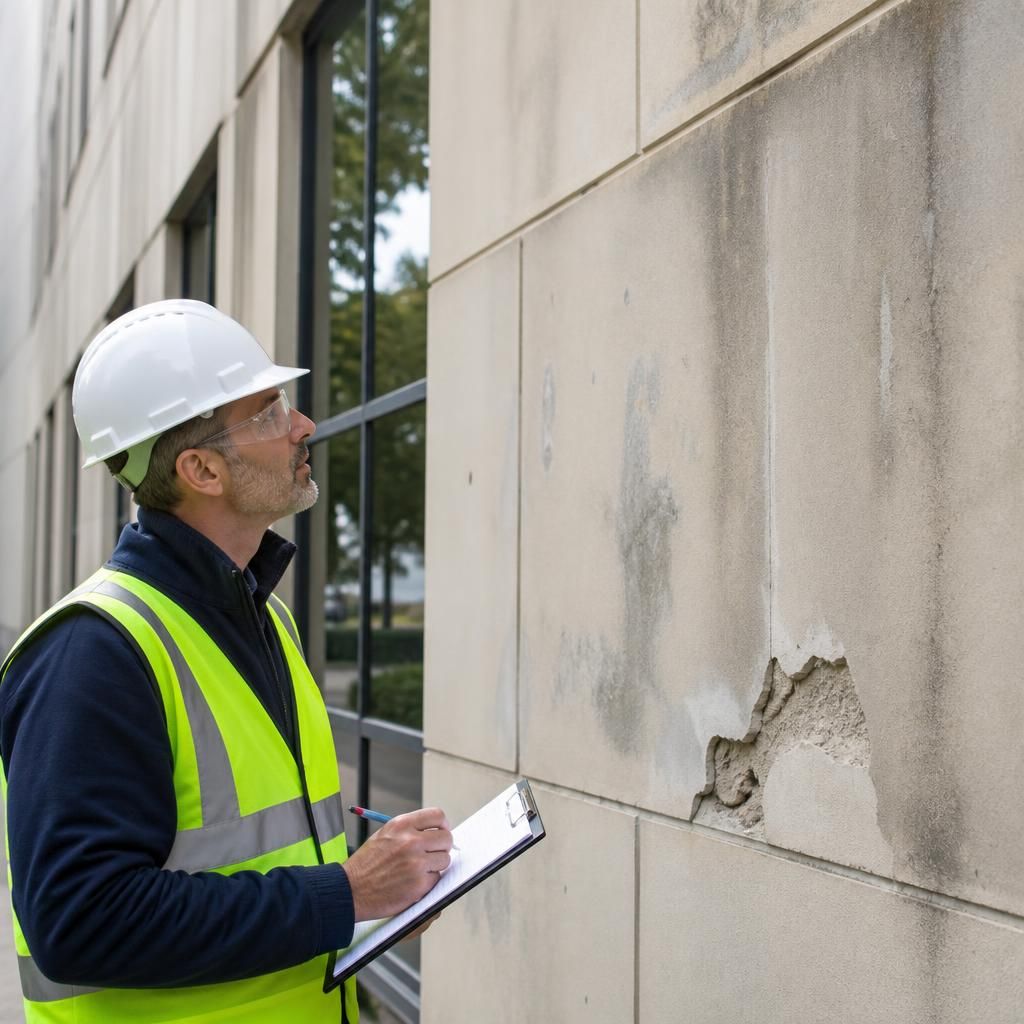
A proper facade survey should take place before any maintenance or restoration quotation is accepted. The contractor should assess the building materials, existing defects, previous treatments, access requirements and likely causes of staining or deterioration rather than selecting a standard cleaning method without inspection.
Ask for the findings to distinguish between cleaning, repair and replacement. Where the surface or proposed treatment is sensitive, a representative test area should be completed and reviewed after drying. This helps identify colour changes, surface damage or incomplete stain removal before work proceeds across the facade.