
What are the most effective methods for facade restoration in urban areas?
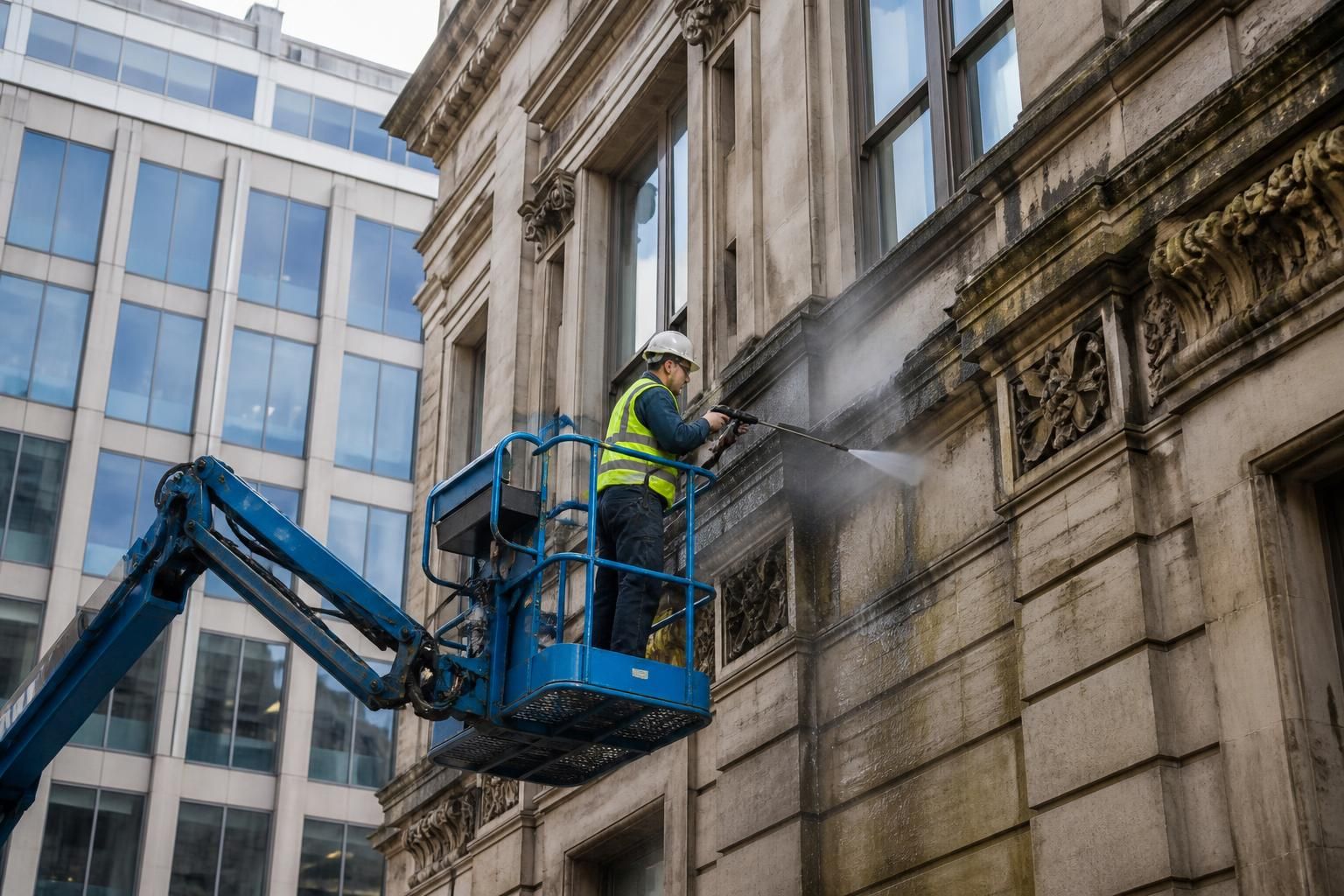
The most effective facade restoration methods in urban areas combine a detailed condition survey with carefully selected cleaning, localised repairs, repointing, replacement of damaged materials and suitable protective treatments. Low-pressure washing, steam cleaning and controlled abrasive techniques can remove pollution, staining and graffiti, while access equipment enables safe, precise work around busy commercial buildings without causing unnecessary damage.
Effective facade restoration in urban areas combines a detailed condition survey with carefully controlled cleaning, localised repairs, repointing, replacement of failed materials and appropriate protective treatments. The method must suit the facade’s construction, age and condition, while also accounting for traffic pollution, restricted access, occupied buildings, neighbouring properties and the risk of debris or runoff entering public areas.
1. Start with a condition survey
Restoration should begin with a close inspection rather than an assumption that the facade simply needs washing. The survey should identify the materials present, areas of staining, cracks, spalled concrete, failed joints, loose coatings, biological growth, corrosion, water ingress and previous repairs that may have failed.
Inspection from ground level can be supplemented with mobile elevated work platforms, scaffold access, rope access or other suitable equipment where safe and practical. Photographs, marked-up elevations and moisture observations help establish the extent of deterioration and provide a record for planning the work.
It is important to distinguish surface contamination from underlying defects. For example, dark staining may be caused by atmospheric pollution, but it can also indicate persistent dampness or defective rainwater goods. Cracking may be superficial, or it may point to movement, corrosion or failing masonry. Cleaning without addressing the cause can result in rapid recontamination or further damage.
2. Select the least aggressive effective cleaning method
Urban facades commonly accumulate soot, traffic film, algae, moss, bird fouling, rust staining, cement residue and graffiti. The cleaning method should remove the contaminant without eroding the substrate, opening joints or driving water into the building.
- Low-pressure washing: Suitable for many robust masonry, concrete, cladding and painted surfaces when pressure, water volume and nozzle distance are carefully controlled. It is often preferable to aggressive high-pressure cleaning, particularly on older brickwork and weathered joints.
- Steam cleaning: Uses high-temperature, low-pressure vapour to soften grime and reduce the need for harsh chemicals. It can be useful on sensitive masonry, stone, signage surrounds and areas where controlled water use is important.
- Soft washing and specialist chemical cleaning: Selected detergents or biocidal treatments can help remove organic growth and persistent staining. Chemicals must be compatible with the substrate, applied for the correct dwell time and thoroughly rinsed or neutralised where required.
- Controlled abrasive cleaning: Fine abrasive media or other specialist systems may be appropriate for hardened deposits, coatings or certain graffiti residues. This approach requires particularly careful testing because abrasive action can remove the surface of stone, brick or concrete.
- Dry or low-moisture techniques: These can be useful where water penetration, runoff or access constraints make conventional washing unsuitable. The correct system depends on the contaminant and the surface finish.
Test panels should be completed in inconspicuous areas before full-scale cleaning. The test should assess colour change, surface loss, joint condition, water penetration and the effectiveness of the proposed process. A method that works on one elevation or material may not be suitable for another.
3. Repair defects before applying finishes
Cleaning reveals the true condition of a facade and should normally be followed by repairs. Loose or friable material needs to be removed safely, while cracks should be assessed to determine whether they are cosmetic, movement-related or associated with water ingress.
Common repair work includes filling compatible masonry cracks, replacing damaged bricks or stone units, repairing spalled concrete and treating exposed reinforcement where corrosion is present. Patch repairs should match the original material in strength, texture, porosity and appearance. A repair that is significantly harder or less permeable than the surrounding masonry can concentrate moisture and contribute to future damage.
Concrete repairs may require removal of unsound concrete, preparation and protection of reinforcement, followed by a compatible repair mortar. The repair specification should consider the exposure conditions and the appearance required on completion, particularly on visible commercial elevations.
4. Repoint masonry using compatible mortar
Open, recessed or failing joints allow water to enter the facade and can accelerate frost damage and internal dampness. Defective pointing should be removed to a suitable depth using methods that avoid unnecessary damage to the arrises of the brick or stone.
The replacement mortar should be compatible with the existing masonry. Older or softer brickwork often requires a more breathable and flexible mortar rather than a hard cement-rich mix. Joint profiles should reflect the original design and be properly compacted, tooled and cured. Repointing only isolated areas may be appropriate where failure is localised, while widespread deterioration may require a planned elevation-by-elevation programme.
Mortar selection and curing conditions are especially important in exposed urban locations. Very cold, hot, wet or windy weather can affect adhesion, drying and long-term performance, so freshly repointed areas may need protection during the work.
5. Replace damaged or unsuitable facade materials
Some materials cannot be restored effectively and need partial or full replacement. This may include severely cracked stone, delaminated panels, failed render, damaged cladding sections, broken architectural features or units affected by long-term water penetration.
Replacement materials should match the existing facade in dimensions, colour, texture, thermal movement and moisture behaviour. Fixings, brackets and seals should also be checked rather than treating the visible panel or unit in isolation. On rainscreen and panelled systems, concealed corrosion, failed gaskets or movement at joints may be the underlying cause of visible damage.
Where an exact match is unavailable, the proposed alternative should be assessed for technical compatibility and visual impact. Sample materials and repair finishes can be reviewed before wider installation.
6. Remove graffiti and stubborn deposits carefully
Graffiti removal in urban areas needs a substrate-specific approach. Paint removers, steam, low-pressure washing and controlled abrasive systems may each be suitable in different circumstances. The objective is to remove the marking without creating a visible patch, stripping the original finish or spreading contamination into porous masonry.
Bird fouling, cement splashes, rust and construction residue may also require separate treatments. These deposits should not automatically be attacked with stronger pressure or abrasive action. Targeted chemical or mechanical methods, followed by controlled rinsing and appropriate runoff management, generally provide better results.
7. Apply protective treatments only where justified
Once the facade has been cleaned and repaired, a protective treatment may help reduce future water penetration, staining or graffiti adhesion. Breathable water-repellent treatments can be considered for suitable masonry, but they should not be used to conceal unresolved dampness, defective pointing or leaking gutters.
Protective coatings must be compatible with the substrate and the building’s moisture movement. Impermeable coatings can trap water within older masonry and cause blistering, salt deposits or frost-related deterioration. Anti-graffiti treatments should be selected according to the surface, the expected cleaning regime and the required visual finish. Any treatment should be tested first and applied to a clean, dry and suitably prepared surface.
8. Plan access, protection and environmental controls
Urban restoration requires careful planning around pedestrians, traffic, neighbouring buildings, deliveries and occupied premises. Suitable access equipment should provide stable working positions while limiting contact with the facade. Hoardings, exclusion zones, scaffold sheeting and overhead protection may be required, depending on the building and the work involved.
Water, cleaning chemicals, paint residues and removed debris must be controlled so they do not enter drains, affect adjoining properties or create slip hazards. The work plan should address collection or filtration of runoff, waste handling, noise, dust and protection of windows, vents, doors, landscaping and vehicles.
Where the building remains occupied, restoration can be phased by elevation or working area. Clear communication about access restrictions, noise and cleaning activities helps reduce disruption and allows sensitive operations to be scheduled appropriately.
9. Use a staged restoration sequence
A practical sequence is to survey the facade, complete trial areas, protect the work zone, undertake the main cleaning, allow the substrate to dry and then carry out repairs, repointing and material replacement. Final detailing, protective treatments and quality checks follow once the repaired areas are ready.
The sequence may change where loose material presents an immediate safety risk or where repairs must precede cleaning. In every case, the work should avoid sealing in contamination or applying finishes before the substrate and repairs are suitable.
10. Finish with planned maintenance
Restoration is more effective when followed by routine inspection and cleaning. Maintenance should monitor joints, sealants, rainwater goods, roof edges, cladding fixings, render, coatings and areas that repeatedly become stained or damp. Early removal of organic growth, graffiti and traffic film reduces the need for more aggressive restoration later.
For commercial and industrial buildings, the completed works should be recorded with photographs, products used, repaired areas and any recommendations for follow-up inspections. This provides a useful baseline for future maintenance and helps identify recurring causes such as blocked gutters, defective seals or water discharge onto the facade.
The most suitable restoration method is therefore not simply the strongest cleaning process. It is a controlled combination of investigation, compatible repairs, safe access, environmental protection and ongoing maintenance. For complex or heavily deteriorated facades, the cleaning contractor, building manager and relevant conservation or construction professionals should agree the specification before work begins.
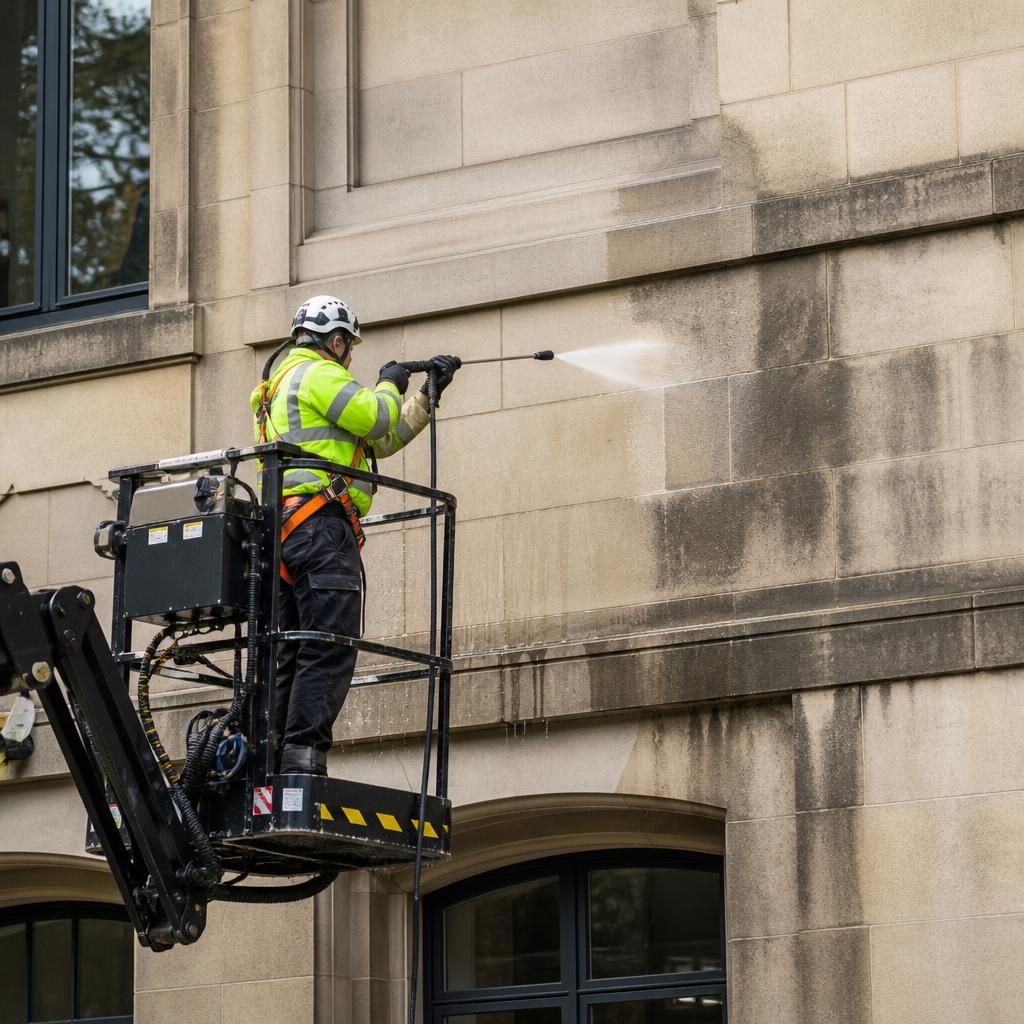
Facade restoration in urban areas should begin with the least aggressive cleaning method that can safely remove the contamination. Low-pressure washing, steam cleaning or carefully selected chemical treatments may be suitable, but the correct option depends on the facade material, surface condition and type of staining.
A small test area should be cleaned before work starts across the full elevation. This checks for colour change, surface erosion, mortar damage and water penetration, while confirming that the process removes traffic film, biological growth or graffiti effectively. The method can then be adjusted before restoration proceeds, helping protect the existing facade and avoid unnecessary repairs.