
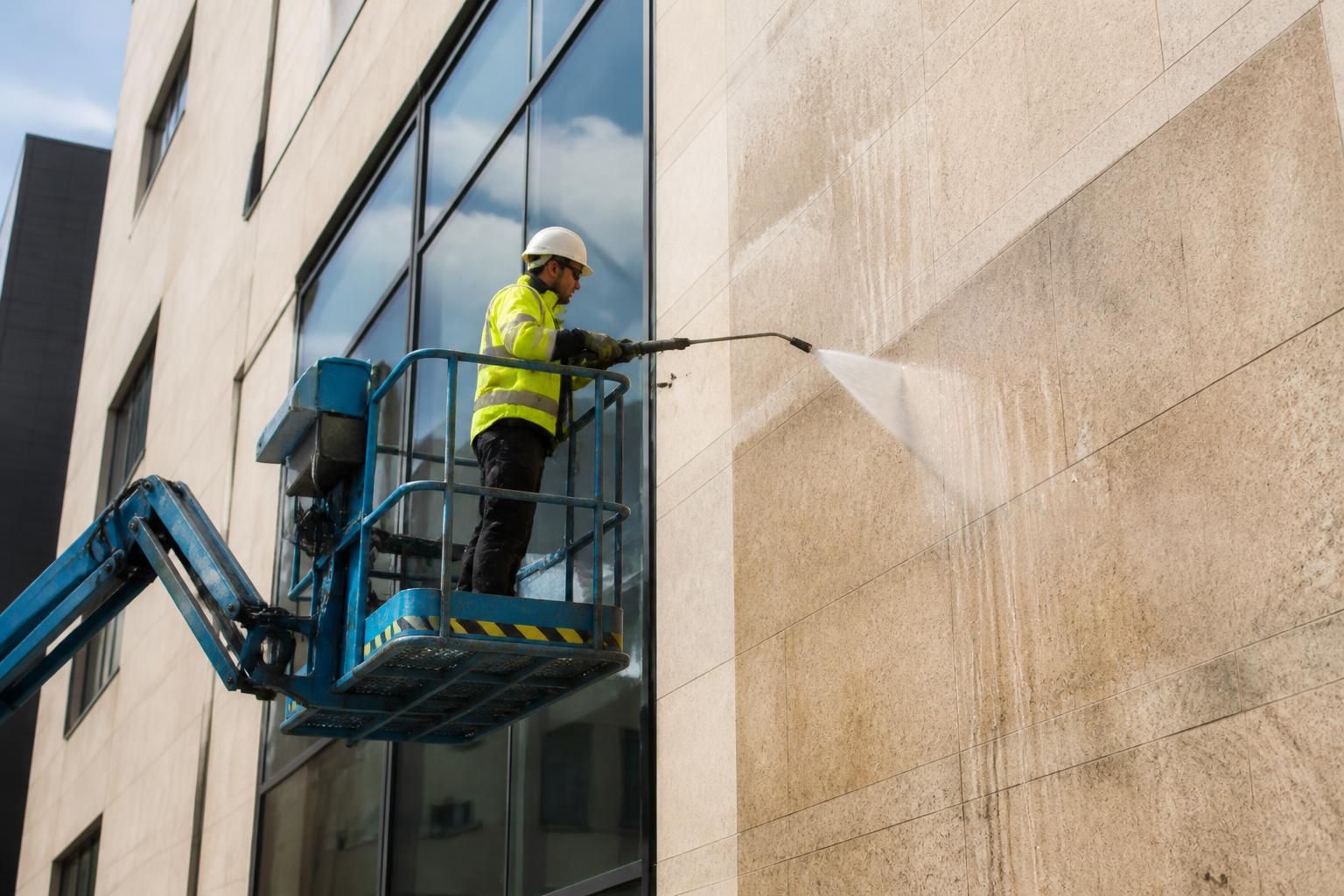
How often should facade cleaning be scheduled for optimal maintenance?
Facade cleaning should generally be scheduled after an annual condition assessment, with cleaning carried out when deposits, staining, algae, pollution or bird fouling begin to affect the surface. Buildings in busy urban areas, exposed locations or areas with heavy footfall may need more frequent cleaning, while well-protected façades may require less frequent treatment.
Facade cleaning should be planned around an annual condition assessment, then scheduled according to the building’s materials, location, exposure and level of soiling. There is no universal interval that suits every property. A protected office façade may remain presentable for longer, while a city-centre building, retail frontage or industrial premises may need more frequent cleaning to control pollution, traffic film, algae, bird fouling and other deposits.
Use an inspection-led maintenance programme
A practical programme combines routine inspections with planned cleaning and responsive treatment. The façade should be checked for visible staining, organic growth, loose deposits, blocked drainage points, damaged sealants and areas where water is not shedding correctly. Inspections can be coordinated with other planned building maintenance so that emerging problems are identified before they become expensive repairs.
Cleaning should normally be arranged when deposits are beginning to affect the appearance or condition of the surface, rather than waiting until staining is deeply embedded. Early treatment is particularly important for porous masonry, rendered surfaces and textured cladding, where contamination can become harder to remove and aggressive methods may then be required.
Factors that determine the cleaning interval
- Location: Buildings near busy roads, construction activity, manufacturing sites or dense urban areas are exposed to more airborne pollution and traffic film.
- Weather exposure: Wind-driven rain, prolonged dampness, frost and limited sunlight can encourage algae, moss and lichen on suitable surfaces.
- Building use: Retail premises, transport facilities, schools, healthcare sites and public buildings may require closer attention because of high footfall, prominent entrances and increased bird fouling.
- Façade material: Glass, metal cladding, brick, stone, concrete, render and composite panels each retain contamination differently and have different cleaning tolerances.
- Design and access: Recessed elevations, ledges, canopies, joints and areas beneath roof outlets can collect deposits more quickly than exposed, smooth surfaces.
- Previous maintenance: A façade that has been neglected may need an initial restoration clean followed by a more manageable routine maintenance cycle.
Typical planning approach for commercial buildings
For many commercial properties, an annual review is a sensible minimum for assessing condition and deciding whether cleaning is required. This does not mean every façade must be cleaned annually. It means that the building is checked consistently and that the decision is based on evidence rather than appearance alone.
High-exposure buildings may benefit from scheduled cleaning as part of a more frequent maintenance plan, particularly on entrances, lower elevations, loading areas and façades facing roads. Lower-exposure buildings may only need full cleaning when inspection identifies visible contamination or when the surface is approaching the standard required by the property owner or occupier.
It is also useful to separate full-façade cleaning from targeted work. Entrances, signs, shopfront surrounds and areas affected by bird fouling can often be treated when needed without cleaning every elevation. This approach maintains key areas between larger planned projects and can help control disruption and expenditure.
Consider the season and cleaning conditions
Seasonal conditions affect both the results and the practicality of façade cleaning. Dry, settled weather can support some external cleaning operations, while very cold conditions may restrict the use of water and increase the risk of freezing. Strong wind can affect access equipment, overspray control and the safe handling of cleaning solutions. Periods of persistent rain may also reduce drying time and make it more difficult to assess the final result.
Organic growth is often more noticeable after damp periods, but it should not automatically be removed using the strongest available treatment. The method should be selected for the material, contamination and surrounding environment. Low-pressure washing, steam cleaning, soft washing or a controlled chemical treatment may be appropriate depending on the façade assessment.
Schedule cleaning before repairs and protective treatments
Cleaning should generally take place before façade repairs, repainting, sealing or protective coatings. Removing surface contamination first allows defects to be assessed properly and helps prevent dirt or biological growth being trapped beneath a new finish. Any damaged pointing, render, sealant, cladding fixings or drainage components should be considered as part of the inspection, although cleaning contractors should not assume that cleaning will correct underlying defects.
Where a façade has historic, delicate or highly porous materials, a small test area should be assessed before the main work begins. The test helps confirm the safest pressure, temperature, dwell time and cleaning agent, while also checking that the method will not cause etching, colour change, water penetration or damage to joints and coatings.
Keep a record of each assessment
Maintenance records should note the areas inspected, the type of soiling observed, photographs, access requirements, cleaning method, products used and any defects requiring separate attention. Comparing records over time makes it easier to identify recurring contamination and refine the cleaning schedule. It also provides useful evidence for property managers responsible for multiple sites or planned maintenance budgets.
A suitable schedule is therefore condition-based rather than calendar-only: inspect the façade routinely, clean before deposits become established, increase attention in exposed or heavily used areas, and review the interval after each project. This protects the appearance and fabric of the building while reducing the likelihood that avoidable staining or biological growth will develop into a more difficult maintenance problem.

Facade cleaning should be scheduled according to the building’s condition and exposure, rather than by using a fixed interval for every property. An annual condition assessment provides a practical basis for deciding whether the façade needs full cleaning, targeted treatment or continued monitoring.
During the assessment, check for traffic film, pollution, algae, moss, bird fouling, staining and deposits beneath roof outlets or around ledges. Also note damaged sealants, pointing, render, cladding joints and drainage issues, as these may require separate repairs. High-exposure areas such as entrances, lower elevations and façades facing busy roads may need attention more often than sheltered elevations.
Keeping inspection photographs and maintenance notes allows the cleaning interval to be refined over time. Early treatment is usually preferable to waiting until contamination becomes deeply embedded, particularly on porous masonry, render and textured cladding where more aggressive cleaning could otherwise be needed.