
What are the key considerations for choosing a construction site cleaning service provider?
Choose a construction site cleaning service provider based on their relevant experience, health and safety procedures, suitable equipment, environmental practices, insurance and ability to work around your programme. They should provide a clear, risk-assessed scope of work, dependable site coordination and consistent results across the required areas, from builders’ cleans and debris removal to façade, cladding and hard-surface cleaning.
The right construction site cleaning service provider should combine relevant site experience with robust health and safety controls, suitable equipment, environmental responsibility and dependable project coordination. Their quotation should be based on a clear understanding of the site, the required cleaning standard, access conditions, programme and waste arrangements—not simply the lowest price.
Construction cleaning can include the removal of building debris, dust, mortar, paint, cement residue, packaging and other construction-related contamination. It may also involve builders’ cleans, post-construction cleaning, façade and cladding washing, brick cleaning, car park cleaning or preparation for handover. Each task presents different risks and requires different methods, so the provider’s suitability should be assessed against the actual work rather than a general claim to offer cleaning services.
Relevant construction cleaning experience
Look for evidence that the contractor has worked on sites comparable to yours in size, type and complexity. A provider experienced in occupied commercial premises may not have the equipment, supervision or processes needed for a large construction site, while a contractor accustomed to basic debris removal may not be suitable for delicate façade materials or specialist brick cleaning.
Relevant experience may include:
- New-build developments and refurbishment projects
- Commercial, industrial, residential or public-sector sites
- Builders’ cleans and end-of-build preparation
- Cleaning façades, cladding, brickwork, roofs and hard-standing areas
- Removing cement, mortar, plaster, dust, adhesive, paint and construction residue
- Working alongside principal contractors, subcontractors, facilities teams and local authorities
Ask for examples of comparable work and establish whether the provider understands construction programmes, phased handovers, restricted access and the need to coordinate with other trades. Experience should be demonstrated through the proposed method and level of detail, not just through a broad list of services.
A clearly defined scope of work
A reliable provider should inspect the site or review sufficiently detailed information before producing a quotation. The scope should identify the areas to be cleaned, the surfaces involved, the level of finish required and any exclusions. It should also explain whether the work covers internal areas, external areas, high-level surfaces, welfare facilities, access routes, loading areas, plant areas and waste removal.
Clarify whether the service includes:
- Loose debris collection and segregation
- Dust and fine-particle removal
- Removal of cement, mortar, paint or adhesive residues
- Pressure washing, steam cleaning or other specialist treatments
- Cleaning around fixtures, drainage channels and service installations
- Protection of completed work and adjacent surfaces
- Collection, storage and disposal of waste
- Final inspection, snagging and remedial visits
Terms such as “full clean” or “handover clean” can mean different things to different contractors. A written specification, agreed cleaning standard and defined completion criteria reduce the risk of disputes and make it easier to verify the finished work.
Health and safety competence
Construction sites contain changing hazards, including unfinished structures, open edges, temporary electrics, moving plant, stored materials, dust, chemicals, uneven ground and other contractors working nearby. The cleaning provider should be able to prepare suitable risk assessments and method statements for the work, and should understand the site rules established by the principal contractor.
Check how the provider will control:
- Access and movement around active work areas
- Work at height and the use of ladders, towers, MEWPs or other access equipment
- Pressure, steam, chemical and electrical hazards
- Slips caused by water, slurry or cleaning products
- Dust, airborne contaminants and exposure to substances hazardous to health
- Run-off entering drains, watercourses or neighbouring areas
- Interaction with vehicles, lifting operations and other site personnel
- Emergency arrangements, exclusion zones and public protection
Where cleaning involves substances or specialist processes, the contractor should provide appropriate COSHH assessments and controls. Where access equipment is required, confirm that operators are trained and that the equipment will be selected, inspected and used in accordance with the relevant site requirements. The cleaning team should also receive a site induction and understand how to report hazards, incidents and changes in working conditions.
Suitable equipment and cleaning methods
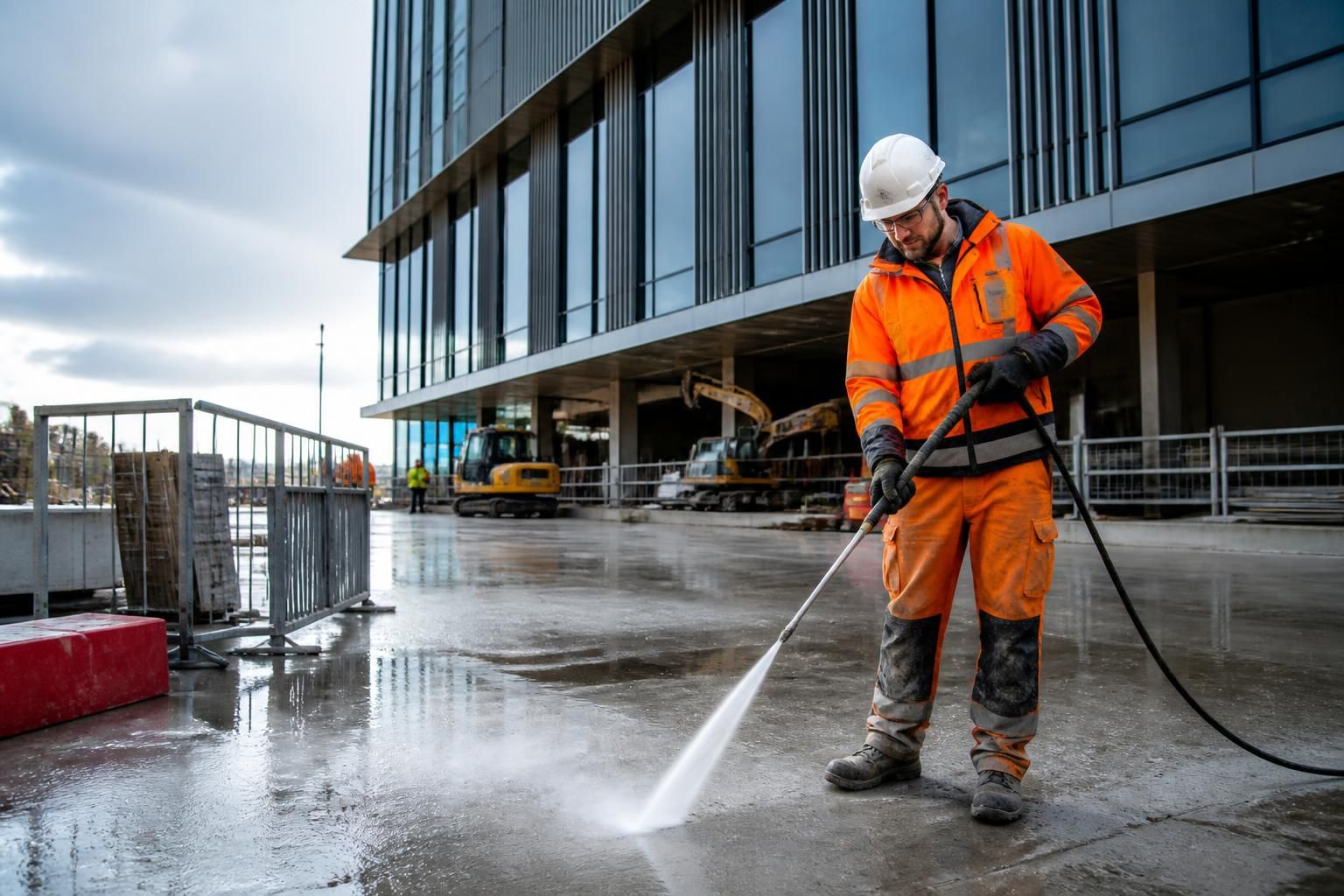
Equipment should be selected for the surface, contamination and working environment. Pressure washing can be effective on robust external surfaces, but excessive pressure or an unsuitable nozzle can damage masonry, coatings, joints, cladding and painted finishes. Steam cleaning may be more appropriate where lower water volumes, controlled heat or chemical reduction is required. Manual methods, soft washing or specialist treatments may be preferable for sensitive materials.
Ask the provider to explain why the proposed method is suitable and whether a test area will be completed before full cleaning. Important points include water pressure, temperature, chemical compatibility, drainage, recovery of dirty water and protection of vulnerable surfaces. Equipment should be maintained, inspected and capable of reaching the required areas without creating unnecessary risks or delays.
Access arrangements are particularly important on construction projects. Establish whether the provider will use site-provided scaffolding or lifting equipment, or whether it will supply its own access solution. The quotation should identify who is responsible for access permissions, ground conditions, traffic management, isolation of areas and any permits required.
Environmental and waste controls
A responsible contractor should prevent cleaning chemicals, sediment and contaminated water from entering surface-water drains or nearby land. They should explain how water will be contained, recovered, filtered or disposed of, where necessary. The method should also minimise unnecessary water use and avoid applying chemicals where a mechanical, steam or lower-impact alternative is suitable.
For solid waste, confirm how debris and packaging will be collected, segregated, stored and transferred. Where waste is removed from site, the contractor should operate in accordance with applicable waste requirements and provide appropriate transfer documentation when required. Waste responsibilities should be stated clearly so that materials are not left on site or placed in the wrong skips.
Environmental responsibility also includes protecting planted areas, neighbouring properties, vehicles, drainage systems, completed finishes and local residents from spray, dust, noise and run-off. These controls should appear in the method statement rather than being left to informal arrangements on the day.
Insurance, training and documentation
Before appointing a provider, request evidence of appropriate insurance, including public liability cover and employers’ liability cover where applicable. The level of cover should be suitable for the nature and scale of the project. You may also need confirmation of qualifications, training records, equipment inspections, safety policies and relevant accreditations required by your site or client.
Useful documentation may include:
- Risk assessments and method statements
- COSHH assessments and product information
- Training and competency records
- Access equipment inspection or examination records
- Insurance certificates
- Waste transfer or disposal records
- Cleaning schedules and inspection records
- Completion reports, photographs and outstanding-work lists
Documentation should be proportionate to the work, current and specific to the site. Generic paperwork that does not reflect the actual surface, access method or hazards provides limited assurance.
Ability to work around the construction programme
Cleaning is often carried out in phases, with different areas becoming available at different times. The provider should be able to work to agreed milestones and adapt when preceding trades are delayed or additional areas require attention. Confirm their availability, expected duration, working hours, mobilisation arrangements and approach to changes.
Good coordination is essential where cleaning takes place before inspections, practical completion or client handover. The contractor should identify dependencies such as completed installations, working drainage, safe access, removal of plant and approval to use water or cleaning chemicals. A competent provider will raise these issues early rather than allowing them to become last-minute obstacles.
Quality control and handover arrangements
Ask how the contractor will check the work during and after cleaning. Quality control may involve supervisor inspections, agreed sample areas, photographic records and a documented snagging process. The required standard should take account of the surface condition and any permanent marks, damage or defects that cannot be removed without specialist repair.
The handover process should state who inspects the work, how defects are recorded, what constitutes a reasonable remedial clean and how quickly outstanding items will be addressed. This is especially important where several parties are responsible for different areas of a development.
Transparent pricing and communication
A dependable quotation should separate labour, equipment, access, materials, waste handling and any provisional items where appropriate. It should identify assumptions such as water and power availability, working hours, surface condition and the extent of debris. Extremely low quotations may omit access, preparation, waste disposal or remedial work that will later appear as additional charges.
Establish who will act as the main contact, how progress will be reported and how variations will be approved. Clear communication is particularly valuable when the site condition changes, when other trades affect access or when the original scope needs to be revised.
Questions to ask before appointing a provider
- Have you completed comparable construction or industrial cleaning projects?
- What areas, surfaces and contamination types are included in the proposed scope?
- What cleaning methods and equipment will you use, and why are they suitable?
- How will you manage work at height, plant movements, dust, chemicals and water run-off?
- Who will prepare and brief the risk assessments and method statements?
- How will waste and contaminated water be handled?
- What access, water, power, permits and site support are required?
- How will the work be inspected, documented and handed over?
- What happens if areas are not ready or additional cleaning is required?
- Can you provide current insurance and competency documentation?
The strongest choice is a provider that can connect its experience, method, equipment, safety controls and programme to the specific requirements of your site. A detailed scope, site-specific risk assessment, competent supervision, responsible waste management and clear handover process give you a more reliable basis for comparing contractors and achieving a safe, presentable and genuinely ready-to-use construction site.

A construction site cleaning provider should produce a site-specific scope of work and risk assessment before starting. These documents should identify the surfaces, contamination, access arrangements, equipment, cleaning methods, waste controls and completion standard required for the project.
This is important because construction sites change throughout a programme. The provider should explain how it will manage unfinished areas, moving plant, work at height, water run-off and other trades working nearby. A clear scope also confirms whether debris removal, specialist residue cleaning, access equipment, waste disposal, snagging and final inspection are included, helping you compare quotations accurately and avoid unexpected gaps at handover.