
What safety measures should be considered during warehouse cleaning?
Warehouse cleaning should begin with a site-specific risk assessment covering vehicle movements, forklifts, pedestrian routes, work at height, machinery, chemicals and wet surfaces. Controls should include trained operatives, suitable PPE, inspected equipment, COSHH-compliant chemical handling, clear signage and segregation of cleaning areas, safe access equipment, and procedures for spillages, waste and emergencies.
Safe warehouse cleaning depends on a documented, site-specific risk assessment, competent operatives, suitable personal protective equipment (PPE), properly maintained equipment and effective separation from normal warehouse activities. The controls must address the actual risks present, including forklift movements, vehicle loading areas, racking, machinery, electrical installations, work at height, cleaning chemicals, wet floors, dust, waste and restricted access.
Complete a site-specific risk assessment before work starts
The cleaning contractor and site representative should identify hazards before equipment or chemicals are brought into the area. The assessment should consider the warehouse layout, operating hours, pedestrian routes, vehicle movements, forklift charging areas, dock levellers, conveyors, racking, fragile stock, fire exits, ventilation and any restricted or contaminated areas.
The assessment should be reviewed when the work changes, such as when cleaning at height, using steam or pressure washing equipment, working around live production processes, or entering an area affected by a spill. The findings should be communicated to everyone involved through a method statement, site induction or toolbox talk where appropriate.
Control interaction with vehicles, forklifts and pedestrians
- Agree cleaning times that reduce conflict with deliveries, picking operations and forklift traffic wherever practicable.
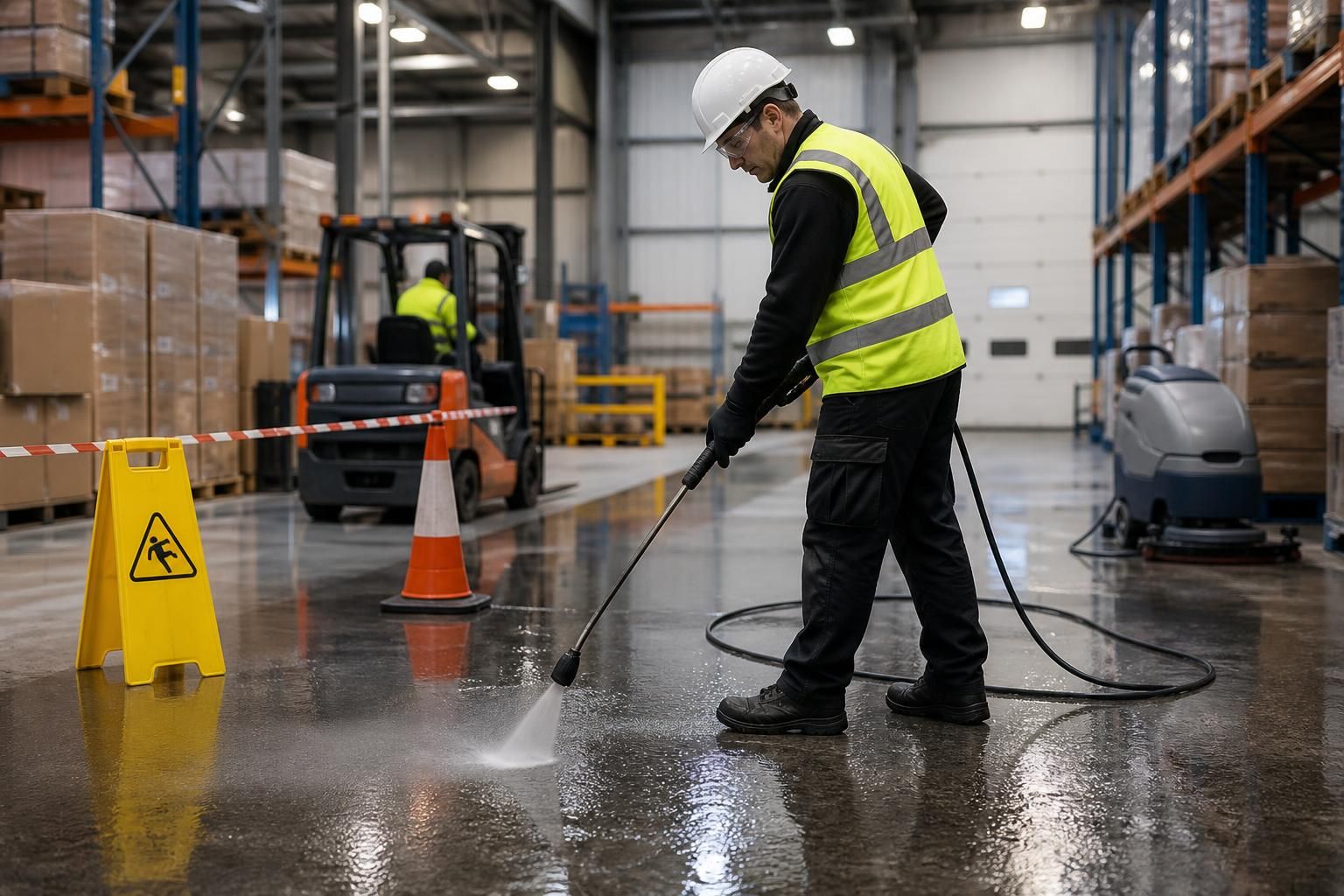
- Use barriers, cones and clearly marked exclusion zones to separate cleaning operatives from vehicles and pedestrians.
- Maintain visibility at crossings, corners, loading bays and aisle ends, and use a banksman or other agreed traffic control arrangement where the risk assessment requires it.
- Never leave hoses, cables, machines or cleaning materials across active traffic routes without suitable protection and authorisation.
- Keep emergency exits, fire points, stairways, access routes and forklift charging areas unobstructed.
Cleaning should not rely on warning signs alone where there is a significant risk of collision. Physical segregation, temporary closure of an aisle or a planned shutdown is usually a stronger control.
Use appropriate PPE and workwear
PPE should be selected from the risk assessment rather than issued as a substitute for safer working methods. Depending on the task, this may include slip-resistant safety footwear, protective gloves, eye or face protection, hearing protection, high-visibility clothing, protective clothing and respiratory protection. Gloves must be suitable for the chemicals and contamination involved; a general-purpose glove is not automatically resistant to every detergent, solvent or disinfectant.
Operatives should be trained to wear, remove, clean and store PPE correctly. Damaged or contaminated PPE must be replaced or decontaminated in line with the product and site procedures. Loose clothing, jewellery and unsecured hair should be controlled around moving machinery.
Check equipment before use
Vacuum cleaners, scrubber dryers, pressure washers, steam cleaners, extension leads, hoses and access equipment should be inspected before use. Operatives should check for damaged cables, exposed conductors, leaking hoses, defective plugs, worn fittings, damaged guards, faulty emergency stops and unstable wheels or platforms. Defective equipment should be taken out of service and reported rather than repaired informally on site.
Electrical equipment should be suitable for the environment, including areas exposed to water, dust or flammable substances. Leads and hoses should be routed to prevent trips, crushing and contact with moving vehicles. Equipment must be operated only by people who have been trained and are familiar with its limitations.
Where applicable, inspections and maintenance should reflect the requirements of the Provision and Use of Work Equipment Regulations (PUWER). Lifting equipment and accessories used to support cleaning at height may also require appropriate examination under the Lifting Operations and Lifting Equipment Regulations (LOLER).
Manage chemicals under COSHH
Cleaning products should be selected for the surface and contamination while avoiding unnecessary hazardous substances. Current safety data sheets and COSHH assessments should be available, and operatives should understand dilution, application, contact time, storage, first aid and disposal requirements.
- Keep chemicals in labelled, suitable containers and never transfer them into unlabelled food or drink containers.
- Do not mix products unless the manufacturer specifically permits it. Mixing acids, chlorine-based products or other incompatible substances can release dangerous gases.
- Use measured dilution systems where suitable to reduce handling and over-concentration.
- Provide ventilation when using products that create vapour, mist or spray.
- Store chemicals securely, away from incompatible materials, heat sources and areas where stock could be contaminated.
- Use spill kits and follow the relevant procedure for leaks, splashes and accidental exposure.
Where spraying, steam or pressure washing could create an airborne mist, the assessment should consider inhalation exposure, nearby workers, ventilation and the need to restrict access until the area is safe.
Control slips, trips and falls
Wet floors are a common warehouse cleaning hazard, particularly around loading bays, smooth concrete, cold stores and pedestrian entrances. Clean in manageable sections, remove excess water promptly and use equipment that recovers water effectively. Place prominent warning signs at every approach to a wet area and keep them in position until the surface is dry and safe.
Signs should not be used to justify leaving a hazardous route open. Where possible, divert pedestrians, close the aisle temporarily or use barriers. Hoses and cables should be routed around the edge of the work area or protected with suitable cable covers. Any uneven flooring, damaged drainage or recurring leaks should be reported to the responsible site manager rather than treated as a cleaning issue alone.
Plan work at height carefully
High-level dusting, cleaning rooflights, façades, lighting, racking and warehouse structures should be planned under the Work at Height Regulations. The preferred approach is to avoid work at height where a ground-level method is reasonably practicable. If access is necessary, use suitable equipment such as an appropriately selected mobile elevated work platform, tower or other approved access system.
- Use trained and authorised operators for powered access equipment.
- Check the ground, overhead obstructions, racking, doors, sprinkler systems and vehicle movements before positioning equipment.
- Prevent unauthorised access beneath or beside the work area.
- Use harnesses and restraint systems only where required by the equipment and risk assessment, with suitable anchor points and rescue arrangements.
- Do not improvise by standing on pallets, racking, forks, boxes or unsuitable steps.
- Plan how an operative will be recovered if access equipment fails or someone becomes unwell at height.
Access equipment should be inspected before use and used within its rated capacity and operating instructions.
Protect machinery, stock and electrical systems
Cleaning around conveyors, compactors, production equipment and other machinery requires communication with the responsible operator. Machinery should be isolated, locked off and labelled where there is a risk of contact with moving parts or unexpected start-up. Only authorised personnel should remove guards or enter restricted machinery areas.
Water, steam and chemicals must be kept away from live electrical components, control panels, sockets and sensitive stock unless the equipment has been designed for that method of cleaning. Cover or protect vulnerable items only where this is approved by the site and does not create a new fire, heat or trip hazard. Cleaning operatives should report damaged insulation, exposed wiring, leaks, unstable racking and other defects immediately.
Use pressure washers and steam cleaners responsibly
Pressure and steam cleaning can remove stubborn contamination efficiently, but the force, heat and water can injure people, damage surfaces and spread contamination. Operatives should use the correct nozzle, pressure, temperature and distance for the material being cleaned, following the equipment and surface manufacturer’s guidance.
- Keep people outside the spray or steam zone and prevent the jet from contacting people, electrical equipment, fragile stock or unprotected openings.
- Wear eye or face protection and other PPE identified by the assessment.
- Control overspray, drainage and runoff so that it does not enter walkways, stock areas or drains without authorisation.
- Inspect hoses, couplings and trigger controls before use, and depressurise equipment before disconnecting it.
- Allow hot equipment and surfaces to cool safely, and warn others about residual heat.
Where water cannot be safely contained or the area cannot be isolated, a low-moisture or dry cleaning method may be more appropriate.
Control dust, waste and possible contamination
Dust should be removed using methods that do not unnecessarily redistribute it. Suitable vacuum extraction is generally preferable to dry sweeping where airborne dust could affect workers, stock or sensitive equipment. The assessment should consider whether dust contains hazardous materials, such as silica, mould, chemical residues or other substances requiring specialist controls.
Waste should be segregated, bagged or contained and removed using an agreed route. Sharps, broken glass, oily materials, chemical containers and other hazardous waste must not be handled or disposed of as general waste. Spillages should be isolated, reported and cleaned using the correct absorbent and disposal method. If the substance is unknown, do not handle it until the site’s emergency or hazardous-substance procedure has been followed.
Provide training, supervision and communication
Operatives should receive site-specific induction and task training covering emergency arrangements, traffic rules, chemical use, equipment operation, PPE, manual handling, work at height and incident reporting. Supervision should be proportionate to the risks and the experience of the team. All workers should know who can authorise isolation, area closure, access equipment use and changes to the agreed method.
Cleaning staff should report near misses, injuries, equipment defects, damaged stock and unsafe conditions promptly. The method statement and risk assessment should be updated when an incident or near miss identifies a weakness in the controls.
Agree emergency arrangements before cleaning begins
The team should know the location of first-aid equipment, fire exits, alarm points, spill kits, eyewash facilities and assembly points. Emergency contact details and site communication methods should be confirmed during the induction. The procedure should cover chemical splashes, electrical incidents, fire, equipment failure, falls from height, vehicle collisions and uncontrolled spills.
At the end of each task, the area should be checked for standing water, abandoned equipment, unsecured chemicals, waste, trip hazards and reopened routes. A documented handover can confirm that the warehouse is safe to return to normal operation and that any outstanding defects have been reported to the responsible person.
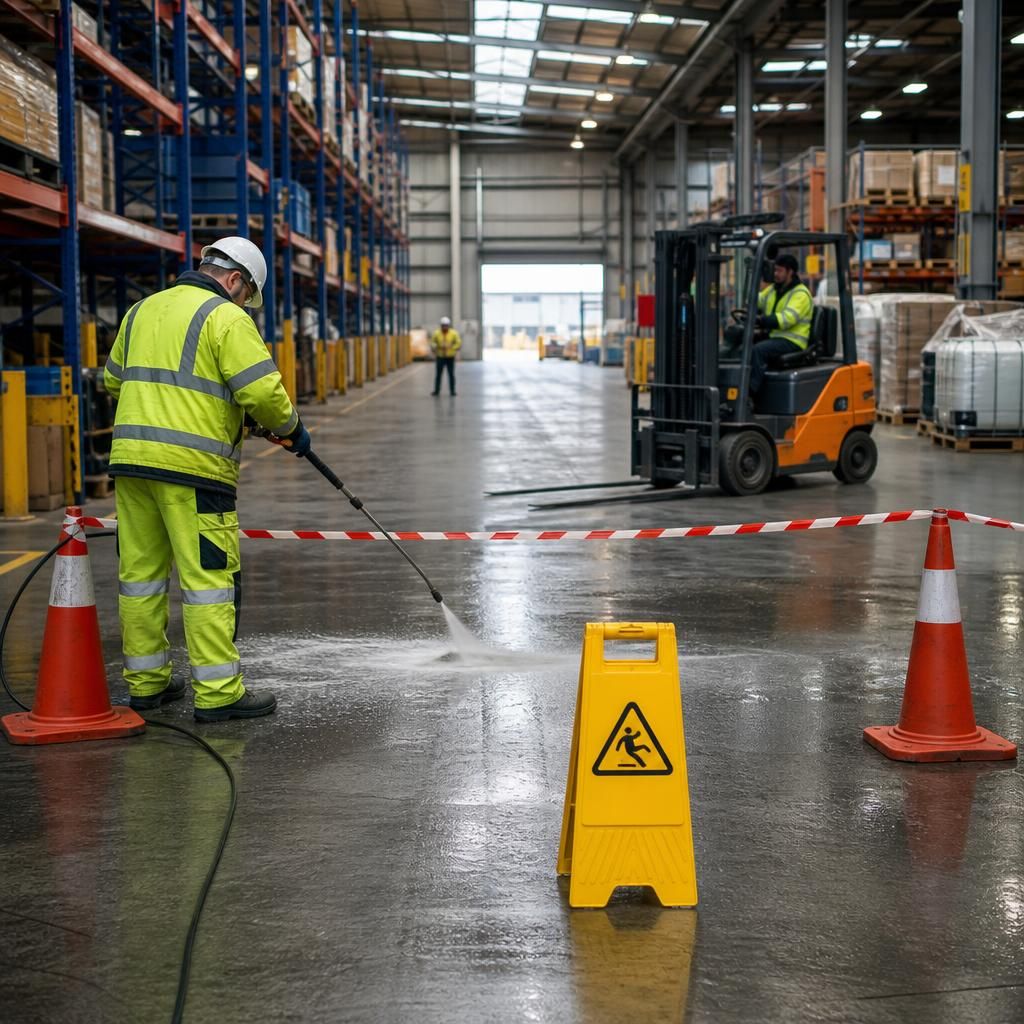
Safe warehouse cleaning depends on separating the cleaning activity from normal warehouse operations. Before work begins, agree the cleaning zone, restrict access and control nearby forklift, vehicle and pedestrian movements.
Use barriers and clear warning signs around wet floors, pressure-washing areas and overhead work. Route hoses and cables away from active aisles, keep fire exits and emergency routes clear, and close or divert walkways where signs alone would not provide adequate protection. Cleaning should be timed around deliveries, picking and loading activities wherever practicable.
At the end of the task, inspect the area for standing water, equipment, chemicals and trip hazards before removing the barriers and returning the space to normal use.