
What are the critical factors to consider when selecting a warehouse cleaning service provider?
When selecting a warehouse cleaning service provider, assess their experience with industrial environments, understanding of site-specific health and safety requirements, suitable equipment, insurance, trained staff and ability to deliver reliable scheduled or project-based cleaning. A clear method statement, risk assessment, transparent quotation and evidence of dependable performance should also be required before appointment.
A suitable warehouse cleaning service provider should be assessed on more than price. The critical factors are relevant industrial experience, a clear understanding of your site’s risks, suitable equipment and access capability, trained operatives, appropriate insurance, reliable service delivery and transparent working methods. The provider should be able to demonstrate how its service will protect people, stock, equipment and business continuity.
Relevant warehouse and industrial experience
Warehouse cleaning differs from routine commercial cleaning. It may involve high-level surfaces, loading bays, racking, dock areas, concrete floors, cladding, roofs, plant rooms, external yards and areas affected by dust, oil, tyre marks or construction residues. Ask whether the contractor has completed comparable work in operational warehouses or other industrial premises, particularly where cleaning must take place around vehicles, machinery, stored goods and staff.
Experience should include working around warehouse traffic management systems, restricted access areas, fragile surfaces and time-critical operations. A capable provider will identify the difference between cleaning requirements for a distribution centre, manufacturing warehouse, cold-storage facility and vacant industrial unit rather than applying the same method to every site.
Understanding of your site and cleaning objectives
The provider should carry out a site survey before preparing a detailed proposal. This allows them to assess surface types, levels of soiling, drainage, water supply, power availability, access restrictions, working heights, pedestrian routes, vehicle movements and any areas that must remain operational.
Establish precisely what is included. The scope may cover floors, walls, ceilings, beams, racking, doors, dock levellers, external hardstanding, car parks, welfare areas, waste storage points or building façades. It should also state whether the service includes preparation, protection of stock, moving items, rinsing, water recovery, waste removal and final inspection.
Health, safety and risk control
Request a site-specific risk assessment and method statement before work begins. These documents should explain the proposed cleaning methods, chemicals, equipment, access arrangements, exclusion zones, slip controls, electrical precautions, water management and emergency procedures. They should be updated if the work scope or site conditions change.
Where applicable, the contractor should show that its procedures address the Control of Substances Hazardous to Health, safe use of work equipment and the requirements associated with lifting equipment or powered access. If cleaning forms part of wider construction or refurbishment work, the relevant construction-site coordination requirements should also be considered. The contractor must provide suitable personal protective equipment, but PPE should support—not replace—effective planning and control measures.
Equipment and access capability
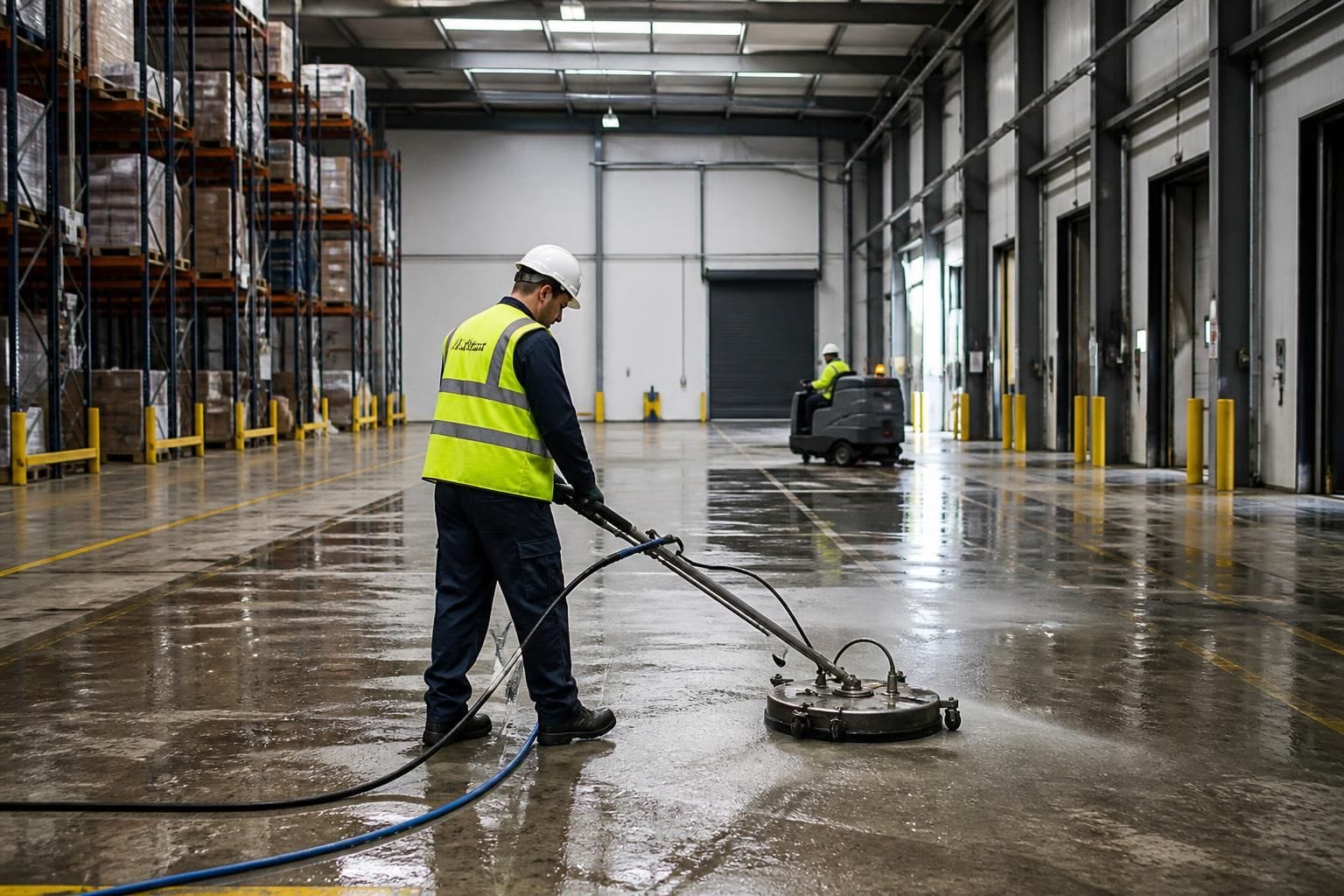
Check that the provider has equipment suited to the surfaces and the level of soiling. Depending on the task, this may include industrial vacuum systems, scrubber dryers, pressure washers, steam cleaners, soft-washing systems, rotary cleaning equipment and water-recovery units. The contractor should be able to explain why a particular method has been selected and how it will avoid damaging floors, coatings, insulation, cladding, racking or stored materials.
High-level cleaning requires particular scrutiny. Confirm whether the contractor can safely provide the required access equipment and whether operatives are trained to use it. Access arrangements may involve mobile elevated work platforms, towers, specialist poles or other controlled methods. A responsible provider will not propose pressure washing or powered access where the building, weather, drainage or surrounding operations make that approach unsuitable.
Competence, supervision and workforce arrangements
Ask how operatives are selected, trained and supervised. Evidence should cover equipment operation, chemical handling, work at height, manual handling, site induction and emergency arrangements, as relevant to the work. Operatives should understand warehouse-specific hazards, including forklift movements, falling objects, contaminated surfaces, uneven ground and restricted visibility.
Find out who will manage the work on site and who will be your point of contact. A named supervisor helps with access coordination, daily briefings, quality checks and prompt resolution of unexpected issues. If subcontractors may be used, establish who will control their competence, insurance and compliance.
Insurance and compliance evidence
Before appointment, request current evidence of appropriate employers’ liability and public liability insurance, together with any other cover relevant to the proposed work. Check that the policy limits and activities covered are suitable for an operational warehouse and for the use of specialist access or cleaning equipment.
The contractor should also be able to provide relevant training records, equipment inspection information, chemical safety data and waste-transfer documentation where applicable. These records help demonstrate that the service is being managed systematically rather than relying on informal assurances.
Reliability and operational flexibility
Cleaning must fit around receiving, dispatch, shift patterns, stock movements and planned maintenance. Confirm whether the provider can work during agreed shutdowns, evenings or other restricted periods, and how it will respond to weather, access changes, spillages or urgent requirements.
For recurring work, agree the schedule, attendance arrangements, response times, reporting process and contingency arrangements for staff absence or equipment failure. A dependable contractor should communicate changes promptly and provide a consistent standard across every visit. For project work, agree the mobilisation plan, work phases, completion criteria and handover process.
Environmental controls and waste handling
Cleaning methods should control water, chemicals, debris and contaminated residues. Ask how wastewater will be contained, recovered or discharged, and whether the method complies with site drainage controls and relevant environmental requirements. The provider should avoid allowing dirty water, oils or cleaning chemicals to enter surface-water drains without appropriate controls.
Where waste is removed, confirm who is responsible for segregation, storage, transfer and documentation. Chemical selection should be proportionate to the soiling and compatible with the surface, drainage arrangements and any environmental policy applying to the site.
Quotation, service standards and value
A useful quotation should be based on an inspected site and should describe the areas, methods, equipment, labour, access arrangements, exclusions and assumptions. It should distinguish one-off restoration or deep cleaning from routine maintenance so that the price and expected result can be compared fairly with other proposals.
Do not assess quotations on the lowest initial cost alone. An unusually low price may reflect limited preparation, unsuitable equipment, inadequate supervision or exclusions that appear later as additional charges. Instead, compare the total value of the service, including risk reduction, protection of surfaces, reduced disruption, reporting quality and the likelihood of consistent completion.
References, reporting and quality assurance
Request relevant references or examples of comparable work, while respecting client confidentiality. Ask how quality is checked and documented. Depending on the scope, useful records may include attendance logs, photographs, inspection sheets, remedial actions, waste documentation and a completion report.
Before signing, agree measurable acceptance standards—for example, the required condition of floors, high-level surfaces, loading areas or external hardstanding—and define how defects will be reported and corrected. A short trial or clearly defined initial project can be appropriate where the site is complex or the cleaning specification is still being refined.
Questions to resolve before appointment
- Has the provider inspected the warehouse and understood its operational constraints?
- Is the proposed method suitable for every surface and level of soiling?
- Are the risk assessment, method statement and chemical controls site-specific?
- Does the contractor have the required trained personnel, access equipment and contingency arrangements?
- Are insurance, waste handling and compliance documents available for review?
- Does the quotation clearly define the scope, exclusions, schedule and completion standard?
- Who will supervise the work and how will progress, defects and changes be reported?
The strongest selection decision comes from comparing documented competence and risk control with the practical needs of the warehouse. A provider that surveys the site properly, explains its methods, supplies appropriate evidence and agrees clear service standards is more likely to deliver safe, efficient cleaning with minimal disruption.

A site survey is a critical part of selecting a warehouse cleaning provider because it confirms the work required, the risks involved and the methods that are suitable. The contractor should assess surfaces, levels of soiling, working heights, drainage, power, access restrictions, forklift routes, pedestrian areas and the need to protect stock or equipment before preparing a quotation.
Ask for a site-specific risk assessment and method statement explaining how the work will be controlled. These documents should cover access equipment, chemicals, water recovery, exclusion zones, slip prevention and emergency arrangements. A provider that can clearly link its proposed methods to the warehouse’s operating conditions is better placed to deliver safe, effective cleaning without unnecessary disruption.