
Why is professional equipment essential for post construction clean up?
Professional equipment is essential for post construction clean up because it removes fine dust, cement residue, adhesive, paint splashes and heavy debris more safely and thoroughly than standard cleaning tools. Industrial pressure washers, steam cleaners, extraction equipment and access systems also improve efficiency while reducing risks to workers, finished surfaces and site users.
Professional equipment is essential for post construction clean up because construction sites contain materials that ordinary cleaning tools cannot remove safely or completely. Fine cement dust, plaster residue, grout, adhesive, paint splashes, sealants, metal filings and heavy debris often require industrial vacuum systems, pressure washing, steam cleaning, extraction equipment and suitable access systems. Using the correct equipment produces a more thorough finish while reducing exposure to dust, chemicals, slips and work-at-height risks.
Construction residue requires more than routine cleaning. Standard commercial cleaning equipment is generally designed for everyday dirt, light dust and surface-level spillages. Post construction cleaning involves removing contamination created by building work, including particles that settle into textured surfaces, joints, drainage channels, cladding profiles and floor finishes. Some residues also bond to surfaces as they dry, meaning that scrubbing by hand can be slow, ineffective or capable of causing damage.
Professional equipment allows the cleaning method to be matched to the material, the type of residue and the condition of the site. This is particularly important where newly installed finishes, glass, façades, roofing materials, flooring or painted surfaces could be marked by excessive pressure, unsuitable chemicals or abrasive tools.
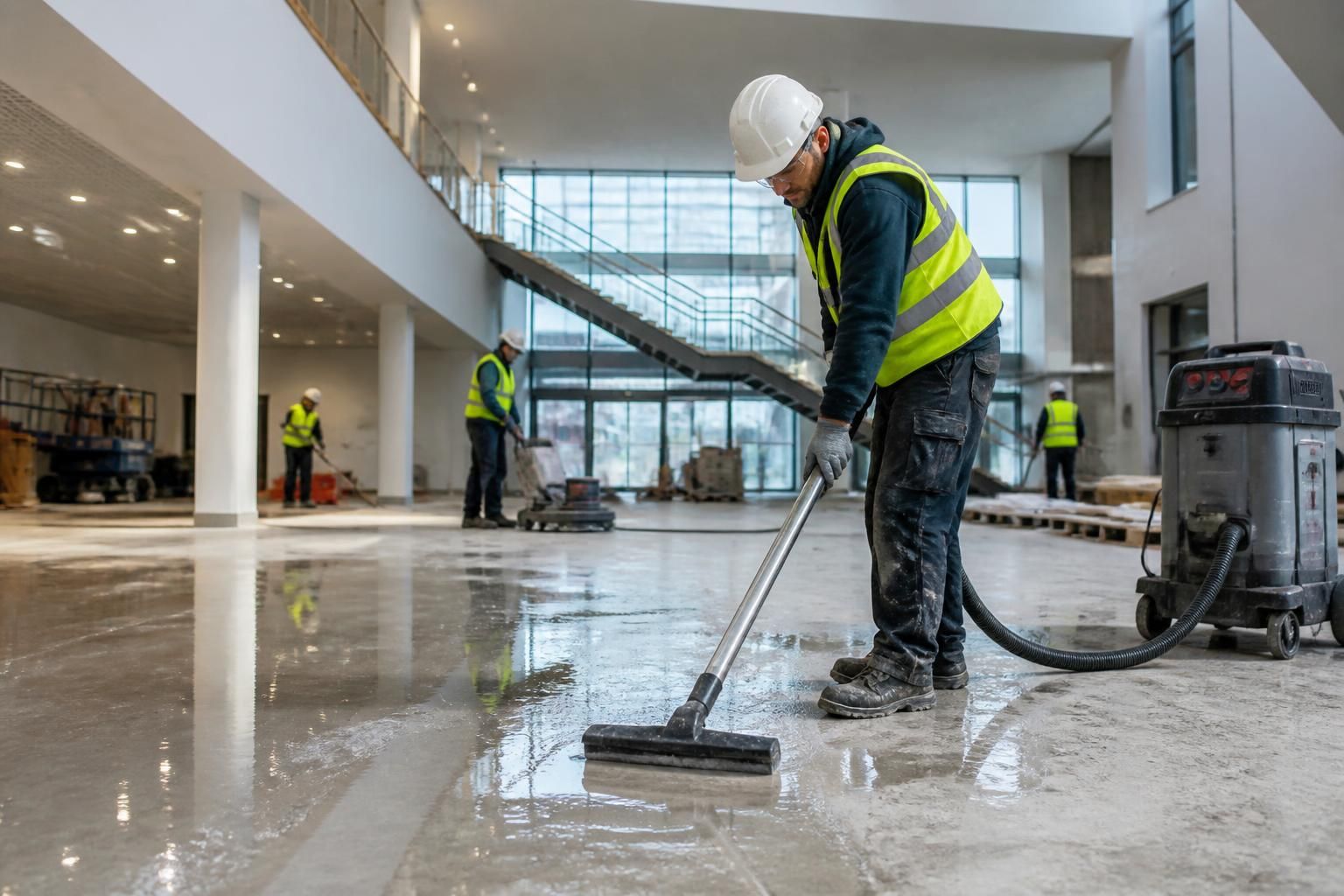
Industrial vacuum equipment controls dust and fine debris. Construction dust can remain suspended in the air and settle repeatedly after visible cleaning has taken place. Commercial-grade vacuum systems with appropriate filtration can collect fine particles from floors, ledges, plant areas, stairwells and other hard-to-reach locations more effectively than domestic or general-purpose vacuums. This helps reduce airborne dust and prevents debris being redistributed across areas that have already been cleaned.
Vacuum equipment is also useful for removing dry debris before wet cleaning begins. Clearing loose dust, insulation fragments, sawdust and small particles first reduces the risk of creating a paste when water is introduced. In occupied or partially operational premises, controlled dust extraction can help protect staff, visitors, furnishings and installed equipment.
Pressure washing removes bonded external contamination efficiently. Exterior construction clean up may involve cement staining, mortar deposits, plaster, soil, traffic film and general site debris on façades, paving, loading areas, car parks and access routes. Professional pressure washing equipment delivers a controlled flow of water that can break down and remove contamination across large areas more consistently than manual brushing.
Pressure must be selected carefully. Excessive force can mark masonry, strip coatings, damage pointing, drive water behind cladding or affect newly finished surfaces. Experienced operatives adjust pressure, temperature, nozzle selection, distance and cleaning solution to suit the substrate. Where water use is unsuitable, alternative methods may be considered after assessing the surface and the residue.
Steam cleaning provides controlled removal for sensitive or detailed surfaces. Steam can soften certain residues, including light cement film, adhesive traces, grease and biological contamination, while using less water than conventional pressure washing. It can be helpful around architectural details, entrances, signs, façades and other areas where water penetration or excessive mechanical force could create problems.
Steam is not appropriate for every material or type of contamination. The surface temperature, moisture sensitivity, existing coatings and surrounding construction details must be assessed before work starts. Professional operators use steam as part of a planned cleaning system rather than treating it as a universal solution.
Extraction equipment improves the finish on internal floors and soft surfaces. Building work can leave wet slurry, tracked-in soil, dust and fine particles in carpet, upholstery, safety flooring and other absorbent materials. Professional wet vacuums and extraction machines remove contaminated water and loosened material from the surface and, where appropriate, from within the material. This supports a cleaner finish and helps prevent residue being left behind as the area dries.
Extraction also assists with spill response and final floor preparation, but the method must reflect the flooring manufacturer’s requirements. Excess moisture, unsuitable detergents or aggressive agitation can damage flooring, adhesives and finishes. A pre-clean inspection and a small test area are therefore important where the material or its condition is uncertain.
Access equipment makes high-level cleaning safer and more complete. Post construction residue is often present on high façades, glazing, cladding, roof edges, beams, canopies, signage and overhead services. Access systems such as mobile elevated work platforms, scaffold-based access or water-fed pole systems can provide a safer and more controlled working position than ladders or improvised methods.
The appropriate system depends on the building height, ground conditions, reach required, obstructions, weather and the nature of the cleaning task. Access equipment must be selected, operated and inspected by competent personnel, with suitable planning for exclusion zones, emergency arrangements and protection of people below. Correct access also improves cleaning quality because operatives can reach surfaces directly rather than working from an unstable or unsuitable position.
Professional equipment improves safety as well as productivity. Construction cleaning can expose workers to silica-containing dust, sharp fragments, chemical residues, wet floors, moving vehicles and unstable debris. Equipment that controls dust, captures wastewater, reduces manual handling and provides safer access can lower these risks when supported by appropriate training and personal protective equipment.
Mechanical equipment can also reduce repetitive scrubbing, lifting and carrying. This does not remove the need for supervision or risk assessment, but it enables the work to be organised around controlled methods instead of relying on physical effort alone. Operators should follow site rules, isolate affected areas where necessary and coordinate activities with other trades and building users.
Equipment selection should be based on the site, not simply the most powerful machine. A suitable pre-clean assessment should consider:
- the materials and finishes requiring cleaning;
- the type, age and thickness of the construction residue;
- whether the area is internal, external, occupied or still under construction;
- available water, drainage, electricity and ventilation;
- the need to collect, filter or dispose of wastewater and debris;
- access restrictions, working height and nearby hazards;
- manufacturer guidance for newly installed surfaces; and
- the required handover standard and any outstanding defects.
This assessment prevents unsuitable pressure, heat, chemicals or mechanical agitation from being applied to vulnerable surfaces. It also identifies whether cleaning should be carried out in stages, such as dry dust removal before wet washing, or high-level work before final floor cleaning.
Professional equipment supports a more controlled cleaning process. A typical approach is to inspect and segregate the site, remove larger debris, control loose dust, test the intended method, complete high-level and external cleaning, treat bonded residues, carry out floor and detail cleaning, and finish with a quality inspection. The exact sequence changes according to the project, but cleaning from less contaminated or higher areas towards final floor-level work helps prevent recontamination.
Equipment should be maintained and checked before use. Filters, hoses, cables, pressure controls, extraction systems and access equipment all affect performance and safety. Poorly maintained machinery may spread dust, leave water behind, fail to remove residue or create additional hazards. Competent teams also know when a stain is actually a surface defect, curing issue or installation problem that should be referred to the construction team rather than aggressively cleaned.
Professional equipment can also support environmental controls. Efficient machinery can reduce unnecessary water use, while wet vacuums, filtration systems and controlled wash-down methods help prevent contaminated water from entering surface drains. Debris and residue should be collected and disposed of in accordance with site procedures and applicable waste requirements. Cleaning products must be selected and used according to their instructions, with attention to dilution, storage, ventilation and runoff controls.
Equipment alone does not guarantee a satisfactory post construction clean. The result depends on correct assessment, trained operators, suitable chemicals, safe access, proper sequencing and a clear inspection standard. However, professional equipment provides the control and capacity needed to deal with construction residue across large or complex premises, while protecting finished surfaces and supporting a safer handover.
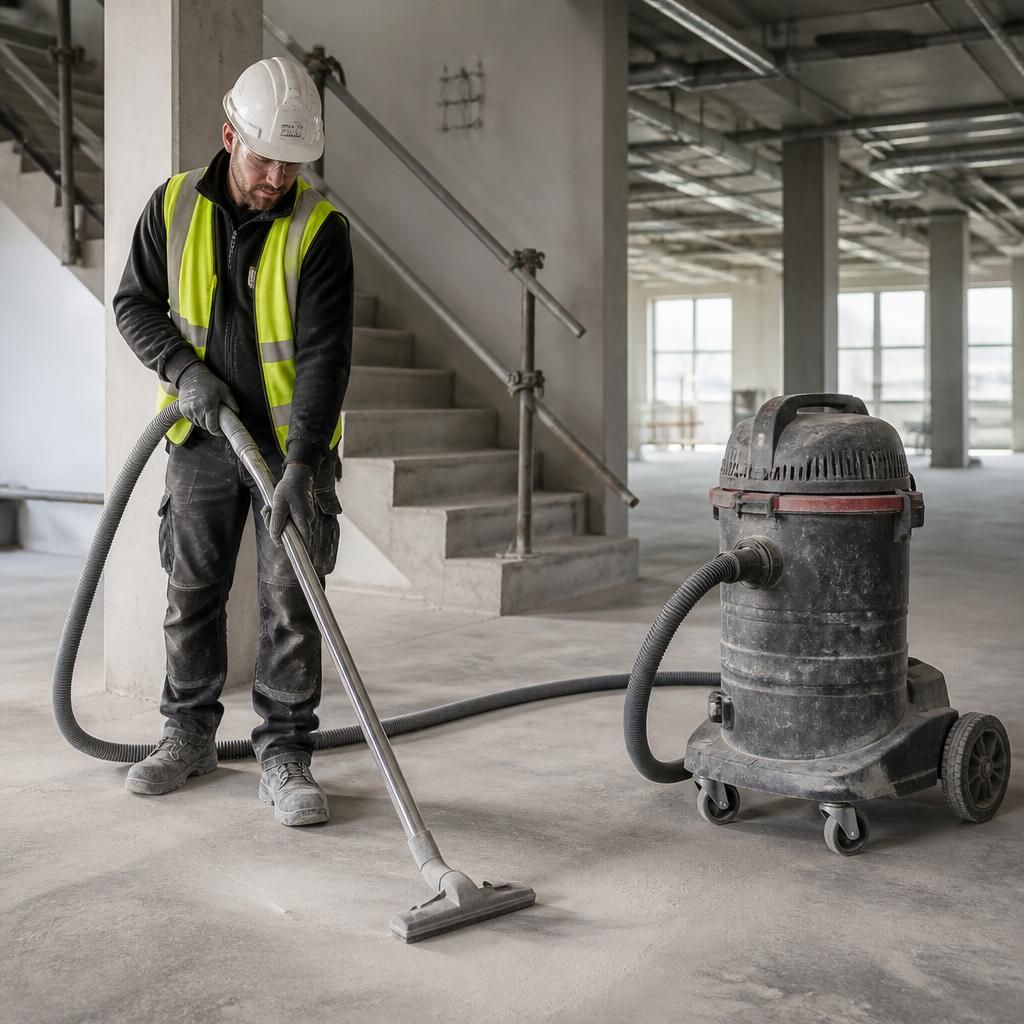
Professional dust-extraction equipment is essential because construction dust is fine enough to remain airborne and settle repeatedly after visible cleaning. Industrial vacuums with suitable filtration capture cement, plaster, timber and insulation particles from floors, ledges, stairwells and plant areas more effectively than standard vacuums, helping prevent dust being redistributed.
Removing dry dust before wet cleaning also reduces the risk of creating a contaminated slurry that can spread across flooring and other finished surfaces. This supports a cleaner handover while helping limit exposure to airborne particles for operatives, building users and other contractors. Equipment must still be matched to the material being cleaned and operated in accordance with the site risk assessment.