
What measures can be taken to ensure safety and cleanliness on a construction site during the clean-up process?
Construction site clean-up should be controlled through a documented risk assessment and method statement, with segregated work areas, suitable PPE, dust suppression, safe access routes and prompt removal of waste, debris and hazardous materials. Final inspections should confirm that surfaces, plant areas and access routes are clean, stable, well-lit and free from trip, slip, sharp-object and contamination risks before the site is handed over.
Construction site clean-up should be managed as a controlled work activity, not treated as ordinary cleaning. Safety and cleanliness are achieved through a documented risk assessment, suitable segregation, effective dust and waste controls, safe access arrangements, appropriate personal protective equipment (PPE) and a final inspection before areas are released for use.
Plan the clean-up before work begins. A site-specific assessment should identify the materials, surfaces, equipment and hazards present. The cleaning method should then be recorded in a method statement, including the order of work, required controls, access arrangements, waste routes and emergency procedures. The plan should be coordinated with the principal contractor, site manager and other trades so that cleaning does not take place beneath lifting operations, alongside active plant movements or in areas that have not yet been made safe.
Where conditions change, the assessment should be reviewed. Examples include unexpected contamination, damaged surfaces, poor weather, newly exposed services or a change from internal to external cleaning. Work should stop if the agreed controls are no longer effective.
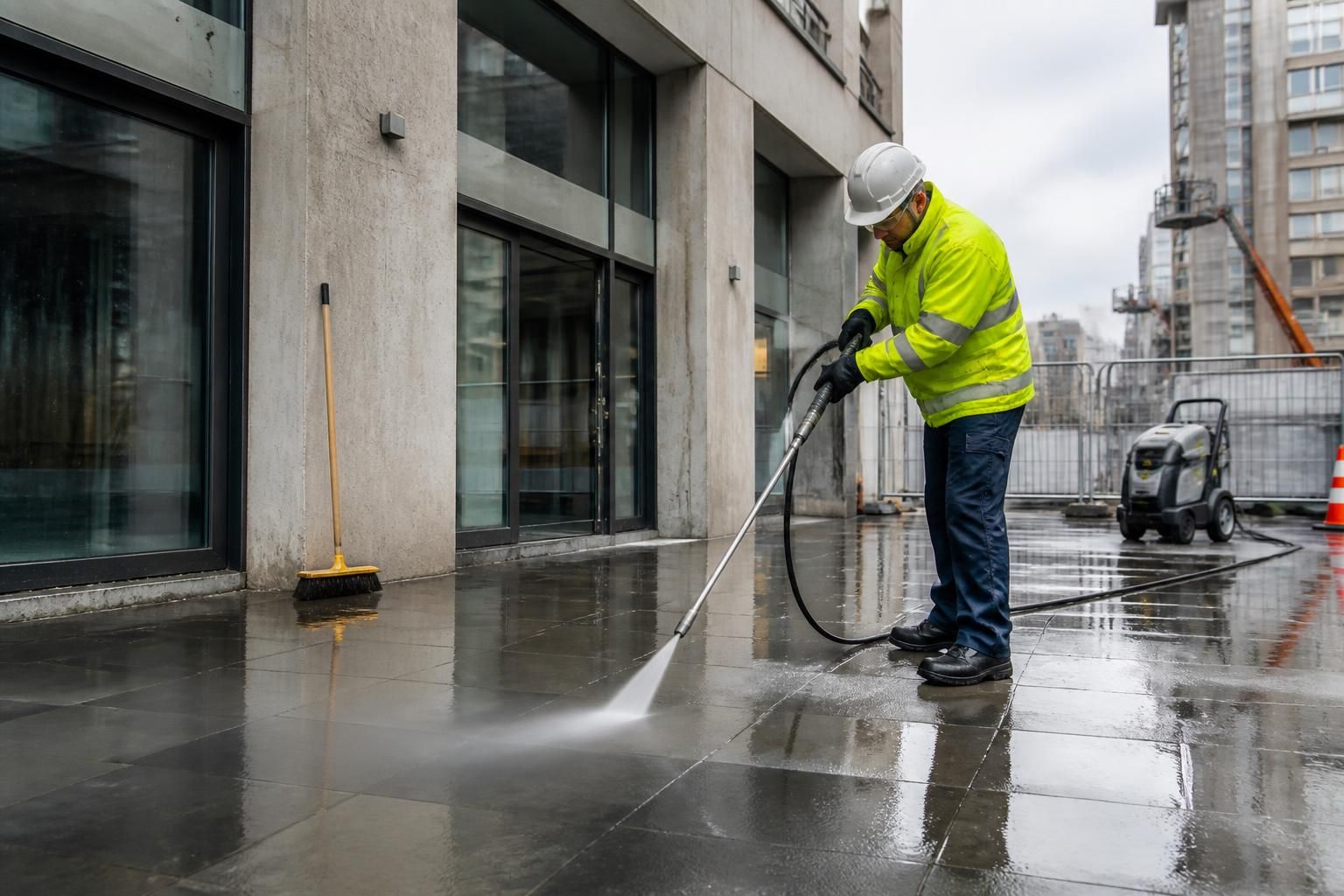
Separate clean-up areas from active construction operations. Barriers, cones, signage and controlled access points help protect cleaning teams and prevent other workers, visitors or members of the public from entering the work zone. The exclusion area should reflect the work being carried out. Pressure washing, steam cleaning, chemical application and high-level work may require a wider exclusion zone than low-level sweeping.
Plant routes, pedestrian routes and waste routes should be kept distinct wherever possible. If a shared route is unavoidable, it should be clearly marked, adequately lit and managed by the responsible site team. Tools, hoses, cables and removed materials must not be left across access routes or near stairways, doorways and emergency exits.
Control dust at the source. Dry sweeping and uncontrolled compressed air can spread fine dust from concrete, mortar, plasterboard, insulation and other construction materials. Dust should be reduced through suitable methods such as vacuuming with appropriate filtration, damp cleaning, local extraction or controlled low-pressure washing. Water suppression must be planned carefully to avoid creating slip hazards, damaging unfinished surfaces or allowing contaminated run-off to enter drains.
Where respirable dust may be present, the control strategy should follow the relevant COSHH assessment and site requirements. Respiratory protective equipment should only be used as part of a wider control system, with the correct type, fit, maintenance and face-fit testing where required. Workers should not be expected to rely on disposable masks as a substitute for effective dust extraction or suppression.
Use PPE that matches the task. Depending on the work, this may include protective footwear with suitable slip resistance, gloves selected for the material or chemical being handled, eye or face protection, hearing protection, hard hats, high-visibility clothing and protective clothing. PPE should be inspected before use and replaced if damaged or contaminated. It should also be compatible with other equipment, particularly when workers are using respiratory protection, face shields or harnesses.
Protective equipment does not remove the need for safe working methods. For example, eye protection is still required when splashing could occur, even if a chemical is diluted, and gloves do not make it safe to handle sharp debris without suitable tools.
Remove debris using controlled methods. Broken masonry, exposed fixings, nails, screws, glass, cable offcuts and sharp sheet materials should be collected with suitable tools rather than by hand wherever possible. Waste should be placed directly into stable containers or designated skips. Containers must not be overfilled, and heavy or awkward items should be handled using mechanical assistance or team lifting where appropriate.
Waste should be separated according to the site waste plan. General construction waste, recyclable materials, contaminated materials and hazardous waste may require different containers and disposal arrangements. Waste transfer documentation and duty-of-care requirements should be followed, while materials suspected of containing asbestos, lead, solvents, oils or other hazardous substances should not be disturbed or disposed of as ordinary waste. Work should stop and the site manager or an appropriately qualified specialist should be informed.
Prevent slips, trips and falls. Standing water, slurry, cleaning chemicals, loose dust and debris can all make surfaces unsafe. Hoses and cables should be routed away from walkways or protected with suitable covers. Wet areas should be signed and cordoned off until dry or otherwise safe to use. Where water is used externally, drainage should be checked in advance and run-off controlled so that it does not flow onto public footways, roads or neighbouring property.
High-level cleaning requires additional controls. Ladders should not be used as a default work platform where a safer alternative is available. Suitable access equipment, edge protection, scaffold arrangements or fall-arrest systems should be selected according to the height, duration and nature of the task. Access equipment must be inspected, positioned on stable ground and operated by competent personnel. No one should work beneath suspended loads or below another team where falling objects could cause injury.
Control machinery, water and chemicals. Pressure washers, steam cleaners, vacuums and other powered equipment should be checked before use, with particular attention to hoses, electrical leads, guards, connections and emergency isolation controls. Electrical equipment must be suitable for the environment, especially where water is present. Operators should be trained in the equipment being used and should never direct high-pressure water at people, live electrical equipment, fragile finishes or unprotected openings.
Cleaning products should be selected for the surface and contamination involved. Product labels and safety data should be followed, chemicals should be stored securely and incompatible products must never be mixed. COSHH controls should cover dilution, ventilation, PPE, spill response, storage and disposal. Test cleaning a small, inconspicuous area can help identify staining, colour change, etching or damage before a larger surface is treated.
Keep the site clean throughout the work, not only at the end. A staged approach limits the amount of debris and contamination that can be redistributed. Larger waste should be removed first, followed by dust removal, surface cleaning, detail work and the final treatment of access routes and plant areas. Cleaning from higher surfaces downwards and from cleaner areas towards dirtier collection points can reduce recontamination.
Temporary storage areas, welfare approaches, fire points, emergency equipment and escape routes should remain accessible. Spillages should be isolated and dealt with promptly using the correct absorbent or containment method. Contaminated water and residues must be collected or discharged only in accordance with the site’s environmental controls.
Communicate responsibilities clearly. Everyone involved should know which areas are closed, which hazards remain, how to report defects and who has authority to release an area. Daily briefings or toolbox talks are useful when several trades are working around the clean-up operation. Any incident, near miss, equipment fault, chemical spill or unexpected material should be recorded and reviewed before work continues.
Complete a documented final inspection. The inspection should confirm that floors, façades, cladding, roofs, plant areas, loading zones, car parks and access routes are free from loose debris, excessive dust, chemical residue, standing water, sharp objects and avoidable trip or slip hazards. Drainage points should be clear, waste should have been removed or secured, and temporary barriers should remain in place wherever an area is not yet safe.
For larger projects, the handover should include photographs, outstanding items, waste records where applicable and any restrictions on using recently cleaned surfaces. Professional post-construction cleaning teams such as Encanto Exterior Cleaning can work within the principal contractor’s site rules, using pressure washing, steam cleaning, dust-control methods and suitable access equipment to support a safe, orderly handover across commercial and industrial premises.
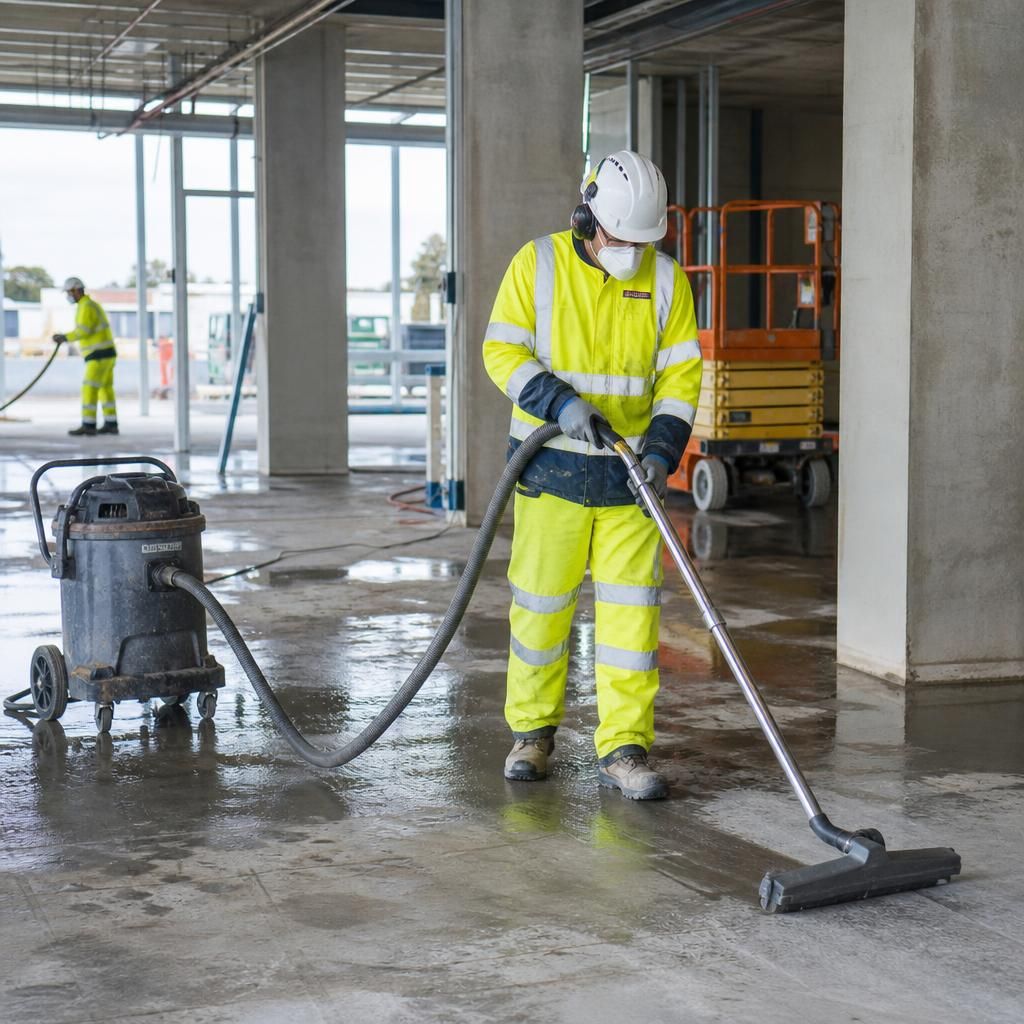
Dust control is a key safety measure during construction site clean-up because dry sweeping, compressed air and uncontrolled debris movement can spread fine particles into occupied areas and create respiratory, visibility and slip hazards. Use suitable industrial vacuuming, damp cleaning, local extraction or controlled low-pressure washing according to the material and surface being cleaned.
Dust suppression should be planned alongside drainage and access controls. Water must not be used in a way that creates standing water, damages unfinished surfaces or allows contaminated run-off to enter drains. Where respirable dust may be present, follow the site’s COSHH assessment and use respiratory protective equipment only as part of a wider control strategy, with appropriate selection, maintenance and fit testing.