
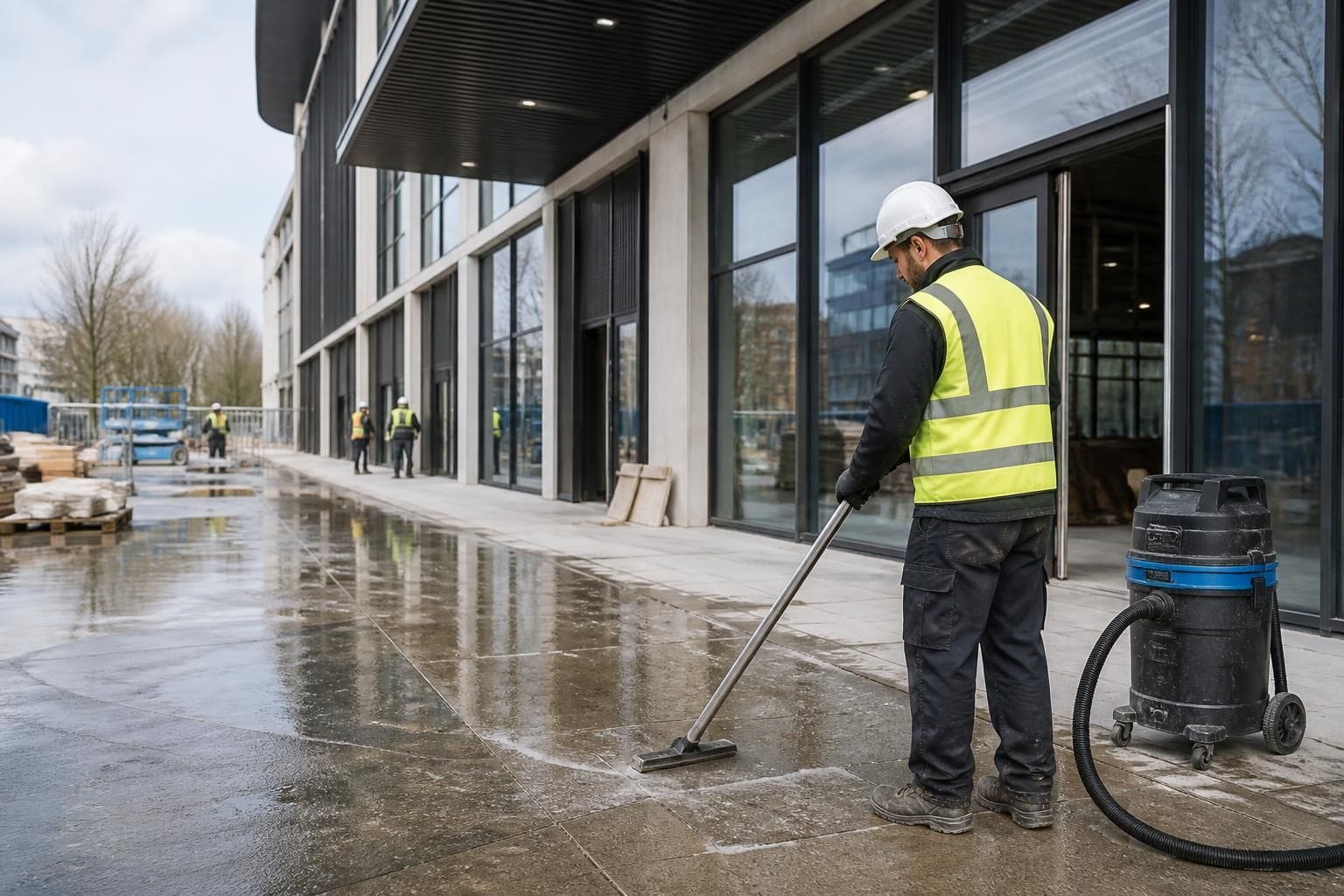
What key factors should I consider when selecting a post construction clean up service for my project?
When selecting a post construction clean up service, assess its relevant project experience, health and safety procedures, equipment, environmental controls, insurance and ability to meet your programme. Request a clear, itemised quotation and confirm the planned scope, access arrangements, waste handling and quality checks before work begins.
Select a post construction clean up service by assessing its experience with comparable projects, understanding of construction-site risks, cleaning methods, equipment, waste controls, insurance and ability to work to your programme. A reliable contractor should inspect the site before quoting, define exactly what will be cleaned, explain how the work will be controlled and provide an itemised quotation that can be checked against your handover requirements.
The cheapest quotation is not necessarily the most suitable. Post construction cleaning can involve fine dust, cement residue, paint splashes, adhesive, silicone, plaster, packaging waste and contamination around newly installed surfaces. The contractor must have the knowledge and equipment to remove these materials without damaging façades, cladding, glazing, floors, fixtures or external areas.
Relevant project experience
Look for experience in the type of property and construction phase involved. A contractor working on a commercial development, industrial premises, housing scheme, public building or infrastructure project should understand the different access, security, sequencing and handover requirements that apply to each environment. Ask for examples of comparable work, particularly projects involving multiple trades, occupied neighbouring premises, external areas or restricted access.
Experience should also cover the required cleaning surfaces and locations. This may include glazing, frames, façades, cladding, roofs, loading areas, car parks, stairwells, plant areas and welfare facilities. Cleaning a newly completed building is different from carrying out a routine office clean, so confirm that the contractor regularly handles builders’ cleans, sparkle cleans and final presentation work.
A clearly defined scope of work
Before appointing a service, agree what is included, excluded and treated as a variation. The scope should identify the areas to be cleaned, the level of finish required, the materials to be removed and whether the work will be completed in phases or as a single visit. It should also clarify who is responsible for removing surplus building materials, separating recyclable waste and clearing areas that remain under the control of other trades.
For larger projects, request a site survey and written method statement rather than relying on a broad description such as “builders’ clean”. The survey should consider the condition of the surfaces, construction residue, water and power availability, drainage, pedestrian routes, vehicle movements, access restrictions and any areas that cannot safely be cleaned using water or pressure.
Suitable methods and professional equipment
The contractor should select methods according to the surface and type of residue. Pressure washing can be effective for robust external surfaces, while steam cleaning or lower-pressure techniques may be more appropriate where excessive water, heat or force could cause damage. Specialist vacuum equipment, filtration, squeegees, scrapers and surface-safe cleaning agents may be needed for internal finishing work and fine dust removal.
Ask how the proposed equipment will be used and controlled. High-pressure water can drive contamination into joints, damage coatings or affect unsealed materials if applied incorrectly. Chemical products should be suitable for the surface, used in accordance with the manufacturer’s instructions and prevented from entering surface-water drainage systems. Where work is at height, confirm that the contractor has appropriate access equipment and trained operators rather than relying on improvised access arrangements.
Health and safety arrangements
Safety documentation should be proportionate to the project and available before work starts. This normally includes risk assessments, method statements, control measures for hazardous substances, equipment checks, personal protective equipment requirements and emergency arrangements. On an active construction site, the cleaning team must follow the site induction, traffic management, permit systems and coordination arrangements established by the principal contractor or site manager.
Check how the contractor will control common risks such as slips, trips, work at height, moving vehicles, falling objects, electrical equipment, wet surfaces and contact with construction chemicals. If materials that may contain asbestos, lead, silica or other hazardous substances are suspected, cleaning should not proceed without suitable identification and specialist advice. A general cleaning contractor should not be expected to undertake licensed hazardous-material removal unless it is properly authorised and competent to do so.
Insurance, competence and supervision
Ask for evidence of appropriate public liability and employers’ liability insurance, and check whether the level and scope are suitable for the project. Depending on the work, additional cover may be relevant for hired equipment, specialist access operations or accidental damage to property. The contractor should also be able to explain how operatives are trained, supervised and briefed for the specific site.
Competence is particularly important where operatives use pressure-washing systems, steam equipment, powered machinery, lifting equipment or mobile access platforms. Confirm that equipment operators hold the relevant training and that the site will have a responsible supervisor who can coordinate with the construction team and respond to changing conditions.
Waste and environmental controls
Clarify how dust, slurry, wastewater, packaging and other waste will be contained, transported and disposed of. Waste should be handled in line with the applicable duty of care requirements, with appropriate records such as waste transfer documentation where required. A contractor should never allow contaminated wash water, chemicals or construction residue to enter surface-water drains without suitable controls and approval.
Ask whether the proposed products and processes minimise unnecessary water use, chemical discharge and airborne dust. On a Birmingham or wider West Midlands site, local drainage arrangements, neighbouring properties and restrictions on vehicle movements may affect the cleaning plan. Environmental controls should be included in the method statement rather than added informally once work has begun.
Programme, access and coordination
Confirm when the cleaning can start, how long each phase is expected to take and what must be ready beforehand. Post construction cleaning is often dependent on the completion of other trades, installation of permanent services, removal of protective coverings and safe access to the relevant areas. A good programme identifies these dependencies and allows time for inspection, remedial cleaning and final sign-off.
Discuss working hours, out-of-hours requirements, parking, loading, keys, security, welfare facilities, power, water, storage and waste collection. If the property is partly occupied or located in a busy commercial area, the contractor should explain how noise, overspray, dust, pedestrian movement and disruption will be controlled.
Quality assurance and handover
Agree how the finished work will be inspected. This may involve room-by-room checks, area schedules, photographs, snagging lists or a joint walk-through with the client, main contractor or site manager. The acceptance standard should be specific enough to identify issues such as remaining grout haze, paint marks, adhesive residue, dust on high-level surfaces, streaked glazing or debris in external areas.
Find out how defects identified during inspection will be recorded and corrected, and whether a return visit is included where the agreed scope has not been met. Clear quality checks reduce disputes and help ensure that cleaning is completed before practical completion, tenant occupation or client handover.
Quotation and contract clarity
Request an itemised quotation showing labour, equipment, access arrangements, cleaning products, waste handling and any applicable additional charges. It should state whether the price is fixed or subject to site conditions, and explain how variations will be authorised. Pay particular attention to exclusions involving heavy residue, high-level work, specialist stains, waste removal, water supply and cleaning after further construction activity.
Before accepting the quotation, confirm the payment terms, cancellation arrangements, programme, insurance details, responsibilities for damage and the process for approving extra work. Written records are especially important where several contractors remain active on the site and the condition of an area may change between the survey and the cleaning date.
Finally, assess the contractor’s communication during the quotation stage. Prompt, specific answers and a practical site plan usually indicate that the team has understood the project. Once appointed, maintain a named point of contact and provide updates on access, sequencing and newly identified risks. Selecting a service on this basis gives you a safer, more controllable clean and a clearer route to achieving the required handover standard.

A clear, site-specific scope is one of the most important factors when selecting a post construction clean up service. Before work begins, the contractor should inspect the project and record the areas, surfaces, construction residues and finish standard included in the clean.
The quotation should distinguish between routine builders’ cleaning, final presentation work, external cleaning, high-level access, waste removal and specialist residue removal. It should also state what is excluded and how additional work will be approved if further construction activity leaves new dust, adhesive, paint or packaging behind.
For larger or active sites, ask for a written method statement covering access, water and power supplies, drainage, pedestrian routes, vehicle movements and coordination with other trades. This gives all parties a practical reference point and helps ensure the finished clean can be checked against the handover requirements.
Request Your Post Construction Cleaning Assessment
Request your post construction cleaning assessment so we can review the site condition, required cleaning methods, access arrangements and handover standard. We will use this information to prepare a clear scope of work and quotation for your project.