
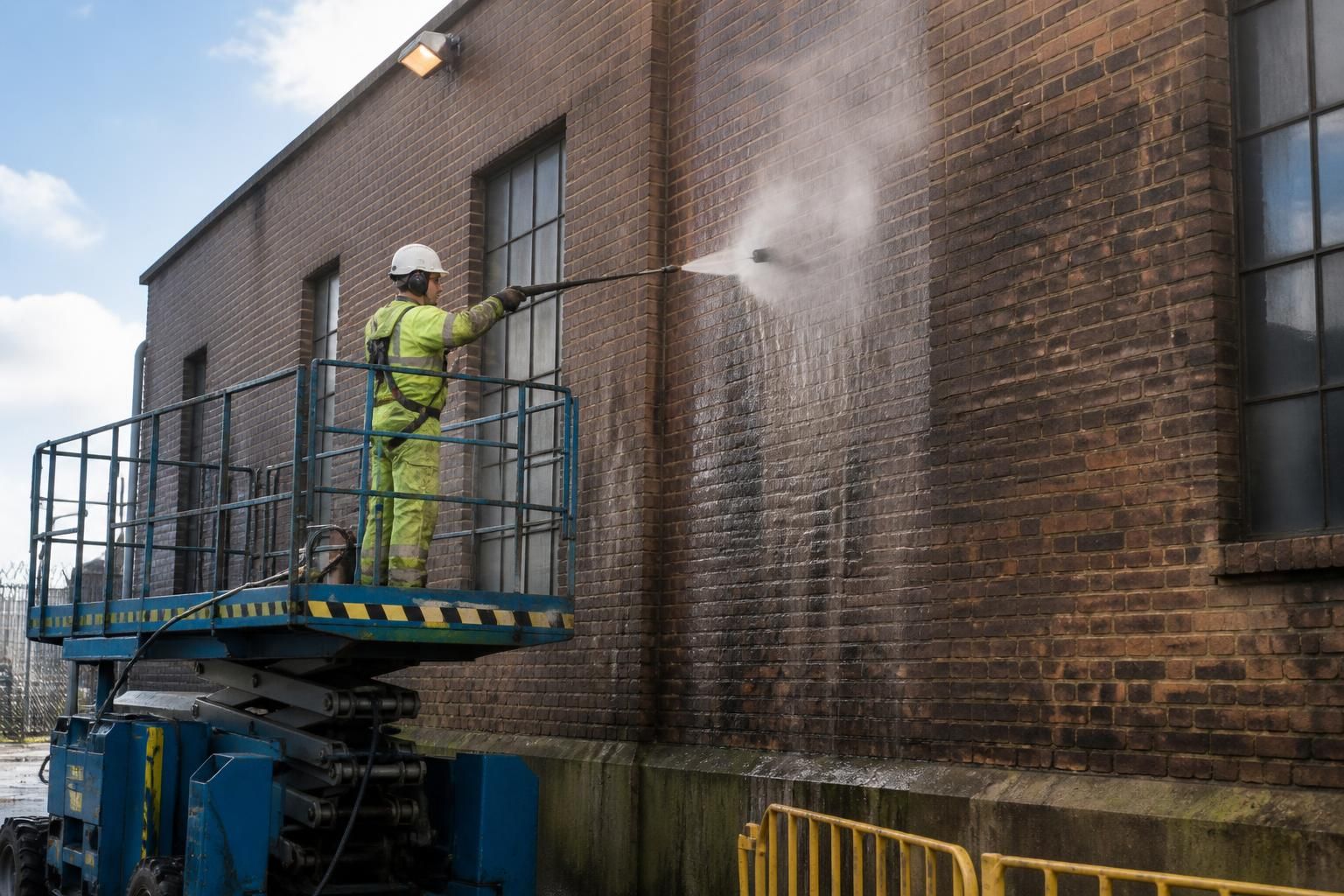
What safety measures should be considered during industrial brick cleaning?
Industrial brick cleaning should be carried out under a documented risk assessment and method statement, with suitable PPE, controlled access, safe work-at-height arrangements and measures to protect nearby people, property and the environment. Operators must also select cleaning methods and pressures that will not damage the brickwork, control dust, spray and chemical exposure, and inspect equipment before work begins.
Industrial brick cleaning should be planned through a documented risk assessment and method statement, supported by competent operators, suitable personal protective equipment, controlled access and safe systems of work. The process must protect workers, the public, adjacent property and the brickwork itself. The controls required will depend on the building, contamination, cleaning method, access arrangements and surrounding environment.
Complete a site-specific risk assessment
Before work starts, the contractor should inspect the elevations and record hazards such as unstable brickwork, damaged joints, loose masonry, fragile surfaces, overhead services, vehicle movements, restricted access and nearby occupants or members of the public. The assessment should also consider weather, drainage, water run-off, chemical exposure, dust, noise and the potential for falling debris.
A written method statement should explain the proposed cleaning sequence, equipment, pressures, products, access system, exclusion zones, waste controls and emergency arrangements. It should be briefed to everyone involved, with workers given the opportunity to raise site-specific concerns before cleaning begins. If conditions change, the assessment and method statement should be reviewed rather than relying on the original plan.
Use competent and suitably trained operatives
Industrial brick cleaning should be undertaken by people who understand masonry, cleaning chemistry, pressure equipment and the risks associated with working at height. Operatives should know how to identify vulnerable brick, soft mortar, spalled faces, historic repairs and coatings that may react differently to cleaning.
Training should cover the safe operation of pressure washers, steam equipment, access equipment and any chemicals in use. Where applicable, operators should also have the appropriate training for harnesses, mobile elevated work platforms, scaffolding, abrasive or water-fed equipment and site emergency procedures. Supervision should reflect the complexity and risk of the work.
Control access and protect other people
Cleaning areas should be separated from pedestrians, vehicles, tenants and other contractors. Barriers, warning signs and, where necessary, a banksman or marshal should be used to prevent people entering the work zone. Particular care is needed around entrances, pavements, roads, loading areas, schools, occupied premises and shared commercial sites.
Windows, doors, ventilation openings, electrical equipment, vehicles, signage and finished surfaces should be protected from water, spray, dust and cleaning products. The work should be coordinated with the building manager and other trades so that people are not exposed to falling debris, overspray or unexpected changes in access.
Plan work at height properly
Where brickwork cannot be cleaned safely from ground level, the safest practical access method should be selected after assessing the height, reach, ground conditions, duration and nature of the task. Scaffolding, mobile elevating work platforms, towers or other systems must be installed, inspected and used in accordance with their design and the relevant work-at-height controls.
Access equipment should stand on suitable ground and must not be positioned where it can be struck by vehicles, affected by unstable surfaces or exposed to unsafe proximity to overhead services. Operatives should use edge protection and fall-prevention or fall-arrest equipment where required, with a realistic rescue plan. A harness is not a substitute for choosing a suitable access system or preventing a fall in the first place.
Tools, hoses and attachments should be secured to prevent objects falling onto people below. The work area should be checked after breaks, movement of equipment or adverse weather, and access equipment should not be altered by unapproved personnel.
Select a cleaning method that will not damage the masonry
Safety includes preventing structural and material damage. Before full-scale cleaning, the contractor should inspect the brick type and condition and carry out a controlled trial in an inconspicuous area. The trial should confirm the lowest effective pressure, temperature, dwell time and product concentration, while checking for colour change, surface erosion, joint loss, staining and water penetration.
Pressure should never be increased simply to remove stubborn contamination. Excessive pressure, unsuitable nozzles or holding the lance too close to the wall can remove the brick face, open joints and drive water into the building. Historic, handmade, soft or already deteriorated brickwork may require a gentler approach, such as low-pressure washing, steam cleaning or carefully controlled chemical treatment.
Operators should maintain a stable stance and keep hoses routed so that they do not create trip hazards or pull unexpectedly on the lance. Pressure equipment must never be directed at people, live electrical equipment, fragile glazing or unprotected openings.
Manage chemicals and exposure
Any detergent, biocide, acid, alkaline cleaner or other treatment should have a current safety data sheet and be assessed under the Control of Substances Hazardous to Health requirements. The assessment should cover storage, dilution, application, contact risks, ventilation, incompatible substances, spill response and disposal.
Only products suitable for the brick and surrounding materials should be used. Operatives should follow the product instructions and never mix chemicals unless the manufacturer specifically permits it. Appropriate gloves, eye or face protection, protective clothing and respiratory protection should be selected from the exposure assessment rather than used generically.
Where spray, mist or vapour could affect workers or the public, application should be controlled through product choice, ventilation, isolation and suitable respiratory protective equipment. Skin and eye washing facilities should be available, and contaminated clothing should be removed or managed safely. Chemical containers must be clearly labelled and secured when not in use.
Control dust, spray, noise and water
Dry brushing, abrasive cleaning and other processes that generate airborne dust require additional controls. Dust should be reduced at source where practicable, with suitable extraction, suppression, respiratory protection and restricted access. The material being removed should be considered, particularly where old coatings, soot or unknown deposits may contain hazardous substances.
Noise from pumps, compressors and access equipment should be assessed and controlled through equipment selection, maintenance, separation and hearing protection where necessary. Residents, tenants and neighbouring businesses may need advance notice if the work is likely to cause disruptive noise.
Water and cleaning residues should be prevented from entering electrical installations, occupied areas, neighbouring property or public drainage without approval. Run-off should be contained, filtered or collected as required, and contaminated water and debris should be disposed of through an appropriate route. Wet surfaces can also create slip hazards, so walkways and access routes should be kept clear or temporarily closed.
Inspect and maintain equipment
Pressure washers, hoses, lances, pumps, chemical dosing systems and electrical supplies should be inspected before use and maintained in line with the manufacturer’s instructions. Operatives should check for damaged hoses, loose couplings, blocked nozzles, defective guards, leaks and signs of wear. Defective equipment must be removed from service.
Electrical equipment should be suitable for the environment and protected against water ingress. Cables and hoses should be routed to reduce trip, crush and vehicle-strike risks. Equipment used at work should be properly maintained and subject to the relevant inspection requirements, including the Provision and Use of Work Equipment Regulations where applicable.
Consider the building and hidden hazards
Pre-cleaning checks should identify cracks, loose bricks, failing pointing, unstable parapets, voids, concealed services and areas where water could enter the building. Cleaning should stop if masonry begins to move, a cavity is exposed, unexpected material is discovered or the substrate reacts adversely.
Particular care is required around electrical intake points, lighting, alarms, vents, roof edges, fragile cladding and sealed or unsealed openings. Building occupants should be informed about any temporary isolation of services, restricted access or ventilation requirements.
Have emergency arrangements in place
The site should have clear arrangements for first aid, emergency communication, chemical splashes, electric shock, falls from height, equipment failure, sudden water ingress and uncontrolled public access. Operatives should know the location of first-aid equipment, eye-wash facilities, fire equipment and the nearest safe assembly point.
A rescue plan is essential where harnesses, suspended access or powered access equipment are used. It should identify who will raise the alarm, how assistance will be provided and what equipment is available. Relying solely on emergency services may not be sufficient for a prompt rescue from height.
Monitor the work and complete a handover
Supervisors should check that controls remain effective throughout the job, especially when moving between elevations or changing cleaning methods. Work should be paused during unsafe weather, loss of exclusion control, equipment defects, unexpected contamination or any deterioration in the building fabric.
On completion, the area should be inspected for residual chemicals, loose material, slippery surfaces, blocked drainage and damage to adjacent property. Barriers should remain in place until the area is safe for normal use. The handover should record any defects identified, repairs recommended, waste arrangements and limitations on the cleaning carried out.
For UK industrial sites, these precautions should be integrated with the site’s own health and safety arrangements and relevant legal duties, including the Health and Safety at Work etc. Act, the Work at Height Regulations, COSHH, PUWER and PPE requirements where they apply. The exact controls should always be confirmed through a competent, site-specific assessment rather than copied from a generic cleaning procedure.
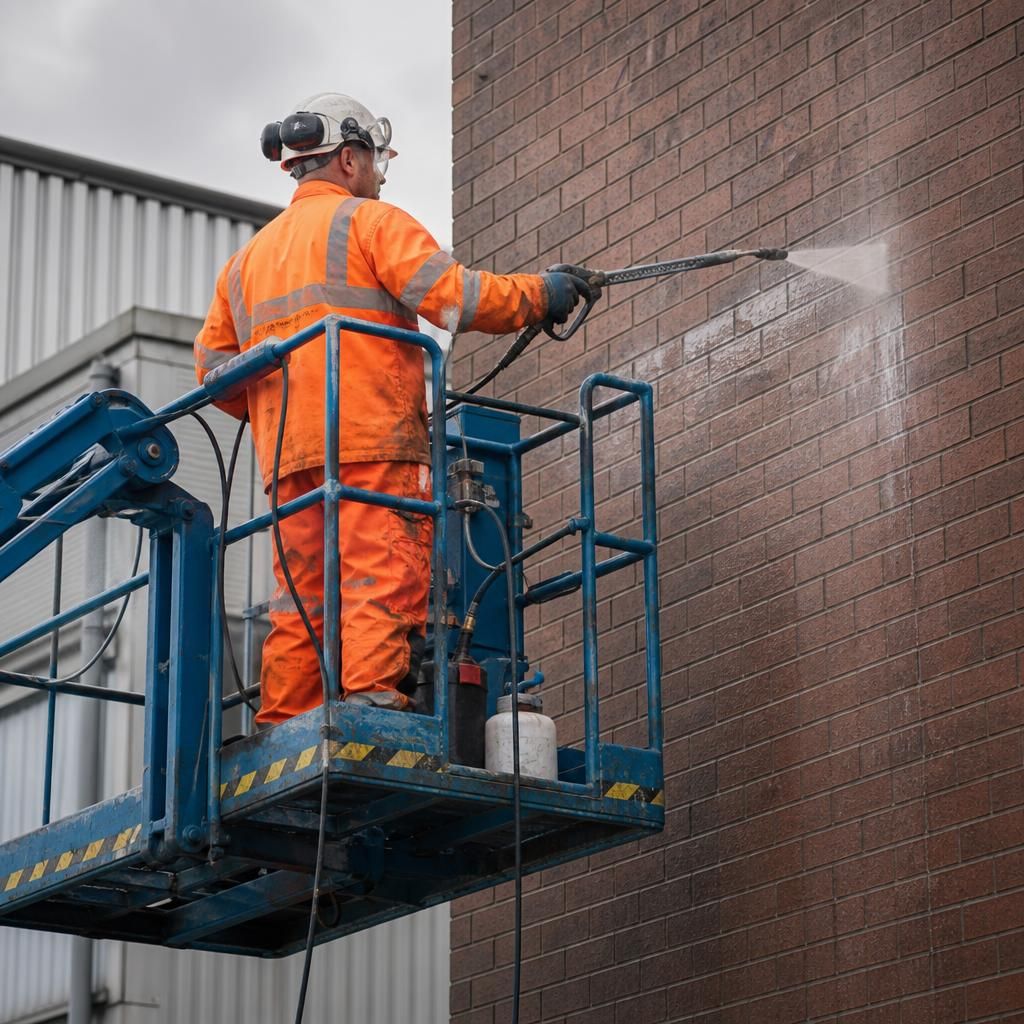
Safe access is a critical part of industrial brick cleaning where elevations cannot be reached from ground level. The contractor should select the safest suitable system for the building, task duration, ground conditions and working height, whether that means scaffolding, a mobile elevating work platform or another approved access arrangement.
Access equipment must be inspected, positioned on stable ground and protected from vehicles, overhead services and unauthorised movement. Tools and hoses should be secured to prevent falling objects, while edge protection and suitable fall-prevention equipment should be used where required. A documented rescue plan is also essential whenever operatives could be exposed to a fall.