
What factors should I consider when selecting an industrial brick cleaning service provider?
When selecting an industrial brick cleaning service provider, assess their experience with commercial brickwork, ability to identify suitable cleaning methods, health and safety procedures, insurance, access equipment and environmental controls. Also check the scope of their quotation, project planning, references and arrangements for protecting surrounding surfaces and managing waste.
The most important factors when selecting an industrial brick cleaning service provider are relevant experience, accurate assessment of the brickwork, safe and suitable cleaning methods, adequate insurance, effective project planning and a clearly defined quotation. The contractor should be able to demonstrate that it understands the condition and construction of industrial buildings, rather than treating the work as routine domestic pressure washing.
Relevant industrial experience
Ask whether the provider has completed comparable work on warehouses, factories, commercial estates, public buildings, boundary walls or other large-scale brick structures. Industrial brickwork may include aged or damaged bricks, dense engineering bricks, soft handmade bricks, mortar affected by weathering and areas contaminated by soot, oil, cement, paint or other deposits. Experience with similar materials and contaminants helps the contractor select a controlled process without causing unnecessary surface damage.
It is also useful to ask for appropriate case studies, references or details of previous projects. These should relate to the scale, access conditions and type of brickwork involved, not simply general exterior cleaning. A reputable provider should be able to explain the problems encountered, the method selected and how risks were controlled.
Inspection and method selection
A proper assessment should take place before the quotation is finalised. The contractor should inspect the brick type, mortar condition, extent of soiling, previous repairs, painted or coated areas, drainage arrangements and surrounding surfaces. They should also identify fragile or defective sections that may require repair before cleaning.
Be cautious of a provider that recommends one standard method without examining the building. Depending on the surface, industrial brick cleaning may involve low-pressure washing, controlled pressure washing, steam cleaning, specialist chemical treatment, abrasive techniques or a combination of processes. The chosen approach should be justified in relation to the brick and mortar, the deposits being removed and the required finish.
Ask whether a small test area will be completed before the main work begins. Testing allows the contractor to confirm the cleaning effect, check for colour changes or damage and agree an acceptable finish with the client. It can also reveal whether mortar joints, coatings or repairs react differently from the surrounding brickwork.
Health and safety arrangements
Industrial brick cleaning can involve pressurised water, chemicals, falling debris, wet surfaces, traffic, plant, work at height and restricted access. The provider should supply suitable risk assessments and method statements and explain how these hazards will be managed. Enquire about exclusion zones, pedestrian and vehicle segregation, site inductions, emergency arrangements and communication with other contractors.
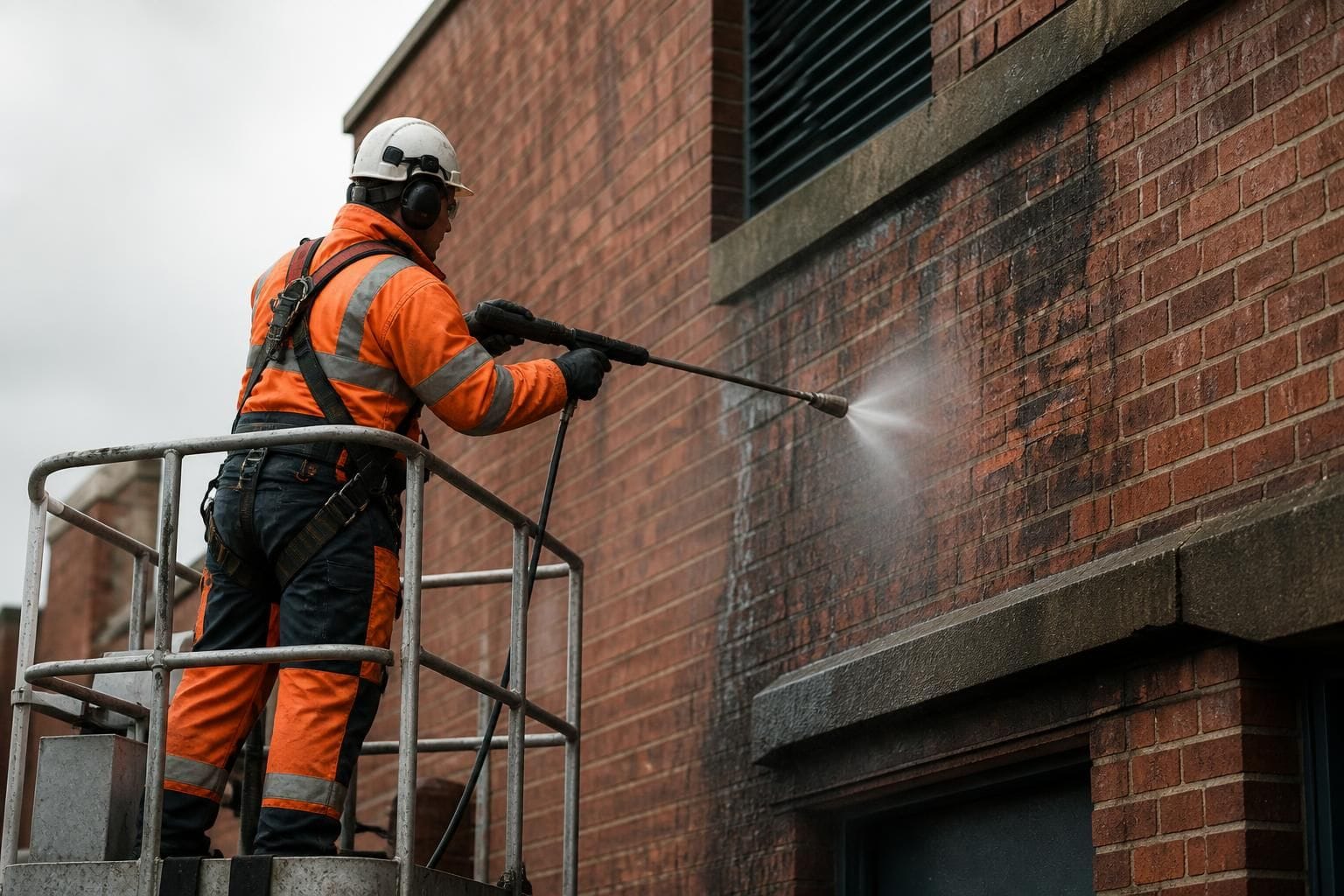
Where access equipment is needed, confirm that the contractor can select and operate suitable equipment for the building and ground conditions. This may include access platforms, towers, scaffolding or other specialist systems. Equipment should be properly inspected and operated by trained personnel. The provider should also plan for overspray, falling debris and water movement so that people, vehicles and nearby operations are protected.
Insurance, competence and compliance
Check that the business holds appropriate public liability insurance and, where relevant, employers’ liability and cover for the equipment and activities involved. Request evidence of cover if it is not included in the tender documentation. Training, site qualifications and documented procedures are also relevant where the project involves work at height, chemicals, traffic management or specialist access equipment.
The contractor should be willing to work within the site’s own compliance requirements, permit systems and working-hour restrictions. For larger or higher-risk projects, ask who will supervise the work, how progress will be recorded and who will act as the point of contact.
Environmental controls and waste management
Cleaning methods should be assessed not only for their effect on the brickwork but also for their effect on drains, soil, neighbouring property and the wider site. Ask how wastewater, slurry, removed coatings and chemical residues will be contained, collected and disposed of. Discharges should not be allowed to enter surface-water drainage systems unless they are demonstrably permitted and appropriately controlled.
A responsible provider should minimise water and chemical use where practical, prevent uncontrolled run-off and explain any environmental restrictions that may affect the programme. This is particularly important on industrial sites where drains, storage areas, production facilities or sensitive neighbouring premises may be close to the cleaning zone.
Access and project planning
Confirm that the provider has considered the building’s height, elevations, rooflines, courtyards, loading areas, overhead obstructions, restricted entrances and ground conditions. Access arrangements can affect both the price and the programme, so they should be assessed before work starts rather than added as an unexpected cost.
The work plan should set out preparation, protection, testing, cleaning, rinsing where required, inspection and site clearance. It should also explain how the contractor will deal with weather, operational disruptions, deliveries and areas that cannot be taken out of service. Industrial cleaning often needs to be phased around the client’s activities, and a realistic programme should reflect that.
Clarity of the quotation
A useful quotation should define the areas included, the cleaning objective, the proposed method, access equipment, protection of adjacent surfaces, waste handling and any post-cleaning treatment. It should state whether preparatory repairs, paint removal, graffiti removal, sealants, traffic management or reinstatement are included or excluded.
Compare quotations on scope and risk controls, not price alone. A low quote may omit access, testing, wastewater management or protection measures that are essential to completing the work properly. Ask the provider to identify assumptions, potential variations and the circumstances in which additional work might be required.
Quality control and expected finish
Brick cleaning should remove the agreed contamination while retaining an appropriate, natural appearance. It should not be judged solely by how bright the surface looks. Excessive cleaning can open the brick face, erode mortar, expose aggregate or create uneven patches. Discuss the intended finish before work begins and agree how areas affected by historic staining, repairs or weathering will be assessed.
Find out how the work will be inspected during and after cleaning. A competent provider should monitor the test area and completed sections, identify any problems promptly and leave the site in a safe and orderly condition. Written records, photographs or completion notes can be useful for property managers responsible for ongoing maintenance.
Communication and ongoing support
Choose a contractor that provides a clear contact route and responds constructively to technical questions. The provider should explain what the team needs from the client, including access, isolations, permits, water supplies, welfare facilities and notification of building users. It should also communicate changes to the programme or method before they affect the work.
For buildings requiring regular cleaning, ask whether the contractor can recommend an appropriate maintenance schedule and identify the causes of recurring soiling. Ongoing maintenance may reduce the need for aggressive restoration cleaning, but the interval should be based on exposure, use, contamination and the condition of the brickwork rather than an arbitrary timetable.
Before appointing a provider, confirm that its experience, proposed method, safety documentation, insurance, environmental controls, access plan and quotation all match the requirements of the site. A contractor that can explain these points clearly is better placed to deliver effective industrial brick cleaning while protecting the building, its occupants and surrounding property.
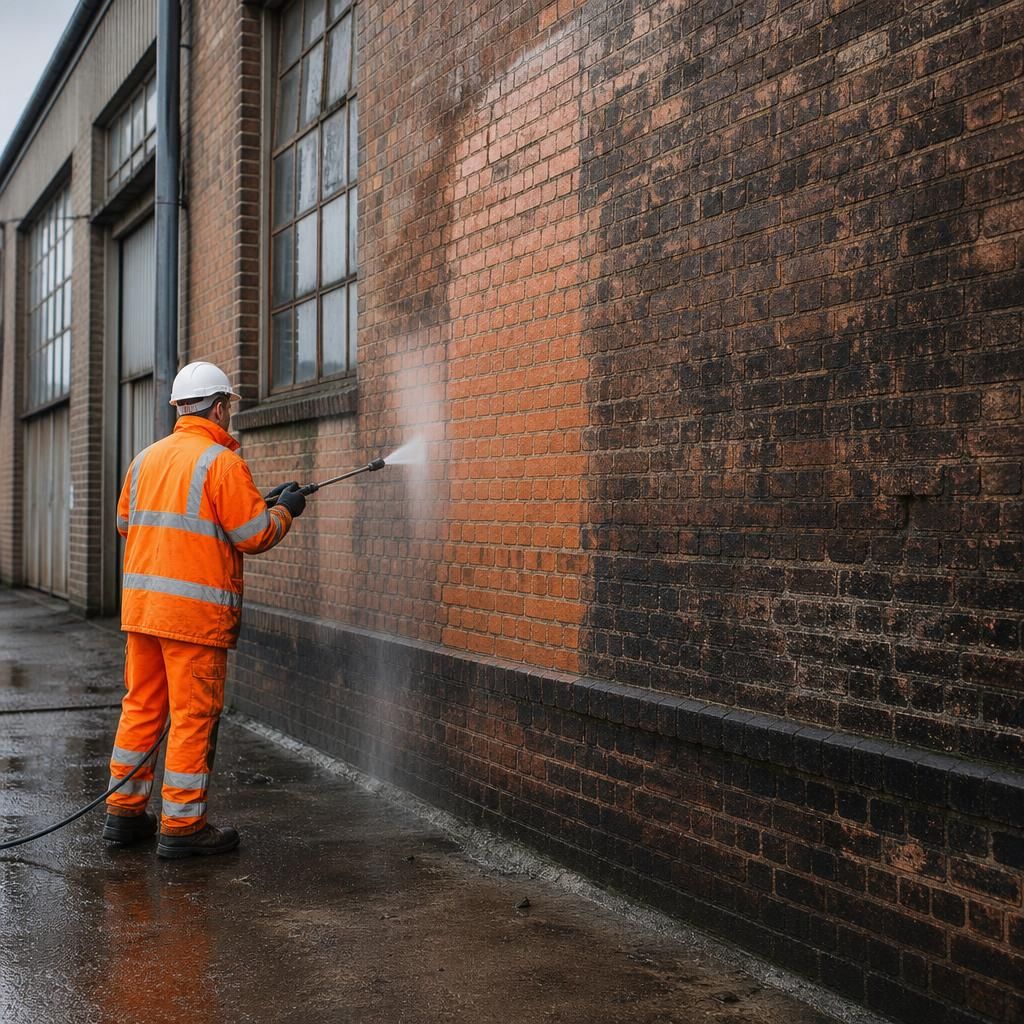
A competent industrial brick cleaning provider should inspect the brickwork and complete a controlled test area before recommending a full cleaning method. This confirms how the bricks, mortar, coatings and deposits respond, helping to prevent avoidable damage across the wider elevation.
The assessment should consider:
- brick type, age, surface condition and previous repairs;
- mortar strength, open joints and areas requiring repair;
- the type and severity of contamination, such as soot, cement, paint, oil or biological growth; and
- nearby surfaces, drainage, access restrictions and the risk of overspray or run-off.
The test area should be reviewed with the client before work proceeds. A reliable provider will explain the proposed pressure, temperature or chemical treatment, the expected finish and any limitations caused by weathering or historic staining. Be cautious of quotations based on a standard process without a site inspection, as an unsuitable method can erode mortar, damage the brick face or leave an uneven appearance.