
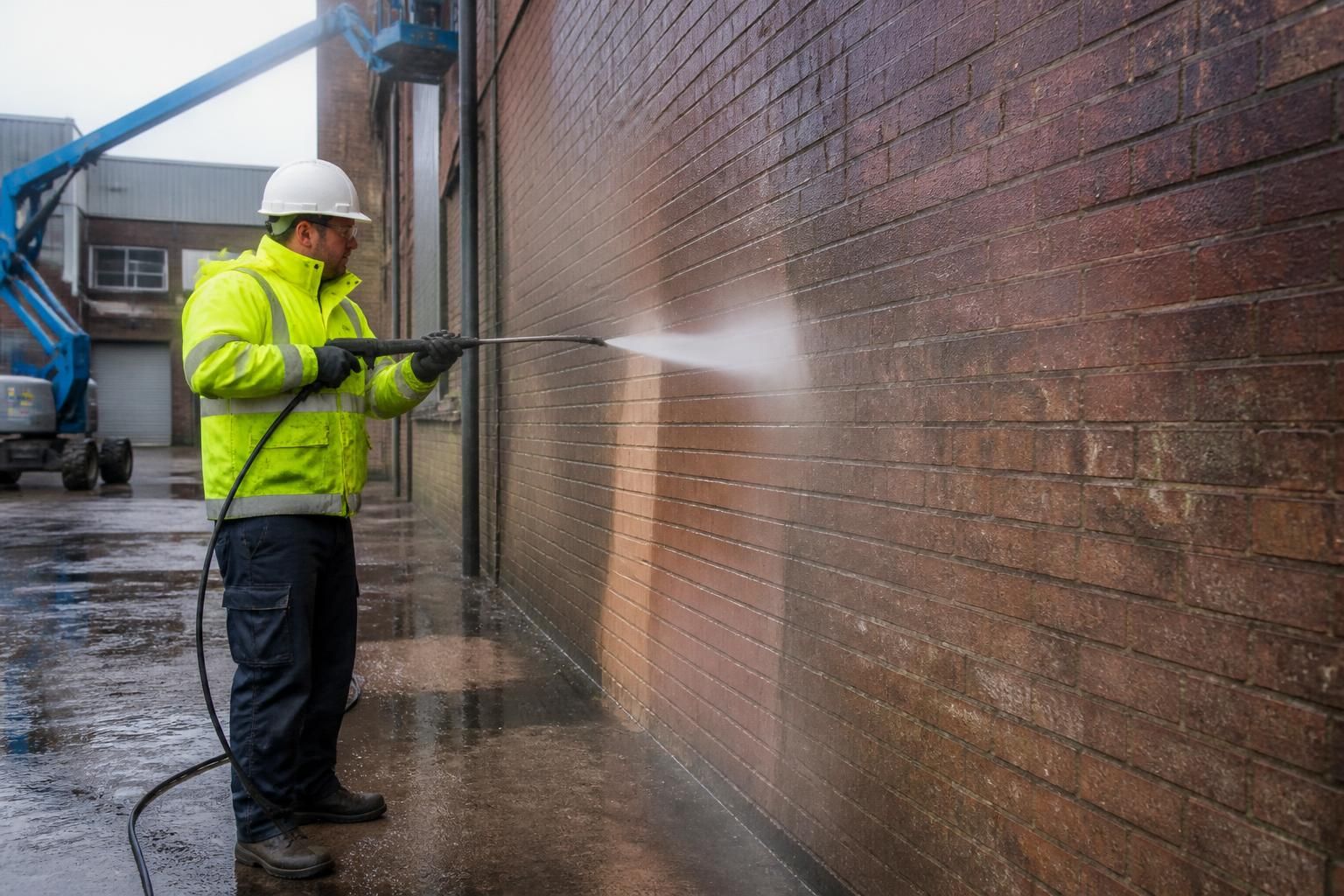
How does industrial brick cleaning differ from regular brick cleaning?
Industrial brick cleaning differs from regular brick cleaning because it is designed for large, complex sites with heavier contamination, stricter safety requirements and specialist access equipment. It typically involves a detailed survey, controlled cleaning methods and measures to protect surrounding structures, workers, the public and the environment.
Industrial brick cleaning differs from regular brick cleaning in its scale, planning, contamination levels, equipment and safety controls. It is carried out on large or complex buildings where brickwork may be affected by cement, mortar, paint, carbon deposits, traffic film, algae, efflorescence, oil or other construction and industrial residues. The objective is not simply to improve appearance, but to remove contamination without damaging the brick, mortar joints, adjacent materials or the surrounding site.
Scale and site complexity
Regular brick cleaning is often limited to a house, small commercial property or an accessible section of wall. Industrial work may involve warehouses, factories, schools, housing developments, transport buildings, public facilities and multi-storey premises. These sites can contain extensive elevations, recessed areas, rooflines, loading bays, service yards and surfaces that are difficult to reach from ground level.
Industrial projects therefore require a planned sequence of work. The cleaning team may need to divide the building into manageable sections, coordinate with site operations, protect entrances and equipment, and maintain safe access for vehicles, staff and the public. Water management, containment and waste collection also become more important as the treated area increases.
Type and severity of contamination
Brickwork on industrial and construction sites commonly has more persistent contamination than brickwork cleaned as part of routine property maintenance. Fresh mortar and cement deposits may have bonded to the surface, while older industrial premises can have layers of soot, atmospheric staining, grease, paint or biological growth. Some deposits are superficial; others may have penetrated porous brick or reacted with the masonry.
The correct treatment depends on the contaminant and the condition of the brick. Cement residue, for example, cannot always be treated in the same way as algae or general dirt. Attempting to remove every stain with greater pressure can cause more harm than the deposit itself. Industrial cleaning relies on identifying the material first and selecting a method that is effective but proportionate.
Surveying and testing
A domestic or small-scale clean may involve a relatively straightforward visual assessment. Industrial brick cleaning normally begins with a more detailed survey. This considers:
- the type, age and condition of the brick and mortar;
- the nature, thickness and distribution of the contamination;
- previous repairs, coatings, sealants or cleaning treatments;
- nearby materials such as glass, metal, render, stone, timber and painted surfaces;
- access requirements, working height and restrictions around the building;
- drainage, water supply, electrical equipment and other site services; and
- requirements for protecting people, vehicles, stock and neighbouring property.
Test cleaning is particularly important. A small, representative area can show whether a proposed pressure, temperature, cleaning agent or dwell time is suitable. It also helps establish the likely finish before the full project begins. Brick types can vary across the same site, so a test should not automatically be assumed to apply to every elevation or repair area.
Specialist equipment and access
Industrial brick cleaning may use pressure washing, low-pressure rinsing, steam cleaning, approved masonry detergents or carefully controlled abrasive techniques, depending on the surface and contamination. The equipment must allow the operator to regulate pressure, flow, temperature and application accurately rather than relying on maximum power.
Access equipment is another major difference. Scaffolding, mobile elevated work platforms, towers, rope access or other systems may be needed for high or obstructed elevations. The choice depends on the height, structure, ground conditions, duration of the work and the need to keep parts of the site operational. Access arrangements must be planned and used by competent personnel, with suitable exclusion zones and control measures.
Greater emphasis on protection and containment
On an industrial site, run-off and airborne debris can affect drains, machinery, stored materials, vehicles and neighbouring premises. Cleaning may therefore require sheeting, drain covers, bunding, collection systems or staged rinsing. Windows, vents, electrical fittings and sensitive plant need to be protected before work starts.
Wastewater and removed residues should be managed in accordance with the site’s procedures and applicable environmental requirements. Contaminated water must not be allowed to enter surface-water drainage systems where it could cause pollution. The method may need to be adapted if the site has limited drainage, restricted water discharge or sensitive surrounding land.
More demanding health and safety controls
Industrial brick cleaning can combine pressurised water, chemicals, working at height, vehicle movements, electrical hazards and falling debris. It may also take place near members of the public, employees, contractors or operating machinery. A suitable plan should address the specific risks rather than treating the work as ordinary washing.
Controls can include site inductions, risk assessments, method statements, personal protective equipment, segregated work areas, traffic management, safe access systems and procedures for handling cleaning agents. Operators must also consider the risk of slips from wet surfaces, splashback, dust or vapour, hidden building defects and unexpected reactions between cleaning products and existing materials.
Quality requirements and acceptable results
Industrial brick cleaning is often part of a wider construction, refurbishment or facilities-management programme. The required result may be a consistent appearance across an elevation, removal of construction staining before handover, preparation for repointing or coating, or improved presentation of a public-facing site. The standard must be agreed in advance because some deep staining, weathering or colour variation may be permanent and excessive cleaning could damage the masonry.
Professional work should distinguish between removing contamination and altering the character of the brick. Over-cleaning can expose softer material, erode arrises, open the brick surface or weaken mortar joints. A controlled finish is generally more important than making every section look artificially new.
Time, coordination and cost
Industrial projects usually need more preparation and coordination than regular brick cleaning. The duration is affected by the size and height of the building, access arrangements, contamination, weather, water and waste controls, testing requirements and whether the site can remain operational during the work. Work may need to be phased around deliveries, production, school hours or public access.
Costs are consequently influenced by more than the cleaning method alone. Surveying, access equipment, protection, containment, labour, traffic management, wastewater handling and any required out-of-hours working may all form part of the scope. Comparing quotations is most useful when each one clearly defines the areas included, proposed method, preparation, protection and expected finish.
In summary, regular brick cleaning may be a relatively simple maintenance task, while industrial brick cleaning is a controlled specialist operation. The key differences are the larger and more complex working environment, heavier or more varied contamination, need for tested methods and access equipment, and stronger requirements for safety, protection and environmental management. These controls help achieve a suitable clean while preserving the brickwork and keeping the wider site under control.
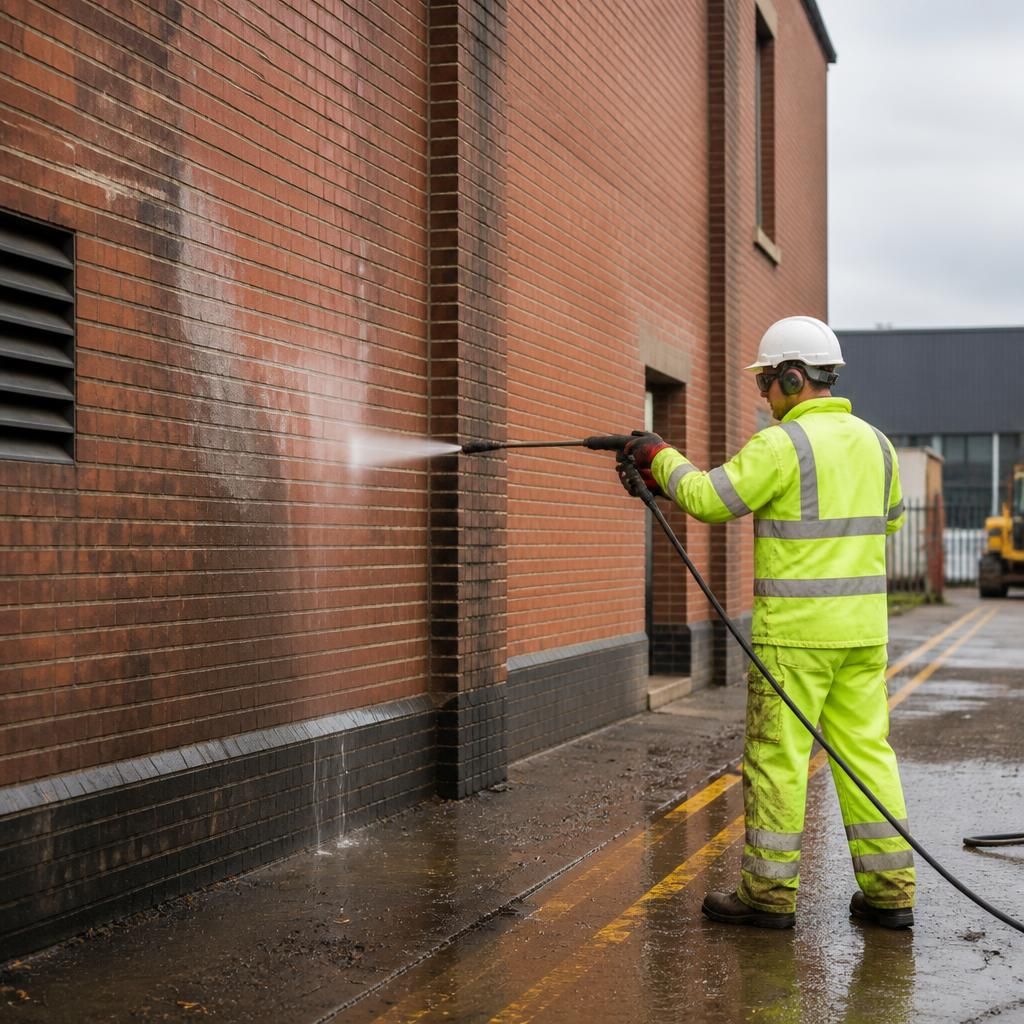
Industrial brick cleaning differs from regular brick cleaning because the work must be planned around the building, site operations and surrounding risks, not just the visible dirt. Large elevations, restricted access and contamination such as cement, soot, grease or paint often require tested cleaning methods, controlled pressure and specialist access equipment.
Before cleaning starts, the brick and mortar should be assessed and a representative test area completed. This helps confirm that the chosen pressure, temperature or cleaning solution will remove the contamination without eroding the brick face, damaging joints or affecting nearby glass, metal, render and painted surfaces. Industrial sites may also require protected drains, contained run-off, exclusion zones and coordination with vehicles, employees or the public. These additional controls are what make industrial brick cleaning a managed specialist operation rather than routine exterior washing.