
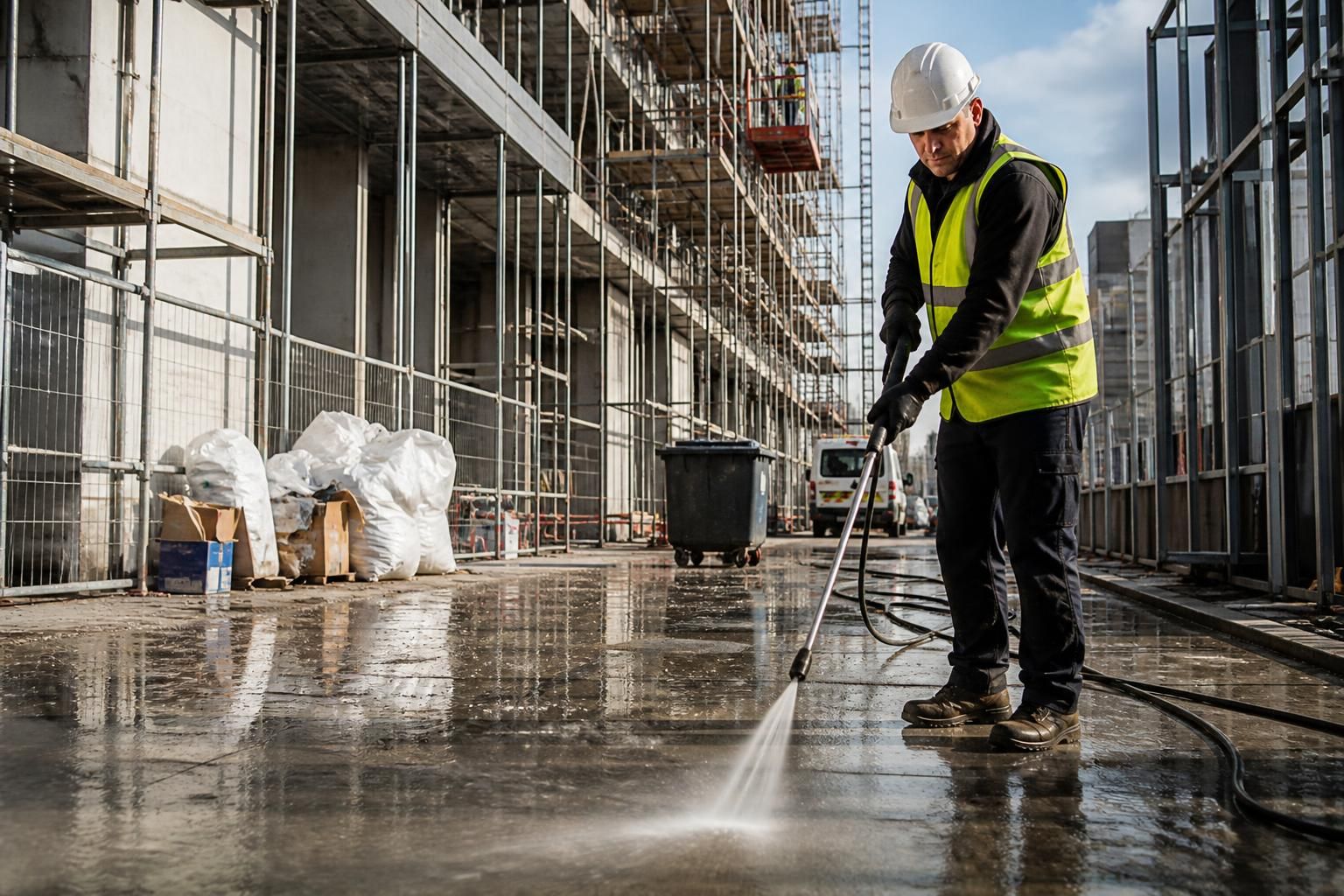
What factors should be considered when selecting a construction site cleaning service?
When selecting a construction site cleaning service, consider its relevant experience, health and safety procedures, equipment, insurance, environmental practices, availability and ability to work safely around active construction operations. The service should also provide a clear scope of work and transparent pricing that reflects the site’s size, access requirements, waste types and cleaning schedule.
Select a construction site cleaning service based on its relevant site experience, health and safety controls, equipment, insurance, waste-handling arrangements, availability and ability to provide a clearly defined scope of work. The right contractor should be able to assess the site, understand the risks created by ongoing construction activity and provide a cleaning plan that is practical, compliant and suitable for the project’s programme.
Relevant construction experience
Construction cleaning is different from routine commercial cleaning. A suitable contractor should understand the conditions found on building sites, including building dust, cement residue, plaster, paint splashes, packaging, timber offcuts, mud, traffic-related debris and changing access routes. Experience should be relevant to the type of work involved, whether that is a new-build development, refurbishment, fit-out, infrastructure project, commercial estate or public-sector site.
Ask whether the service has worked around active trades, plant, deliveries, temporary works and occupied areas. A contractor familiar with construction environments is more likely to schedule tasks safely, protect unfinished surfaces and coordinate effectively with the principal contractor, site manager and other subcontractors.
Ability to assess the site and define the work
A reliable service should inspect the site, or review sufficiently detailed information, before providing a quotation. The assessment should consider the size and layout of the site, the condition of surfaces, the type of contamination, working heights, drainage, water and power availability, vehicle access, pedestrian routes and areas that remain in use.
The proposed scope should state what will be cleaned and what is excluded. It may cover welfare facilities, compounds, access roads, car parks, façades, cladding, windows, hard landscaping, loading areas, internal or external handover cleaning and removal of construction debris. It should also clarify whether waste collection, container loading, stain treatment, high-level cleaning and final presentation cleaning are included.
Health and safety arrangements
Construction sites involve changing hazards, so the contractor should demonstrate a structured approach to risk management. Before work starts, it should be able to provide suitable risk assessments and method statements, together with evidence that operatives are trained and briefed for the tasks they will perform.
Check how the service controls risks such as slips and trips, vehicle movements, contact with chemicals, high-pressure water, steam, work at height, falling objects, electrical equipment, poor weather and interaction with other contractors. The cleaning plan should account for exclusion zones, signage, barriers, pedestrian segregation and safe storage of equipment and chemicals.
Where cleaning takes place on an active site, the contractor should follow the site induction, permit and communication procedures. It should also explain how incidents, near misses, defects and changes in site conditions are reported. A low price is not a suitable substitute for safe working methods.
Competence, training and qualifications
Ask for evidence that the operatives who will attend the site are competent for the work involved. This may include training in pressure washing, steam cleaning, chemical handling, manual handling, work at height, use of access equipment and the operation of relevant machinery. The exact requirements depend on the site and the cleaning methods proposed.
Membership of recognised trade or safety organisations, formal management systems and independently assessed certifications can provide useful assurance, but certificates should be relevant to the work rather than treated as a replacement for practical competence. You should also establish who supervises the team and how quality and safety are checked during the project.
Suitable equipment and access capability
The contractor should have equipment appropriate to the surfaces, contamination and access restrictions. Pressure washing can be effective for robust external surfaces, while steam cleaning may be more appropriate where lower water use, controlled heat or careful treatment is required. Vacuum recovery systems, surface cleaners, dust-control equipment and water collection measures may be needed to prevent dirty water or debris entering drains and surrounding areas.
For high-level or difficult-to-reach work, ask how access will be achieved. Depending on the site, this may involve water-fed poles, mobile elevated work platforms, scaffolding interfaces, access towers or other specialist equipment. The contractor should confirm that access equipment is suitable, inspected and operated by trained personnel. It should not assume that the equipment used on one project will be suitable for every surface or location.
Equipment selection should also protect the completed work. Excessive pressure, unsuitable chemicals or incorrect temperatures can damage coatings, sealants, masonry, cladding and drainage components. A competent contractor should explain the proposed method and, where appropriate, carry out a test clean before treating a larger area.
Insurance and contractual protection
Confirm that the service holds appropriate insurance for the work, including public liability cover and, where relevant, employers’ liability and cover for vehicles, plant or specialist operations. Request current evidence rather than relying on an old quotation or verbal assurance.
The contract should identify responsibilities for access, water, power, permits, protection of finished surfaces, waste transfer, damage reporting and making good. It should also explain how variations will be authorised if site conditions differ from those described at the quotation stage.
Waste and hazardous-material controls
Construction cleaning can generate mixed waste, contaminated water and materials requiring controlled handling. The contractor should explain how it will segregate, contain, transport and dispose of waste, and whether disposal costs are included in the price. Waste documentation should be available where required.
Do not assume that a general cleaning contractor is equipped to deal with hazardous substances. Suspected asbestos, fuel, oils, solvents, lead-based residues, contaminated soil or other hazardous materials may require specialist assessment and a separate controlled process. The cleaning service should identify such limitations clearly and avoid disturbing materials outside its competence.
Environmental practices
Consider how the contractor manages water, chemicals, energy and wastewater. Good practice may include selecting low-impact cleaning agents, using water efficiently, preventing contaminated run-off, recovering dirty water where necessary and disposing of waste through appropriate channels. Run-off must not be allowed to enter surface-water drains or neighbouring land when it could cause pollution.
Ask whether the proposed method can reduce water use or chemical use without compromising the required result. Environmental controls should be matched to the site’s drainage arrangements, local conditions and any requirements set by the client or principal contractor.
Availability and ability to work around the programme
The service must be able to attend when the project needs it, including around deliveries, inspections, handover dates and changing trade schedules. Clarify whether it can provide one-off deep cleaning, phased works, recurring maintenance, emergency attendance or additional labour when the programme changes.
Cleaning should be coordinated so that completed areas are not unnecessarily re-contaminated by later construction activity. For example, external washing may need to follow dusty works, while final presentation cleaning is usually planned after major installation and snagging activities. A written programme with agreed preparation requirements helps prevent delays and disputes.
Communication and reporting
Choose a contractor that provides a clear point of contact and responds promptly to site instructions. Effective communication is particularly important where access changes, weather affects external work or other trades create new contamination.
For larger or ongoing projects, agree how progress will be recorded. Useful records may include attendance details, completed areas, photographs, defects, outstanding works, waste documentation and any recommendations for follow-up cleaning. These records help the client and site team confirm that the agreed specification has been delivered.
Quotation and overall value
Compare quotations on a like-for-like basis rather than selecting the lowest headline price. The cost should reflect the site area, surface condition, access arrangements, equipment, labour, water recovery, traffic management, waste handling, travel, frequency and any out-of-hours requirements.
A transparent quotation should separate the main cleaning tasks from optional or provisional items and explain the assumptions on which the price is based. Be cautious of vague descriptions such as “site clean” without an area, standard or completion condition. Ask how additional work will be priced if hidden contamination, restricted access or changes in the construction programme affect the original scope.
References and evidence of quality
Relevant references can help confirm whether the contractor consistently delivers work in construction environments. Look for examples involving comparable surfaces, access conditions, project scale and operational constraints. Ask specifically about reliability, safety performance, communication, care of finished surfaces and how the contractor dealt with changes or defects.
Before appointing the service, review the written specification, insurance documents, risk information, waste arrangements and proposed programme. Selecting a contractor that can demonstrate practical competence, controlled methods and clear accountability will usually provide better protection for the project than choosing on price alone.

A site assessment is essential when selecting a construction site cleaning service because the quotation and cleaning plan should reflect the actual working conditions. The contractor should review the site layout, surfaces, contamination, access routes, working heights, drainage, water and power availability, and areas that remain in use.
Ask for a written scope that clearly states what is included, such as access roads, compounds, façades, cladding, welfare facilities, loading areas, construction debris, high-level cleaning and final presentation cleaning. It should also identify exclusions, waste-handling arrangements and how variations will be agreed if site conditions or the construction programme change.