
What factors should businesses consider when choosing a commercial exterior cleaning service provider?
Businesses should assess a commercial exterior cleaning provider’s relevant experience, planned methods and equipment, health and safety procedures, environmental controls, insurance, and ability to work safely around staff, visitors and operations. Check that the contractor can cover the required surfaces and access challenges, provides a clear written quotation and method statement, and offers dependable scheduling for one-off or planned maintenance work.
Choosing a commercial exterior cleaning service provider requires more than comparing prices. Businesses should assess the contractor’s relevant experience, understanding of the site, cleaning methods, access equipment, health and safety controls, environmental procedures, insurance, service coverage and ability to deliver work without disrupting normal operations. A suitable provider should explain how the proposed work will be carried out and provide a clear written quotation, risk assessment and method statement where appropriate.
Relevant commercial experience
Look for experience with properties and surfaces similar to your own. Cleaning a retail frontage, industrial unit, school, warehouse, office block or public building can involve different access arrangements, contamination risks and operational constraints. A contractor familiar with commercial work should understand the need to protect employees, visitors, vehicles, stock, plant, landscaping and neighbouring premises.
Ask whether the provider has completed comparable work involving façades, cladding, roofs, loading areas, car parks, yards, paving or graffiti removal. Experience should include the practical coordination required for larger sites, phased cleaning and planned maintenance, rather than only small domestic-style jobs.
A proper site assessment
A reliable quotation should be based on an assessment of the site or on sufficiently detailed information. The provider should consider the material and condition of each surface, the extent and type of soiling, drainage, nearby electrical equipment, pedestrian routes, traffic movements, water availability and suitable areas for equipment.
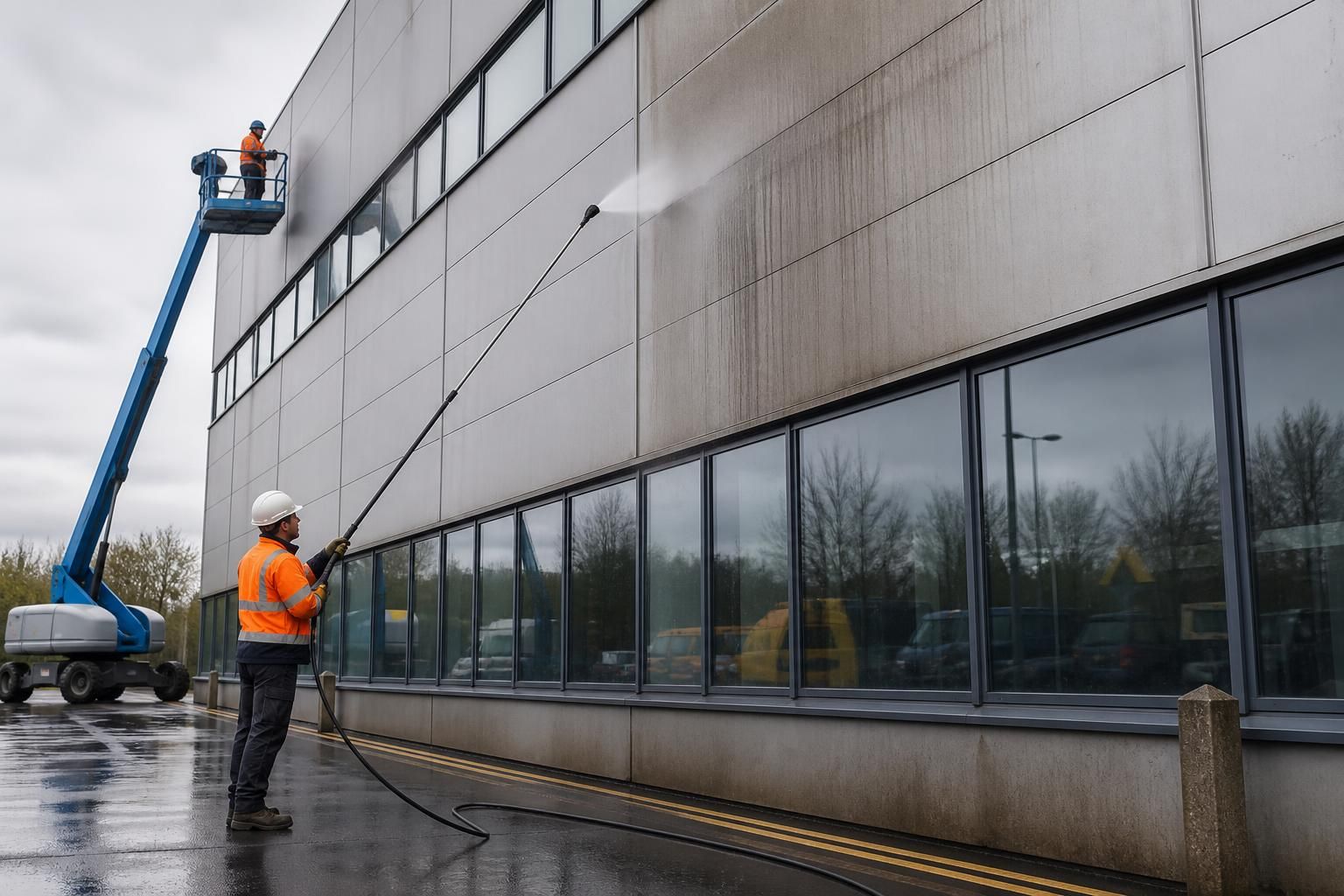
High-level or difficult-to-reach surfaces require particular attention. The contractor should identify whether the work can be completed from the ground, or whether it requires water-fed equipment, specialist access equipment, elevated work platforms or other controlled methods. They should also identify fragile materials, defective surfaces, loose coatings and areas where cleaning could cause water ingress or damage.
Appropriate cleaning methods
The proposed method should match the surface and the contamination. Pressure washing can be effective for robust paving, concrete and some hard external surfaces, but excessive pressure or an unsuitable nozzle can damage pointing, coatings, cladding and softer materials. Steam cleaning or other lower-pressure approaches may be more suitable where heat and controlled water use are needed, particularly on sensitive surfaces or certain types of staining.
Graffiti, oil deposits, algae, moss, traffic film and general dirt may require different treatments. Ask the contractor to explain the products, pressure, temperature and dwell times they propose to use, as well as how they will prevent run-off from spreading contamination. A small test area can help confirm that the method is effective and does not adversely affect the substrate.
Equipment and access capability
Check that the provider has equipment suitable for the scale and height of the work. This may include commercial pressure washing systems, steam-cleaning equipment, vacuum recovery, water-fed systems, surface cleaners and access equipment. The important issue is not the size of the machinery alone, but whether it can be used safely and effectively at your premises.
Where powered equipment, lifting equipment or elevated work platforms are required, the contractor should be able to demonstrate suitable inspection, maintenance and operator competence. They should also plan how equipment, hoses, cables and vehicles will be positioned without creating avoidable trip, access or traffic hazards.
Health and safety arrangements
Commercial exterior cleaning should be supported by a site-specific risk assessment and method statement when the work presents significant risks or when the client’s procedures require them. These documents should address work at height, water and electrical hazards, slips, spray and chemical exposure, vehicle movements, falling debris, public access and emergency arrangements.
Ask how the contractor will segregate the work area and protect people who are not involved in the cleaning. Suitable controls may include barriers, warning signs, exclusion zones, banksmen, controlled access routes and scheduling during quieter periods. Work at height must be properly planned and carried out using suitable equipment, with arrangements for rescue or emergency response where relevant.
The provider should also be prepared to comply with your site induction, permit-to-work system, contractor rules and reporting requirements. Evidence of training, competence and appropriate personal protective equipment is useful, but these should support a wider safe system of work rather than replace proper planning.
Insurance and professional documentation
Confirm that the contractor holds appropriate public liability insurance and, where relevant, employers’ liability cover and insurance for vehicles or specialist equipment. Ask to see current certificates if your procurement process requires them. You should also establish who is responsible for obtaining permissions, managing traffic or arranging access equipment.
For larger or higher-risk projects, request the relevant risk assessments, method statements, product information and waste or water-management arrangements before work starts. Clear documentation helps both parties understand the scope, controls and responsibilities.
Environmental controls
Cleaning methods should take account of water use, chemical selection and the management of contaminated run-off. The contractor should explain how dirty water, cleaning agents, oil residues, paint particles and other contaminants will be contained, recovered or disposed of in accordance with applicable requirements.
Do not assume that using less water is always the only environmental consideration. The correct approach depends on the surface and contamination. A controlled method that prevents repeat cleaning, avoids substrate damage and manages run-off responsibly may be preferable to an unnecessarily aggressive process. Ask whether biodegradable or lower-impact products are suitable and how the provider will protect drains, soil, planting and watercourses.
Scope of work and expected result
A written quotation should describe the areas to be cleaned, the surfaces involved, the type of work included and any exclusions. It should clarify whether preparation, stain treatment, rinsing, waste-water recovery, graffiti protection, re-sanding of joints or post-cleaning inspection is included.
It is also important to define the expected result. Some staining is permanent, embedded or caused by deterioration within the material, so complete removal may not be possible without unacceptable damage. A competent contractor should explain likely outcomes and identify areas requiring repair, redecoration or specialist treatment rather than promising an unrealistic finish.
Compare quotations on a like-for-like basis. A lower price may reflect fewer included areas, a less suitable method, limited preparation or no provision for access and run-off control. The cheapest quotation is not necessarily the lowest overall cost if poor cleaning causes surface damage, repeat work or disruption.
Scheduling and operational disruption
Discuss when the work can be carried out and how it will affect your operations. The contractor should plan around deliveries, shift patterns, public opening hours, parking, loading bays and access for emergency services. They should explain whether water, noise, spray, odour or temporary closures could affect staff, visitors or neighbouring occupiers.
For ongoing maintenance, check how visits are scheduled, how urgent issues are handled and how changes caused by weather or site conditions are communicated. A dependable service should provide a clear point of contact, confirm attendance and report any problems identified during the work.
Quality assurance and aftercare
Ask how the finished work will be checked. This may involve a joint inspection, photographs, completion records or a report noting areas that could not be cleaned safely. Records can be particularly useful for property managers responsible for multiple sites or for demonstrating that planned maintenance has been completed.
Where appropriate, discuss preventative measures such as graffiti-resistant coatings, scheduled façade cleaning, moss control or regular car-park maintenance. These measures should be recommended because they suit the surface and operating environment, not added as unnecessary extras.
Questions to ask before appointing a provider
- Have you completed similar commercial or industrial sites?
- How will you assess the surfaces and contamination before selecting a method?
- What access equipment and cleaning systems will be used?
- How will pedestrians, vehicles, staff, visitors and neighbouring premises be protected?
- How will water, chemicals and contaminated run-off be controlled?
- Can you provide the required insurance, risk assessment and method statement?
- What areas, treatments, access arrangements and follow-up work are included in the quotation?
- How will the work be scheduled to minimise operational disruption?
- How will completion and any limitations be recorded?
The most suitable provider is one that can demonstrate relevant experience, select a proportionate cleaning method, control safety and environmental risks, and communicate the scope clearly. Reviewing these factors before appointment gives your business a better basis for comparing quotations and helps ensure that the completed work protects the condition, appearance and day-to-day usability of the property.
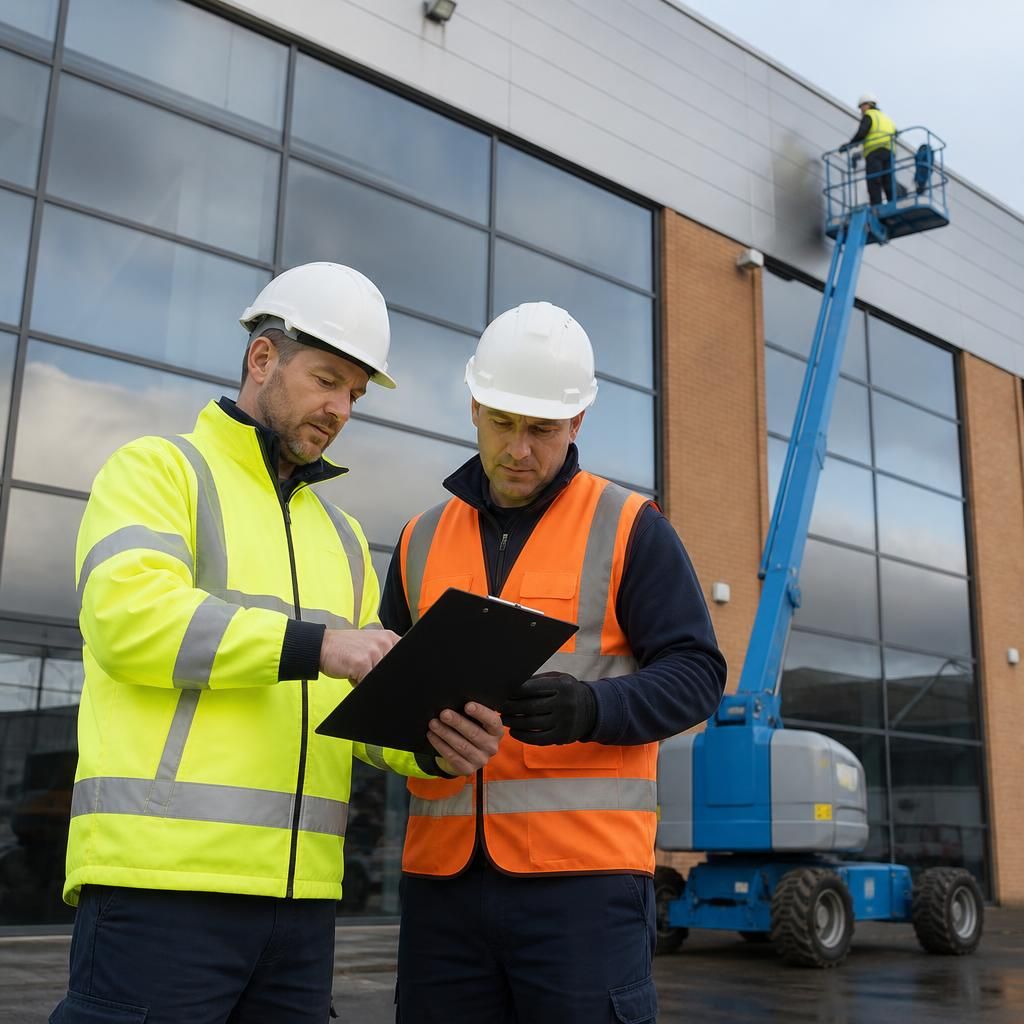
A suitable commercial exterior cleaning provider should select its methods and equipment after assessing the building, surfaces, access requirements and type of soiling. This site-specific approach helps prevent damage to cladding, pointing, coatings, paving and other external materials while producing a consistent result.
Before work begins, the contractor should explain whether pressure washing, steam cleaning, specialist treatments or a combination of methods is appropriate. They should also identify how high-level areas will be reached, how pedestrians and vehicles will be protected, and how dirty water, chemicals and debris will be controlled.
A clear written quotation should reflect this assessment and state the areas included, expected outcome, access arrangements, exclusions and any follow-up work. Comparing quotations on this basis gives businesses a more reliable indication of overall value than choosing solely on the lowest price.
Discuss Your Commercial Exterior Cleaning Requirements
Discuss your commercial exterior cleaning requirements with our team to review the surfaces, access arrangements, cleaning methods and site controls involved. We can help you establish a suitable scope of work for one-off cleaning or planned maintenance.