
What safety protocols are in place for university exterior cleaning services?
University exterior cleaning services should operate under documented risk assessments and method statements, with trained teams using suitable PPE, safe access equipment and controlled work zones. Additional protocols typically cover work at height, traffic and pedestrian management, chemical handling, equipment checks, emergency procedures and coordination with university staff to protect students, employees and contractors.
University exterior cleaning services should be delivered under a documented safety management plan that covers risk assessment, method statements, competent operatives, work at height, equipment, chemical use, pedestrian control and emergency arrangements. The plan must be adapted to each campus, building and cleaning method so that students, staff, visitors and contractors are protected while work is taking place.
Site-specific risk assessments and method statements form the basis of the work. Before starting, the contractor should assess the building’s height, structure, access points, surrounding roads and paths, nearby services, weather exposure, water and drainage arrangements, and the presence of vulnerable building users. The method statement should explain the proposed cleaning process, equipment, exclusion zones, sequence of work, supervision and emergency controls. It should be reviewed if the scope changes or conditions on site differ from those identified during the initial assessment.
The university’s facilities, estates or health and safety team should be involved in planning. This allows the contractor to identify examination periods, teaching areas, laboratories, residences, deliveries, events, accessibility routes and other activities that could affect the work. A clear site contact and communication process should be agreed before mobilisation, including how hazards, delays, incidents and changes to the work plan will be reported.
Competence and supervision are essential. Operatives should be trained and experienced in the cleaning methods and access systems they are expected to use. This may include pressure washing, steam cleaning, soft washing, chemical application, mobile elevated work platforms, tower scaffolds, cradles or rope access, depending on the building. Training should cover equipment operation, hazardous substances, manual handling, face-fit requirements where respiratory protection is used, and the risks associated with working around members of the public. Supervisors should check that the team understands the method statement and has the authority to stop work if conditions become unsafe.
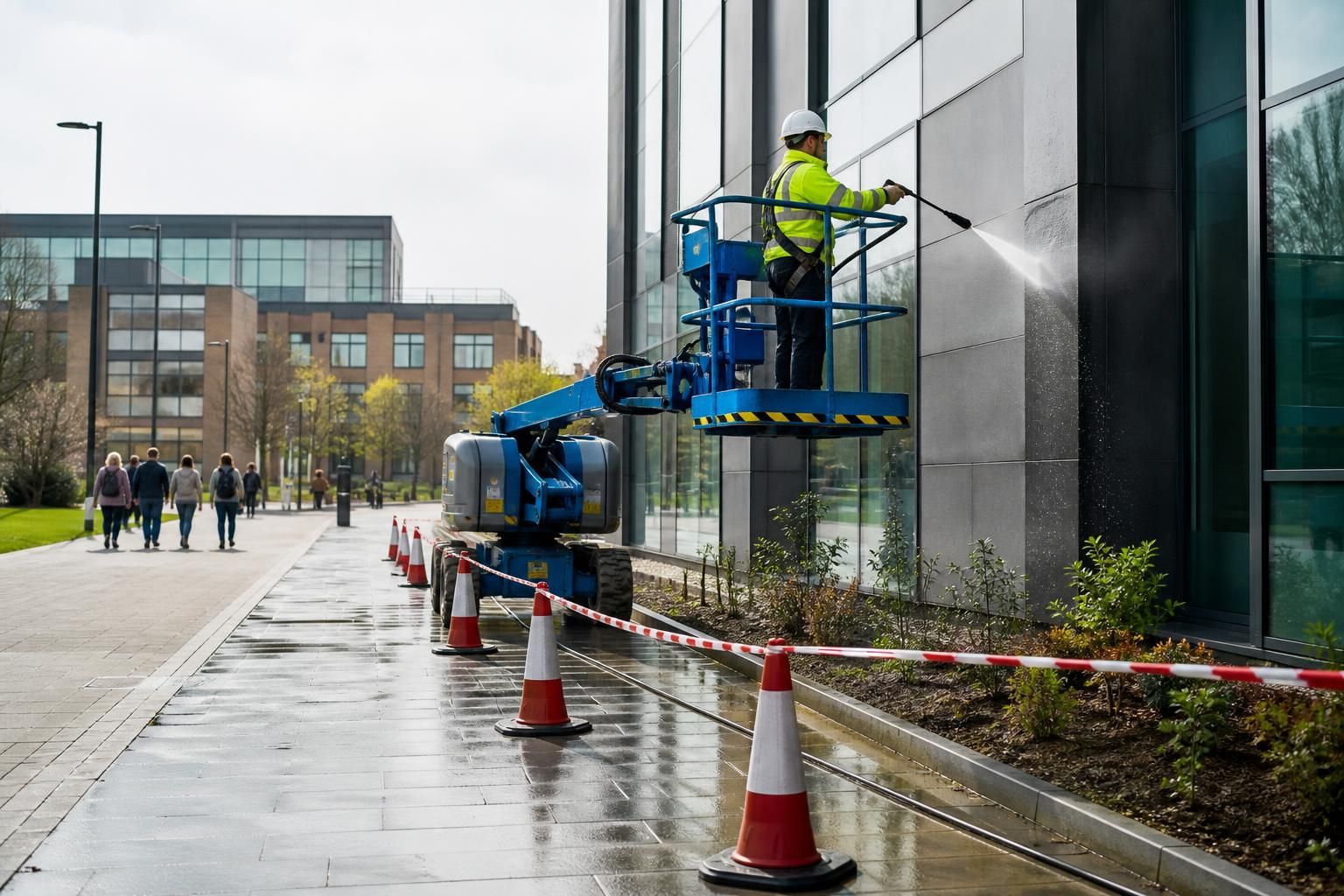
Work at height controls should follow the hierarchy of control: avoid working at height where practical, use suitable collective protection where possible, and select properly maintained access equipment when it is unavoidable. Ladders should not be treated as a general-purpose working platform for prolonged cleaning. Access equipment must be appropriate for the surface, reach, ground conditions and task. Platforms, scaffolds and other systems should be inspected as required, positioned on stable ground and protected from unauthorised use. Where fall-arrest or restraint equipment is required, anchor points, harnesses and rescue arrangements must be suitable and checked.
Equipment used for lifting people or materials should be inspected and maintained in line with the relevant legal requirements and the manufacturer’s instructions. This includes considering the requirements of the Provision and Use of Work Equipment Regulations and, where lifting equipment is involved, the Lifting Operations and Lifting Equipment Regulations. Contractors should retain inspection records and remove defective equipment from service rather than relying on informal checks.
Exclusion zones and public protection are particularly important on open campuses. Barriers, cones, warning signs and, where necessary, banksmen or marshals should separate the work area from pedestrians. Barriers must be positioned far enough from the building to account for falling objects, spray, overspray and moving equipment. Access routes should remain clear and accessible, with suitable alternative routes provided where a normal entrance, footpath or ramp is affected. The controls should be monitored throughout the shift because students and visitors may move barriers or enter an area without understanding the risk.
Where cleaning takes place near roads, car parks, service yards or cycle routes, a traffic management plan may be needed. It should control vehicle movements, delivery times, reversing, parking of access equipment and interaction between cleaning plant and campus users. High-visibility clothing, a trained vehicle marshal and temporary route controls may be appropriate, subject to the site assessment. Emergency access, fire exits, disabled access and escape routes must never be obstructed.
Plant, pressure and electrical safety require specific controls. Pressure-washing equipment should be selected for the surface and used at a pressure that does not damage masonry, joints, coatings, windows or fixtures. Hoses should be routed to prevent trips and protected from vehicle damage. Operatives should maintain a safe stance and avoid directing high-pressure water towards people, electrical installations, fragile surfaces or unprotected openings. Electrical equipment must be suitable for the environment, protected from water ingress and connected through appropriate residual-current protection where required. Cables, hoses, fuel and generators should be positioned to reduce trip, fire and fume risks.
Chemical handling should be controlled under the Control of Substances Hazardous to Health requirements. Before use, the contractor should identify the product hazards, follow the safety data sheet, provide suitable gloves and eye or face protection, and establish safe storage and transport arrangements. Chemicals must not be mixed unless the manufacturer specifically permits it. Particular care is needed around laboratories, planted areas, watercourses, air-intake systems, food service areas and public entrances. The team should prevent contact with skin and eyes, control run-off and have suitable arrangements for dealing with a spill or accidental exposure.
Personal protective equipment should be selected from the risk assessment rather than used as the only control. Depending on the task, this may include safety footwear, gloves, eye protection, hearing protection, waterproof clothing, respiratory protection, high-visibility clothing and fall-protection equipment. PPE should be compatible, maintained and replaced when damaged. It should not prevent operatives from communicating effectively or using access equipment safely.
Weather and environmental conditions must be checked before and during the work. High winds, ice, lightning, heavy rain, poor visibility and extreme temperatures can affect access equipment, fall risks, chemical performance, surface conditions and the ability to control spray. Work at height or external cleaning should be paused when the conditions exceed the safe operating limits of the equipment or method statement. Water discharge should be managed so that it does not create slippery surfaces, flood entrances or carry contaminants into drains.
Emergency procedures should be agreed before work begins. The team should know how to raise the alarm, contact campus security or emergency services, provide first aid, isolate equipment, deal with chemical exposure, respond to a fall from height and rescue a person who becomes suspended in a harness. A rescue plan must be realistic for the access system being used; calling emergency services alone may not be sufficient for a prompt recovery. Incident, near-miss and equipment defect reporting should be completed and shared with the university’s nominated contact.
Good practice also includes a pre-start briefing, daily checks, housekeeping and a formal handover at the end of the work. The contractor should confirm that barriers have been removed only when the area is safe, surfaces are no longer slippery, windows and entrances are secure, waste and chemical containers have been taken away, and any defects discovered during cleaning have been reported. These controls allow the university to verify that the work has been completed safely rather than relying solely on the cleaning result.
When reviewing a cleaning contractor, the university should request relevant training records, equipment inspection documentation, insurance details, risk assessments, method statements, COSHH assessments and examples of comparable campus or commercial work. The most suitable provider will be able to explain how its controls will be adapted to the university’s buildings, timetable, access arrangements and safeguarding requirements, rather than offering a generic safety document.
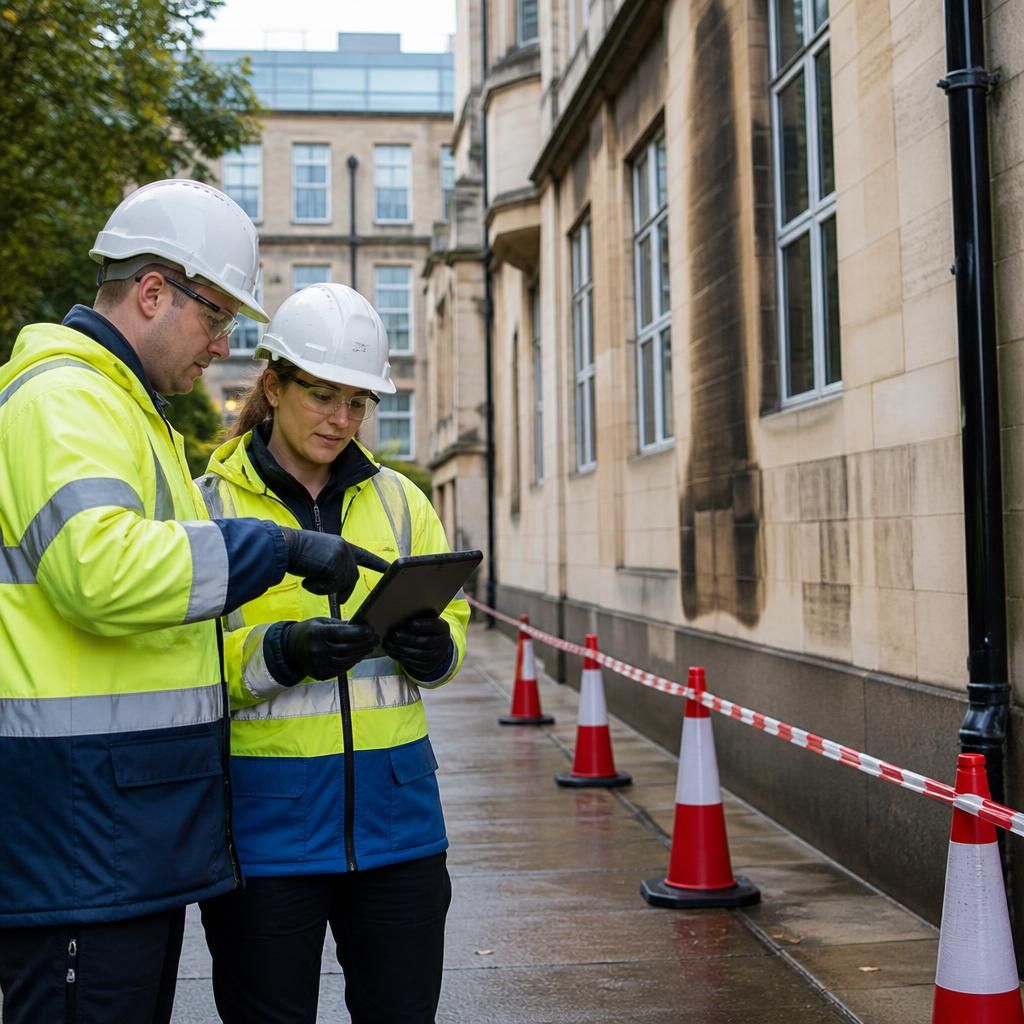
Site-specific risk assessments and method statements are the foundation of safe university exterior cleaning. They identify hazards linked to the building, cleaning method, access equipment, weather, nearby roads and the movement of students, staff and visitors before work begins.
The cleaning plan should be agreed with the university’s estates or facilities team and adapted around teaching areas, residences, laboratories, events, deliveries, accessible routes and emergency exits. It should define exclusion zones, pedestrian diversions, equipment positions, chemical controls, supervision arrangements and the process for stopping work when conditions change.
- Confirm a named university contact and clear reporting process.
- Brief operatives on the method statement before each shift.
- Inspect barriers, hoses, access equipment and work areas throughout the task.
- Review the controls if the scope, weather or site conditions change.