
What factors should universities consider when evaluating the cost-effectiveness of exterior cleaning services?
Universities should assess exterior cleaning cost-effectiveness by comparing the full service cost with cleaning quality, safety improvements, building protection, disruption to teaching and the likely maintenance interval. A reliable evaluation should include the scope and condition of the work, access requirements, cleaning methods, environmental controls, contractor competence, insurance and whether planned maintenance can prevent more expensive repairs.
Universities should evaluate exterior cleaning services by comparing the full cost of the work with its effect on building condition, safety, appearance, access and future maintenance. The lowest quotation is not necessarily the most cost-effective option if it relies on unsuitable methods, requires repeated cleaning, causes disruption to teaching or increases the risk of surface damage. A sound assessment considers whole-life value rather than the initial price alone.
Define the required scope before comparing prices
Obtain a clear condition assessment and specification before asking contractors to quote. The scope may include façades, cladding, roofs, windows, entrances, paved areas, car parks, service yards, bin stores, pedestrian routes, retaining walls and graffiti removal. It should also identify staining, biological growth, oil contamination, chewing gum, corrosion, weathering and areas where previous cleaning has caused damage.
Quotations are difficult to compare when one contractor has priced a full clean and another has allowed only for easily accessible areas. Ask each provider to state exactly what is included, what is excluded, how difficult areas will be reached and whether preparation, protection, rinsing, waste management and final inspections are included.
Consider the condition and materials of each surface
The condition of a surface affects both the cleaning method and the likely cost. A heavily soiled façade may require testing, pre-treatment, controlled rinsing or several cleaning stages. Fragile masonry, painted surfaces, render, stone, metal cladding and glass cannot all be treated in the same way. Aggressive pressure or unsuitable chemicals may remove coatings, open joints, etch stone or drive water into the building fabric, creating repair costs that outweigh any initial saving.
A competent contractor should inspect the site, identify vulnerable materials and recommend a method proportionate to the level of soiling. Small test areas are useful where the surface, coating or staining is uncertain. The cost of testing should be considered alongside the value of preventing avoidable damage.
Compare cleaning methods on performance and risk
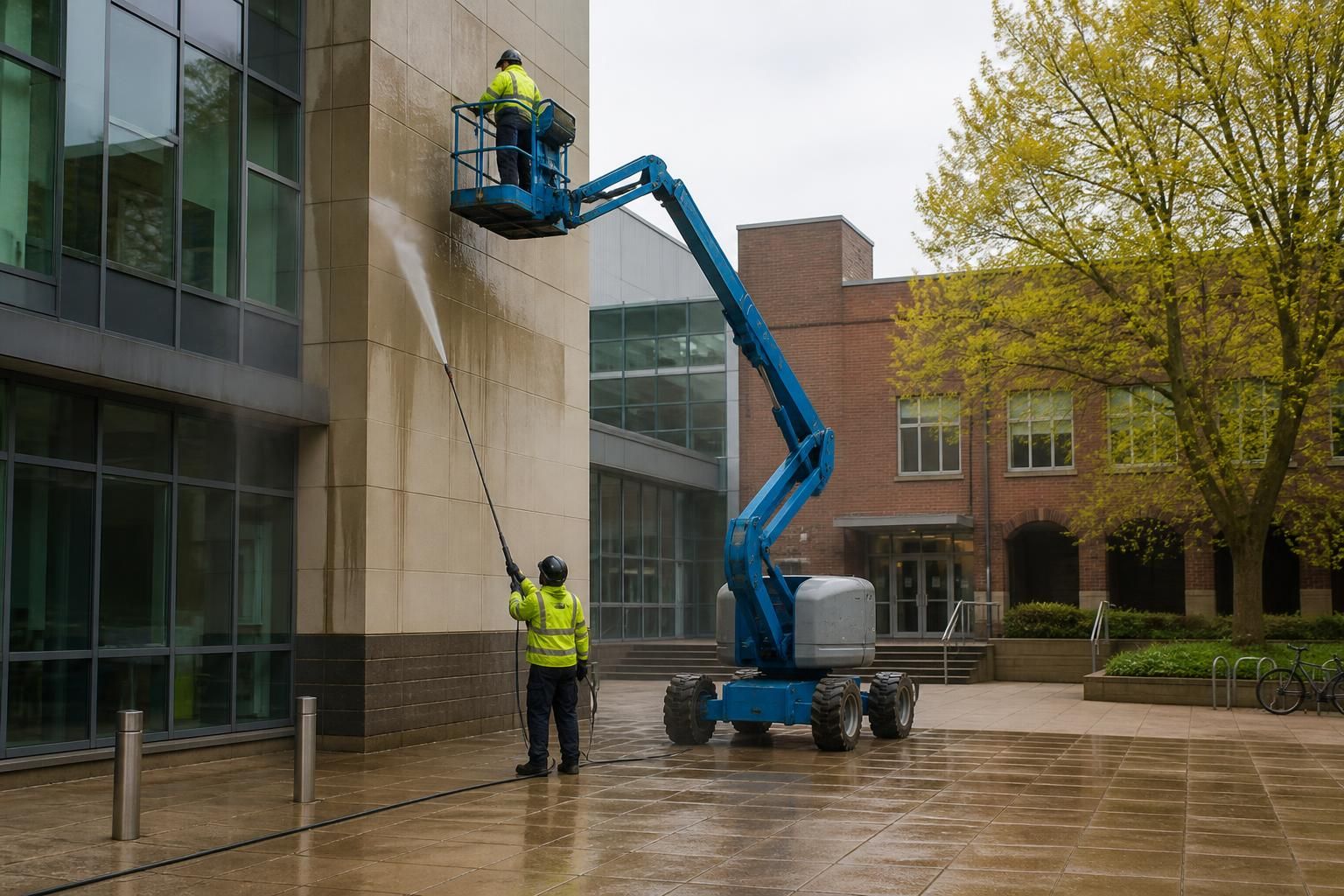
Pressure washing, steam cleaning, soft washing and specialist chemical treatments each have different cost implications. Pressure washing can be efficient for robust hard surfaces, while steam cleaning may offer better control on sensitive areas or where reduced chemical use is important. Specialist treatments may be necessary for biological growth, mineral deposits, oil or graffiti.
The assessment should cover water consumption, chemical use, preparation time, rinsing requirements, drying time, waste handling and the likelihood of repeat visits. A method that appears cheaper because it uses higher pressure or minimal preparation may leave staining behind or cause surface deterioration. Ask for the reasons behind the proposed method, not just the method name.
Include access and site logistics in the total cost
University buildings often combine different heights, restricted courtyards, busy walkways, glazed areas and multiple buildings spread across a large campus. Access requirements can therefore be a significant part of the price. Consider the need for mobile elevating work platforms, towers, water-fed equipment, long-reach systems, traffic management, barriers, permits and specialist operatives.
A quotation should explain whether access equipment, delivery, setup, relocation between buildings and removal are included. It should also identify any assumptions about ground conditions, parking, power, water supply and working space. Resolving these details before work begins reduces the risk of variations and helps the university compare genuinely like-for-like proposals.
Assess disruption as a measurable cost
Cleaning can affect lectures, examinations, accommodation, laboratories, libraries, public events, deliveries and pedestrian movement. The financial and operational cost of disruption should be included in the evaluation, even where it does not appear on the contractor’s invoice.
Ask providers to explain how they will phase the work, isolate work areas, control noise and spray, maintain emergency routes and coordinate with campus representatives. Early starts, out-of-hours working, holiday periods or sectional cleaning may reduce disruption, although these arrangements can affect the price. The most cost-effective programme is usually the one that balances labour and access costs with the value of keeping essential university activities running normally.
Check safety and compliance arrangements
Safety performance is part of value. Poorly controlled work at height, interaction with vehicles, wet walkways, chemical handling or uncontrolled access can lead to incidents, delays and liability. Universities should check the contractor’s relevant training, risk assessments, method statements, insurance, equipment inspection arrangements and approach to safeguarding the public, staff and students.
Consider how the service will protect entrances, ventilation points, electrical equipment, fire routes, sensitive research areas and adjacent property. A detailed mobilisation and site plan can indicate whether the provider understands the complexity of a live campus. The cost of suitable controls should be treated as an essential project requirement, not an optional extra.
Measure the value of planned maintenance
One-off cleaning may be appropriate for a handover, event or heavily neglected area, but planned maintenance can provide better value for assets that soil gradually or are exposed to recurring graffiti and biological growth. Regular, proportionate cleaning may prevent deposits from becoming more difficult to remove and can make future visits quicker and less intrusive.
Universities should compare the cost of a planned programme with the likely cost of reactive call-outs, extensive restoration, premature repainting, blocked drainage, slip hazards and damage to external finishes. The programme should be based on building use, exposure, surface type and risk rather than applying the same interval to every structure.
Evaluate the contractor’s competence and reliability
Price should be considered alongside relevant experience, the quality of the survey, communication, supervision and the ability to manage large or complex sites. Ask for evidence of comparable commercial or public-sector work, suitable risk controls and a clear process for reporting defects discovered during cleaning.
Reliable delivery also has a cost benefit. Missed visits, incomplete areas, poor protection or unclear communication can create additional administration and require the university to arrange remedial work. Confirm who will manage the contract, how progress will be recorded and how urgent issues such as fresh graffiti or unsafe contamination will be handled.
Review what is included after cleaning
Effective evaluation does not end when the surface appears clean. Establish whether the service includes inspection, photographic records, defect reporting, removal of wastewater or debris, reinstatement of access areas and sign-off by the university’s representative. These details provide evidence that the agreed scope has been completed and help inform future maintenance planning.
Where appropriate, agree practical performance criteria such as even coverage, removal of specified staining, protection of surrounding materials, clean and safe pedestrian areas, and completion within the agreed working windows. Criteria should recognise the condition and age of the surface; cleaning cannot always restore a finish that is permanently weathered or damaged.
Compare quotations using whole-life value
A useful comparison records the initial charge, access costs, likely frequency, method, programme, safety controls, environmental measures, exclusions and potential additional works. It should also consider the expected effect on repairs, appearance, asset life and campus operations. Clarify how variations will be authorised so that unexpected costs do not arise without approval.
In practice, the strongest proposal is the one that provides a suitable level of cleaning, protects the building fabric, minimises disruption and gives the university a dependable maintenance plan at a transparent overall cost. Reviewing these factors with the contractor during the survey stage enables the university to select services based on risk, performance and long-term value rather than headline price alone.

The cost-effectiveness of university exterior cleaning is best assessed through whole-life value, not the lowest initial quotation. A suitable service should clean the specified surfaces, protect the building fabric, minimise disruption and reduce the likelihood of avoidable repairs or frequent reactive call-outs.
When comparing proposals, review the cleaning method, access equipment, preparation, protection, waste handling, safety controls and post-cleaning inspection alongside the quoted price. Also consider whether a planned maintenance programme could prevent staining, biological growth, graffiti or slip hazards from becoming more difficult and expensive to manage. A clear scope, transparent exclusions and agreed variation process make it easier to compare providers and control the overall cost.