What environmental considerations should universities take into account when selecting exterior cleaning solutions?
Universities should select exterior cleaning solutions that minimise water use, chemical discharge, energy consumption, noise and disruption while protecting façades, landscaping, drainage systems and local wildlife. The assessment should cover the cleaning method, detergents, wastewater capture and disposal, equipment efficiency, access requirements and the contractor’s ability to comply with environmental regulations.
Universities should select exterior cleaning solutions that reduce water use, chemical discharge, energy consumption, noise and disruption while protecting buildings, landscaping, drainage systems and local wildlife. The assessment should consider the cleaning method, products used, wastewater controls, equipment efficiency, access arrangements and the contractor’s ability to meet relevant environmental requirements.
Assess the whole cleaning process, not just the visible result
A sustainable approach considers what happens before, during and after cleaning. A method that uses little detergent may still have a significant environmental impact if it requires excessive water, energy-intensive access equipment or uncontrolled discharge. Equally, a low-water system is not automatically suitable if it could damage a sensitive façade, remove protective coatings or transfer contamination into surrounding areas.
Universities should ask contractors to explain the proposed method, why it is appropriate for the surface and how environmental risks will be controlled. This should include a site assessment covering the building materials, type of soiling, nearby drains and watercourses, planted areas, nesting sites, pedestrian routes and the operating timetable of the campus.
Control water consumption and runoff
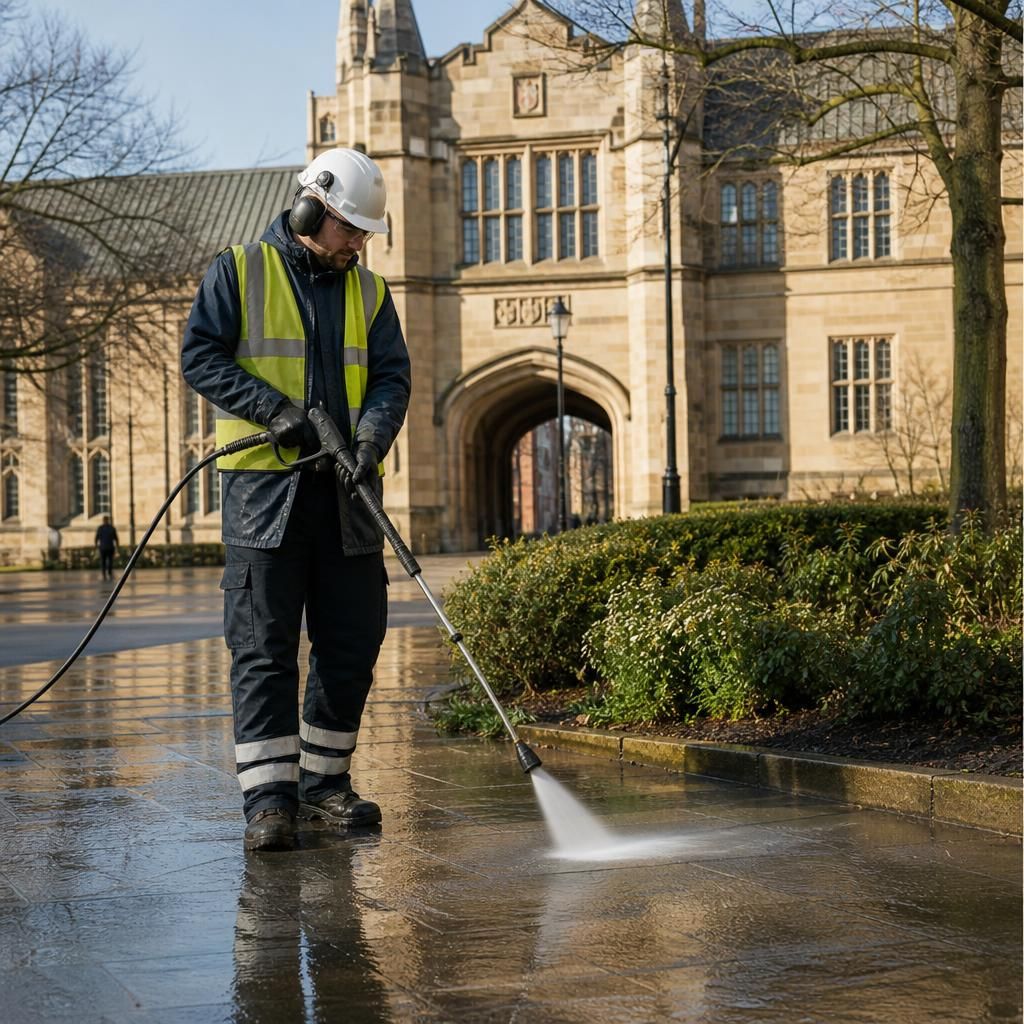
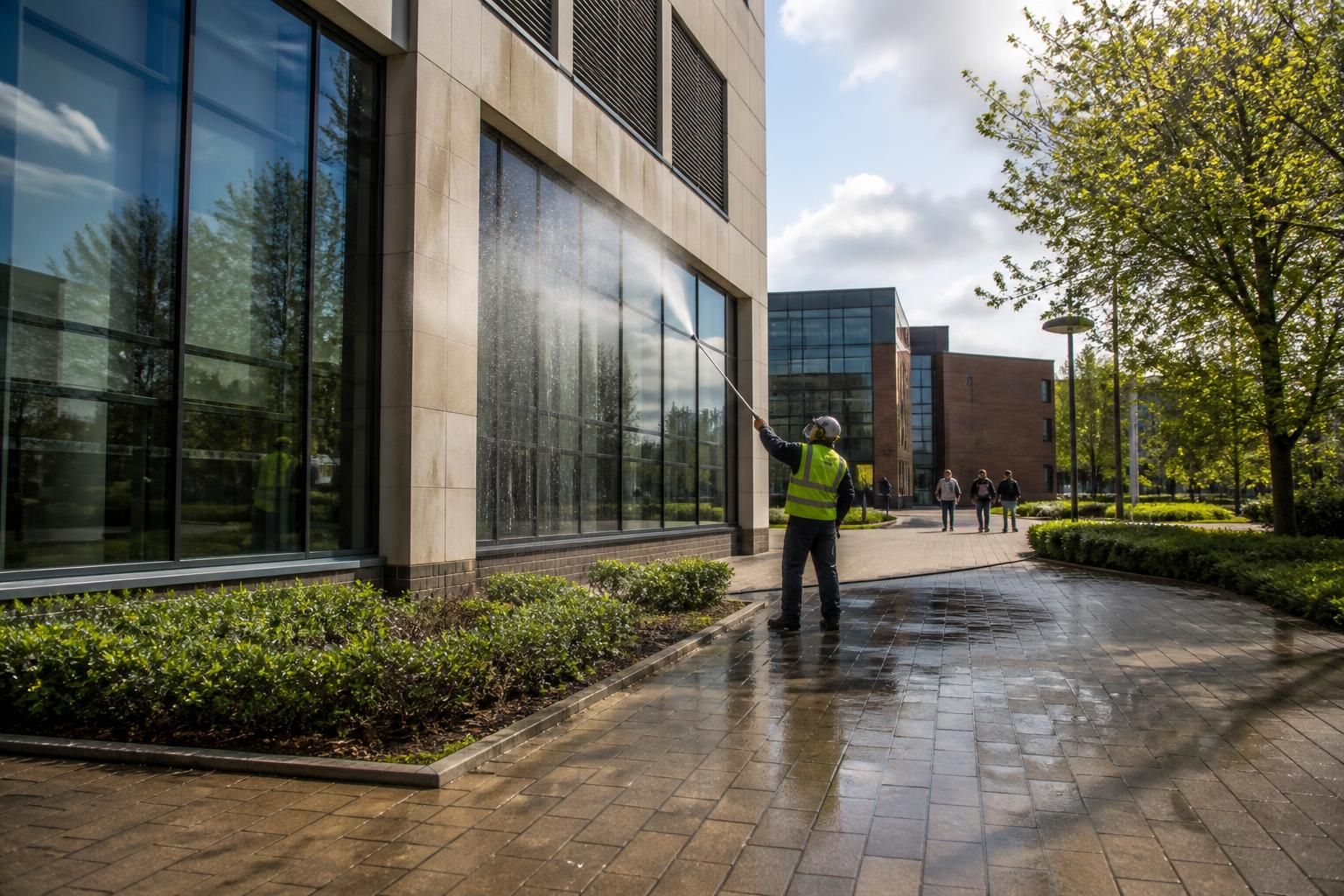
Pressure washing can be effective for hard surfaces, façades and external areas, but water use should be controlled through suitable equipment, pressure settings and operating practices. Steam cleaning or other low-moisture methods may be more appropriate for certain delicate surfaces or localised contamination. The correct choice depends on the substrate and the nature of the soiling; using the most powerful or wettest method is not necessarily the most sustainable option.
Runoff must be managed rather than allowed to enter surface-water drains without assessment. Water from cleaning may contain dirt, oils, paint residues, biological growth, detergents or other contaminants. A responsible contractor should identify drainage routes, prevent polluted water from reaching watercourses and use suitable collection, filtration, containment or recovery measures where required. Wastewater should be disposed of lawfully and in accordance with the requirements of the relevant water company, local authority or environmental regulator.
Universities should also consider whether water can be used efficiently on site, subject to suitable controls and local requirements. Any proposal to reuse or recover water should account for contamination, filtration and the risk of spreading pollutants across other areas.
Choose chemicals carefully
Cleaning products should be selected for the specific material and contamination rather than applied as a standard treatment across the estate. Products with lower environmental hazard profiles may help reduce risks to planting, soil, aquatic environments and building users, but they must still be used at the correct concentration and prevented from entering drains or watercourses.
The contractor should provide product information and explain how detergents, biocides, degreasers and other treatments will be stored, diluted, applied and removed. Particular care is needed with biocidal treatments, acidic or alkaline products and substances used to remove oil, chewing gum, paint or graffiti. Product selection should take account of surface compatibility, toxicity, persistence and the potential effect on adjacent materials.
Using more chemical is not a substitute for proper preparation, dwell time, mechanical action or accurate application. Targeted treatment can reduce consumption and minimise the amount of residue requiring containment and disposal.
Protect drainage, soil, planting and wildlife
Exterior cleaning can affect more than the building being treated. Overspray and runoff may damage lawns, planted borders, trees, soil, water features and ornamental planting. Before work begins, vulnerable areas should be identified and protected with appropriate sheeting, barriers or temporary exclusion zones. Protection must not create a separate hazard by blocking walkways, restricting access or allowing trapped water to affect the building.
Façade and roof cleaning may also disturb birds, bats or other wildlife, particularly where buildings contain nesting features, roof voids, ledges or vegetation. A pre-start inspection should identify relevant ecological constraints, with specialist advice obtained where necessary. Work may need to be adapted, delayed or controlled to avoid disturbing protected species. This is particularly important for older buildings and campuses with mature trees, ponds or areas of high ecological value.
Consider energy use, emissions and equipment
Universities should compare the energy requirements of pumps, hot-water systems, steam equipment, lighting, generators and access machinery. Efficient, well-maintained equipment can reduce fuel use, emissions and unnecessary operating time. Where practical, equipment should be selected to match the scale of the task rather than using a larger system than necessary.
Access arrangements are part of the environmental assessment. Mobile elevated work platforms, cranes and other equipment may increase fuel consumption, ground pressure, noise and disruption. The least intensive safe access solution should be chosen, while still allowing the work to be completed properly. Equipment should be positioned to avoid damaging grassed areas, tree roots, drainage covers and underground services.
Travel and logistics should also be planned efficiently. Combining visits, coordinating work across nearby buildings and avoiding unnecessary return journeys can reduce vehicle movements. However, environmental objectives must not override safe access, effective supervision or the need to comply with campus traffic controls.
Manage noise, dust and air quality
Noise and airborne particles are environmental considerations as well as operational concerns. Pressure washing, generators, compressors, abrasive techniques and powered access equipment may affect lectures, examinations, libraries, laboratories, residences and neighbouring properties. The contractor should identify noisy activities and agree suitable working periods with the university.
Dust and spray can affect air quality, ventilation intakes, laboratory environments, sensitive equipment and people using nearby routes. Controls may include selecting a lower-dust method, using localised containment, dampening appropriate materials, positioning equipment carefully and maintaining exclusion zones. Cleaning products and emissions must also be managed so that fumes do not enter occupied buildings.
Check waste handling and material protection
Cleaning may produce sludge, sediment, paint debris, contaminated absorbents, used filters, packaging and disposable protective materials. These wastes should be segregated where appropriate, stored securely and transferred through lawful disposal or recovery routes. The university should be able to obtain relevant waste documentation where the work generates controlled or contaminated waste.
Preventing damage is itself an environmental measure. Incorrect pressure, unsuitable chemicals or aggressive abrasion can shorten the life of cladding, masonry, coatings, sealants and roof materials, creating additional repair waste and replacement demand. A method statement should explain the proposed pressure, temperature, chemical use, test areas and protection of joints, seals, electrical fittings and drainage outlets. Small test sections are useful for confirming that the method cleans effectively without causing avoidable damage.
Evaluate the contractor’s environmental controls
When comparing suppliers, universities should look for evidence rather than relying solely on broad sustainability claims. Useful information includes:
- A written method statement and environmental risk assessment for the specific site.
- Details of water-saving equipment, wastewater capture and discharge arrangements.
- Product data and procedures for chemical storage, handling and spill response.
- Measures for protecting planting, wildlife, drainage systems and nearby buildings.
- Equipment maintenance records and a clear approach to reducing fuel use and emissions.
- Waste transfer and disposal procedures appropriate to the materials removed.
- Training, supervision and incident-reporting arrangements for operatives.
- Evidence of relevant insurance, licences, permits or consents where the work requires them.
Environmental performance should be included in the tender or service specification, with clear requirements for method approval, site protection, reporting and reinstatement. After completion, the contractor should report any spill, unexpected discharge, surface damage or ecological issue promptly rather than leaving the university to identify it later.
The most suitable solution is therefore the one that achieves the required level of cleanliness with the lowest reasonable environmental impact for that building and location. Universities should balance water and chemical reduction with surface protection, lawful wastewater management, biodiversity, energy use, noise, waste and operational safety. A site-specific assessment and transparent method statement provide the strongest basis for selecting an exterior cleaning service that supports both campus standards and wider environmental responsibilities.