
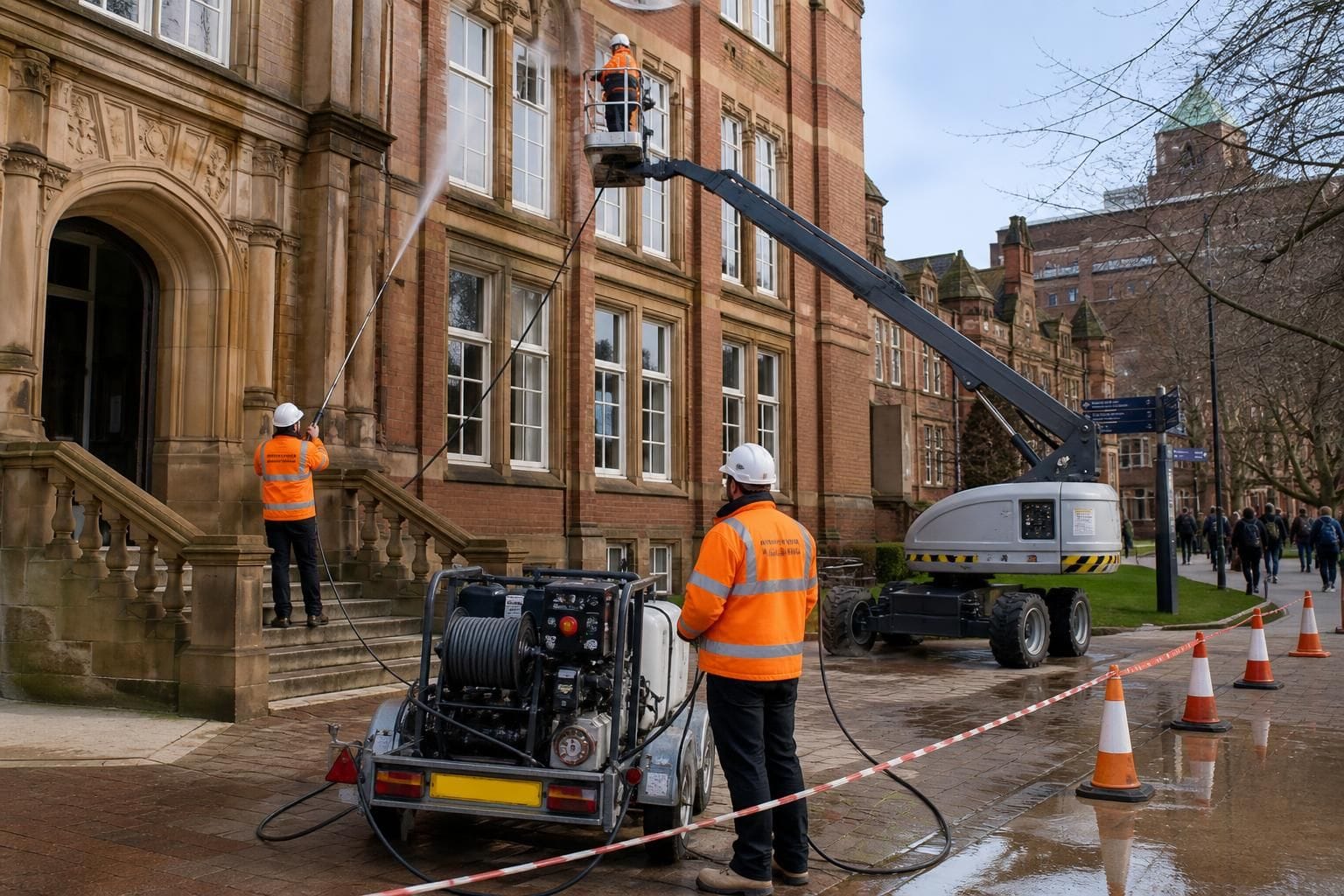
What are the essential safety protocols to consider when selecting exterior cleaning services for university campuses?
Universities should select exterior cleaning contractors that provide a task-specific risk assessment and method statement, demonstrate trained and competent operatives, and comply with relevant UK health and safety requirements. Essential controls include secure access and work-at-height planning, segregation of students and the public, equipment and chemical safety checks, environmental protection, emergency arrangements, and suitable insurance.
Universities should select exterior cleaning services that can provide a site-specific risk assessment and method statement (RAMS), competent operatives, appropriate insurance and clear controls for work at height, public access, equipment, chemicals and environmental risks. On a live campus, safety planning must protect students, staff, visitors, contractors and members of the public while allowing the cleaning work to be completed without creating avoidable hazards.
Check the contractor’s competence and compliance
Before appointing a contractor, the university should check relevant experience in commercial or institutional environments, operator training, supervision arrangements and evidence of suitable health and safety procedures. The contractor should understand the requirements of the Health and Safety at Work etc. Act 1974 and other legislation relevant to the planned work. Depending on the project, this may include the Construction (Design and Management) Regulations, the Work at Height Regulations, the Control of Substances Hazardous to Health Regulations (COSHH), the Provision and Use of Work Equipment Regulations (PUWER) and the Personal Protective Equipment at Work Regulations.
Membership of a trade or safety scheme can support due diligence, but it should not replace checking the contractor’s actual competence for the work. Ask for examples of comparable projects, training records where appropriate, inspection arrangements, accident and emergency procedures, and evidence of public liability and employers’ liability insurance. The university should also confirm who will supervise the work and who has authority to stop it if conditions become unsafe.
Require a site-specific risk assessment and method statement
A generic RAMS document is not sufficient for a complex campus. It should address the buildings, surfaces, access routes, operating hours and nearby activities involved in the specific project. The assessment should identify hazards such as falling objects, slips, trips, vehicle movements, fragile roofs, overhead services, electrical equipment, pressurised water, chemical exposure, poor visibility and changing weather conditions.
The method statement should explain the sequence of work, equipment to be used, exclusion zones, access arrangements, cleaning products, waste controls, supervision and emergency actions. It should be shared with relevant university representatives before work begins, reviewed when the scope or conditions change, and communicated to all operatives through a suitable briefing. Where several contractors or university teams are working in the same area, responsibilities and coordination arrangements should be agreed in advance.
Control work at height and falling-object risks
Façade, roof, gutter and high-level cleaning may involve mobile elevated work platforms, towers, ladders, rope access or other access systems. The safest practical method should be selected using the hierarchy for work at height: avoid working at height where possible, prevent falls using suitable collective protection, and use personal fall protection where other measures are not reasonably practicable.
Access equipment should be suitable for the surface, height, reach and ground conditions. It must be operated by trained personnel, inspected as required and positioned away from unstable ground, unprotected edges, overhead services and vehicle routes. Rescue arrangements are particularly important for suspended or harness-based systems; a harness alone is not an emergency plan. Tools, hoses, attachments and removed debris should be secured so that they cannot fall into occupied areas. The contractor should also define when high winds, lightning, ice or heavy rain require work to stop.
Segregate the work from campus users
Students, staff, visitors and delivery vehicles should be kept outside the work area through clearly defined barriers, signs and, where necessary, a banksman or dedicated marshal. Cones alone may not provide adequate protection where there is a risk of falling materials, overspray, pressurised water or vehicle interaction. The exclusion zone should reflect the equipment and cleaning method, not simply the immediate footprint of the operative.
Plan routes for pedestrians, wheelchair users, cyclists, emergency vehicles and deliveries before work starts. Temporary diversions should be accessible, well signed and kept free from hoses, cables, standing water and equipment. Cleaning near entrances, footpaths, catering areas, laboratories, accommodation, libraries or examination spaces may require additional controls and agreed working windows. Barriers should remain in place until surfaces are safe and any residual hazards have been removed.
Assess water, pressure and surface hazards
Pressure washing can create spray, airborne contaminants, noise, slippery surfaces and damage to joints, coatings, seals or vulnerable materials if the pressure and temperature are unsuitable. The contractor should confirm that the proposed method has been assessed for the building fabric and nearby fixtures, including windows, vents, electrical installations, sensors, signage and public art.
Water run-off should be controlled to prevent flooding, contamination, icing and movement into buildings or drainage systems. Hoses should be routed and protected to prevent trip hazards. Wet areas should be isolated until they have drained or dried, and the contractor should identify how blocked drains, unexpected leaks or water ingress will be dealt with.
Manage chemicals and personal protective equipment
Any detergents, biocides, solvents, graffiti removers or other substances should be selected for the surface and used in accordance with the supplier’s instructions and the relevant COSHH assessment. The university should be told what products will be brought to site, how they will be stored, how they will be diluted and how spills, exposure and disposal will be managed. Chemicals must not be decanted into unlabelled containers or stored where students and unauthorised persons can access them.
Operatives should use suitable gloves, eye or face protection, footwear, protective clothing, respiratory protection or fall-arrest equipment where the assessment requires it. PPE is an important final control, but it should not be used instead of safer access arrangements, substitution of hazardous products or effective segregation. Where cleaning takes place near ventilation intakes, food preparation areas or sensitive research facilities, additional containment or temporary isolation may be necessary.
Control plant, equipment and traffic
Powered equipment, pressure washers, generators, access platforms and lifting accessories should be suitable, maintained and inspected. Operators should be trained for the specific equipment, and pre-use checks should be recorded where appropriate. Electrical equipment and temporary supplies need protection from water, damage and unauthorised use. Noise and vibration should be considered near teaching rooms, residential buildings, clinical or research areas and events.
Vehicle movements require a separate plan where vans, tankers, cherry pickers or delivery vehicles enter pedestrian areas. Establish approved loading points, reversing controls, speed restrictions, visibility requirements and arrangements for securing equipment when unattended. Engines and generators should be positioned to prevent exhaust fumes entering buildings or affecting people nearby.
Protect the environment and campus infrastructure
Cleaning methods should prevent contaminated water, chemical residues, paint particles, biological material and waste from entering surface-water drains, soil or watercourses. Confirm the drainage layout and identify any sensitive outlets before work begins. Use controlled collection, filtration or other suitable measures where run-off cannot safely enter the drainage system, and dispose of waste through appropriate routes.
Protect planted areas, trees, wildlife, building interiors and sensitive equipment from spray, heat and chemicals. The university should disclose known hazards such as asbestos-containing materials, lead paint, nesting birds, protected habitats or contaminated surfaces before the contractor starts. Cleaning should stop if previously unidentified hazardous material or structural damage is discovered, with the issue referred to the responsible university team.
Agree communication and emergency arrangements
A named university contact and contractor supervisor should be available throughout the work. The plan should include arrangements for reporting incidents, near misses, property damage, chemical spills, service strikes, public access breaches and unsafe conditions. Operatives should know the location of first-aid facilities, fire points, welfare facilities, emergency access routes and assembly arrangements.
Emergency procedures should cover falls from height, suspension in a harness, eye or skin exposure, electric shock, fire, collision, sudden weather changes and a member of the public entering the work zone. The contractor should have suitable first-aid provision and a practical rescue plan rather than relying solely on the emergency services. Incidents should be recorded and reported through the university’s agreed process, with statutory reporting completed where applicable.
Confirm safeguarding, access and security controls
Campus cleaning often takes place around vulnerable people, accommodation and restricted facilities. Operatives should follow the university’s sign-in, identification, safeguarding, photography, confidentiality and access requirements. Access should be limited to the areas necessary for the task, and keys, passes, chemicals and equipment should be secured when not in use.
Where work is scheduled outside normal hours, agree lighting, lone-working, welfare, security and communication arrangements. The contractor should not photograph occupied areas, students or confidential facilities unless this has been authorised for a defined purpose. Any university-specific induction should be completed before work starts, including local rules for laboratories, residences, sports facilities and emergency access.
Use a practical pre-start and handover process
Before mobilisation, review the RAMS with the university’s facilities or estates representative and complete a joint site walkover. Confirm the work area, access equipment, exclusion zones, drainage controls, water and power supplies, working hours, weather limits, emergency contacts and permit requirements. A permit-to-work or roof-access permit may be appropriate for higher-risk activities, but the permit does not remove the contractor’s duty to work safely.
During the project, carry out proportionate checks to confirm that barriers, equipment, PPE, signage and run-off controls remain effective. Review arrangements if the work moves to another elevation or building, campus conditions change, or an incident or near miss occurs. At completion, inspect façades, roofs, paths and surrounding areas for damage, residue, loose materials and remaining hazards. The area should only be reopened after it is clean, dry where necessary, secure and safe for normal university use.
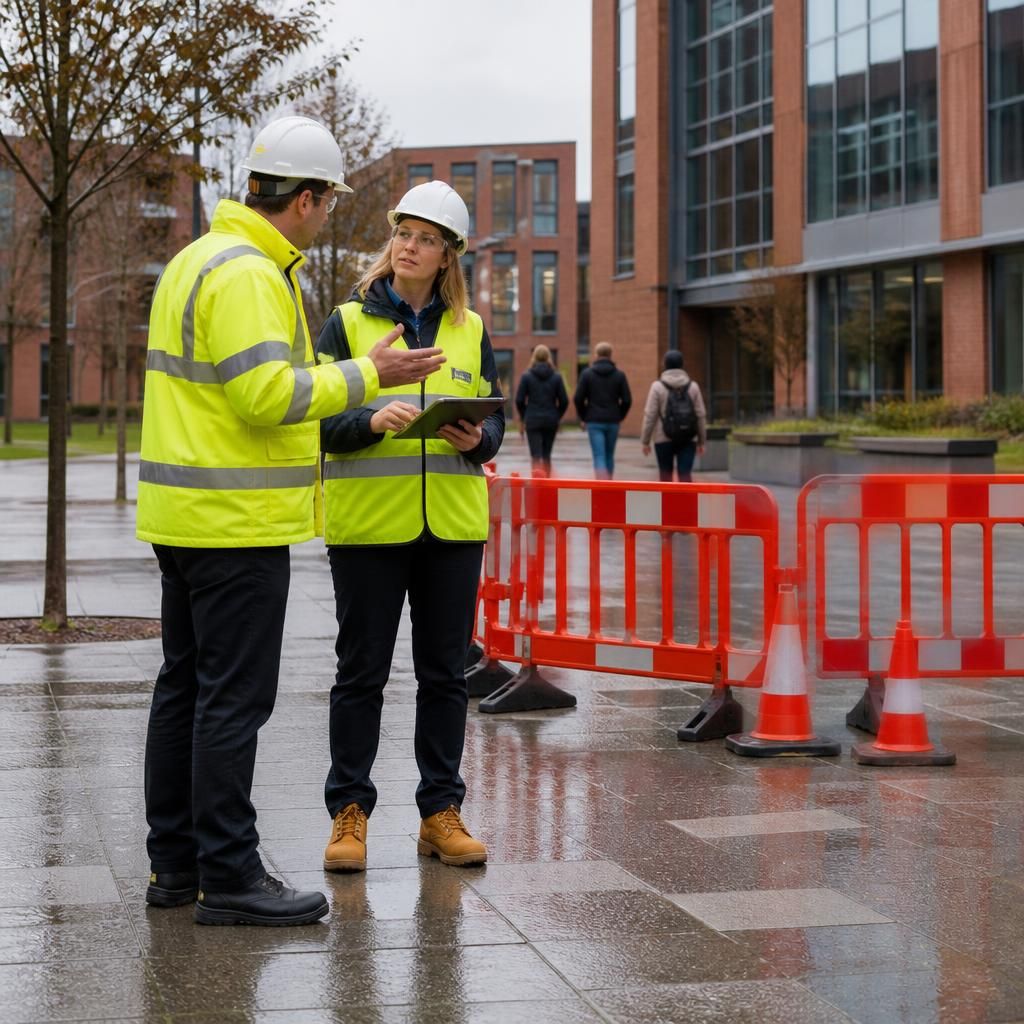
A site-specific risk assessment and method statement (RAMS) is the essential safety document for exterior cleaning on a university campus. It should explain the exact cleaning tasks, access equipment, working areas, hazards and controls for each building, rather than relying on a generic procedure.
Effective RAMS should cover:
- work at height, falling objects and rescue arrangements;
- segregation of students, staff, visitors, vehicles and operatives;
- pressure, water run-off, chemicals, noise and electrical equipment;
- weather limits, emergency procedures and named contacts; and
- handover checks before paths, entrances and other areas reopen.
The university should review the RAMS with the contractor before mobilisation and whenever the work area, method or conditions change. A joint site walkover helps confirm that barriers, pedestrian diversions, drainage protection and access arrangements are practical for the live campus environment.
Review your campus cleaning safety requirements
Review your campus cleaning safety requirements with our team before work begins, including RAMS, access arrangements, exclusion zones and emergency controls. We can help confirm that the proposed exterior cleaning plan is suitable for your buildings and campus activities.