
How can you ensure the commercial exterior cleaning service you choose aligns with industry health and safety standards?
Choose a commercial exterior cleaning contractor that can demonstrate competent, trained operatives, suitable insurance, documented risk assessments and method statements, COSHH controls, appropriate PPE, and safe systems for working at height, near traffic and around the public. Confirm that equipment is inspected and maintained, site-specific controls are agreed before work begins, and cleaning is carried out in line with relevant UK health and safety legislation and recognised industry guidance.
A compliant commercial exterior cleaning service should be able to demonstrate competent operatives, suitable insurance, documented risk assessments and method statements, effective COSHH controls, appropriate personal protective equipment, and safe systems of work for the specific site. Before work starts, the contractor should agree site controls with you, confirm that equipment is suitable and maintained, and explain how risks from height, water, chemicals, vehicles, electricity and members of the public will be controlled.
Check the contractor’s competence and responsibilities
Ask who will manage health and safety on the project and how the operatives’ competence has been assessed. Training should be relevant to the work being undertaken, rather than limited to general induction. Depending on the site and cleaning methods, this may include training for work at height, mobile elevating work platforms, powered access, pressure-washing equipment, chemical handling, traffic management, abrasive or high-pressure cleaning, and emergency procedures.
The contractor should understand its duties under the Health and Safety at Work etc. Act and other applicable UK legislation. Where cleaning forms part of a construction project, the requirements of the Construction (Design and Management) Regulations may also be relevant. A responsible contractor should be able to provide evidence of training, competency assessments, supervision arrangements and any specialist qualifications required for the equipment or access method being used.
Membership of a trade body or possession of a particular certificate is not, by itself, proof that a project will be managed safely. Look for evidence that competence is relevant to your property, the cleaning system and the risks identified during the site survey.
Request project-specific risk assessments and method statements
A risk assessment should identify the hazards present at your premises and set out proportionate controls. A method statement should then explain how the work will be carried out safely, including the sequence of activities, equipment, exclusion zones, access arrangements and responsibilities. Generic documents that do not reflect the building, surrounding land or cleaning specification are not sufficient on their own.
For commercial exterior cleaning, the documentation should consider:
- Falls from roofs, platforms, ladders, scaffolds or other elevated areas.
- Falling tools, equipment, debris, ice, loose masonry or contaminated material.
- High-pressure water, steam, hoses and reaction forces from cleaning equipment.
- Slips, trips and falls caused by wet surfaces, hoses, leads and uneven ground.
- Exposure to cleaning chemicals, biological contamination, dust, fumes and aerosols.
- Contact with electricity, lighting, overhead services and building-mounted equipment.
- Moving vehicles, loading areas, pedestrians, visitors and nearby businesses.
- Damage to façades, cladding, seals, windows, coatings, drainage systems or sensitive surfaces.
- Weather conditions, poor visibility, wind, temperature and water run-off.
The method statement should be available to the site team, communicated before work begins and reviewed if conditions change. You should be told who to contact if the agreed controls cannot be followed.
Confirm safe arrangements for work at height
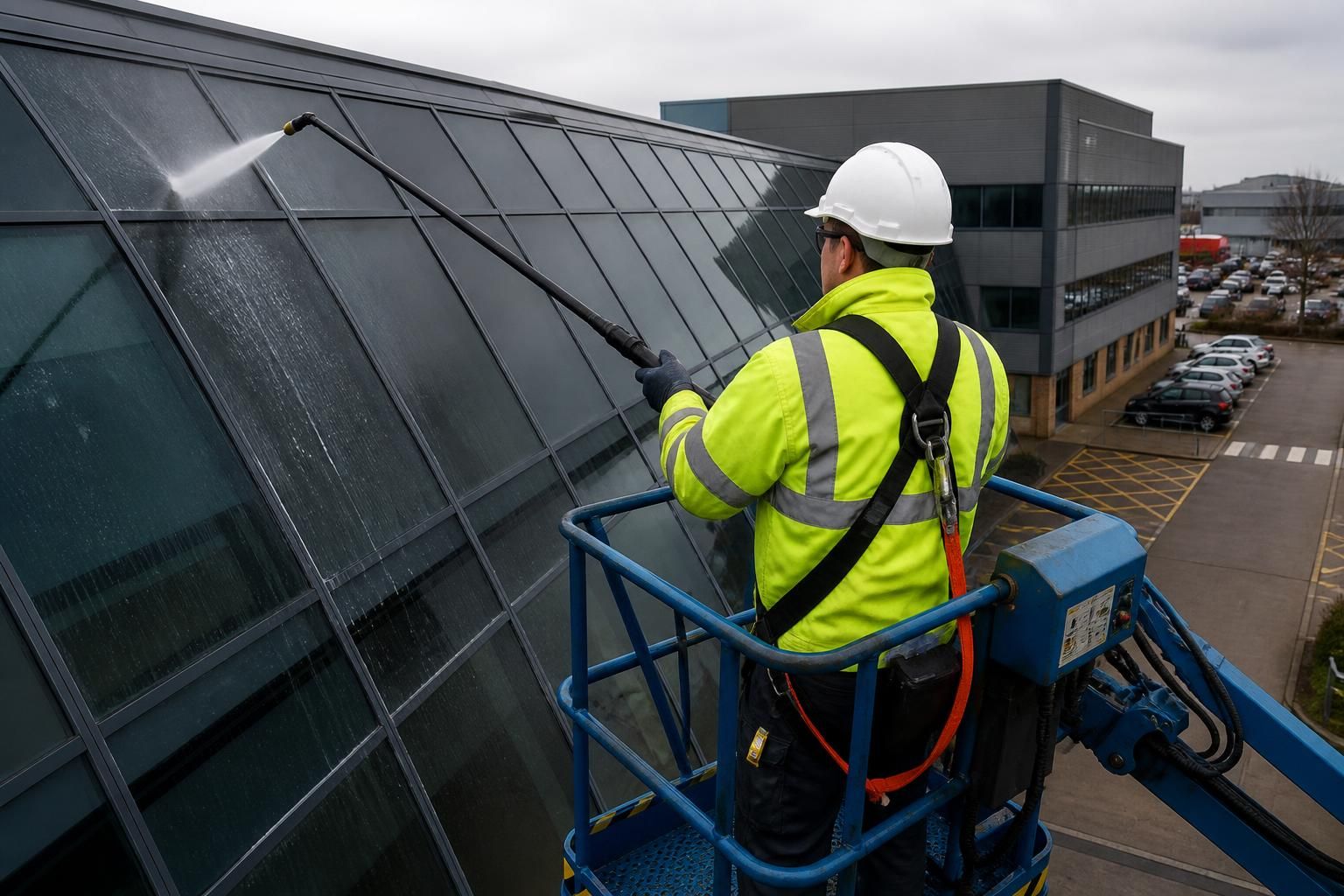
Work at height must be properly planned, supervised and carried out by competent people, in line with the Work at Height Regulations. The safest practical access method should be selected after considering whether the work can be completed from ground level. Water-fed systems, telescopic equipment, mobile elevating work platforms, scaffolds or other access equipment may each be appropriate in different circumstances.
Where powered access is used, check that operators are trained for the type of platform provided and that the equipment is inspected before use. The contractor should also have a rescue plan for anyone who becomes stranded or injured at height. A harness may be required in a mobile elevating work platform, but it is not a substitute for planning, suitable equipment, edge protection or effective supervision.
Roof cleaning requires particular care. Fragile surfaces, rooflights, unprotected edges and access hatches should be identified before work starts. Operatives should not rely on visual assumptions about a roof’s strength, and walkways, guardrails, fall-restraint systems or other controls should be used where appropriate.
Check equipment inspection and maintenance
Cleaning machinery and access equipment should be suitable for the task, maintained in a safe condition and subject to the necessary inspection and testing. The Provision and Use of Work Equipment Regulations apply to many items of work equipment, while lifting equipment may also fall within the Lifting Operations and Lifting Equipment Regulations.
Ask how the contractor checks pressure washers, steam cleaners, hoses, lances, electrical leads, generators, scaffolds and access platforms. Safety-critical defects should be addressed before equipment is used. Electrical equipment should be appropriate for the environment, protected from water where necessary and supported by suitable inspection arrangements. Hoses and cables should be routed to prevent damage and trip hazards.
Equipment should never be selected solely because it provides greater pressure or productivity. The operating pressure, temperature, nozzle, chemical concentration and distance from the surface must be appropriate for the material being cleaned. A controlled test area can help confirm the method without creating unnecessary damage or exposure.
Review COSHH and chemical controls
If detergents, biocides, degreasers, solvents or other substances are used, the contractor should provide suitable Control of Substances Hazardous to Health assessments and current safety data information. These controls should cover storage, dilution, labelling, handling, ventilation, exposure, spill response, disposal and first aid.
Operatives should know which substances are being used and what precautions are required. COSHH controls may include gloves, eye or face protection, protective clothing, respiratory protection, barriers and methods that reduce spray or aerosol formation. Chemicals should not be decanted into unlabelled containers, and incompatible substances must be kept apart.
Agree in advance how contaminated wash water and chemical run-off will be contained and disposed of. It must not be allowed to enter surface-water drains, watercourses, neighbouring premises or areas where it could harm people, animals or the environment. Where necessary, drain protection, collection, filtration or controlled discharge arrangements should form part of the method statement.
Confirm PPE and personal hygiene arrangements
Personal protective equipment should be selected from the risks identified, fit the wearer and be compatible with other equipment. Depending on the work, this may include waterproof protective clothing, slip-resistant safety footwear, gloves, eye protection, face protection, hearing protection, head protection and respiratory protective equipment.
PPE should not be the only control where a hazard can be removed or reduced by safer equipment, isolation or work methods. It should be inspected, maintained, replaced when damaged and used by operatives who have been shown how to wear and care for it. Where work involves bird fouling, mould, sewage contamination or other biological hazards, the hygiene and decontamination arrangements should be clearly defined.
Check controls for traffic and the public
Commercial cleaning often takes place beside roads, car parks, loading bays, entrances or occupied buildings. The contractor should agree how vehicles and pedestrians will be separated from the work area. Controls may include barriers, cones, signed diversion routes, banksmen, temporary closures, controlled deliveries and timed working.
Exclusion zones should account for spray, falling debris, moving plant and the reach of access equipment. Barriers must be stable, visible and maintained throughout the work, not simply placed at the start of the day. Entrances, emergency exits, fire equipment and accessible routes must remain usable unless alternative arrangements have been agreed.
Where cleaning is carried out during occupied hours, the contractor should coordinate with your responsible person or facilities team. Site rules, induction requirements, safeguarding arrangements and communication procedures should be agreed before operatives arrive.
Ask how weather and changing conditions are managed
Wind can affect powered access equipment, suspended materials, spray drift and the stability of temporary controls. Rain, ice and low temperatures can increase slip risks, while bright sunlight or poor visibility can affect vehicle movements and the use of access equipment. The contractor should define when work will be paused and who has authority to stop it.
A safe system is not fixed once paperwork has been signed. The supervisor should monitor conditions during the work and update the risk assessment or method statement if the weather changes, unexpected defects are found, access becomes obstructed or members of the public enter the controlled area.
Check emergency and incident arrangements
Before work starts, establish how the contractor will respond to falls, chemical splashes, electric shock, equipment failure, injury, fire, uncontrolled water run-off and damage to the building. The arrangements should identify first-aid provision, emergency contacts, access for emergency services, rescue equipment and the location of welfare facilities.
Incidents, near misses and defects should be reported promptly to the relevant site contact. The contractor should have a process for investigating what happened and implementing corrective action. Where an incident is reportable under the Reporting of Injuries, Diseases and Dangerous Occurrences Regulations, the responsible employer must follow the applicable reporting requirements.
Verify insurance and documentation
Request evidence of current employers’ liability insurance and suitable public liability cover. The level and scope of cover should be appropriate to the work, the site and the potential consequences of damage or injury. If the project involves specialist access, environmental risks or subcontractors, confirm that these activities are covered.
It is also sensible to retain the agreed quotation or specification, site survey, risk assessments, method statement, COSHH information, insurance evidence, inspection records and completion notes. These records provide a clear reference if the scope changes or future maintenance is planned.
Use a practical pre-start checklist
Before authorising the work, confirm that:
- The contractor has surveyed the site and identified relevant hazards.
- Competent operatives and suitable supervision have been assigned.
- Risk assessments and method statements are specific to the planned work.
- Access, work-at-height and rescue arrangements are documented.
- Cleaning equipment and access equipment are suitable, inspected and maintained.
- COSHH assessments, safety data and run-off controls are in place.
- PPE, welfare, first aid and emergency procedures have been agreed.
- Pedestrian, vehicle and public protection measures are ready before work begins.
- Working-hour restrictions, tenant communications and site rules are understood.
- There is a clear process for stopping work and reporting changes, incidents or defects.
Health and safety compliance is demonstrated through consistent planning and site practice, not through paperwork alone. During the project, check that barriers remain in place, hoses are controlled, PPE is being used correctly, access equipment is operated as planned and the work area is left safe. If conditions differ from the agreed method, pause the activity and require the contractor to reassess it before continuing.
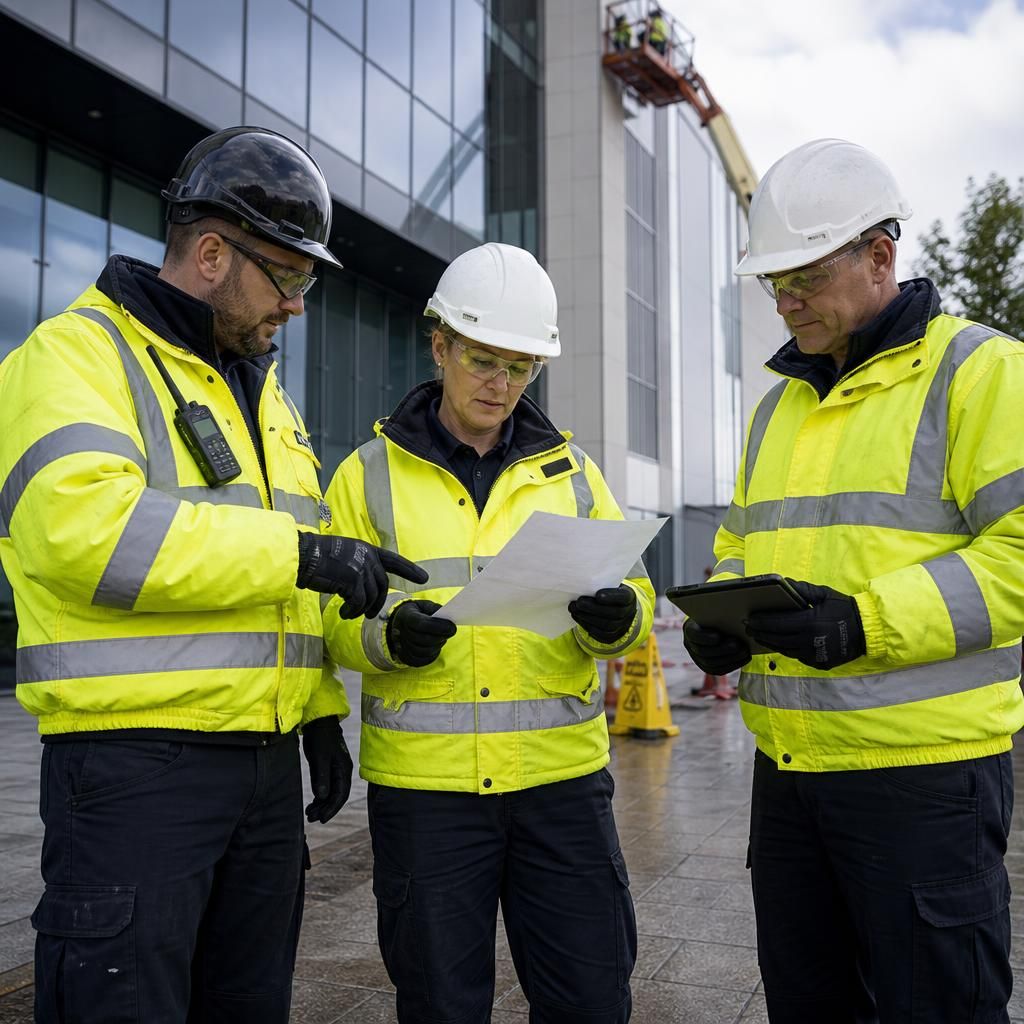
Project-specific risk assessments and method statements are central to demonstrating that commercial exterior cleaning will be carried out safely. They should reflect the actual building, surfaces, access routes, equipment, working hours and surrounding activities, rather than relying solely on generic paperwork.
Before work begins, check that the documentation explains how the contractor will control:
- falls from roofs, platforms and other elevated areas;
- falling debris, high-pressure water, steam and cleaning equipment;
- chemical exposure, contaminated surfaces and wastewater run-off;
- slips, trips, electrical hazards and damage to building materials; and
- vehicles, pedestrians, tenants and members of the public near the work area.
The site team should understand the agreed method, know who can stop the work and review the controls if weather, access or site conditions change. This practical process is more meaningful than a document that has been prepared but is not followed on site.