
What safety measures should be considered when conducting exterior cleaning of factories and warehouses?
Exterior cleaning of factories and warehouses should be planned through a site-specific risk assessment covering work at height, access equipment, pressure or steam, electrical hazards, traffic, falling debris, chemicals and public or employee movement. Controls should include competent operatives, suitable PPE, inspected equipment, secure exclusion zones, safe water and waste management, and clear coordination with the site’s health and safety procedures.
Safe exterior cleaning of factories and warehouses depends on a site-specific risk assessment, competent operatives, suitable access equipment, controlled use of water and chemicals, and effective separation from people, vehicles and production activities. The cleaning method should be selected only after assessing the building, surfaces, working height, site traffic, weather, drainage, electrical installations and any operational hazards.
Plan the work before arriving on site
A method statement and risk assessment should define the cleaning sequence, equipment, access arrangements, exclusion zones, emergency procedures and responsibilities of everyone involved. The assessment should consider the building’s construction, fragile surfaces, roof edges, loading bays, plant, overhead services, refrigeration equipment, ventilation outlets and areas where debris or contaminated water could enter the workplace.
The cleaning contractor should coordinate with the factory or warehouse manager before work starts. This allows the team to identify delivery schedules, forklift routes, fire exits, staff entrances, emergency access routes, production constraints and any permit-to-work requirements. Where cleaning could affect operations, the work may need to be completed outside normal production or delivery periods.
Any change in conditions should trigger a review of the controls. For example, unexpected wind, a blocked drain, a newly identified fragile panel or a change in vehicle movements may require the work to stop until the method is reassessed.
Use competent, properly briefed operatives
Operatives should have suitable training, experience and supervision for the equipment and cleaning methods being used. This includes understanding pressure washing, steam cleaning, chemical handling, work at height, access equipment, manual handling and emergency arrangements. They should be briefed on the site rules and made aware of hazards that are specific to the premises.
Where specialist access equipment is required, operators should hold appropriate training for that equipment and understand its limitations. A trained person should also be able to carry out pre-use checks, recognise unsafe conditions and implement the rescue plan. Supervision should reflect the complexity of the task rather than relying on a standard procedure for every site.
Control work at height
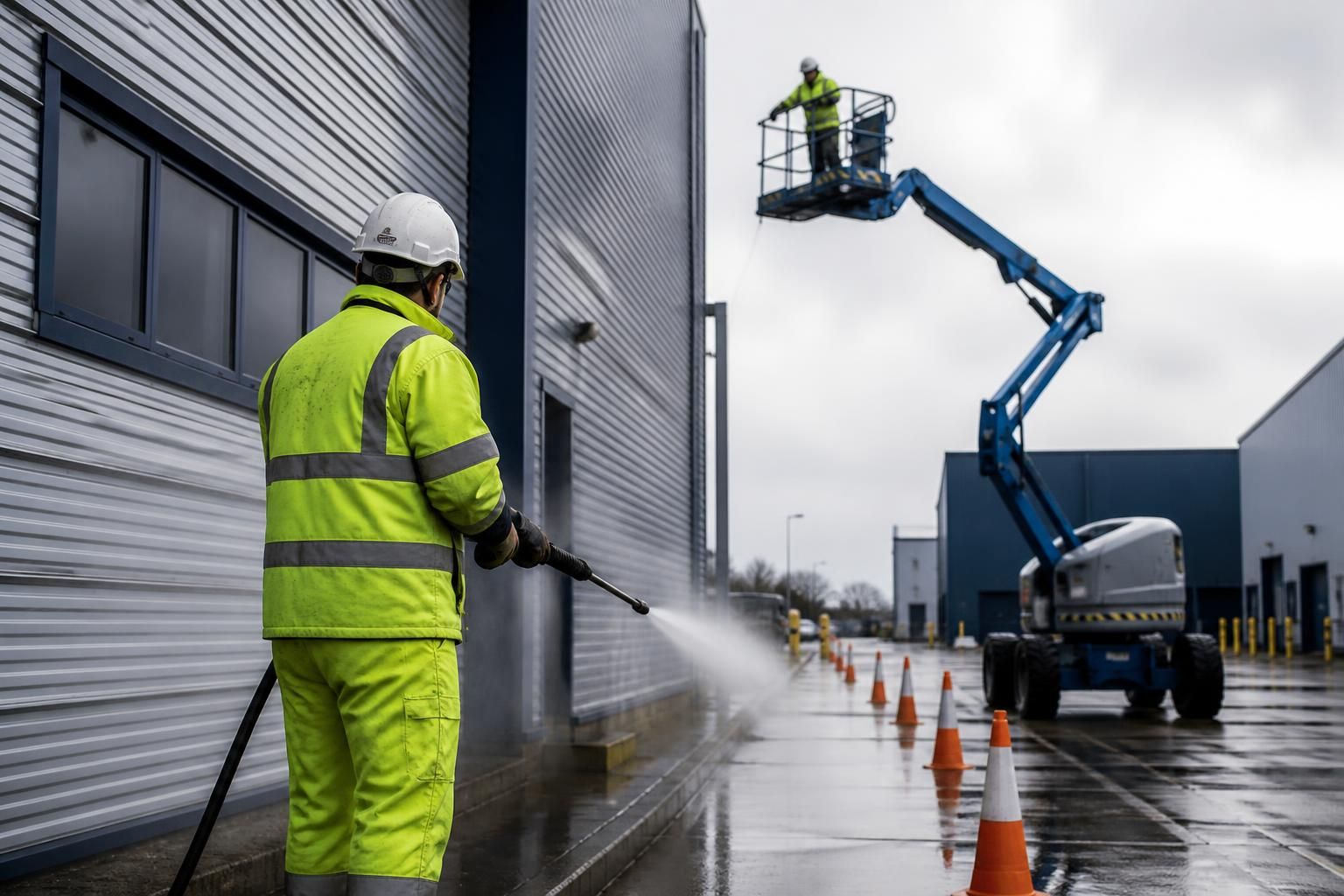
Factories and warehouses commonly have high façades, roofs, canopies, gutters and cladding that cannot be cleaned safely from ground level. Work at height should be avoided where a suitable ground-based method is practical. If it cannot be avoided, the safest reasonably practicable access method should be selected following the hierarchy of control.
Possible controls include water-fed systems used from ground level, mobile elevated work platforms, scaffold towers, fixed platforms, temporary access systems or rope access by suitably trained specialists. Ladders should generally be limited to short-duration, low-risk tasks where they can be used securely and no safer suitable option is reasonably practicable.
Access equipment should be positioned on stable ground, kept clear of edges and overhead obstructions, and used within the manufacturer’s operating limits. Mobile elevated work platforms require appropriate ground conditions, safe travel routes and consideration of wind speed. Outriggers, stabilisers, harnesses and anchor points should be used where required by the equipment and risk assessment.
When work is carried out near roof edges, openings or fragile roof materials, suitable edge protection, barriers or other fall-prevention measures are required. Operatives should never step onto roof areas, rooflights or cladding panels merely because they appear sound. A rescue plan must be realistic and must explain how a fallen or incapacitated operative would be recovered without creating further risk.
Inspect and maintain equipment
Pressure washers, steam cleaners, hoses, lances, pumps, generators, access platforms, lifting equipment and electrical tools should be inspected before use and maintained in accordance with the manufacturer’s instructions. Defective equipment should be removed from service rather than improvised or used until the end of the shift.
Where applicable, equipment should be subject to the required examination, inspection and maintenance arrangements. This may include controls under the Provision and Use of Work Equipment Regulations, the Lifting Operations and Lifting Equipment Regulations and electrical safety procedures. Records should be available to demonstrate that relevant equipment has been examined and that pre-use checks have been completed.
Hoses and cables should be routed to prevent trip hazards, crushing, vehicle damage and contact with sharp edges. Connections should be secure, and high-pressure equipment should never be directed towards people, electrical components, glazing, seals or vulnerable building materials.
Manage pressure washing and steam cleaning risks
High-pressure water can cause serious injection injuries, eye injuries, lacerations and slips. The spray can also dislodge masonry, coatings, rust, dirt, glass fragments or other material, creating a falling-object hazard. Operatives should maintain a safe working position, use the correct nozzle and pressure for the surface, and keep all other people outside the spray and debris zone.
Steam cleaning presents additional risks from hot water, hot surfaces and vapour. Burns can occur through direct contact, splash-back or defective hoses and fittings. Suitable gloves, protective clothing, eye protection and face protection should be selected for the task. Equipment should be depressurised and allowed to cool before maintenance, adjustment or disconnection.
Pressure and temperature should be controlled rather than maximised. A lower-pressure or softer cleaning method may be appropriate for painted surfaces, aged cladding, pointing, seals, windows and areas close to vents or electrical equipment. A small test area can help confirm that the method will not cause damage or release hazardous material.
Prevent falls, falling objects and public access
Tools, hoses, attachments and removed debris should be secured when work is carried out above ground level. Materials should not be left on platforms, parapets or roof areas where they could fall. Loose panels, damaged masonry and unstable signs should be identified before cleaning and dealt with under a controlled procedure.
Ground-level exclusion zones should be proportionate to the height, equipment and spray or debris risk. Barriers, cones and warning signs should be supported by active control where pedestrians or vehicles could enter unexpectedly. Tape alone may not be sufficient in a busy yard or near a public footpath. A banksman or site marshal may be needed to control movements and protect the work area.
Fire exits, pedestrian routes, emergency equipment and access for emergency services must remain available unless the site manager has approved an alternative arrangement. Doors and entrances should not be left wet, obstructed or contaminated during operating hours.
Separate cleaning from vehicles and site operations
Warehouse yards often combine cleaning activities with deliveries, forklift movements, reversing vehicles and contractor traffic. A traffic management plan should establish vehicle routes, pedestrian walkways, parking locations, reversing controls and the position of cleaning equipment. Vehicles should not be allowed to pass through a live spray area or beneath suspended equipment.
Where possible, the cleaning area should be isolated from active loading bays and plant movements. If this is not practical, the site should agree clear communication arrangements, stop-work signals and a named person responsible for coordinating the activity. High-visibility clothing may be required, but it does not replace physical segregation or safe traffic control.
Identify electrical and other service hazards
Water and electricity present a serious combined risk. External sockets, lighting, sensors, security systems, distribution equipment, cables and other electrical installations should be identified before work begins. Electrical equipment may need to be isolated, protected or kept outside the spray zone by a competent person. Operatives should not assume that weatherproof equipment is safe to pressure wash at close range.
Overhead power lines, external pipework, gas installations, refrigeration systems and ventilation plant should also be considered. Access equipment must maintain the required clearance from overhead services, and the site should provide information about hidden services or restricted areas. Where isolation is necessary, it should be completed through the site’s formal procedure rather than by an operative making an informal adjustment.
Control chemicals, dust and surface contamination
Cleaning products should be selected for the surface and used in accordance with the product safety information and the Control of Substances Hazardous to Health requirements. The assessment should cover storage, dilution, application, contact time, ventilation, spill response, incompatible substances and disposal. Chemicals should never be mixed unless the manufacturer specifically permits it.
Appropriate gloves, eye protection, protective footwear, coveralls and respiratory protection should be determined by the substance and application method. Respiratory protective equipment, where required, must be suitable, correctly fitted and supported by appropriate arrangements for use and maintenance.
Older industrial buildings may contain hazardous coatings, bird fouling, mould, oils, biological contamination or materials that could release harmful dust when disturbed. Suspected asbestos-containing materials should not be pressure washed, drilled, abraded or otherwise disturbed. Work should stop and the material should be assessed through the site’s asbestos management arrangements.
Use suitable personal protective equipment
PPE should supplement, not replace, physical and procedural controls. Depending on the task, this may include waterproof and chemical-resistant gloves, safety footwear with suitable slip resistance, eye or face protection, hearing protection, hard hats, high-visibility clothing, protective clothing, respiratory protection and fall-arrest equipment.
PPE must be compatible with the equipment and cleaning products, fit the wearer and be inspected before use. Wet conditions can reduce grip and visibility, while hearing protection can affect communication, so additional controls may be needed. Fall-arrest equipment requires a suitable anchor system and a rescue plan; wearing a harness alone does not prevent a fall or guarantee recovery.
Manage water, drainage and slip hazards
Run-off should be planned before cleaning starts. The team should identify drains, interceptors, watercourses, loading areas, public paths and internal entrances that could be affected. Contaminated water, detergents, oils, paint residue and graffiti-removal products must not be allowed to enter surface-water drainage without suitable approval and control.
Drain covers, bunding, temporary barriers, wet vacuums, collection systems or other containment measures may be required. Wastewater should be collected, treated or disposed of through an appropriate route in accordance with site procedures and environmental requirements. Operatives should not wash pollutants into a drain simply because it is nearby.
Water on hardstanding creates an immediate slip risk and can freeze in cold conditions. The work area should be kept as dry as reasonably practicable, excess water removed, and wet surfaces clearly identified. Access routes should be checked before they are reopened to employees, visitors or vehicles.
Consider weather and visibility
Wind, rain, frost, heat, poor light and lightning can affect access equipment, chemical performance, surface grip and visibility. Work at height and use of elevated platforms may need to stop in unsafe wind conditions or when the manufacturer’s limits cannot be maintained. Rain can also dilute cleaning chemicals, increase run-off and make results unpredictable.
Lighting should be sufficient for the operative to see the work area, equipment, cables, access points and hazards. Temporary lighting must be positioned so that it does not create glare or introduce electrical risks. Conditions should be monitored throughout the work, not only checked at the start of the shift.
Maintain communication and emergency arrangements
Everyone involved should know who is supervising the work, how to raise an alarm and what to do if equipment fails, a person is injured, a chemical is spilled, a service is damaged or a member of the public enters the exclusion zone. Mobile phones or radios should be suitable for the environment and remain accessible without compromising safe operation.
First-aid arrangements, emergency contact details, the site address, access for emergency services and the location of welfare facilities should be confirmed before work begins. Rescue arrangements for work at height should be specific to the access system in use and should not rely solely on the emergency services.
Confirm the area is safe before handover
At the end of the work, the supervisor should check that equipment, hoses, barriers, waste and residues have been removed or safely stored. Surfaces, entrances, drains, access routes, roof areas and plant should be inspected for water, chemical residue, loosened material or damage. Any defect or incident should be reported promptly to the responsible site contact.
A clear handover confirms which areas have been cleaned, which remain restricted, whether any defects were found and when normal operations can resume. This final check is particularly important at loading bays, pedestrian entrances and areas where cleaning has taken place above occupied or operational spaces.
For a factory or warehouse, the safest approach is therefore a documented, coordinated process rather than simply selecting a powerful cleaning machine. The risk assessment, access plan, equipment checks, exclusion controls, environmental arrangements and site communication should all match the building and the work being carried out.
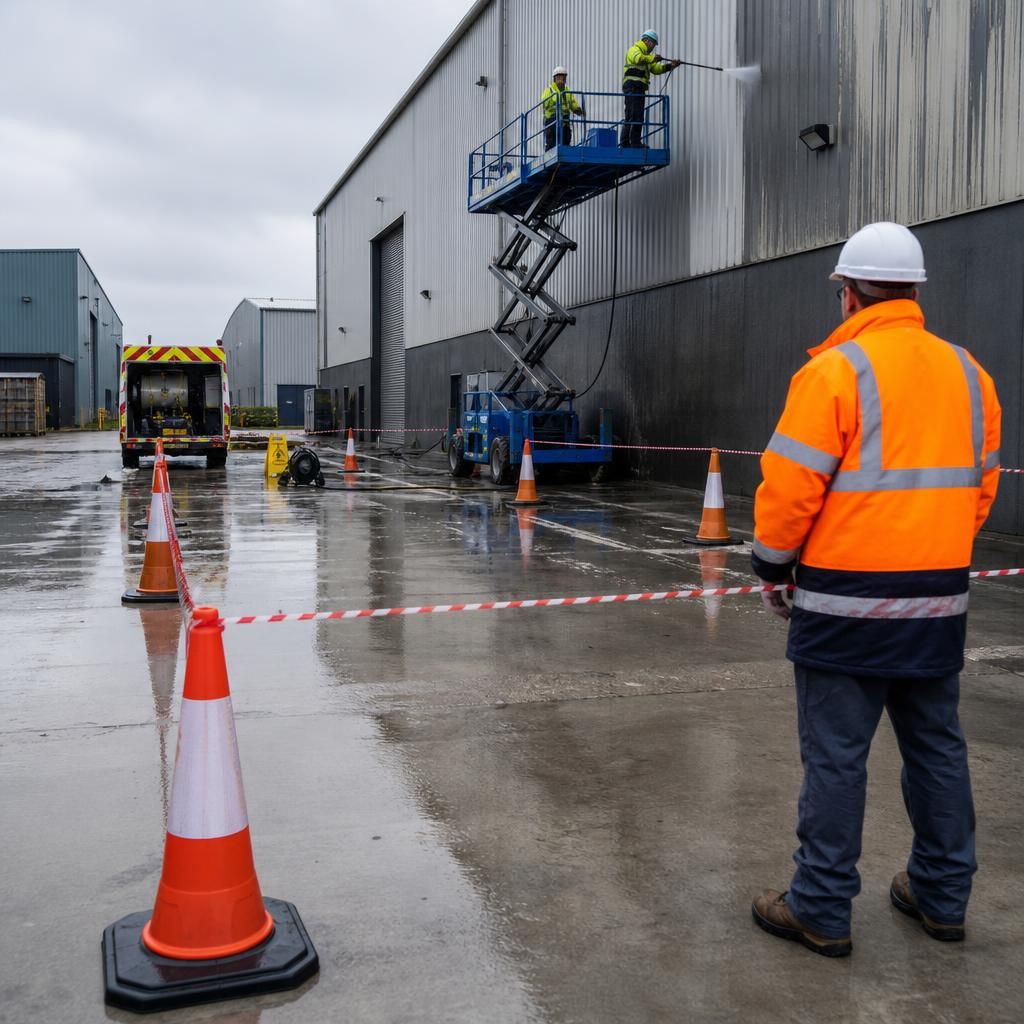
Exclusion zones are controlled areas that keep people, vehicles and site operations away from falling debris, high-pressure spray, hot steam and moving access equipment during exterior cleaning. They should be established before work begins and sized according to the building height, cleaning method, equipment and potential spray or debris travel.
Barriers, cones and warning signs should be supported by active supervision where employees, visitors, forklifts or delivery vehicles could enter unexpectedly. A banksman or site marshal may be needed near loading bays, entrances and busy yard routes. Tape alone is rarely sufficient in an operational factory or warehouse. Fire exits, emergency routes and pedestrian access must remain available, or an agreed alternative route must be provided before cleaning starts.
Before the area is reopened, the supervisor should check for standing water, chemical residue, loosened material, discarded equipment and remaining hazards. The site contact should receive a clear handover confirming which areas are safe to use and whether any restrictions or defects remain.
Plan safer factory and warehouse exterior cleaning
Contact Encanto Exterior Cleaning to arrange a site-specific assessment and method statement for your factory or warehouse exterior cleaning requirements. We can review access, operational and environmental risks before agreeing a safe, practical cleaning plan.