
What safety measures are implemented during factory and warehouse exterior cleaning?
Factory and warehouse exterior cleaning is carried out using documented risk assessments, method statements, suitable personal protective equipment and controlled work areas. Access equipment, traffic management, chemical controls and procedures for working at height are selected to protect workers, site personnel, visitors, vehicles and the building.
Factory and warehouse exterior cleaning is made safe through planned risk control before work starts and continuous supervision while it is under way. The cleaning team assesses the building, access requirements, work equipment, weather, traffic movements, chemicals, water run-off and nearby people before preparing a site-specific risk assessment and method statement.
Site-specific planning and risk assessment
Before attending site, the cleaning contractor should identify hazards associated with the building and the proposed cleaning method. This includes fragile roofs and cladding, roof edges, loading bays, delivery routes, overhead services, electrical installations, plant, vehicles, restricted access and areas used by employees or members of the public. The control measures should be recorded in the risk assessment and method statement, then reviewed if conditions change.
The site team should liaise with the responsible person on site to confirm working hours, access arrangements, emergency procedures, fire routes, welfare facilities, isolation requirements and any operational restrictions. A pre-start briefing or site induction ensures that cleaners, facility staff and other contractors understand the work area and the controls in place.
Competent staff and supervision
Exterior cleaning should be carried out by trained, competent operatives who understand the equipment and techniques being used. This includes pressure washing, steam cleaning, chemical application, work at height and the operation of access equipment where relevant. Supervisors should monitor the work, check that the agreed method is being followed and stop the task if conditions become unsafe.
Workers should be briefed on communication arrangements, exclusion zones, emergency actions and the location of first-aid equipment. Where several contractors are working on the premises, the cleaning team should coordinate with the site manager to prevent conflicting activities.
Controls for working at height
Work at height is planned to avoid the need for height access where possible. When access is necessary, the safest suitable method is selected following a hierarchy of control. Depending on the building and task, this may include ground-based telescopic equipment, mobile elevated work platforms, scaffold towers, scaffolding or industrial rope access. Ladders are generally limited to suitable short-duration tasks where a higher level of control is not reasonably practicable.
Access equipment must be suitable for the ground conditions, reach, load and working environment. It should be operated by trained personnel, inspected before use and positioned on stable ground away from unprotected edges, vehicle routes and overhead hazards. Harnesses, lanyards and other fall-protection equipment are used where the method requires them, with suitable anchor points and a rescue plan in place. A plan for recovering an incapacitated worker is important; relying solely on emergency services is not an adequate rescue arrangement for many access tasks.
Roof work requires additional controls because roof sheets, rooflights and coverings may be fragile. Operatives should not assume that a roof is load-bearing. Designated walkways, edge protection, staging, guardrails or other suitable measures may be required, and access onto a roof should only take place when the method has been assessed and authorised.
Inspection and safe use of equipment
Pressure washers, steam-cleaning systems, hoses, poles, pumps, generators and access equipment should be checked before use. Operatives look for damaged cables, leaking hoses, loose fittings, worn safety devices, unstable platforms and other defects. Equipment should be maintained in line with the manufacturer’s instructions, with statutory examinations and inspection records completed where required.
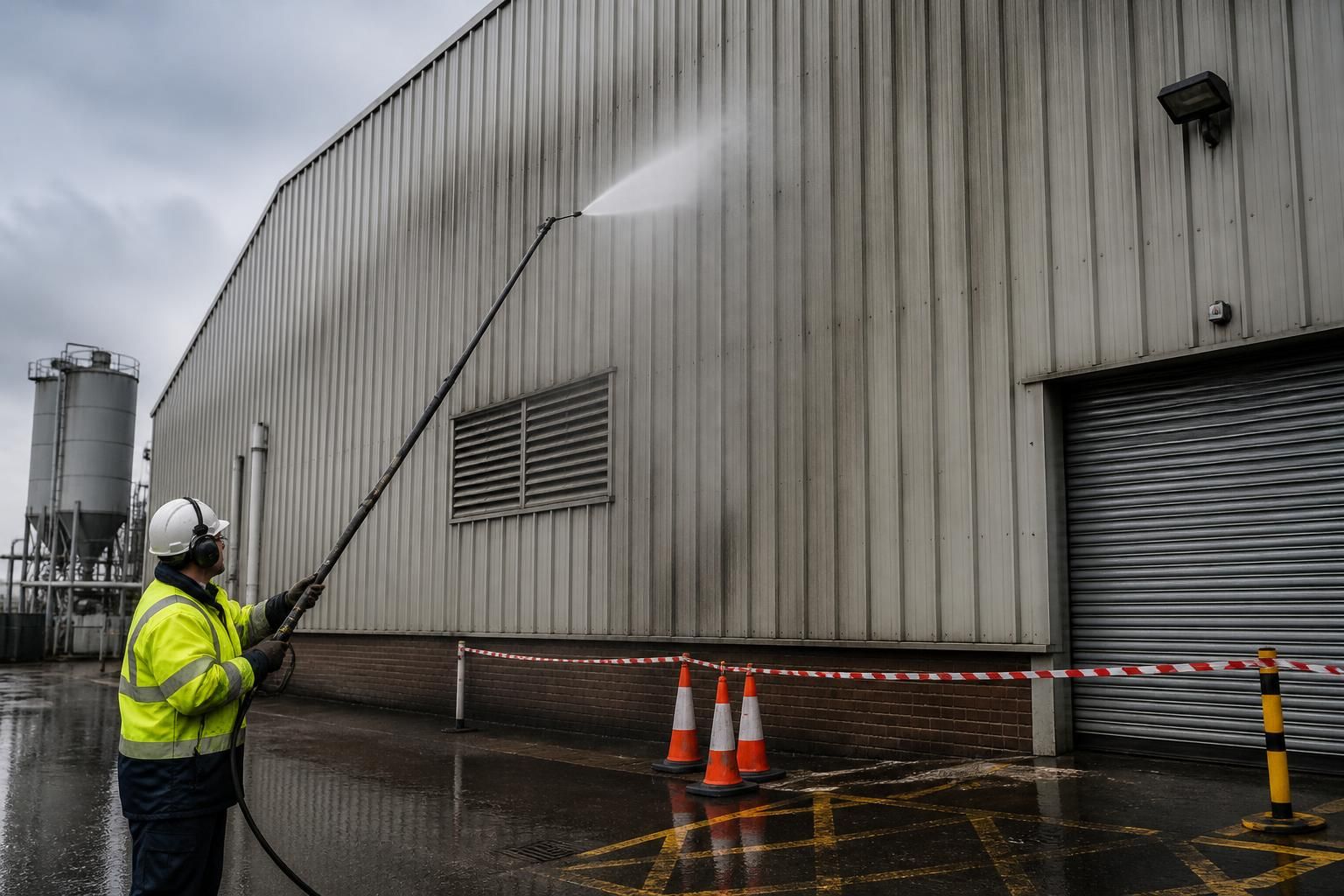
High-pressure water can cause serious injury, damage surfaces and force contaminants into unwanted areas. The operator should maintain a safe stance, control the lance and hose, avoid directing the jet at people or unprotected electrical equipment, and use the correct pressure, temperature, nozzle and distance for the surface. Hoses should be routed to reduce trip hazards and protected from vehicles, sharp edges and excessive bending.
Electrical equipment and cables must be suitable for the wet environment. Electrical supplies may need to be isolated or protected in agreement with the site’s responsible person. Operatives should also consider the risk of water entering lighting, sockets, control panels, machinery, ventilation systems or other building services.
Exclusion zones and traffic management
Cleaning areas are separated from pedestrians and site operations using barriers, cones, warning signs and, where appropriate, a banksman or dedicated marshal. The size and position of the exclusion zone should reflect the equipment, working height, spray pattern, falling debris, vehicle movements and the possibility of contaminated water leaving the work area.
At factories and warehouses, delivery vehicles, forklift trucks and reversing movements can create significant additional risk. Cleaning should be scheduled away from busy operating periods where practical, and traffic routes, loading bays and entrances should be temporarily diverted or controlled. Access platforms, hoses and barriers must not obstruct fire exits, emergency routes or essential site access without an agreed alternative.
Doors and entrances may need temporary protection or controlled closure to prevent spray, water and cleaning agents entering the building. The site team should be told when an area is safe to reopen, particularly where surfaces remain wet or slippery.
Personal protective equipment
Personal protective equipment is selected from the risk assessment and is used alongside, not instead of, safer planning and physical controls. Depending on the task, this may include waterproof protective clothing, safety footwear with suitable slip resistance, gloves, eye or face protection, hearing protection, head protection and respiratory protection.
Protection must be compatible with the work. For example, eye and face protection may be needed where high-pressure spray or chemical splash is possible, while hearing protection may be required when operating noisy machinery for extended periods. Harnesses and fall-arrest equipment must be correctly fitted, inspected and used with an appropriate system rather than treated as general-purpose PPE.
Chemical and contamination controls
Cleaning products are assessed under the Control of Substances Hazardous to Health requirements. Operatives should follow the product safety data sheet, use the correct dilution and application method, and wear the specified protective equipment. Chemicals should be stored securely, clearly labelled and kept away from incompatible substances, drains and unauthorised personnel.
Before applying a detergent, biocide, degreaser or graffiti-removal product, the team should check its compatibility with the substrate and nearby materials. Small test areas can help identify staining, colour change or damage before full application. Spray drift should be controlled, particularly around ventilation intakes, vehicles, food-related operations, sensitive landscaping and neighbouring premises.
Where bird fouling, mould, algae, oil, dust or other contaminants are present, the method should control exposure and prevent the material being spread by spray or runoff. Appropriate collection, containment and disposal arrangements should be established for contaminated water and debris.
Weather, surfaces and changing conditions
Wind, rain, ice, poor visibility and extreme temperatures can affect access equipment, spray control, footing, drying times and chemical performance. Work at height or high-pressure cleaning may need to pause if weather conditions make the method unsafe. The supervisor should reassess the task rather than continuing to meet a timetable.
Surfaces are checked for loose panels, unstable masonry, damaged render, defective gutters and other conditions that could worsen during cleaning. Cleaning should not proceed against a defective surface without agreement on the appropriate repair or control. Care is also needed around fragile seals, vents, louvres, signage, insulation and painted coatings.
Water, run-off and property protection
Drainage points are identified before washing starts. Runoff may contain detergents, oils, dirt, paint residues or biological contamination, so it must not be allowed to enter surface-water drains or neighbouring land without suitable controls. Drain covers, bunding, wet vacuums, temporary containment and controlled discharge arrangements may be used where appropriate.
Windows, doors, vents, machinery, stock, vehicles and sensitive landscaping should be protected from water and cleaning products. Any pre-existing damage should be recorded during the site inspection so that it is not confused with an effect of the cleaning work. The completed area should be checked for standing water, slippery surfaces, displaced materials and damage before handover.
Emergency arrangements and completion checks
The method statement should explain what to do in the event of injury, equipment failure, chemical exposure, a spill, falling debris, structural damage or sudden weather deterioration. First-aid arrangements, emergency contact details, access for emergency services and rescue procedures should be known to the team before work begins.
On completion, equipment and barriers are removed safely, waste and contaminated materials are dealt with correctly, and the work area is inspected with the site representative where required. Any defects, incidents, near misses or changes to the agreed method should be reported and recorded. These final checks help confirm that the factory or warehouse exterior is clean without leaving avoidable risks for employees, visitors, vehicles or ongoing site operations.
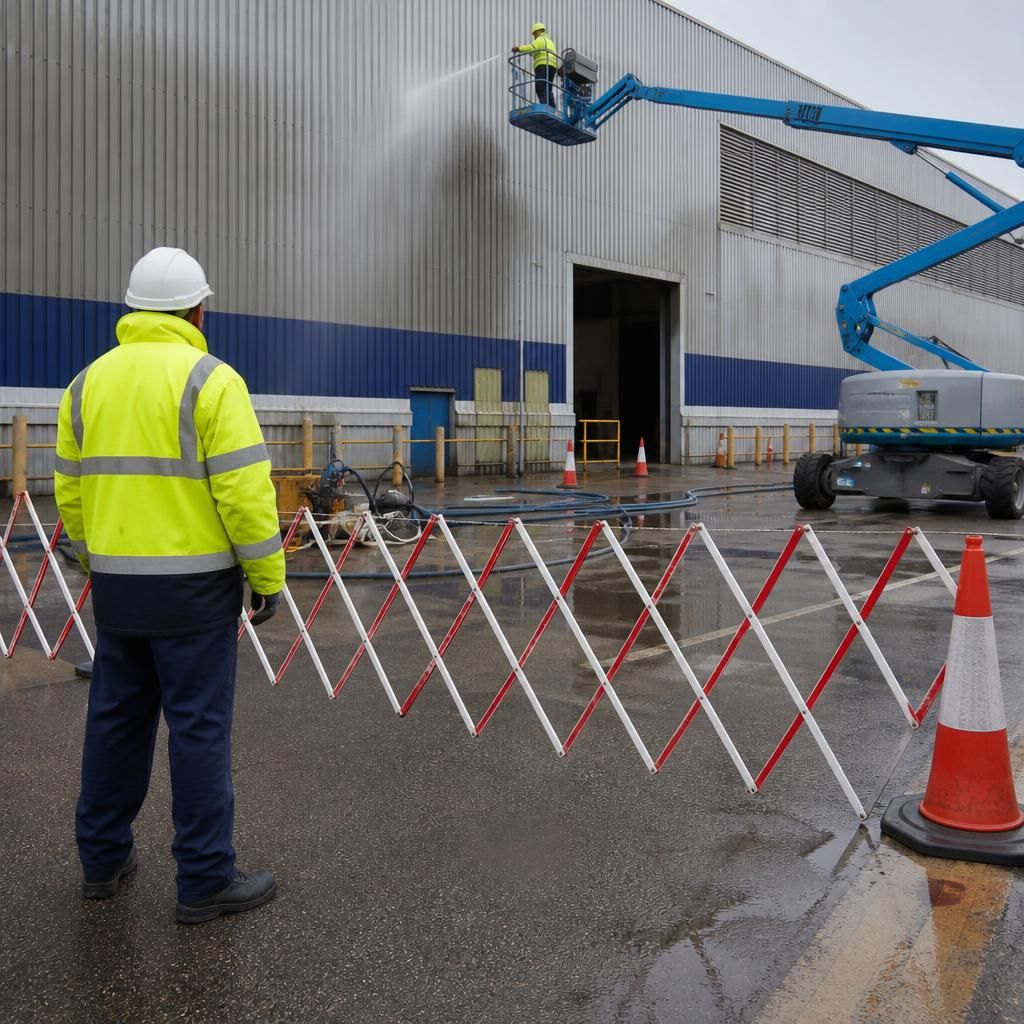
Exclusion zones and traffic management protect people, vehicles and building users during factory and warehouse exterior cleaning. Barriers, cones and warning signs separate the cleaning area from pedestrians, forklifts, delivery vehicles and falling debris, while a trained marshal may control movements near loading bays or access routes.
The size and position of the controlled area are agreed during the site assessment and adjusted for working height, spray reach, hoses, access platforms and runoff. Cleaning is scheduled around busy operational periods where practical, with entrances, fire routes and delivery paths kept clear or temporarily diverted. Before reopening an area, the team checks for standing water, slippery surfaces, equipment and other remaining hazards.