
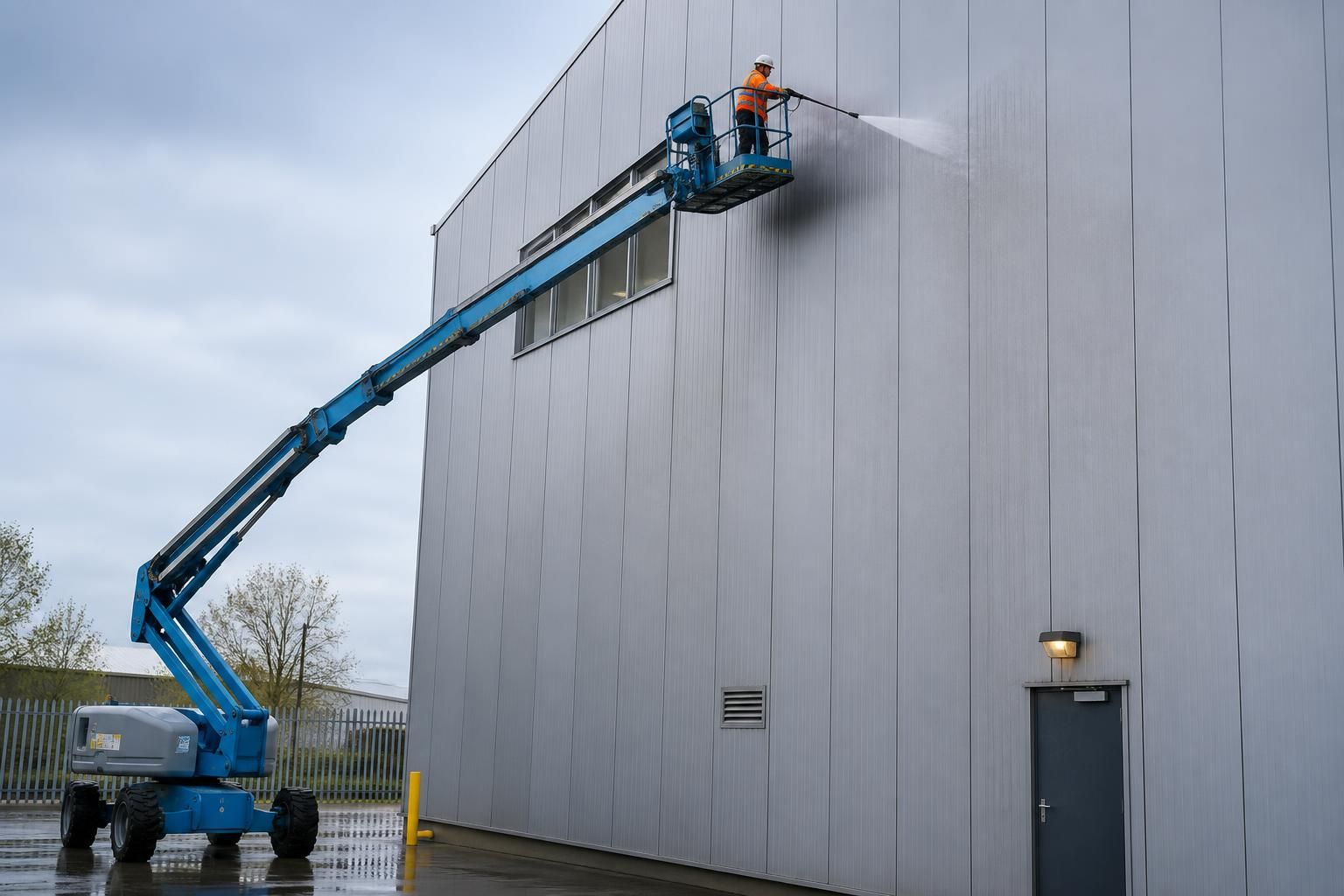
How can advanced access equipment improve the efficiency and safety of cleaning factory and warehouse exteriors?
Advanced access equipment, including suitable mobile elevating work platforms, gives trained operatives safer and more direct access to high façades, cladding, roofs and warehouse elevations. This reduces setup time, improves cleaning reach and limits the need for ladders or extended work at height, helping factory and warehouse exterior cleaning proceed more efficiently with better control.
Advanced access equipment improves factory and warehouse exterior cleaning by giving trained operatives controlled access to elevated and difficult-to-reach surfaces. Suitable mobile elevating work platforms (MEWPs), including boom lifts and scissor lifts, can position the operator close to façades, cladding, roofs, loading-bay canopies and high-level signage. This reduces reliance on ladders, limits unnecessary repositioning and allows cleaning equipment to be used with greater control.
The correct equipment is selected according to the building, the cleaning method and the conditions on site. A scissor lift may be suitable where the work is predominantly vertical and the ground is firm and level. A boom lift can provide outreach over obstacles, allowing operatives to reach upper elevations, recessed façades and areas above plant or loading bays. Compact or tracked access platforms may be more appropriate where access is restricted, ground pressure must be controlled or the work takes place inside a covered service area.
Using access equipment effectively starts with a site assessment. This should consider the height and shape of the building, the distance from the machine to the cleaning surface, access routes, overhead obstructions, ground conditions, slopes, underground services, traffic movements and the position of doors and loading areas. It should also account for the weight of operatives, tools, hoses and other cleaning equipment within the platform’s rated capacity. Choosing a machine with insufficient reach can create unsafe working positions, while selecting equipment that is larger than necessary can cause avoidable disruption and access problems.
Improved cleaning efficiency
Access platforms can make the cleaning process more efficient in several ways:
- Better reach: Operatives can work across larger areas from a stable platform instead of repeatedly climbing, descending and moving ladders or temporary equipment.
- More consistent results: Working at a suitable distance from the surface makes it easier to maintain a steady spray pattern, steam-cleaning position or soft-washing application.
- Less setup time: A mobile platform can often be repositioned between work zones more quickly than fixed access systems, provided the route has been planned and the surface is suitable.
- Improved access around obstructions: Articulated or telescopic booms can reach over canopies, pipework, plant and other features that would otherwise leave sections of the building untreated.
- Reduced physical strain: A properly positioned platform helps operatives avoid overreaching, awkward ladder work and prolonged use of hand tools above shoulder height.
- More organised equipment handling: Hoses, poles and tools can be managed from the platform, reducing repeated movement between ground level and the work area.
These benefits are particularly relevant to large warehouses and factories, where elevations may include extensive metal cladding, tall wall panels, roof edges, vents, glazing, signage and sheltered loading areas. Access equipment also helps create a more systematic cleaning sequence, such as progressing elevation by elevation or dividing the building into clearly defined work zones.
How access equipment supports safer work at height
A properly selected MEWP provides a guarded working platform, giving operatives a more stable position than a ladder for tasks that require extended work, pressure-washing equipment or two-handed operation. The platform can be positioned close enough to the surface to reduce stretching and leaning, while the guardrails and designated access point help prevent falls when used correctly.
However, access equipment does not remove the risks associated with work at height. Its use must be planned and supervised in line with the site’s risk assessment and the requirements of the Work at Height Regulations. Operators should be trained and competent for the equipment being used, and the machine should be inspected before use. Relevant examination, maintenance and inspection requirements under the Lifting Operations and Lifting Equipment Regulations and the Provision and Use of Work Equipment Regulations must also be addressed.
Important controls commonly include:
- checking that the ground is firm enough to support the machine and any stabilisers;
- identifying overhead power lines, roof edges, fragile surfaces and other hazards;
- establishing exclusion zones below and around the platform;
- separating the work area from forklifts, delivery vehicles, pedestrians and site traffic;
- using the specified harness and lanyard arrangements where required by the equipment and risk assessment;
- securing tools and materials so they cannot fall from the platform;
- monitoring wind, rain, ice, visibility and other weather conditions that could affect stability or cleaning control; and
- providing a documented emergency and rescue procedure, including arrangements for a person who becomes ill or is stranded at height.
Managing water, hoses and cleaning equipment
Exterior cleaning introduces additional considerations that are not present in some other MEWP tasks. Pressure-washing hoses can snag on barriers, wheels or building features and may affect the movement of the platform. Steam-cleaning equipment and other tools add weight and may create hot surfaces or restricted visibility. Hoses should therefore be routed and managed so they do not obstruct the platform controls, become trapped during movement or create a trip hazard at ground level.
Operators also need to control spray drift, overspray and falling debris. Windows, electrical equipment, vents, air-intake systems, stored goods and finished surfaces may require protection. Ground-level staff can help manage hoses, barriers and drainage, but they must remain outside the exclusion zone unless their task requires them to enter and the movement of the platform is controlled.
Runoff should be considered before cleaning begins. The team may need to protect drains, collect contaminated water or adjust the cleaning method where oils, chemical residues, paint particles or other pollutants are present. This helps prevent environmental harm while also keeping access routes and working surfaces safe.
Planning access around an operating site
Factories and warehouses often remain operational during cleaning. Access equipment can reduce disruption when the work is divided into planned zones and coordinated with the client’s production, delivery and maintenance activities. The cleaning plan should identify suitable machine entry points, temporary closures, delivery schedules, pedestrian diversions, emergency routes and safe parking areas for equipment.
Where a platform must travel across a site, the route should be checked for potholes, slopes, drainage channels, soft ground, kerbs and changes in level. Moving a MEWP while elevated should only be carried out where the equipment is designed for that use and the ground and surrounding conditions permit it. In many cases, lowering the platform before relocation provides greater control.
Advanced access equipment is most effective when it forms part of a complete cleaning method rather than being treated as a substitute for planning. The building survey, risk assessment, equipment selection, operator competence, surface protection, runoff controls and emergency arrangements should all be considered together. Used in this way, access platforms help deliver more thorough factory and warehouse exterior cleaning while reducing avoidable work-at-height, manual-handling and site-traffic risks.
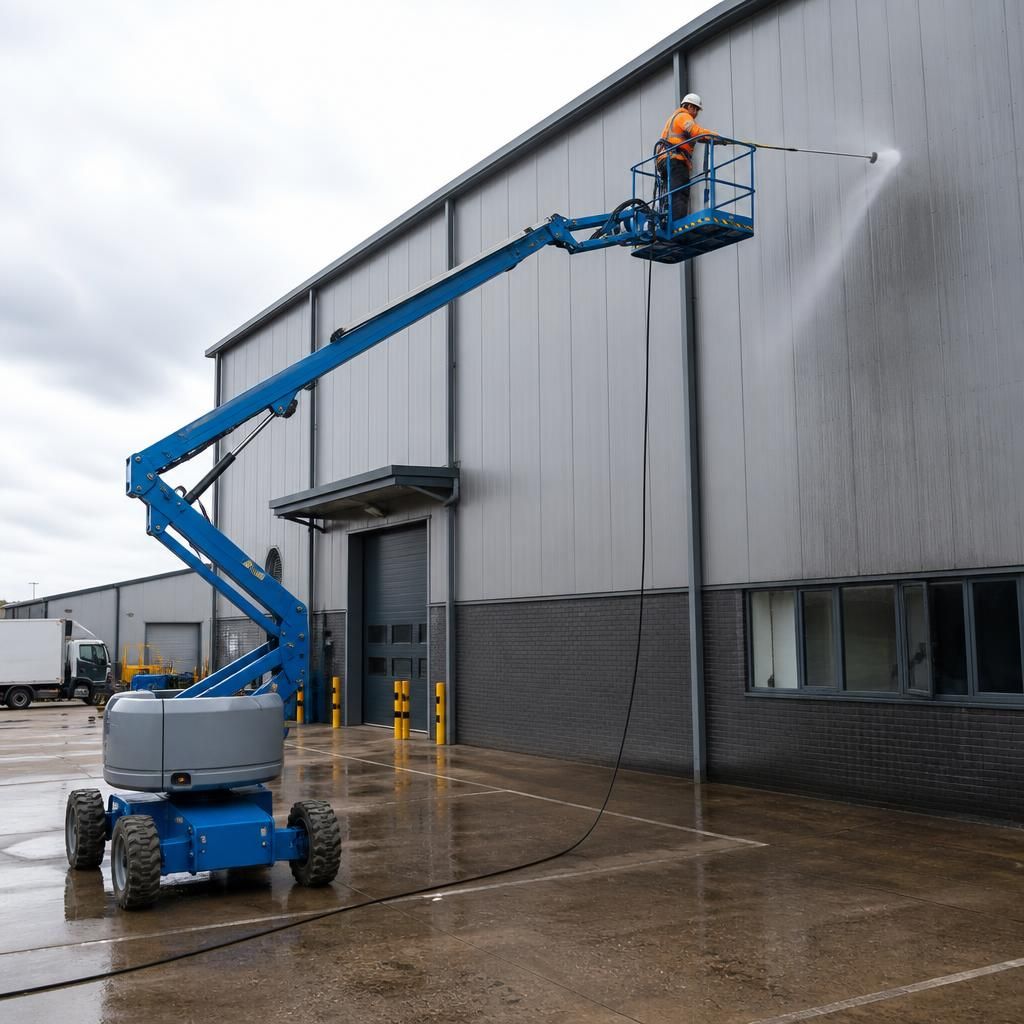
Advanced access equipment improves exterior cleaning by placing trained operatives at a controlled working height and distance from the building. A suitable MEWP, such as a scissor lift or boom lift, reduces overreaching and provides a steadier position for pressure-washing, steam cleaning and detailed work on cladding, façades and high-level signage.
The equipment must be matched to the site. A scissor lift suits open, level areas, while a boom lift can reach over loading bays, canopies and fixed plant. Before use, the access route, ground conditions, overhead hazards, weather, platform capacity and exclusion zone should be assessed. This helps the cleaning team work efficiently without creating additional risks for building occupants, vehicles or nearby personnel.