
What safety measures should be considered during commercial power washing?
Commercial power washing should be carried out following a site-specific risk assessment, with trained operatives using suitable PPE, inspected equipment and controlled water pressure. Barriers, warning signs, traffic and pedestrian controls, safe access procedures, and measures to protect nearby people, surfaces, electrical systems and drainage must also be in place.
Commercial power washing should be controlled through a site-specific risk assessment and method statement, with trained operatives, appropriate personal protective equipment (PPE), correctly maintained equipment and effective separation from people, vehicles and vulnerable property. The pressure, temperature, water flow and cleaning products must be selected for the surface and the site conditions rather than applied uniformly.
Carry out a site assessment before work starts. The assessment should identify hazards including pedestrians, moving vehicles, fragile surfaces, work at height, overhead services, electrical installations, drainage, chemical exposure, slips and trips, falling debris and contaminated water. It should also consider the building’s condition, access arrangements, weather, nearby businesses and any activities that need to continue while cleaning takes place. Findings should be recorded in a method statement and explained to everyone involved.
Use trained and competent operatives. Commercial power washing requires more than operating a pressure washer. Staff should understand pressure and temperature controls, surface-specific cleaning methods, chemical handling, safe access, emergency procedures and the risks created by spray, noise and run-off. Where specialist equipment is used, such as powered access platforms, operators should hold appropriate training and authorisation. Work should be supervised where the site, equipment or hazards require it.
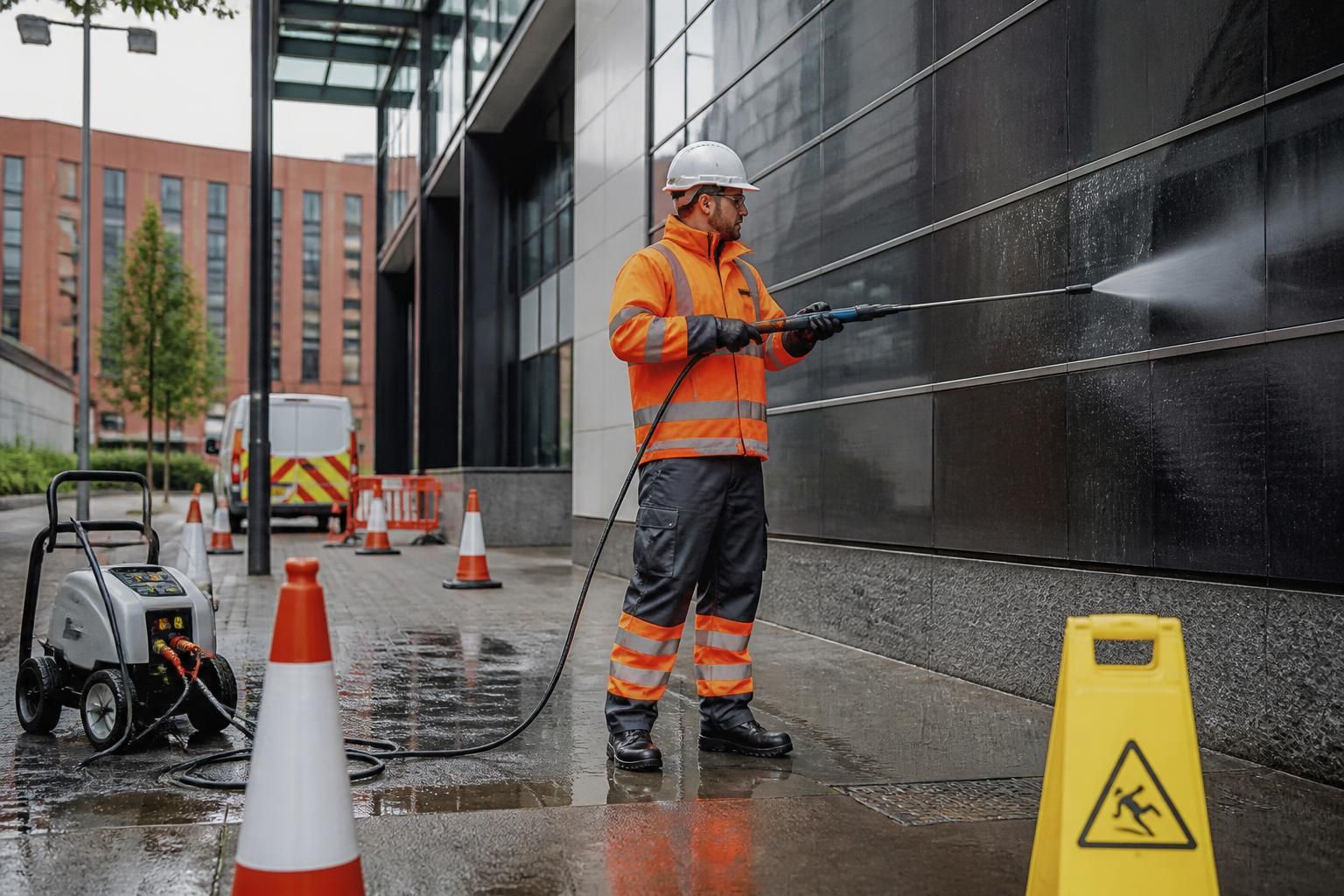
Wear suitable PPE. PPE should be selected following the risk assessment and may include waterproof protective clothing, gloves that provide the required chemical and mechanical protection, slip-resistant safety footwear, eye protection or a face shield, and hearing protection. Respiratory protection may be necessary when using certain cleaning agents or where contaminated material could become airborne. PPE must be compatible with the work, kept in good condition and replaced when damaged or contaminated. It should not be treated as a substitute for guarding, isolation or other control measures.
Inspect and maintain the equipment. Hoses, lances, trigger mechanisms, couplings, seals, nozzles, cables and protective guards should be checked before use. Defective equipment must be taken out of service rather than repaired temporarily on site. Electrical equipment should be suitable for wet conditions and protected from water ingress, with cables routed to prevent damage, contact with standing water and trip hazards. Where applicable, equipment should be managed in line with the requirements for work equipment, lifting equipment and electrical safety.
Control the pressure, temperature and cleaning agents. Operators should begin with the least aggressive effective setting and test an inconspicuous area before cleaning the main surface. Excessive pressure or heat can remove coatings, damage mortar joints, force water behind cladding, mark stone, disturb seals or break fragile materials. Nozzles should be selected to provide suitable coverage without creating unnecessary impact. Cleaning chemicals must be correctly labelled, stored, diluted and applied in accordance with their safety data sheets and COSHH controls. Chemicals should never be mixed unless the manufacturer specifically permits it.
Protect people and establish an exclusion zone. High-pressure spray can cause injury and can propel grit, paint flakes, broken material and other debris. Barriers, cones and clear warning signs should define the work area, with access restricted to authorised personnel. Operatives should never direct the lance towards another person, use it to clean clothing or leave a pressurised hose unattended. Doors, windows and entrances should be protected or temporarily closed where spray could enter the building. Occupants and visitors should be informed about temporary restrictions and alternative routes.
Separate the work from traffic and pedestrian movement. Car parks, service yards, pavements and loading areas often require a specific traffic management plan. This may involve signed diversions, banksmen, temporary closures, segregated walkways and controlled vehicle movements. Warning signs should be visible before people reach the cleaning area, not placed where spray or parked vehicles can obscure them. The arrangement should be reviewed if site conditions change or if normal operations create unexpected conflict with the cleaning team.
Manage access and work at height safely. Ladders should not be used as a substitute for a suitable access system where prolonged or forceful work is required. Scaffolding, towers, mobile elevating work platforms or other access equipment must be selected for the task and used on stable ground by trained personnel. Operators should maintain a secure working position and avoid overreaching while handling a reactive lance or hose. Equipment and debris must be prevented from falling, and areas below should remain within the exclusion zone.
Check electrical and building services before washing. Water and electrical systems present a serious risk, particularly around external sockets, lighting, distribution boards, signage, plant and temporary supplies. Vulnerable components should be isolated, covered or kept outside the spray area by a competent person. The operator should also identify gas, ventilation, communications and other service openings that could allow water into the building. Cleaning should stop if exposed wiring, damaged cladding, unstable masonry or other unsafe conditions are discovered.
Prevent slips, trips and falls. Hoses and cables should be routed away from walkways or covered with suitable protection. Water should be directed towards controlled collection points rather than allowed to accumulate around entrances, ramps or vehicle routes. The team should monitor changing ground conditions during the work and clean or isolate wet areas as necessary. Staff and site users should not be permitted to walk through an area containing pooled water, loose debris or active spray.
Control run-off and protect drainage. Dirty water may contain detergents, oil, traffic film, paint particles, biological growth or other contaminants. It should not be allowed to enter surface-water drains unless this is permitted and the discharge is suitable. Drain covers, bunding, wet vacuums, drain mats, collection tanks or other containment methods may be needed, particularly when cleaning car parks, industrial areas, façades with coatings or heavily soiled surfaces. Wastewater should be handled and disposed of in accordance with the site requirements and applicable environmental controls.
Plan for weather and visibility. Strong wind can carry spray and debris beyond the intended work area, while cold conditions can create ice and unstable footing. Rain, poor visibility, heat and lightning can also affect safe operation and access equipment. Work should be paused or rearranged when conditions prevent effective control of spray, traffic, equipment or the exclusion zone. Artificial lighting should be provided where natural light is insufficient.
Have emergency arrangements in place. The site team should know how to stop the machine, isolate electrical supplies, deal with a burst hose, respond to chemical contact, report an injury and summon emergency assistance. Suitable first-aid provision, clean water for rinsing chemical splashes and accessible contact details should be available. Any incident, near miss, property damage or uncontrolled discharge should be reported, recorded and reviewed before work resumes.
Before the area is reopened, operatives should confirm that equipment has been removed, surfaces are safe to use, residual chemicals have been cleared, drainage controls have been dismantled appropriately and no damage has been caused to the building or surrounding property. A properly briefed team, documented controls and continual supervision help ensure that commercial power washing protects workers, visitors, the public and the premises being cleaned.
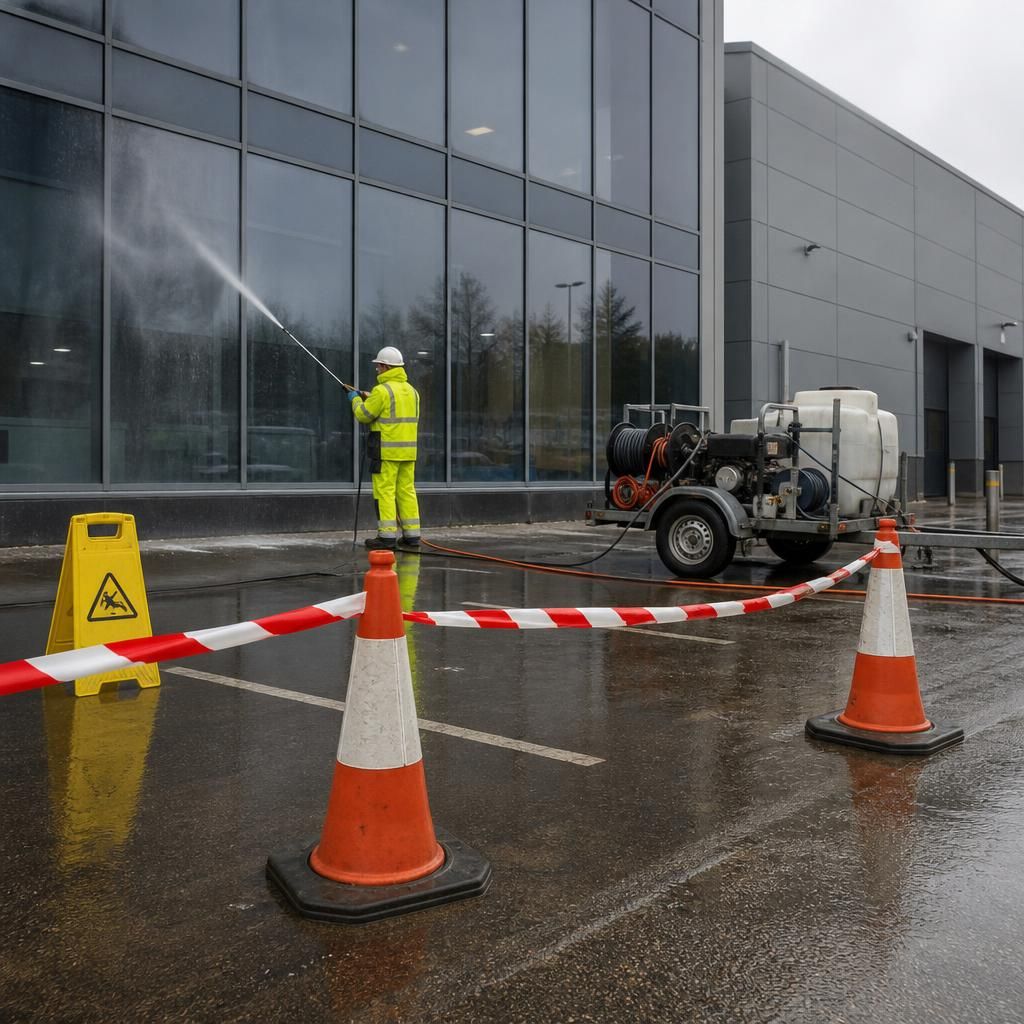
Exclusion zones are a core safety measure during commercial power washing because high-pressure spray can injure people and propel loosened dirt, paint, grit or fragments beyond the area being cleaned. Barriers, cones and clear warning signs should keep employees, visitors and members of the public away from the spray, while doors, windows and vulnerable entrances should be closed or protected.
Where cleaning takes place near car parks, pavements, loading bays or service yards, the exclusion zone should be supported by a site-specific traffic plan. This may include temporary closures, signed pedestrian diversions, segregated walkways and a trained banksman to control vehicle movements. The controls should be checked throughout the work and adjusted if weather, visibility, deliveries or normal site activity changes.