
What safety measures should be taken during the car park and forecourt cleaning process?
Safe car park and forecourt cleaning requires a documented risk assessment, clear traffic and pedestrian controls, suitable PPE, and competent operation of pressure-washing, steam-cleaning and access equipment. Operatives should also isolate hazards, protect nearby people and vehicles, and manage contaminated water and detergents so the work does not create slip, electrical, chemical or environmental risks.
Safe car park and forecourt cleaning depends on controlling traffic, pedestrians, water, chemicals, equipment and site-specific hazards before work begins. A competent contractor should complete a documented risk assessment and method statement, agree the working arrangements with the client, and keep the area controlled throughout cleaning, rinsing, recovery and reopening.
Complete a site-specific risk assessment
The assessment should cover the layout and condition of the site, vehicle movements, pedestrian routes, lighting, drainage, electrical installations, fuel-related hazards, access requirements, weather conditions and nearby premises. It should identify who could be affected, including cleaning operatives, customers, staff, delivery drivers, contractors and members of the public.
Controls should be recorded in a method statement and explained to the cleaning team during a site briefing. Any change in conditions, such as an unexpected delivery, damaged surface, blocked drain or increase in pedestrian traffic, should trigger a review before work continues. Operatives should have a clear stop-work procedure where a hazard cannot be controlled safely.
Control vehicles and pedestrians
Cleaning should be scheduled during quieter periods where practicable, but timing alone is not a sufficient control. The work area should be clearly identified using suitable barriers, cones, signs and exclusion zones. Vehicle entrances, exits, turning areas and pedestrian walkways need particular attention, especially where cleaning equipment, hoses or recovery machinery could obstruct normal movement.
Where a car park or forecourt remains partially open, a planned traffic-management system should separate moving vehicles from the cleaning operation. This may include temporary diversion routes, controlled access points, banksmen or trained traffic marshals, and a clearly communicated sequence for closing and reopening sections. Operatives should never rely solely on high-visibility clothing to protect them from moving traffic.
Pedestrians should be directed around wet or restricted areas using a safe, accessible route. Signs must be positioned where they can be seen before a person reaches the hazard, rather than after they have entered it. Particular care is needed around shop entrances, payment points, accessible parking bays and pedestrian crossings.
Use appropriate personal protective equipment
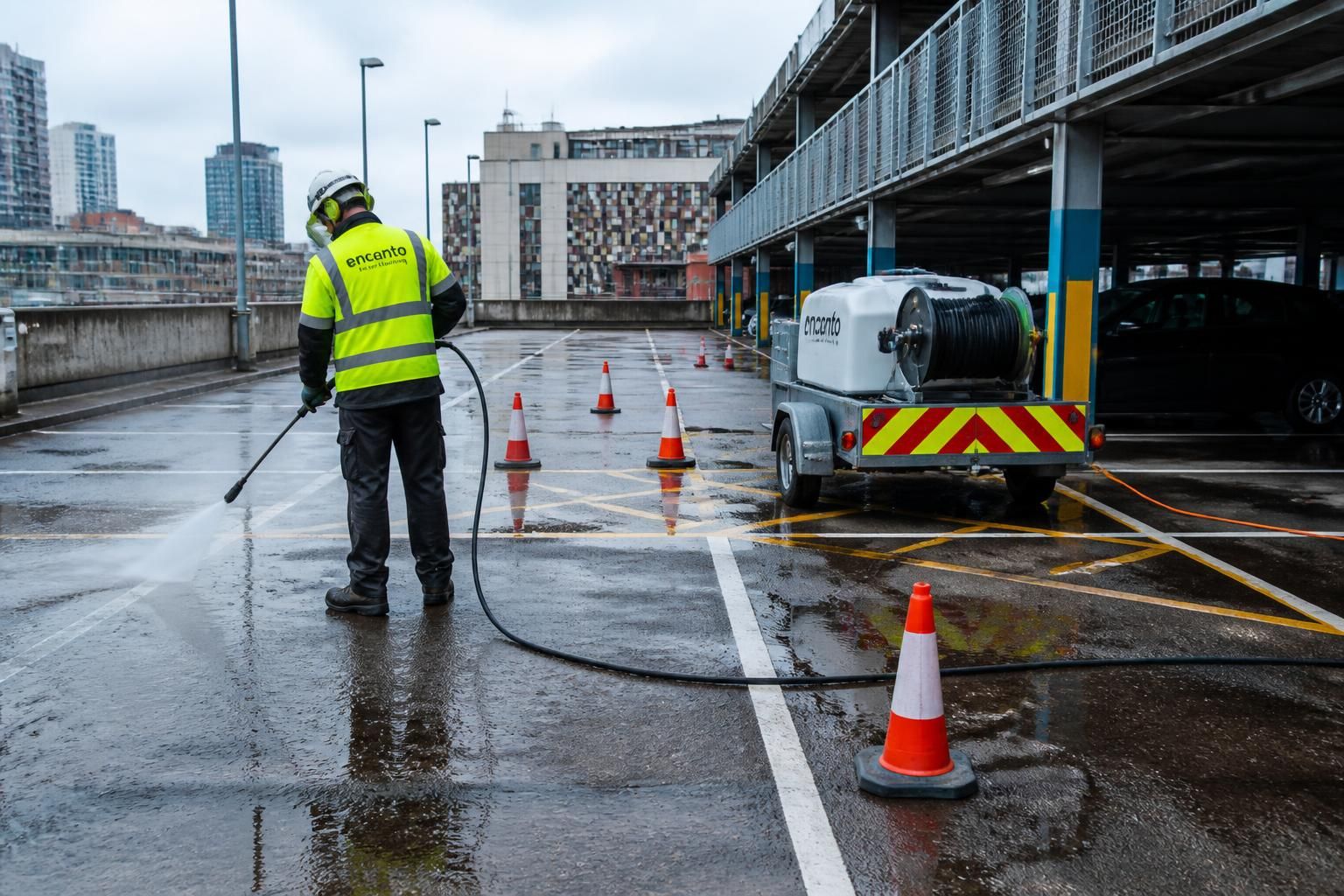
Personal protective equipment should be selected from the risk assessment and used alongside, not instead of, physical controls. Depending on the task, this may include waterproof or chemical-resistant gloves, eye or face protection, hearing protection, safety footwear with suitable slip resistance, protective clothing and high-visibility garments.
Forecourt work may require additional protection against fuel residues and cleaning chemicals. PPE must be compatible with the substances being used, correctly fitted, maintained and replaced when damaged or contaminated. Operatives should also have access to hand-washing facilities and should not eat, drink or smoke while handling contaminated materials or chemicals.
Manage pressure washers, steam equipment and other machinery safely
Only trained and authorised operatives should use pressure-washing, steam-cleaning, vacuum-recovery and access equipment. Before use, equipment should be inspected for damaged hoses, loose fittings, exposed wiring, defective guards, leaks and other faults. Couplings and hoses should be secured to prevent sudden disconnection, and equipment should be isolated before adjustments, nozzle changes or maintenance.
High-pressure water can cause serious injection injuries, cuts, eye injuries and damage to surfaces. The lance should be directed away from people, vehicles, glazing, electrical equipment and vulnerable building materials unless the method has been assessed as suitable. Operatives should maintain a stable stance, manage hose routing and avoid creating trip hazards across traffic or pedestrian routes.
Noise, spray and mist should also be controlled. People who are not involved in the work should remain outside the exclusion zone, and nearby doors, ventilation intakes and sensitive equipment should be protected from water and aerosolised contaminants.
Control chemicals and contaminated residues
Detergents, degreasers and biocidal products should be selected for the surface and contaminant, used at the correct dilution and handled in accordance with the manufacturer’s safety data and instructions. A COSHH assessment should address storage, mixing, application, exposure, spill response and disposal. Chemicals should never be mixed unless the product instructions specifically permit it, as incompatible substances can produce harmful reactions or gases.
Fuel, oil, hydraulic fluid, rubber deposits, algae, faecal matter and other contaminants may be present on car parks and forecourts. Operatives should avoid direct skin contact, use suitable PPE and follow hygienic handling procedures. Spills should be contained promptly, and contaminated absorbents, sludge and disposable PPE should be managed as waste in accordance with the relevant requirements.
Prevent slips, falls and electrical hazards
Water, detergent and loosened grime can make surfaces extremely slippery. The work area should be divided into manageable sections, excess water should be recovered where possible, and wet-floor signage should remain in place until the surface is safe for normal use. Slopes, ramps, painted markings, metal covers and polished surfaces require additional care because they may remain hazardous after visible cleaning is complete.
Electrical supplies, lighting columns, charging points, ticket machines and other installations should be identified before washing. Electrical equipment should be protected from water, and portable electrical equipment should be suitable for the conditions and used with appropriate protection. Damaged cables, sockets or site installations should be reported and kept out of use rather than covered temporarily.
Apply safe access and work-at-height controls
Cleaning can involve canopies, signs, upper decks, façades and difficult-to-reach areas. Work at height should be avoided where a ground-based method is reasonably practicable. Where access equipment is required, it should be suitable for the surface, inspected, operated by trained personnel and positioned away from vehicle routes and unstable ground.
Ladders should not be used as a substitute for proper access planning, particularly where an operative needs both hands to control a pressure-washing lance. Equipment such as mobile elevating work platforms must be operated in line with its instructions, with appropriate exclusion zones and rescue arrangements. The risks of falling objects, overhead services and changing weather must also be considered.
Plan for weather and emergencies
Rain, frost, high winds, poor visibility and extreme temperatures can alter surface conditions and make equipment or access work unsafe. The supervisor should monitor conditions and postpone or amend the work where the controls are no longer effective. Lighting should be sufficient for the task, particularly in enclosed or multi-storey car parks.
The team should know how to respond to a chemical spill, fuel contamination, electrical incident, injury, equipment failure and uncontrolled vehicle access. Emergency contact details, first-aid arrangements, spill kits and suitable fire precautions should be available. Any incident or near miss should be recorded and reviewed before the next visit.
Inspect the area before handover
After cleaning, the supervisor should check that water has been removed or safely contained, drains are clear, hoses and equipment have been taken away, barriers are correctly positioned and no chemical residue or loose debris remains. Surface condition and slip risk should be assessed before reopening each section.
The client should be told which areas are ready for use, which remain restricted and whether any defects or unusual contamination were found. This final inspection, combined with clear communication and appropriate records, helps ensure that cleaning improves site safety without introducing new risks to people, vehicles, property or the drainage environment.
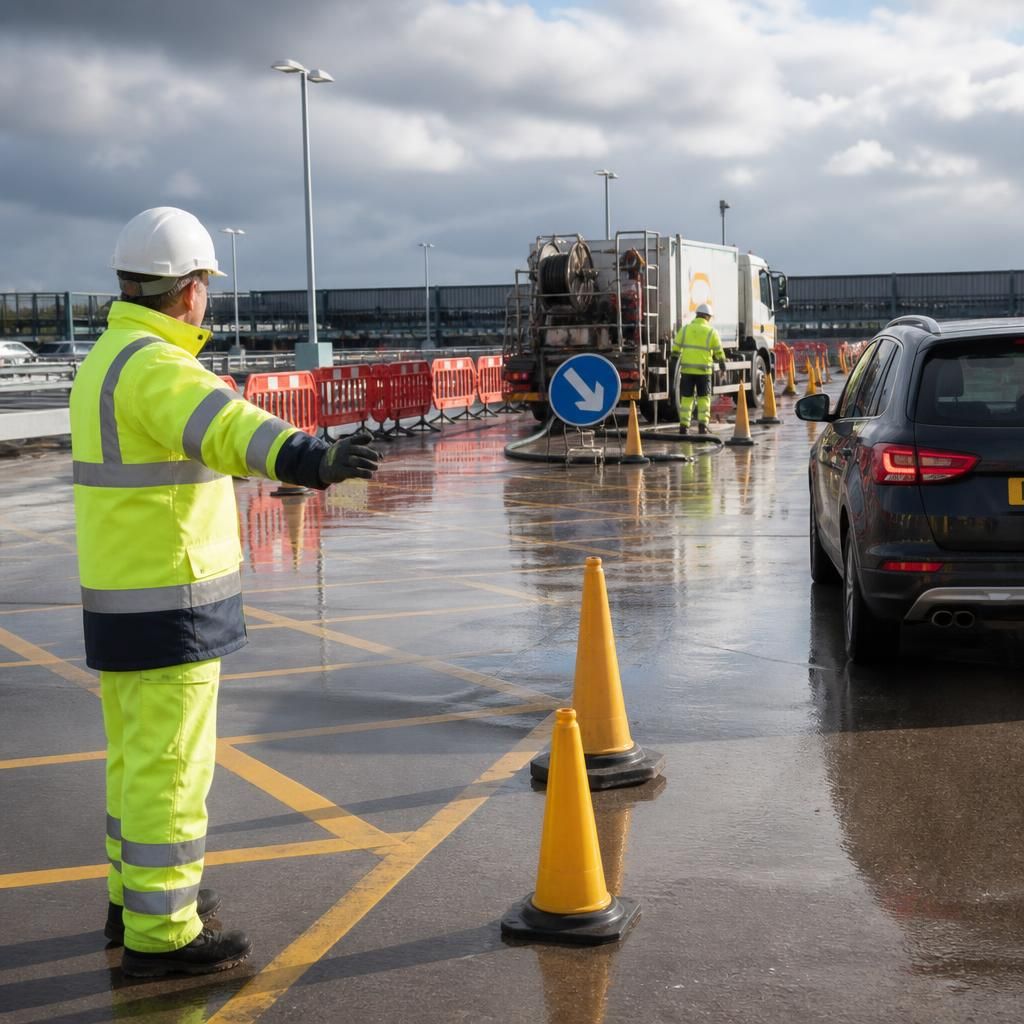
Traffic and pedestrian separation is a central safety measure during car park and forecourt cleaning. Cones, barriers, warning signs and clearly marked exclusion zones should keep people and vehicles away from pressure-washing equipment, hoses, wet surfaces and contaminated water.
Where the site remains partly open, a planned route should separate moving vehicles from the cleaning area. Trained traffic marshals may be needed at entrances, exits and crossing points, while pedestrians should be directed along a safe, accessible route. Sections should only be reopened after equipment has been removed, standing water has been controlled and the surface has been checked for slip risks.
Arrange a Safe Car Park and Forecourt Cleaning Assessment
Arrange a site-specific car park and forecourt cleaning assessment with Encanto Exterior Cleaning to review traffic control, surface hazards, equipment access and environmental requirements. We can then agree a safe, practical cleaning plan for your premises.