
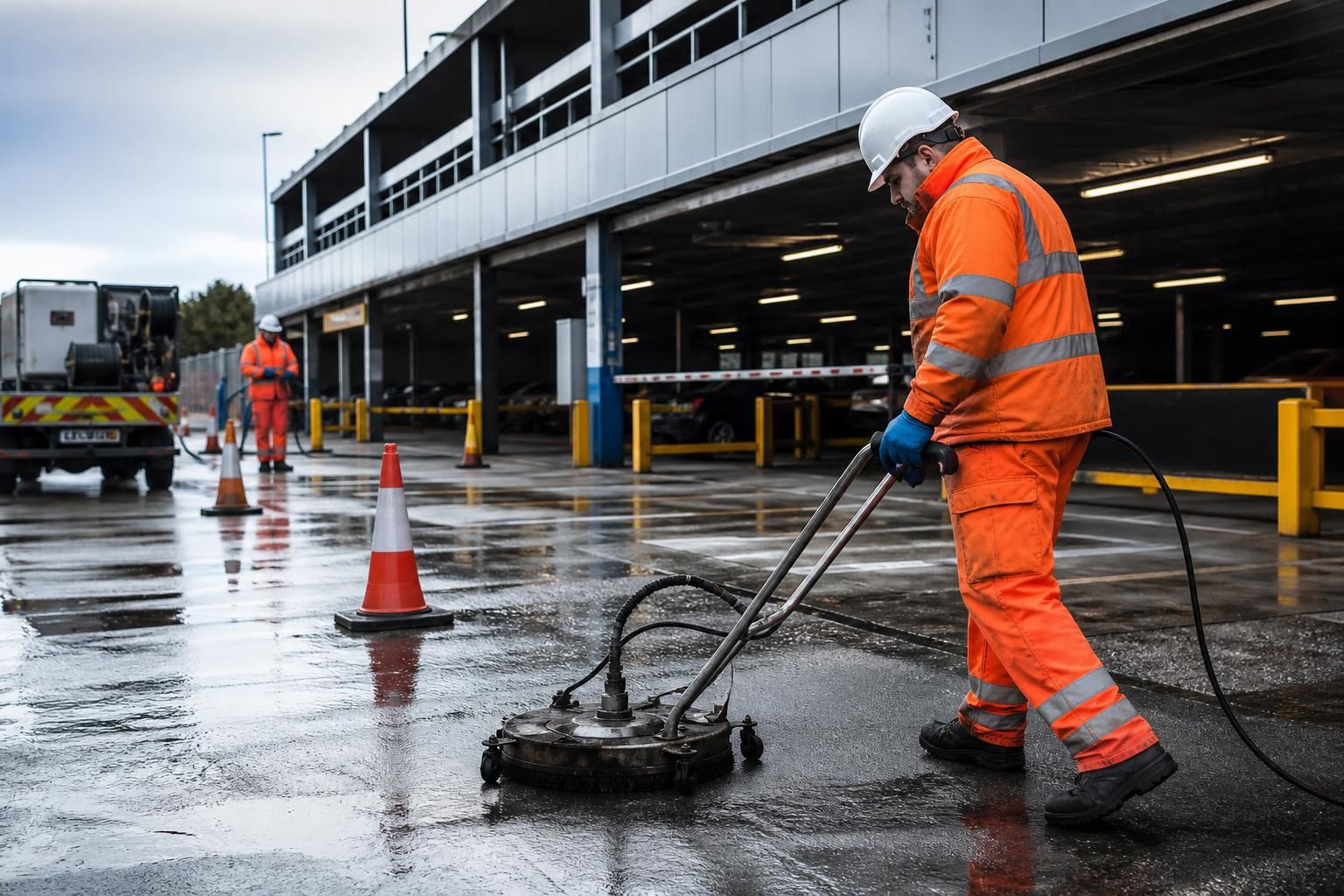
What safety measures and environmental considerations are important when selecting a car park and forecourt cleaning service?
Select a car park and forecourt cleaning service that provides site-specific risk assessments, trained operatives, suitable PPE, traffic and pedestrian controls, and safe systems for working around vehicles, fuel residues, moving equipment and access areas. Environmental safeguards should include low-impact cleaning methods where appropriate, controlled use of detergents, prevention of contaminated runoff entering drains, and responsible collection and disposal of wastewater in line with UK requirements.
When selecting a car park and forecourt cleaning service, look for a contractor that combines documented risk control with responsible water and chemical management. The service should be planned around the site’s traffic, layout, surfaces, drainage, fuel residues, pedestrians and operating hours, rather than delivered as a standard pressure-washing visit.
Site-specific health and safety planning
A competent contractor should inspect the area before work begins and prepare a suitable risk assessment and method statement. These documents should identify hazards such as moving vehicles, reversing areas, delivery traffic, slips, trips, contaminated surfaces, poor lighting, confined sections, overhead obstructions and work at height. They should also explain the control measures, equipment, responsibilities, emergency arrangements and conditions under which the work will stop.
For larger commercial sites, the cleaning plan should be coordinated with the client’s own procedures and other contractors. A reliable service provider will ask about opening hours, vehicle movements, access restrictions, vulnerable areas, fire routes, drainage and any known contamination before confirming the method.
Trained operatives and suitable equipment
Operatives should be trained and competent to use pressure washers, steam-cleaning equipment, wet vacuums, rotary surface cleaners, pumps and access equipment relevant to the work. Pressure washing can cause serious injection injuries, burns, flying debris and damage to surfaces if it is poorly controlled. Steam cleaning introduces heat and scalding risks, while hoses and recovery equipment can create trip hazards.
Equipment should be maintained, inspected and used in accordance with the manufacturer’s instructions. Where applicable, the contractor should demonstrate suitable arrangements for work equipment, lifting equipment and access systems under relevant UK health and safety requirements. Cleaning attachments, hoses and recovery systems should be appropriate for the surface and the volume of water being generated.
Personal protective equipment should be selected from the risk assessment rather than treated as a substitute for other controls. Depending on the task, this may include protective footwear with suitable slip resistance, gloves, eye or face protection, hearing protection, waterproof clothing, respiratory protection and high-visibility clothing. PPE should be correctly fitted, maintained and replaced when necessary.
Traffic and pedestrian control
Car parks and forecourts often remain partially operational during cleaning, so segregation is essential. The contractor should use an agreed plan for cones, barriers, warning signs, exclusion zones and safe pedestrian routes. Where vehicles cannot be removed from the area, cleaning should be sequenced in manageable sections and coordinated with the site operator.
Vehicle movements, delivery schedules and reversing operations need particular attention. Operatives should not rely solely on high-visibility clothing to protect them from moving traffic. Depending on the layout and level of activity, a banksman, controlled access point, temporary closure or additional traffic management may be necessary. The work should be paused if site conditions change or the agreed separation between people and vehicles cannot be maintained.
On forecourts, the contractor should understand the risks associated with fuel dispensers, tanker deliveries, fuel vapour, oil residues and emergency equipment. Cleaning methods and equipment must be suitable for the site’s operating requirements, and the forecourt operator’s instructions must be followed. Any suspected fuel leak or significant spill should be reported and managed through the site’s emergency procedure rather than treated as routine dirt.
Control of slips, trips and access risks
Water, detergent, algae, oil and loosened deposits can make surfaces hazardous during and immediately after cleaning. The contractor should control the work area, remove standing water where practicable, keep hoses routed safely and provide clear information about wet surfaces. The reopening decision should take account of drying conditions, weather, surface texture and pedestrian use.
Where façades, signs, stairwells, ramps or upper levels are included, the selection process should cover work-at-height controls. Suitable access equipment, edge protection, rescue arrangements and inspection procedures may be required. Ladders should not be used as a default work platform where a safer system is reasonably practicable.
Environmental protection and wastewater control
The most important environmental consideration is preventing dirty water from entering surface-water drains, watercourses or soil. Runoff from car parks and forecourts can contain oil, fuel residues, brake dust, metals, detergents, rubber deposits and other contaminants. A responsible contractor should identify drainage routes before cleaning and use drain covers, bunding, temporary dams, vacuum recovery or other suitable containment measures where needed.
Recovered wastewater should be collected, stored and disposed of through an appropriate route. It should not be discharged to a surface-water drain simply because the water appears clear. Any proposed discharge to a foul sewer should be permitted by the relevant sewerage undertaker and carried out in accordance with its conditions. Where disposal or treatment is required, the contractor should use an appropriately authorised waste provider and retain relevant transfer or disposal records.
Ask how the contractor will deal with wastewater if the site has no suitable foul drainage, if the drainage system is unknown or if the cleaning produces heavily contaminated water. The method should be agreed before work starts, not improvised after runoff has reached a drain.
Responsible use of detergents and cleaning methods
Cleaning chemicals should be selected for the contaminant and surface, used at the lowest effective concentration and stored securely. The contractor should be able to provide safety data and explain how chemical risks are controlled under the Control of Substances Hazardous to Health requirements. Chemicals should never be mixed unless the manufacturer specifically permits it.
Low-pressure rinsing, steam cleaning, mechanical agitation, spot treatment or dry removal may sometimes achieve the required result with less water or chemical use than intensive pressure washing. This does not mean that one method is suitable for every site: oil, chewing gum, tyre marks, algae, silt and embedded grime require different treatments. The service should justify its method according to the surface, contamination and drainage arrangements.
Good environmental practice also includes preventing spills during chemical storage and refuelling, checking hoses and tanks for leaks, reducing unnecessary water use and avoiding overspray onto planted areas, vehicles, electrical equipment or neighbouring property. Waste such as removed sludge, absorbent materials and contaminated debris should be segregated and disposed of through suitable channels.
Evidence to request when comparing contractors
- A site-specific risk assessment and method statement, including traffic, pedestrian, chemical, drainage and access controls.
- Details of operative training, supervision, equipment maintenance and relevant work-at-height competence.
- The proposed approach to wastewater recovery, storage, discharge or disposal.
- Safety data and usage controls for detergents, degreasers and other treatments.
- Evidence of suitable public liability and employer’s liability insurance, where applicable to the contract.
- Emergency procedures for fuel spills, equipment failure, injury, blocked drainage and unexpected contamination.
- Records or completion notes confirming what areas were cleaned, how wastewater was handled and whether any defects or hazards were identified.
The strongest selection criteria are not simply the lowest quotation or the most powerful equipment. Choose a contractor that can explain the controls before work begins, adapt the method to the site and provide clear evidence that safety and environmental responsibilities have been managed throughout the clean.
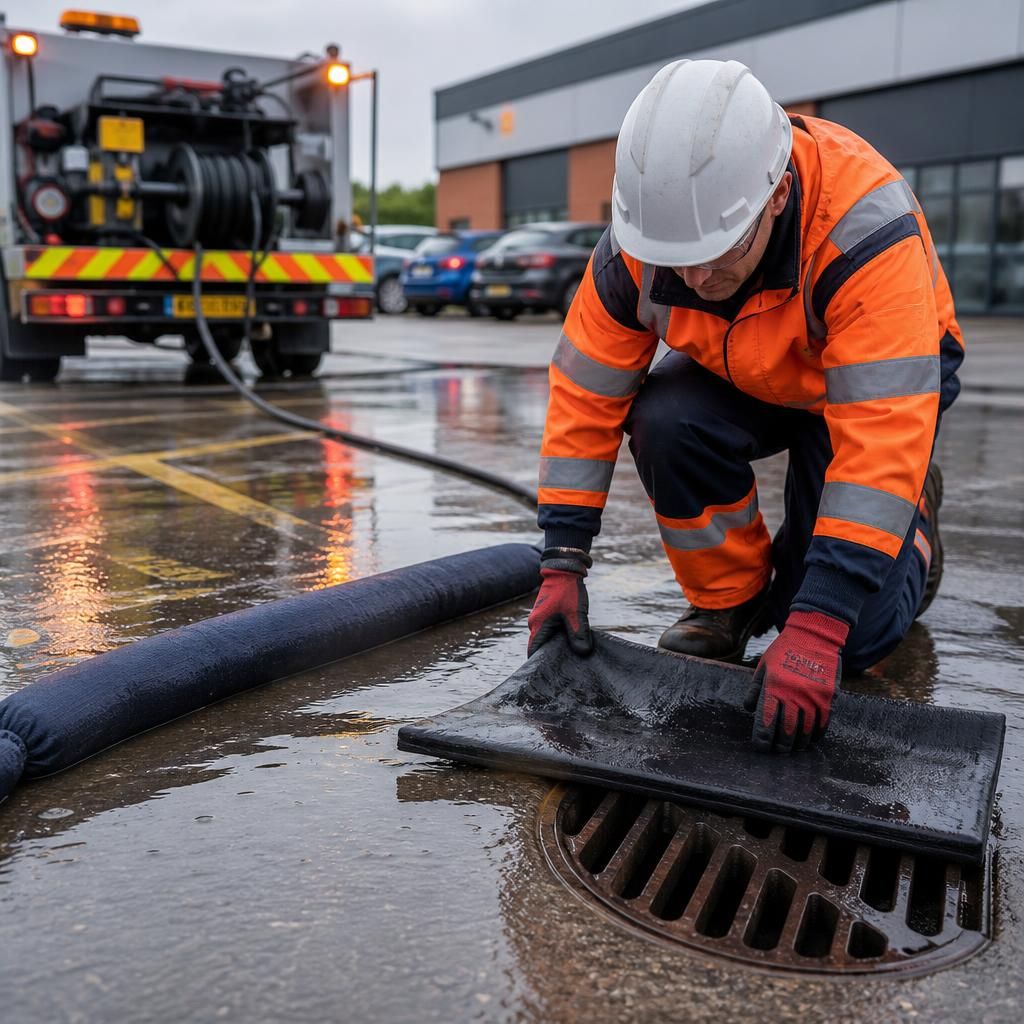
Wastewater control is a key environmental safeguard when selecting a car park or forecourt cleaning service. Wash water can carry oil, fuel residues, brake dust, detergents and sediment, so it must be prevented from entering surface-water drains, soil or nearby watercourses.
A competent contractor should identify drainage routes before work starts and use suitable controls such as drain covers, temporary bunding, vacuum recovery or sealed collection systems. Ask how recovered water, sludge and contaminated absorbent materials will be stored and disposed of, particularly where foul drainage is unavailable or the discharge route is uncertain. The method should be agreed in advance and recorded after the work is completed.