
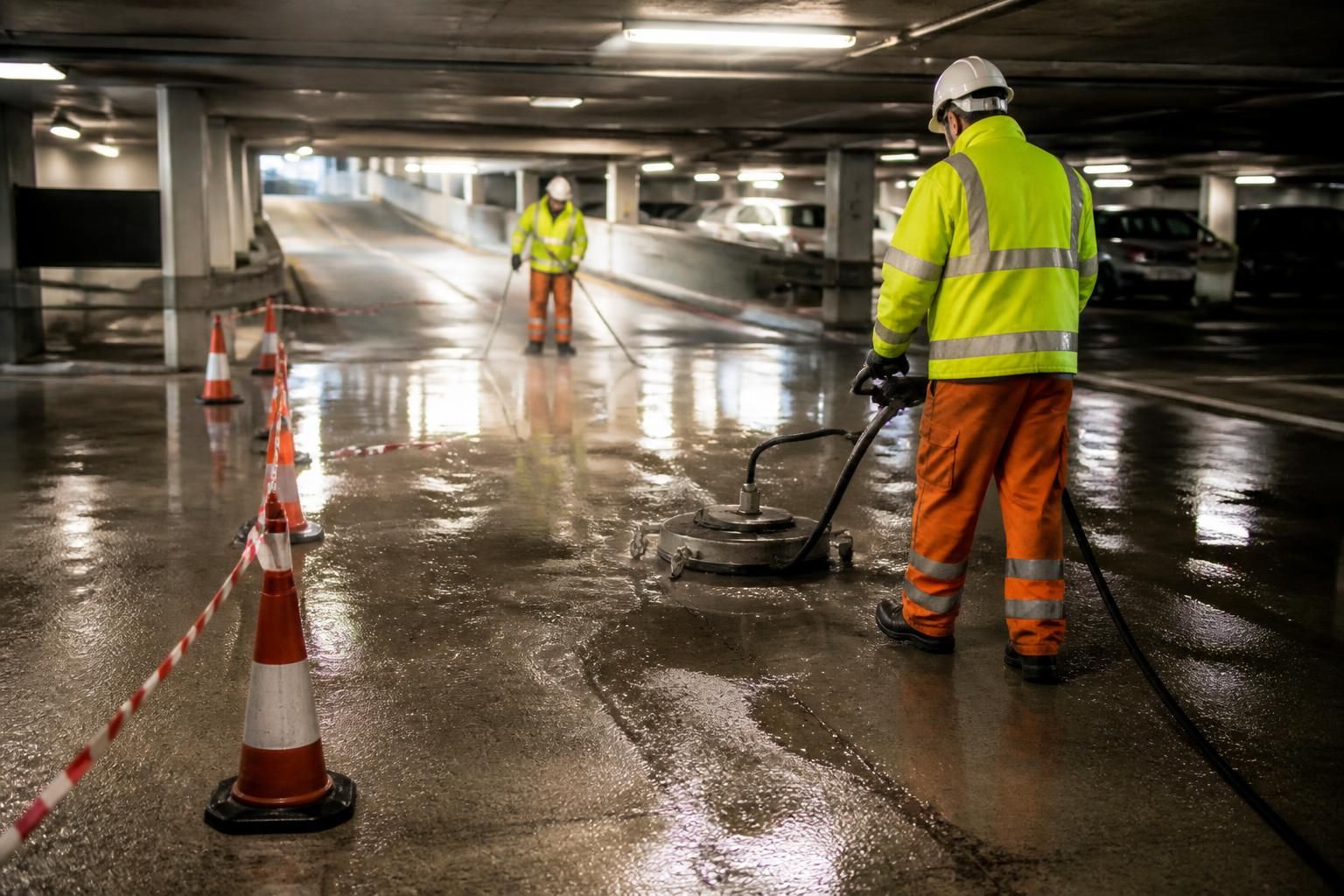
What safety precautions should be taken during the multi-storey car park cleaning process to ensure the wellbeing of both workers and users?
Multi-storey car park cleaning should be planned with a site-specific risk assessment, controlled vehicle and pedestrian movements, suitable personal protective equipment, and safe procedures for work at height, water, chemicals and electrical equipment. Clear exclusion zones, signage, competent operatives and effective communication help protect both the cleaning team and car park users throughout the work.
Safe multi-storey car park cleaning depends on controlling the main risks before work begins, rather than relying on operatives to react to hazards as they arise. A site-specific risk assessment and method statement should cover vehicle and pedestrian movements, work at height, pressure and steam equipment, electrical supplies, cleaning chemicals, slip hazards, falling objects, ventilation and emergency arrangements. The controls should protect both the cleaning team and people using or working around the car park.
Plan the work around the car park’s layout and operating conditions. Before cleaning starts, the contractor should inspect the ramps, decks, stairwells, walkways, plant areas, drainage points, lighting and access routes. The assessment should identify damaged surfaces, low headroom, exposed edges, blind corners, restricted ventilation, water-sensitive equipment and areas where vehicles may enter unexpectedly. It should also consider the weather where external decks, open sides or roof-level areas are involved.
The cleaning method statement should explain the sequence of work, equipment to be used, areas to be closed, how wastewater will be controlled and what will happen if conditions change. Cleaning should be scheduled during quieter periods where practicable, but reduced traffic must not be treated as a substitute for proper segregation. The responsible supervisor should review the controls at the start of each shift and whenever the work area, equipment or weather changes.
Separate cleaning operations from vehicles and pedestrians. Clear exclusion zones are essential around pressure washing, steam cleaning, lifting operations and any work where water, debris or equipment could enter a user’s path. Barriers should be sufficiently robust and positioned so that people cannot easily walk or drive through the work area. Cones alone may be unsuitable where there is a risk of vehicle impact or where pedestrians could approach from several directions.
Appropriate signs should be placed at entrances, ramps, stairways and pedestrian routes. They should warn users about cleaning in progress, wet surfaces, changed traffic routes and any temporary closure. Where vehicles remain in operation, a planned traffic management system may include a banksman, controlled entry, one-way routing or a temporary closure of the affected level. Operatives should never work behind a vehicle or in a blind spot without suitable protection and communication.
Control wet floors and contaminated water. Pressure washing and steam cleaning can create a significant slip risk, particularly on ramps, polished surfaces and pedestrian routes. Wet areas should be kept as small as practicable, cleaned progressively and isolated until they are safe to use. Excess water should be directed towards suitable drainage points without creating flow across driving lanes or into areas being used by pedestrians.
Where possible, recovery equipment should remove standing water and contaminated residue. Drain covers, sumps and separators should be checked before work, and wash water should not be allowed to enter an unsuitable surface-water system. Any detergent, oil, silt or vehicle residue collected during cleaning should be managed in accordance with the site’s drainage arrangements and environmental requirements.
Use pressure, steam and electrical equipment correctly. Operatives should be trained and competent to use the equipment provided. Hoses, lance extensions and power cables should be routed to avoid creating trip hazards, becoming trapped by vehicles or crossing unprotected edges. Equipment should be inspected before use, with particular attention to hoses, couplings, trigger controls, guards, plugs and cables. Defective items should be removed from service rather than repaired temporarily on site.
High-pressure water can injure skin, eyes and hearing, damage surfaces and dislodge loose material. The operator should maintain a safe distance, use the correct nozzle and pressure for the surface, and never direct the spray at people, vehicles, electrical installations or unprotected openings. Steam equipment presents additional burn and scalding risks, so operators must allow for hot surfaces, vapour, restricted visibility and pressure release when changing attachments or carrying out maintenance.
Electrical equipment should be suitable for the conditions in which it is used. Connections must be protected from water, cables kept away from wet areas where practicable and any required residual current protection used. Petrol or diesel-powered equipment should not be operated in poorly ventilated areas because of exhaust fumes and carbon monoxide risk. If ventilation is inadequate, the work method should be changed or mechanical ventilation provided.
Manage chemicals under COSHH procedures. Cleaning products should be selected for the surface and soil being treated, with the least hazardous effective product used where practicable. Operatives should follow the manufacturer’s instructions and the site’s COSHH assessment, including requirements for dilution, storage, handling, spill response and disposal. Chemicals should remain in labelled containers and must never be mixed unless the product instructions specifically permit it.
Suitable gloves, eye protection, footwear and respiratory protection should be provided where the assessment requires them. Chemicals should be kept away from public areas, food and incompatible substances. A spill kit and clear reporting procedure should be available, and users should be kept away from treated areas until residues have been removed or the surface is safe.
Provide suitable personal protective equipment. PPE should support, not replace, physical controls such as barriers and safe working methods. Depending on the task, this may include slip-resistant safety footwear, waterproof protective clothing, gloves selected for the chemical or task, eye or face protection, hearing protection, high-visibility clothing and suitable respiratory protection. PPE must fit correctly, be maintained and be replaced when damaged or contaminated.
High-visibility clothing is particularly important where cleaning takes place near moving vehicles, but it does not make it safe for an operative to enter an uncontrolled traffic route. PPE requirements should be explained during the briefing, and supervisors should check that equipment is being used correctly.
Apply strict controls for work at height. Cleaning around open edges, roof decks, atria, stairwells, ramps and high-level façades requires a separate work-at-height assessment. The preferred approach is to clean from ground level or from a protected position wherever possible. If access equipment is needed, it should be suitable for the surface, inspected, operated by trained personnel and positioned away from vehicle routes and unprotected edges.
Guardrails, edge protection, fall-restraint or fall-arrest systems should be used where required by the assessment. Ladders should not be used as a general work platform where a safer alternative is reasonably practicable. Tools and accessories should be secured so that they cannot fall onto people or vehicles below, and the area beneath the work should be closed and controlled.
Maintain communication and emergency arrangements. A named supervisor should coordinate the work and remain able to contact the site representative. Operatives should receive a briefing covering exclusion zones, traffic routes, chemical hazards, equipment shutdown, first aid, fire procedures and actions to take if a member of the public enters the work area. Radios or agreed hand signals may be needed where machinery noise, distance or poor visibility makes verbal communication unreliable.
Emergency arrangements should account for slips, chemical exposure, burns, electric shock, vehicle collision, equipment failure and a person falling from height. Access for emergency services must remain clear, and the location of first-aid equipment, eyewash, fire points and isolation switches should be known before work begins. Incidents, near misses and unexpected hazards should be reported and used to improve the method for future visits.
Reopen areas only after a final inspection. The supervisor should confirm that floors are suitably dry or otherwise safe, barriers and hoses have been removed, drains are clear, residue has been collected, equipment is isolated and no loose material remains at height. Signs should stay in place until the hazard has genuinely passed. A documented handover can confirm which areas have been cleaned, which remain closed and whether any defects need to be reported to the car park operator.
These precautions create a controlled process in which cleaning quality, public safety and worker welfare are considered together. The exact controls should always reflect the car park’s construction, traffic levels, surfaces, drainage, equipment and operating arrangements rather than relying on a generic cleaning procedure.
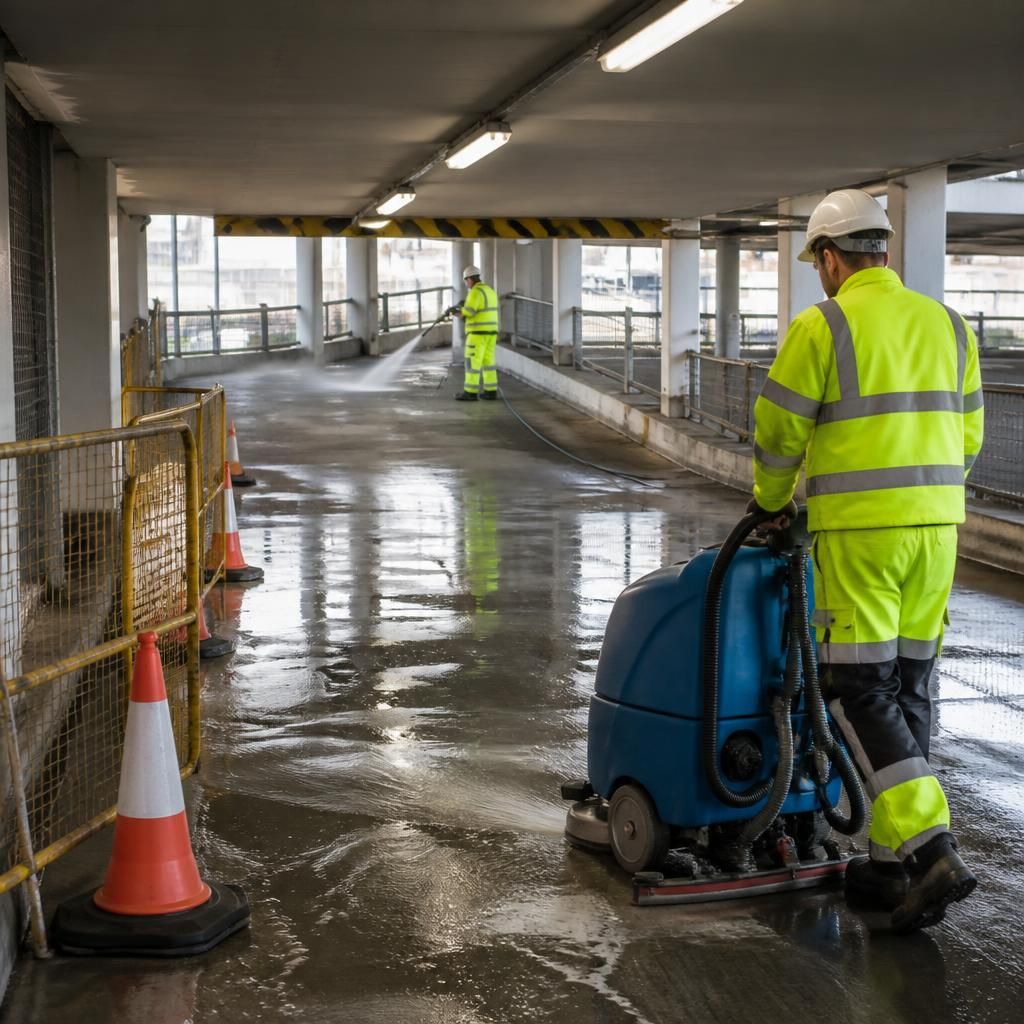
During multi-storey car park cleaning, wet-floor control and effective segregation are essential for protecting both users and operatives. Pressure washing and steam cleaning can leave slippery surfaces, hoses and contaminated water in areas where vehicles or pedestrians may still be moving.
Work should progress in manageable sections, with robust barriers and clear warning signs positioned at entrances, ramps, stairways and pedestrian routes. Where traffic cannot be stopped, a controlled diversion, banksman or temporary level closure may be required. Standing water should be recovered or directed to suitable drainage without flowing across driving lanes, while the cleaned area remains isolated until the surface is safe to use.
Discuss Your Multi-Storey Car Park Cleaning Requirements
Discuss your multi-storey car park cleaning requirements with Encanto Exterior Cleaning, including access arrangements, traffic controls, surface risks and preferred working times. Our team can help plan a safe, practical cleaning schedule for your site.