
What are the key safety considerations when cleaning a multi-storey car park?
Safe multi-storey car park cleaning requires a site-specific risk assessment, effective traffic and pedestrian control, suitable access equipment, and competent operators. Cleaning methods must also control water, chemicals, electrical hazards and falling debris so workers, drivers, pedestrians and the building are protected throughout the work.
Safe multi-storey car park cleaning depends on a site-specific risk assessment, controlled vehicle and pedestrian movements, suitable access equipment, and competent operators. The cleaning plan must also manage water, chemicals, electrical installations, falling debris, restricted visibility and emergency access so that workers, drivers, pedestrians and the structure remain protected throughout the work.
Begin with a site-specific risk assessment
Before work starts, the contractor should inspect the car park and document the hazards associated with its layout, condition and use. This includes checking ramps, stairwells, low headroom areas, open edges, vehicle routes, drainage channels, lighting, ventilation, fire exits and areas where the structure is damaged or deteriorating. The assessment should consider the cleaning method, equipment, access requirements, likely traffic levels and the presence of members of the public.
A method statement should then set out how the work will be completed safely. It should identify exclusion zones, cleaning sequences, equipment locations, emergency arrangements, waste-water controls and the responsibilities of everyone involved. If conditions change, such as an unexpected vehicle flow, blocked drainage or defective lighting, the work should be paused and the controls reviewed.
Control vehicles and pedestrians
Vehicle movements are one of the main risks in an operational multi-storey car park. Cleaning areas should be isolated using clear barriers, cones, warning signs and, where necessary, temporary closures or a managed one-way system. Barriers must be positioned so that vehicles cannot pass close to workers, hoses or machinery, while still preserving access to fire routes and emergency exits.
Pedestrian routes should be kept separate from wet work wherever practicable. If customers or staff must pass through the work area, a clearly marked, dry alternative route should be provided and supervised. Signs should warn of wet surfaces, restricted access, overhead work and moving equipment. A trained banksman or marshal may be required at vehicle entrances, ramps and reversing areas, particularly when machinery is being moved between levels.
Cleaning should be planned around the car park’s busiest operating periods where possible. However, reduced activity does not remove the need for segregation: drivers may have limited visibility on ramps and pedestrians may not notice hoses, barriers or temporary hazards.
Use access equipment appropriate to the structure
Façades, soffits, high-level beams, signs and lighting often require work at height. Access equipment must be selected for the surface, working height, available floor space, ground condition and load limits of the car park. Mobile elevated work platforms, towers or other systems should only be used by trained and authorised operators, with pre-use inspections and suitable fall protection.
Equipment must be positioned on a stable surface and kept clear of ramps, vehicle lanes, unprotected edges and overhead obstructions. The operator should confirm that the equipment can pass through entrances and between levels without striking the structure. Where a platform is used near an open edge, the required edge protection and restraint arrangements must be in place. Ladders should not be treated as a general solution for prolonged or high-risk work.
Tools, hoses and cleaning materials should be secured so they cannot fall from a platform or ledge. An exclusion zone below overhead work is essential, and no person should work or park beneath an area where debris or equipment could drop.
Prevent slips, trips and falls
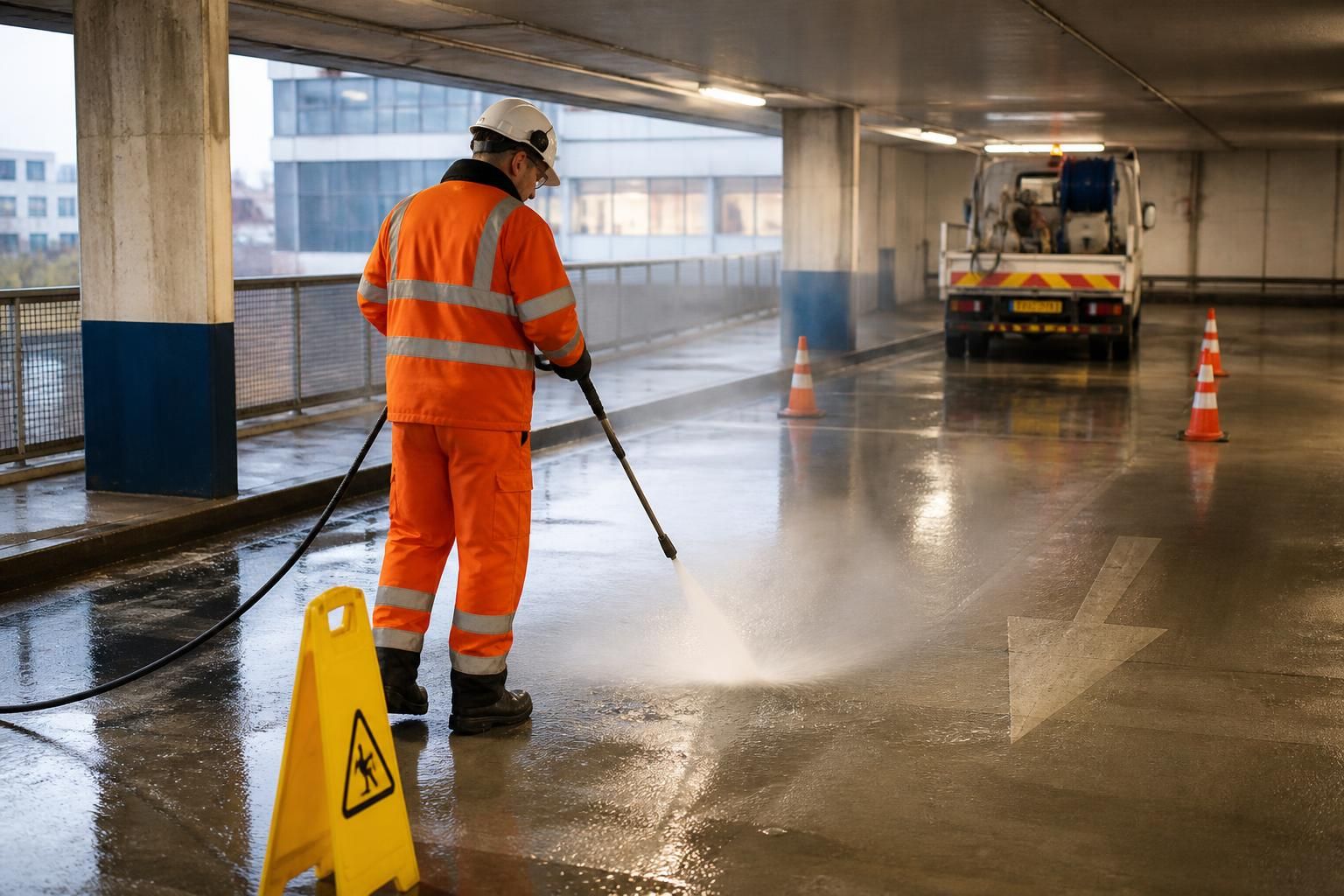
Pressure washing and steam cleaning introduce water to surfaces that may already be contaminated with oil, algae, grit or vehicle deposits. Wet floors can become extremely slippery, especially on ramps, pedestrian walkways and painted surfaces. Work should be completed in manageable sections, with barriers maintained until the surface is safe for use.
Hoses and power cables should be routed away from traffic and walking routes, protected by suitable covers where crossing is unavoidable, and checked regularly for damage. Equipment should be positioned to minimise trailing lines. Operatives should wear slip-resistant safety footwear and keep access points, stairways and escape routes clear.
Drainage must be checked before washing begins. Gullies should be clear, and temporary bunding or wet vacuums may be needed to prevent water spreading to lower levels, electrical equipment or public areas. Standing water should not be left to migrate across ramps or collect near entrances.
Manage chemicals, spray and contaminated water
Cleaning products should be selected for the surface and used in accordance with the manufacturer’s instructions and the relevant COSHH assessment. Operatives need to understand dilution, contact time, storage, handling and first-aid requirements. Chemicals should be clearly labelled, kept in secure containers and transported in a way that prevents spills.
Spray must be controlled to protect people, vehicles, ventilation openings, electrical components, signage and neighbouring property. High-pressure cleaning can create airborne droplets and dislodge contaminated deposits, so suitable eye, face and respiratory protection may be required depending on the substance and process. Waste water may contain oil, detergents, heavy deposits or other pollutants. It should be collected, contained and disposed of through an approved route rather than allowed to enter surface-water drains without appropriate controls.
Protect electrical systems and building services
Multi-storey car parks commonly contain lighting, ticket machines, payment equipment, security systems, electric vehicle charging points, ventilation controls and other electrical installations. These must be identified before washing. Water and pressurised spray should not be directed at exposed equipment, damaged cables, sockets, control panels or ventilation and drainage openings.
Where electrical equipment cannot be adequately protected, it may need to be isolated by an authorised person before cleaning. Electrical leads, plugs and portable equipment should be suitable for the working environment, inspected before use and protected from standing water. Any damaged installation discovered during preparation should be reported and kept outside the work area until it has been made safe.
Protect workers with suitable training and PPE
Everyone involved should be competent for their role and briefed on the risk assessment, method statement, site rules, communication arrangements and emergency procedures. Training may be needed for pressure washers, steam equipment, access platforms, chemical handling, traffic marshalling and work at height.
Personal protective equipment should reflect the hazards rather than replace other controls. Depending on the task, this may include a hard hat, eye or face protection, hearing protection, waterproof protective clothing, chemical-resistant gloves, high-visibility clothing and slip-resistant safety footwear. PPE must be compatible with any fall-arrest or respiratory equipment being used and kept in serviceable condition.
Plan for emergencies and changing conditions
The site team should know how to summon assistance, report an incident, deal with chemical exposure, isolate equipment and provide first aid. Emergency exits, fire points, fire lanes and access for emergency services must remain available throughout the work. A reliable communication method is particularly important when teams are spread across different levels or when machinery creates high noise levels.
Wind, rain, poor lighting, freezing conditions and inadequate ventilation can change the risk profile. External façade or roof-level work may need to stop in unsafe weather, while enclosed areas require adequate ventilation when using chemicals, engines or equipment that produces vapour or exhaust. Supervisors should carry out ongoing checks rather than relying only on the initial assessment.
Complete a controlled handover
At the end of each work section, barriers should remain in place until floors are sufficiently dry and safe. Hoses, cables, equipment, debris and waste containers must be removed without obstructing traffic or escape routes. Drains should be checked, surfaces inspected and any damage or defects recorded and reported to the responsible property manager.
A proper handover confirms which areas are ready to reopen and whether any temporary restrictions remain. This final check is as important as the preparation because it prevents a clean area from becoming a new slip, obstruction or vehicle hazard.
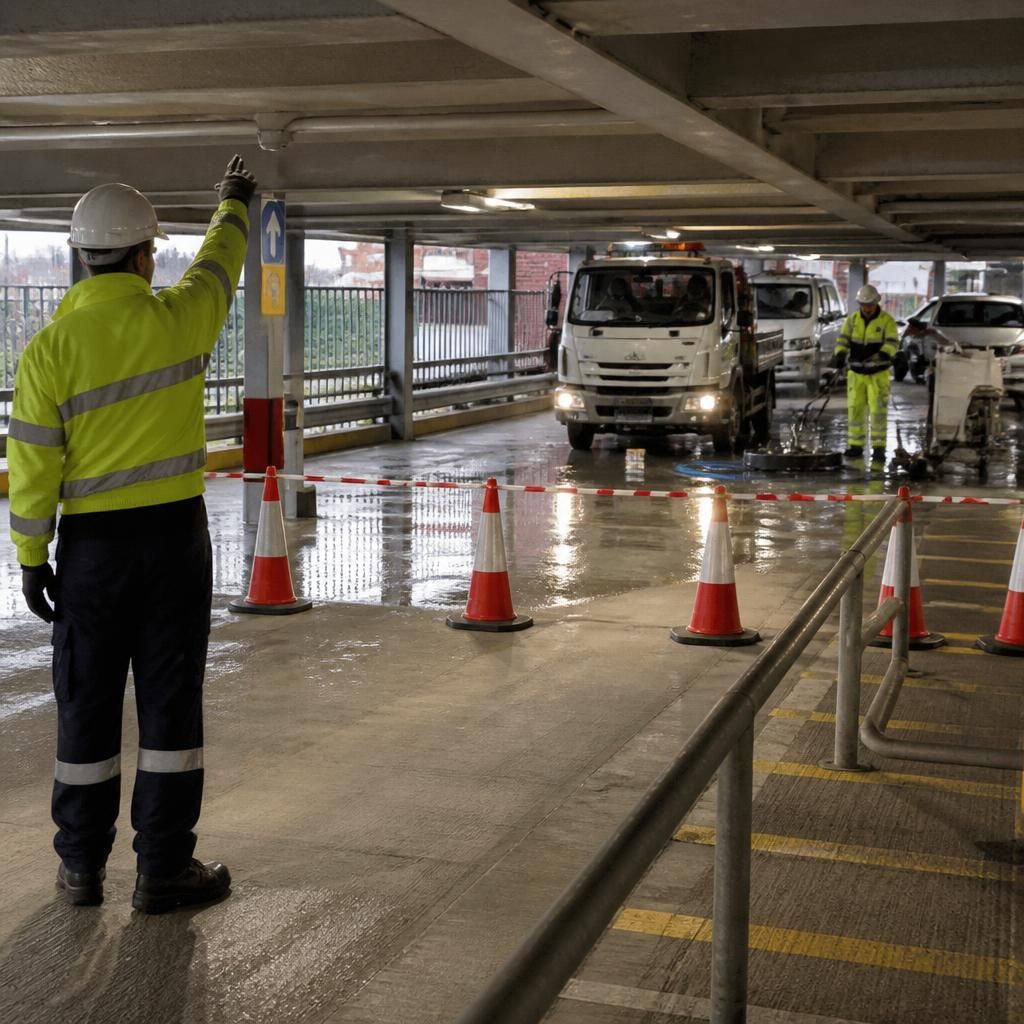
Traffic and pedestrian segregation is one of the most important safety controls during multi-storey car park cleaning. Work areas should be isolated with suitable barriers, cones and warning signs, while drivers and pedestrians are directed along clearly marked routes that remain separate from wet floors, hoses and moving equipment.
Cleaning should be scheduled around busy periods where practicable, with a trained marshal managing vehicle movements at entrances, ramps and reversing areas when required. Barriers must not obstruct fire exits, emergency access or escape routes, and areas should remain closed until surfaces are dry, clear of equipment and safe to reopen.