
What safety measures should be considered during forecourt cleaning to protect both staff and visitors?
Forecourt cleaning should be planned and controlled to protect staff and visitors from moving vehicles, fuel vapours, slips, pressurised water, cleaning chemicals and contaminated run-off. Effective measures include isolating the work area, using suitable PPE, managing traffic and pedestrians, following chemical and equipment procedures, and completing a site-specific risk assessment before work begins.
Safe forecourt cleaning depends on controlling vehicle movements, fuel-related hazards, slips, pressurised water, cleaning chemicals and contaminated run-off before work starts. A site-specific risk assessment and method statement should define the cleaning area, equipment, substances, access arrangements, emergency controls and responsibilities, with the work reviewed if site conditions change.
Plan and isolate the work area
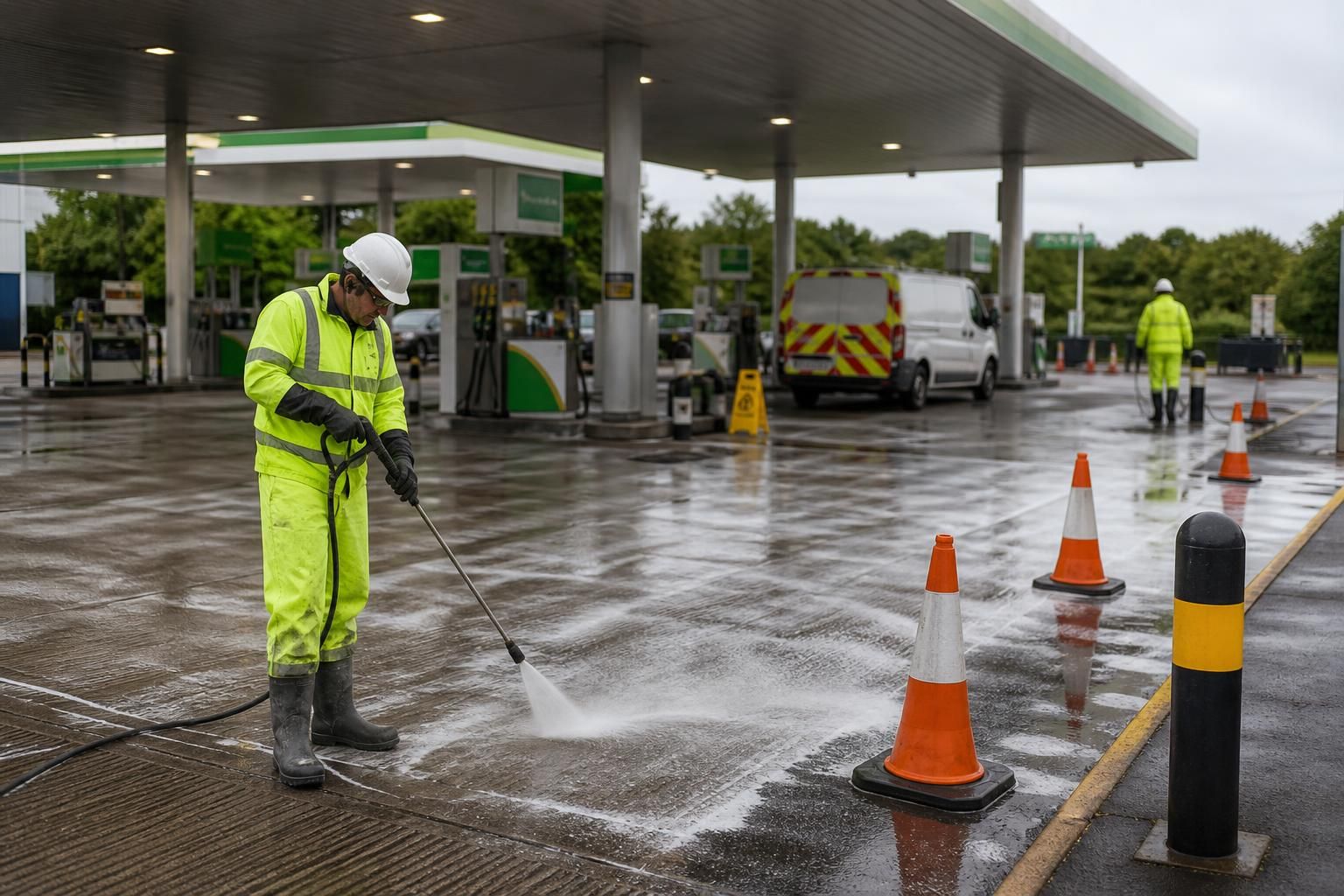
Before cleaning begins, the forecourt should be inspected for vehicle routes, pedestrian access, fuel pumps, drainage points, overhead obstructions, damaged surfaces, spills and areas where vapours may collect. The work zone should be separated from customers and unauthorised staff using suitable barriers, cones and clear warning signs. Where practical, affected bays or sections should be taken out of service rather than relying solely on signage.
Cleaning should be scheduled during a quieter period where this reduces interaction with customers and delivery vehicles. The site operator and cleaning team should agree who controls access, how vehicles are diverted and what conditions require work to stop. Barriers must remain stable and visible in poor weather, low light and around parked vehicles.
Control vehicle and pedestrian movements
- Establish a clearly marked exclusion zone around pressure-washing and steam-cleaning activities.
- Keep hoses, cables and recovery equipment away from live traffic lanes, entrances and emergency routes wherever possible.
- Use a trained banksman or site representative where vehicles need to pass close to the work area or cleaning plant.
- Maintain a safe route for pedestrians, including customers, delivery drivers and people with mobility needs.
- Do not leave wet, obstructed or partially cleaned areas open to traffic without suitable controls.
- Check that reversing vehicles, plant and cleaning operatives can be seen by one another before movements take place.
Manage fuel, vapour and ignition risks
Forecourts may contain petrol, diesel, liquefied petroleum gas or other flammable products. Operatives should follow the site’s rules for hazardous areas and avoid introducing ignition sources, unapproved electrical equipment or hot work. Engines, generators and other equipment should be positioned and operated in accordance with the manufacturer’s instructions and the site risk assessment, with exhausts kept away from areas where vapours could accumulate.
Cleaning should not proceed through an active fuel spill or where a strong fuel odour, damaged dispenser, leaking hose or other unsafe condition is identified. The area should be isolated and reported to the responsible site operator so that the appropriate emergency and spill response can be followed. Operatives must never use cleaning methods or chemicals that could react dangerously with fuel residues.
Use appropriate personal protective equipment
PPE should be selected from the risk assessment rather than used as a substitute for barriers, safe procedures or suitable equipment. Depending on the task, this may include slip-resistant safety footwear, protective gloves, eye or face protection, hearing protection and waterproof or chemical-resistant clothing. Respiratory protection should only be specified where the assessment identifies an inhalation risk and should be correctly selected, fit-tested where required and supported by suitable training.
Protective equipment must be kept clean, inspected before use and replaced when damaged or contaminated. Operatives should also use suitable hand-washing facilities and avoid eating, drinking or smoking in areas where fuel, dirt or cleaning chemicals are present.
Control pressure-washing and steam-cleaning equipment
High-pressure water can cause serious injection injuries, cuts, eye injuries and damage to surfaces or equipment. Only trained operatives should use the machinery, and the lance must never be directed at people, animals, vehicles in use, electrical installations or fragile components. Connections, hoses, trigger controls, guards and safety devices should be checked before use. The machine should be isolated before clearing a blockage, changing attachments or carrying out maintenance.
Steam and hot water introduce burn and scald risks, while spray can reduce visibility and spread contaminated material. Operatives should maintain a controlled stance, keep other people outside the spray zone and use the lowest effective pressure and temperature for the surface. Electrical equipment and cables must be suitable for the environment and protected from water in accordance with the manufacturer’s instructions.
Handle chemicals under COSHH controls
Cleaning products should have current safety data and COSHH assessments available before use. The assessment should cover dilution, storage, ventilation, incompatible substances, exposure routes, required PPE, spill response and disposal. Chemicals must be labelled, kept in secure containers and mixed only as instructed. Products should never be combined unless the manufacturer specifically confirms that this is safe, as some mixtures can release hazardous gases or generate heat.
Where possible, use the least hazardous product that will achieve the required result and apply it in a way that minimises mist, splash and unnecessary spread. Any operative handling chemicals should understand the product instructions and the action to take after skin, eye or inhalation exposure.
Prevent slips, trips and falls
Fuel, oil, detergent, algae, silt and cleaning water can make forecourt surfaces slippery. Loose deposits should be removed using a controlled method, hoses should be routed away from walkways and wet areas should be kept behind barriers until they are safe for use. Operatives should work in a planned sequence that avoids trapping people or vehicles on wet surfaces.
After cleaning, the surface should be checked for remaining oil, standing water, loose covers, damaged paving and trip hazards. Any defect that cleaning exposes or cannot safely resolve should be reported to the site contact rather than left for customers to discover.
Control run-off and protect drainage
Wash water from a forecourt can contain fuel residues, oils, detergents, heavy dirt and other pollutants. It should not be allowed to enter surface-water drainage unless the site’s drainage arrangements and applicable requirements permit this. Drain covers, temporary bunding, wet vacuums, recovery systems or other containment measures may be needed, particularly near fuel dispensers and vulnerable outlets.
Recovered water and contaminated absorbent materials should be handled and disposed of through an appropriate route. The team should know the location of spill kits, isolation points and drainage controls, and should stop work if run-off cannot be contained as planned.
Maintain communication and emergency arrangements
The site contact should be informed when work starts, when an area is taken out of service and when it is safe to reopen. All operatives should know the location of first-aid equipment, emergency contact details, fire equipment, shut-off controls and assembly arrangements. Incidents, near misses, chemical exposures, equipment faults and uncontrolled spills should be reported and recorded so that controls can be improved.
Before reopening the forecourt, the responsible person should confirm that barriers and equipment have been removed, surfaces are acceptably dry and free from residue, drainage controls have been dealt with, no hoses or cables remain and pumps, access routes and safety equipment are fully available. These final checks help protect both visitors and staff after the cleaning team has left the work area.
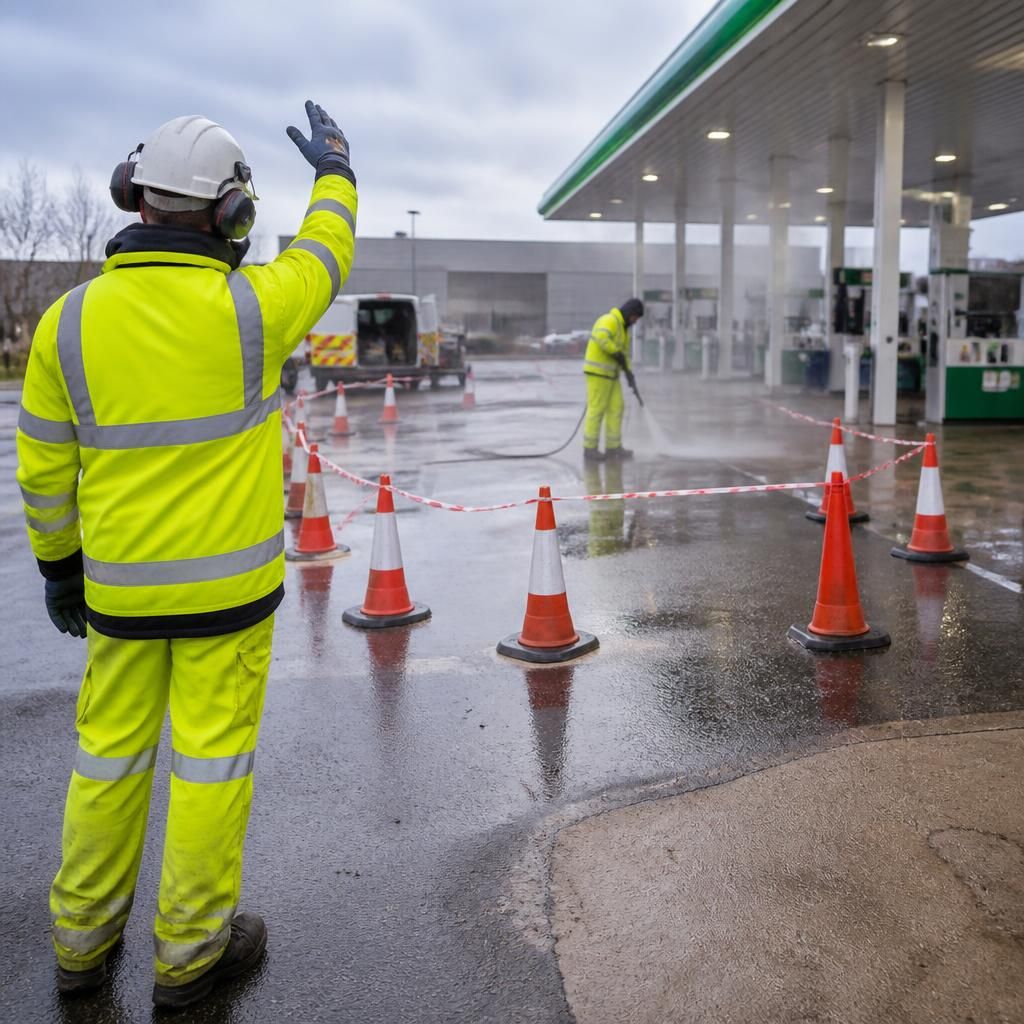
Keeping the cleaning area separate from vehicles and pedestrians is one of the most important forecourt safety measures. Use stable barriers, cones and clear warning signs to create an exclusion zone around pressure-washing, steam-cleaning and wet surfaces, and close affected bays where possible rather than relying on signs alone.
Plan a safe alternative route for customers, delivery drivers and people with mobility needs. Hoses, cables and recovery equipment should not cross live traffic lanes or emergency access routes. If vehicles must pass near the work area, a trained banksman or agreed site representative should control movements and maintain clear communication with the cleaning team.
Do not reopen the area until the surface is safe to walk and drive on, standing water and residues have been removed, and all equipment, barriers and drainage controls have been cleared or secured.
Discuss Your Forecourt Cleaning Safety Requirements
Discuss your forecourt cleaning safety requirements with our team so we can help plan suitable access controls, equipment, PPE and run-off management for your site. We can work with your existing procedures to support safe, compliant cleaning with minimal disruption.