
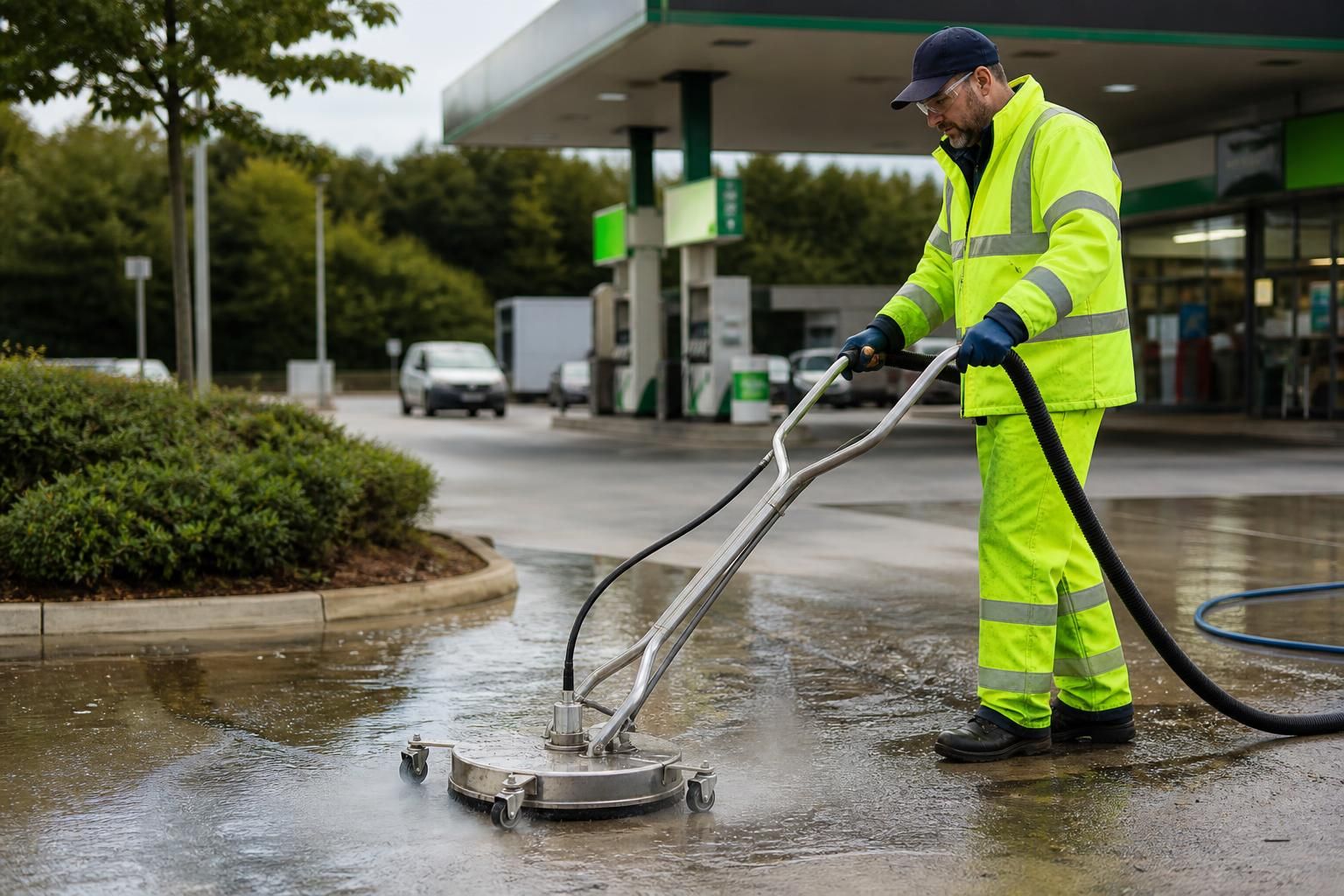
What environmental considerations should be taken into account when choosing forecourt cleaning services?
When choosing forecourt cleaning services, consider how the contractor manages water consumption, cleaning chemicals, contaminated runoff and waste, particularly where fuel, oil or other pollutants may be present. Select a provider that uses suitable low-impact methods, prevents polluted water entering drains or soil, disposes of waste responsibly and works in accordance with relevant environmental requirements.
Environmental considerations when choosing forecourt cleaning services centre on how the contractor controls water use, polluted runoff, cleaning chemicals, energy consumption and waste. A suitable provider should be able to clean fuel, oil, rubber deposits, traffic film and general grime without allowing contaminated water or debris to enter surface-water drains, soil or nearby watercourses. They should also understand the environmental requirements that apply to commercial forecourts and be able to explain how each cleaning project will be managed.
Assess how wash water and runoff will be controlled
Forecourt surfaces can contain fuel residues, lubricants, oil, detergents, heavy metals, grit and other pollutants. Pressure washing these surfaces mobilises contaminants, so the cleaning method must include a plan for containing, collecting and treating the resulting water. Simply directing wash water towards the nearest drain is not an environmentally responsible practice.
Before work starts, the contractor should identify the drainage layout and establish whether drains lead to a foul sewer, a surface-water system, an interceptor or another outlet. Surface-water drains commonly discharge to the environment with limited treatment, so polluted cleaning water must not be allowed to enter them. Where discharge to the foul sewer is proposed, the contractor or site operator may need approval or trade effluent consent from the relevant sewerage provider. The requirements depend on the site, the discharge and the substances present.
Suitable controls can include drain covers, bunding, temporary barriers, wet vacuums, recovery systems and a planned collection point. The contractor should explain how recovered water will be tested, treated, reused or removed from site. If water is taken away as controlled or hazardous waste, appropriate documentation should be retained.
Consider water consumption and recovery
Water use is an important part of the environmental impact of forecourt cleaning, particularly on large sites or where cleaning is scheduled regularly. A responsible contractor should select the least water-intensive method that will achieve the required result rather than using high volumes of water by default.
High-pressure cleaning can often remove deposits efficiently, while steam cleaning may be appropriate where reduced water use and controlled application are important. These methods are not interchangeable: the correct choice depends on the surface, the type of contamination, drainage controls and the required finish. Water recovery, filtration and reuse systems can further reduce fresh-water demand where they are suitable for the work.
Ask the provider how water use is monitored, whether recovered water can be reused safely and how the method will change for oil-contaminated areas. A credible assessment should consider the whole process, because a method that uses less water but creates poorly controlled contaminated waste may not have the lower overall environmental impact.
Check the approach to cleaning chemicals
Detergents, degreasers and biocidal products should only be used where they are necessary for the contamination and surface involved. Excessive or unsuitable chemical use can increase the pollutant load in recovered water and may damage paving, coatings, planted areas or drainage infrastructure.
Ask for the product information and confirm that chemicals are suitable for commercial forecourt cleaning, used at the correct dilution and applied in a way that prevents overspray or uncontrolled discharge. Products described as biodegradable or environmentally friendly are not automatically harmless to aquatic life or safe to discharge. Their environmental effect depends on the formulation, concentration, contact time and disposal route.
Chemicals should be stored securely, transported in suitable containers and handled in accordance with the relevant safety and environmental information. The contractor should also have a procedure for dealing with spills, damaged containers and accidental releases.
Review waste management arrangements
Forecourt cleaning can produce more than dirty water. Removed sludge, absorbent materials, oil-affected grit, filter residues, disposable sheeting, packaging and damaged deposits may all require controlled disposal. Waste should be segregated where appropriate and transferred through an authorised waste carrier to a suitable disposal or treatment facility.
The contractor should be able to describe how recovered solids and contaminated materials are classified, stored and removed. Waste transfer documentation, and hazardous waste documentation where applicable, provides a clear record of what was removed and where it went. Waste should not be swept into drains, placed in general bins without assessment or left in an area where rain can carry contaminants into the drainage system.
Consider equipment efficiency and emissions
Equipment affects environmental performance through fuel or electricity consumption, noise, exhaust emissions and the quantity of water required. Well-maintained pressure washers, steam cleaners, pumps and recovery equipment are generally more efficient and provide better control than poorly maintained machinery. The provider should use equipment that is properly sized for the surface and contamination rather than applying excessive pressure or prolonged cleaning time.
Where practical, lower-emission or electric equipment may reduce local exhaust emissions and noise, although its suitability depends on power availability, operating duration and the location of the work. Vehicle movements should also be planned efficiently, particularly on large sites or where multiple visits are required. These factors are secondary to preventing polluted discharge, but they form part of a sensible environmental assessment.
Ask how surrounding areas will be protected
Environmental controls should cover more than the forecourt itself. Overspray, mist, splashes, dust and dirty water can affect planted areas, neighbouring properties, pedestrian routes, parked vehicles and water features. The cleaning plan should identify sensitive areas and specify controls such as screens, covers, exclusion zones, low-pressure rinsing or manual collection.
Work should be planned to reduce the risk of rain carrying loosened contaminants away before they can be recovered. Weather conditions, wind direction and the condition of nearby drainage should be considered before and during the work. If unexpected contamination or a damaged interceptor is found, the contractor should pause, report the issue and agree a safe response rather than continuing without adequate controls.
Confirm legal and operational compliance
Environmental responsibilities can involve waste management, water pollution prevention, drainage permissions, chemical handling and pollution incident response. In England, relevant requirements may arise under the Environmental Protection Act, the Environmental Permitting regime, water pollution legislation and local sewerage arrangements. Equivalent requirements apply through the devolved administrations, with the responsible regulators and rules varying by location.
The cleaning contractor should understand that permission to access a site is not permission to discharge polluted water. They should be willing to coordinate with the forecourt operator, property manager, drainage contractor or sewerage provider where approvals are needed. It is reasonable to request evidence of waste carrier registration, appropriate insurance, risk assessments, method statements and pollution-control procedures. Contractors should also work in accordance with the site’s environmental management system where one is in place.
Look for clear records and reporting
Good environmental management is easier to verify when the contractor keeps records. Depending on the project, these may include the cleaning method, products used, drainage controls, recovered waste volumes, disposal or transfer notes, incidents, photographs and any discharge approvals. Records are particularly useful for property managers and businesses that must demonstrate responsible contractor management to landlords, auditors, regulators or corporate clients.
The quotation or method statement should state what is included: water recovery, interceptor checks, waste removal, chemical use, protection of drains and reinstatement of the area. If an environmentally important control is excluded, it should be identified before work begins rather than treated as an additional issue on site.
Questions to ask before appointing a provider
- How will contaminated wash water be contained, recovered and disposed of?
- Which drains are present, and where will any permitted discharge go?
- What steps will be taken to prevent oil, fuel and detergents entering surface-water drains?
- Can the cleaning method reduce fresh-water use or allow safe water recovery?
- Which chemicals will be used, and are they necessary for the identified contamination?
- How will sludge, filters, absorbents and other contaminated waste be classified and removed?
- What procedures are in place for spills, unexpected pollution or a failed interceptor?
- What environmental records and waste documentation will be supplied after the work?
The most suitable forecourt cleaning service is therefore not necessarily the one using the least water or the fewest chemicals in isolation. It is the provider that considers the complete environmental pathway: identifying contaminants, selecting an appropriate method, protecting drainage, recovering polluted water, managing waste lawfully and documenting the work. This approach helps maintain a clean and safe commercial forecourt while reducing the risk of pollution, enforcement action and avoidable environmental damage.
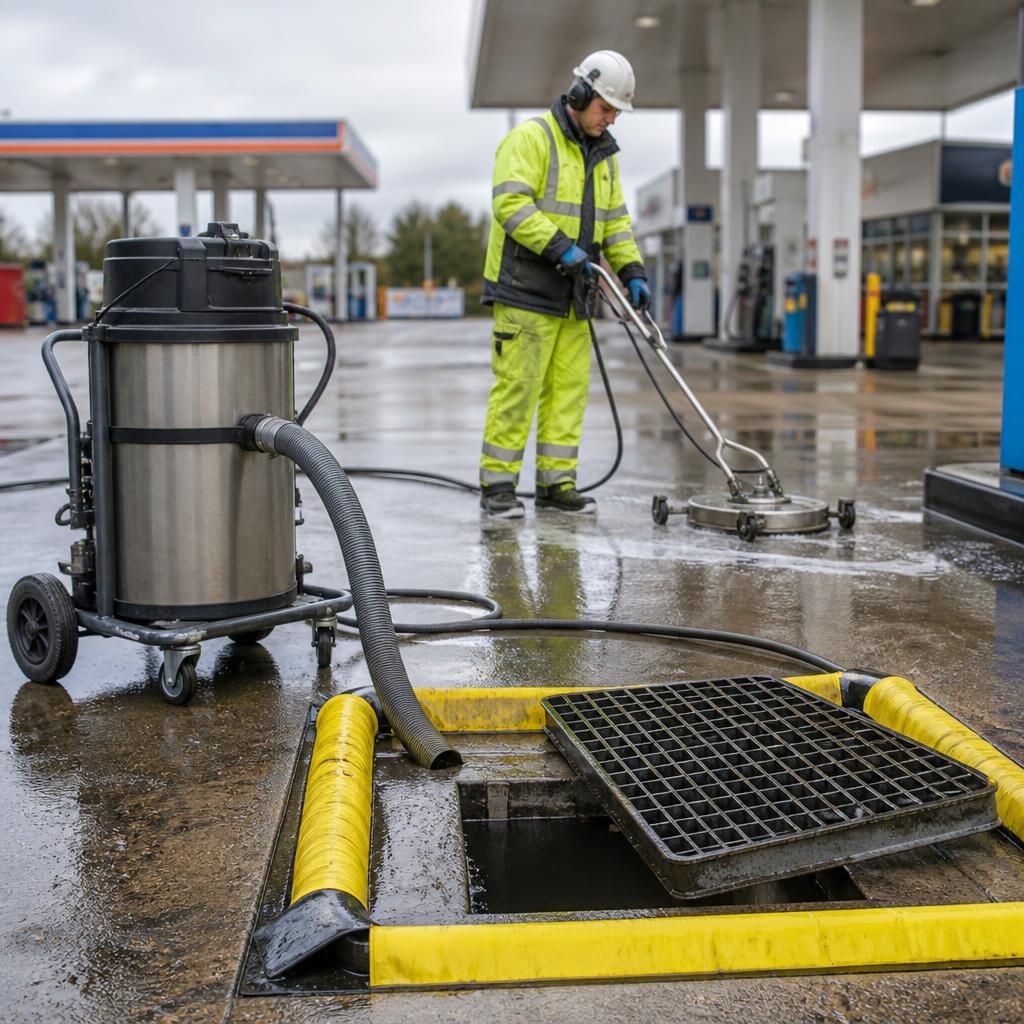
Controlling contaminated wash water is one of the most important environmental considerations in forecourt cleaning. Pressure washing can carry fuel, oil, detergent, grit and heavy metals into drainage systems, so the contractor should identify nearby drains and use suitable covers, bunding and water-recovery equipment before cleaning begins.
Recovered water and sludge must be treated, reused where appropriate or removed through a lawful disposal route. A responsible provider should explain how surface-water drains, foul drainage, interceptors and surrounding soil will be protected, and provide waste or discharge records where required.