
What safety protocols should be implemented during car park cleaning to ensure worker and public safety?
Car park cleaning should be controlled through a site-specific risk assessment, trained operatives, suitable PPE, inspected equipment, safe chemical handling and clear separation of workers, vehicles and pedestrians using barriers, signage and a managed traffic plan. Contractors should also control slips, water, cables, pressure-washing hazards and vehicle movements, while maintaining communication, emergency procedures and checks that the area is safe before it reopens.
Safe car park cleaning depends on a site-specific risk assessment, competent operatives, suitable personal protective equipment (PPE), well-maintained equipment and effective separation between cleaning activities, vehicles and pedestrians. Before work starts, the contractor should agree a method statement and traffic management plan with the client, taking account of the car park layout, operating hours, surface condition, cleaning chemicals, access equipment, drainage and nearby public areas.
Complete a site-specific risk assessment
A risk assessment should identify hazards before equipment or chemicals are brought onto site. Typical hazards include moving vehicles, pedestrians, poor visibility, uneven surfaces, oil contamination, slippery floors, pressurised water, electrical supplies, trailing hoses, work at height, contaminated run-off and restricted access for emergency vehicles. The assessment should set out control measures, responsible personnel and actions to take if conditions change.
The associated method statement should explain the cleaning sequence, equipment to be used, exclusion zones, emergency arrangements and reopening checks. It should be reviewed if the work area changes, weather conditions deteriorate, an incident occurs or an unexpected hazard is found.
Control vehicles and pedestrians
Vehicles and pedestrians should be kept physically separate from the cleaning operation wherever possible. Appropriate measures may include:
- Closing the affected section or arranging cleaning outside the car park’s busiest operating periods.
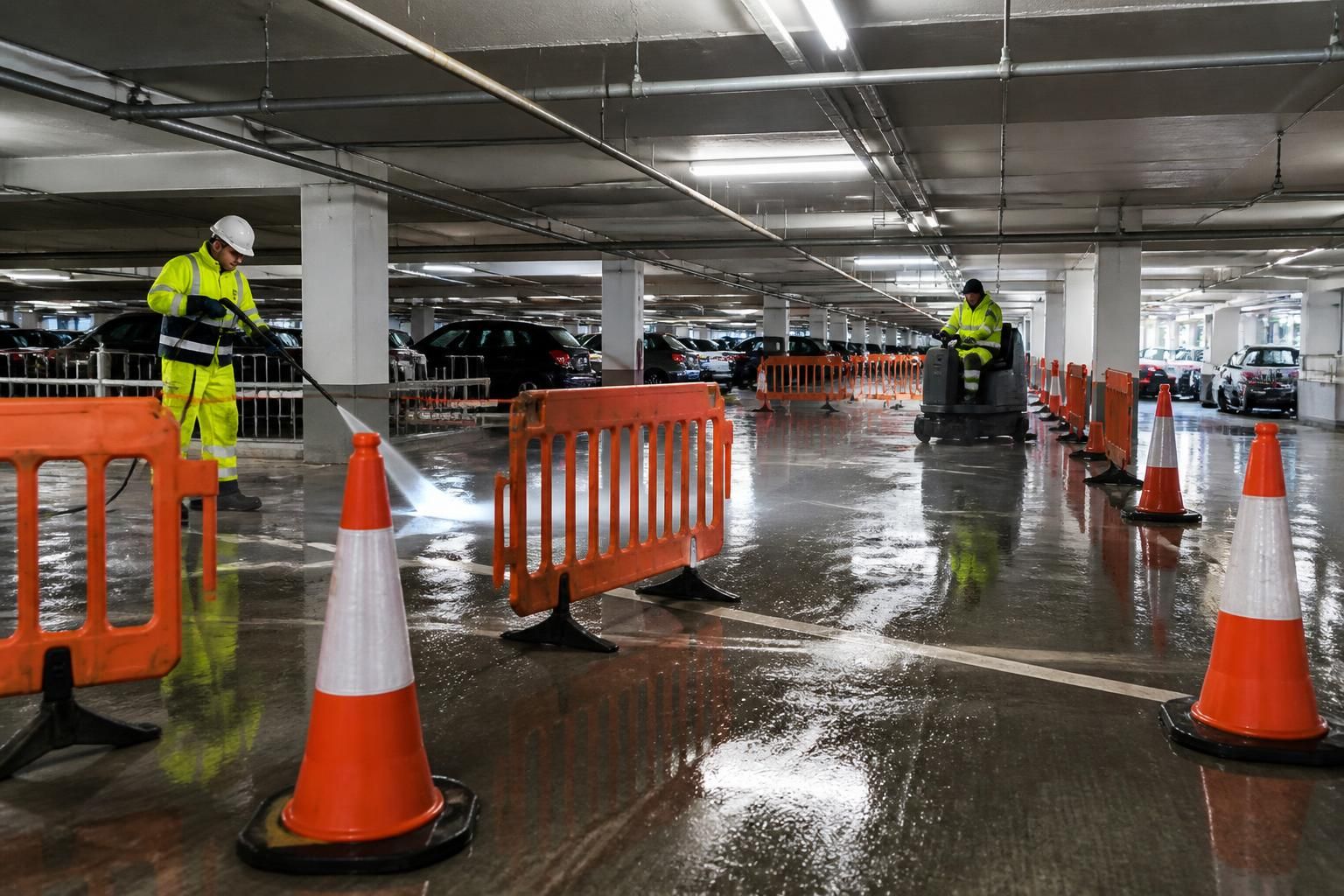
- Using cones, barriers, pedestrian barriers and clear warning signs to create a defined work zone.
- Providing a safe, clearly marked alternative route where a pedestrian walkway is affected.
- Using a trained banksman or traffic marshal when vehicles need to pass close to operatives or equipment.
- Keeping access routes, fire exits, disabled parking access and emergency routes clear.
- Using high-visibility clothing and suitable lighting when cleaning in low-light conditions.
Signs should be positioned where drivers and pedestrians have enough time to understand and respond to them. A barrier should not be treated as a substitute for supervision where vehicle movements remain possible.
Use trained operatives and appropriate PPE
Operatives should be trained in the cleaning methods, machinery and chemicals used on the site. They should understand the limits of pressure-washing equipment, how to work safely around traffic and what to do in the event of a spill, injury, equipment failure or unexpected public access.
PPE should be selected following the risk assessment. Depending on the task, this may include waterproof and high-visibility clothing, slip-resistant safety footwear, gloves, eye or face protection, hearing protection and suitable respiratory protection. PPE must be correctly fitted, inspected before use and kept clean. It should supplement, rather than replace, physical controls such as barriers and safe working distances.
Inspect and operate equipment safely
Pressure washers, scrubber dryers, vacuum systems, generators, hoses and access equipment should be suitable for the surface and task. Equipment should be inspected before use, with defects removed from service until repaired. Hoses and electrical leads should be routed away from vehicle lanes and pedestrian paths, protected where necessary and removed promptly when no longer required.
Pressure-washing operatives should maintain a safe distance from the spray, never direct high-pressure water at people, vehicles, electrical installations or fragile surfaces, and avoid creating spray that reduces visibility for drivers. Triggers should not be left unattended, and machinery should be isolated before clearing blockages or carrying out adjustments.
Where powered equipment is used outdoors or in damp conditions, the electrical supply, connectors and residual current protection should be appropriate for the environment. Petrol or diesel-powered machinery should only be used with adequate ventilation and positioned so that exhaust fumes cannot enter buildings or enclosed areas.
Any work at height, such as cleaning elevated structures or sections of a multi-storey car park, should be planned to avoid work at height wherever possible. Where access equipment is necessary, it should be suitable, inspected and operated by trained personnel. Access equipment must be positioned on stable ground, protected from vehicle impact and used in accordance with the relevant instructions and legal requirements.
Manage water and slip hazards
Water, detergent and loosened deposits can make concrete, painted markings, ramps and pedestrian routes slippery. The work area should be controlled while it is wet, with signs and barriers maintained until the surface is safe to use. Cleaning should progress in a planned direction so that operatives do not walk through contaminated water or leave wet routes across open pedestrian areas.
Drainage points should be identified before work begins. Silt, leaves and debris should not be washed into drains, and contaminated water containing oil, fuel, detergents or other pollutants should be collected, contained or treated in line with the site’s drainage arrangements and environmental requirements. Operatives should not allow dirty water to migrate onto public footways, roads or neighbouring property.
Handle chemicals and oil contamination correctly
Cleaning products must be selected for the surface and contamination, supplied with current safety information and used according to the manufacturer’s instructions. COSHH controls should cover storage, dilution, application, exposure risks, incompatible substances and spill response. Chemicals should remain labelled, secured when not in use and transported in suitable containers.
Operatives should avoid mixing products unless the manufacturer specifically permits it. Gloves, eye protection and other PPE should be used where the assessment requires them. Oil-affected surfaces may present both a slip risk and a hazardous-waste concern, so absorbents, recovered residues and contaminated materials should be handled and disposed of through appropriate arrangements.
Maintain communication and emergency controls
A responsible person should coordinate the work and communicate with the client or site representative before cleaning starts. Staff should know who can stop the operation, how to contact emergency services and where first-aid equipment, welfare facilities, spill kits, isolation points and fire equipment are located.
Emergency procedures should cover injury, chemical contact, electric shock, fire, equipment failure, uncontrolled vehicle access, flooding and environmental release. Any incident or near miss should be reported, investigated and used to improve the control measures before work continues.
Carry out a formal handover before reopening
The car park should not be reopened simply because the cleaning equipment has been removed. The responsible person should check that:
- Surfaces are sufficiently dry and free from loose debris, oil residue and slip hazards.
- Hoses, cables, barriers, signs, tools and vehicles have been removed or safely positioned.
- Drains, gullies, ramps, pedestrian routes and parking bays are clear.
- There is no uncontrolled contaminated water or cleaning solution remaining on site.
- Lighting, access routes and safety markings have not been obstructed or damaged.
- Any defects discovered during cleaning have been recorded and reported to the client.
For larger or regularly maintained sites, the contractor should retain suitable records of risk assessments, equipment checks, chemical controls, training, incidents and handovers. These records support consistent standards across repeat visits and help the client demonstrate that cleaning activities have been properly planned and controlled.
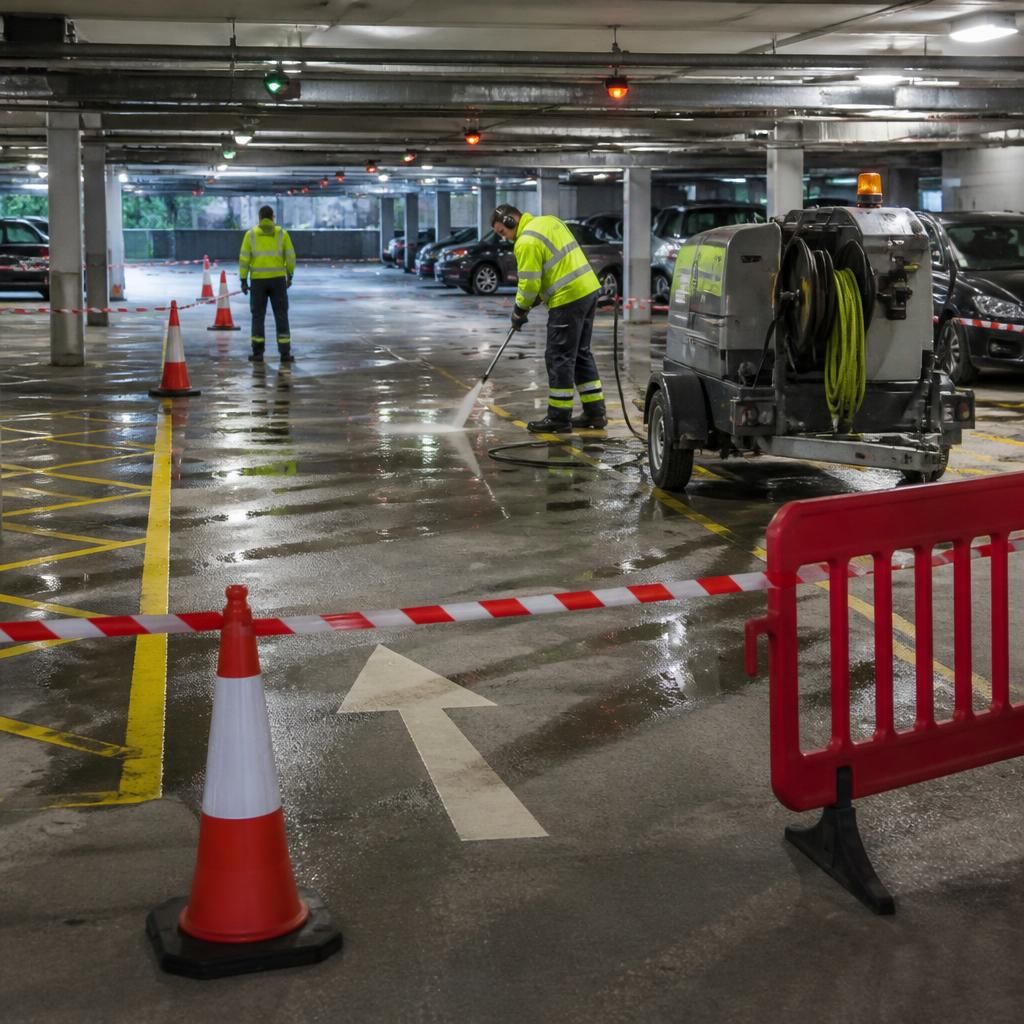
Separating the cleaning zone from vehicles and pedestrians is one of the most important car park safety controls. Use barriers, cones and clearly positioned warning signs to define the work area, and provide a safe alternative route where walkways or entrances are affected.
Keep hoses, cables, pressure-washing equipment and cleaning vehicles within the controlled zone. If traffic must pass nearby, a trained traffic marshal should coordinate movements and maintain communication with the cleaning team. Barriers and signs should remain in place until surfaces are dry, equipment has been removed and the area has been checked before reopening.