
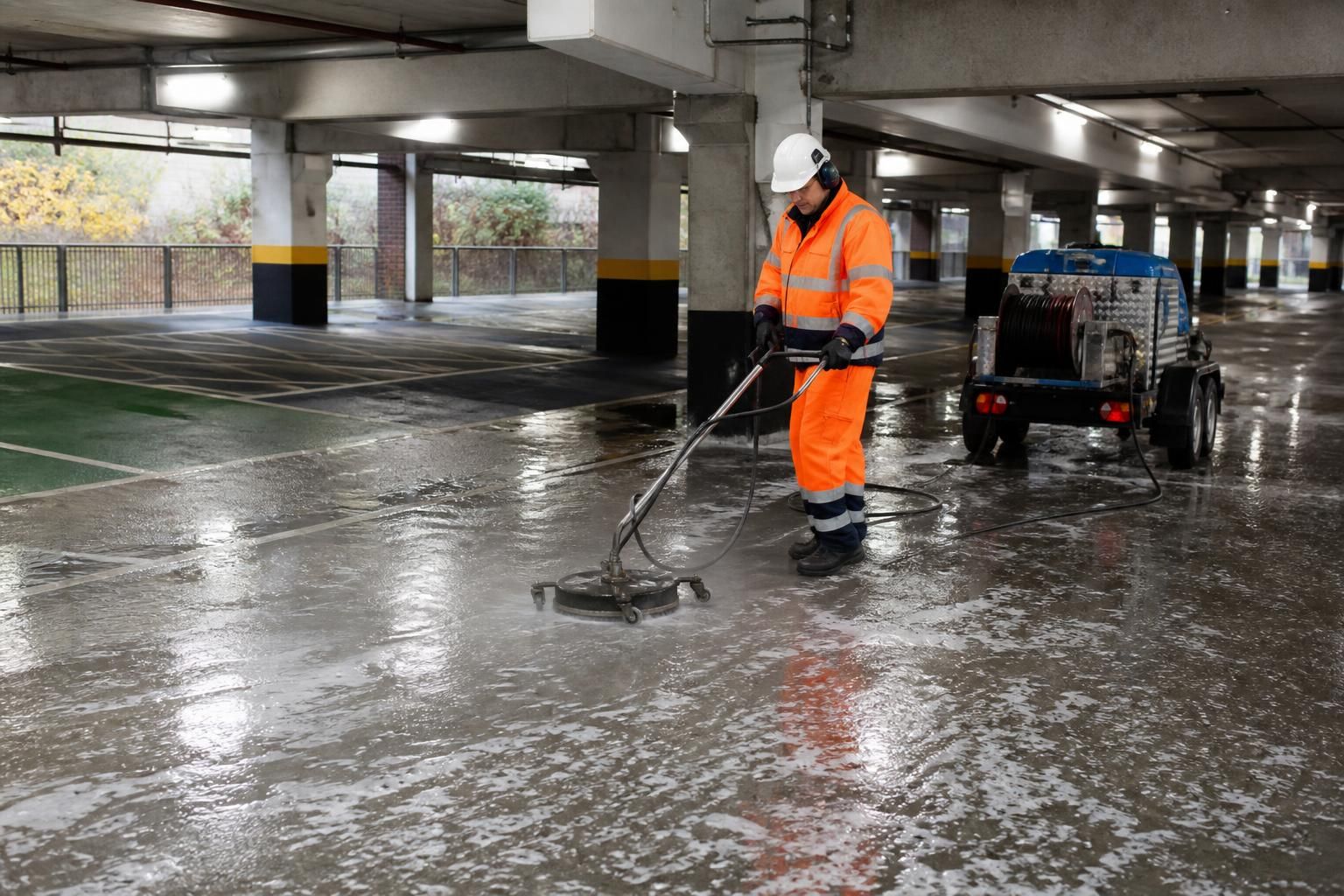
What environmental considerations should be taken into account when selecting a car park cleaning service?
When selecting a car park cleaning service, consider its water-use controls, biodegradable cleaning products, prevention of contaminated run-off, responsible waste disposal and the environmental efficiency of its equipment. The contractor should also follow relevant drainage and waste regulations, using methods such as controlled pressure washing, steam cleaning and water recovery where appropriate.
Select a car park cleaning service that can control water use, prevent contaminated run-off, use suitable lower-impact products, manage waste responsibly and operate efficient equipment. The contractor should also understand drainage arrangements and comply with applicable environmental, water pollution and waste requirements rather than allowing dirty wash water, oil or cleaning chemicals to enter surface-water drains.
Water use and recovery
Pressure washing can use substantial volumes of water, particularly across large decks, multi-storey car parks and service yards. Ask how the contractor controls consumption without compromising cleaning standards. Suitable measures may include targeted pressure washing, pre-treatment of heavily soiled areas, low-flow equipment, steam cleaning where appropriate and recovering wash water for controlled disposal or treatment.
Water-saving does not mean simply using less water and allowing contamination to remain on the surface. A competent contractor should balance water efficiency with effective removal of oil, fuel residues, dirt, chewing gum and other pollutants. The cleaning method should be selected according to the surface, level of contamination and drainage layout.
Protection of drains and prevention of polluted run-off
Run-off from a car park can contain oil, diesel, brake dust, rubber particles, silt, litter and cleaning residues. If this water enters a surface-water drain, it may reach a watercourse without adequate treatment. Before work begins, the contractor should identify drainage points, establish where wash water can safely go and use suitable controls to prevent uncontrolled discharge.
Depending on the site, controls can include drain covers or mats, temporary bunding, wet vacuums, water recovery systems, silt control and directing water to an appropriate foul drainage connection where permitted. A contractor should never assume that every drain leads to a treatment works. Where discharge arrangements are uncertain, the site operator and relevant water or environmental authority may need to confirm what is permitted.
Oil separators and drainage systems should not be treated as a substitute for responsible cleaning controls. They may require inspection, maintenance and correct operation, and they are not designed to accept every type of chemical or sediment. The cleaning plan should reflect the site’s drainage infrastructure and any restrictions imposed by the landlord, local authority, water company or environmental regulator.
Cleaning products and chemical selection
Cleaning agents should be selected for the particular contamination and used at the lowest effective concentration. Biodegradable or readily degradable products can reduce environmental persistence, but the term alone does not prove that a product is suitable for discharge or harmless to aquatic life. The contractor should be able to explain the product’s intended use, dilution, storage and disposal requirements.
Ask whether less hazardous alternatives can be used for routine dirt, algae and general staining, while reserving stronger degreasers for oil and fuel contamination. Products should not be mixed unless the manufacturer specifically permits it. Their safety data and COSHH assessments should be available, and operatives should understand how to prevent spills and respond if a product reaches a drain or soil.
Oil, fuel and other hazardous contamination
Oil stains need more than aggressive washing. A suitable process normally involves absorbing or collecting free oil, applying an appropriate treatment, agitating only as necessary and recovering the resulting residue rather than flushing it across the site. The method must be compatible with the paving, concrete, coatings and drainage arrangements.
Absorbent materials, contaminated sludge, used filters and other residues may require controlled handling and disposal. They should not be swept into drains, placed in general litter bins or left on site. Where contamination is extensive or linked to a spill, the cleaning contractor should advise the responsible site manager promptly so that the incident can be assessed and managed under the site’s spill and pollution procedures.
Waste segregation and disposal
Environmental performance includes what happens after cleaning. Litter, silt, moss, used absorbents and recovered wash water should be contained, separated where practical and transferred through appropriate waste arrangements. The contractor should use authorised waste carriers and suitable disposal or treatment facilities, retaining waste transfer or other relevant documentation where required.
It is reasonable to ask for an explanation of how waste will be classified and removed, particularly where the car park contains oil residues, construction debris, chemicals or fly-tipped material. Waste should not be stockpiled beside drains or mixed with recyclable material when separation is reasonably possible.
Equipment and energy efficiency
Equipment affects both resource use and local disturbance. Modern pressure washers, steam cleaners and water-recovery systems can be selected to match the scale and type of work, avoiding unnecessary water, fuel and operating time. Electric equipment may reduce on-site exhaust emissions and noise where the site has a suitable power supply, while fuel-powered plant may be necessary for remote or large-scale areas. The relevant consideration is whether the equipment is properly maintained, correctly sized and operated efficiently.
Maintenance is also an environmental control. Leaking hoses, pumps, fuel tanks or hydraulic systems can contaminate paving and drainage. Equipment should be checked before use, transported and refuelled carefully, and switched off when not required. Where access equipment is needed, the contractor should plan its use to minimise repeated movements, idling and the risk of damage to landscaped areas or drainage features.
Protection of surrounding areas
A car park cleaning plan should consider kerbs, planted areas, soil, water features, neighbouring properties and building entrances. Dirty water and chemical spray should be kept away from vegetation unless the product and application method are demonstrably suitable. Overspray can damage painted markings, façade materials, vehicles and planted areas, while high pressure can dislodge surface material and create additional sediment.
The contractor should assess the surface before selecting pressure, temperature and chemical treatment. This is particularly important for block paving, resin-bound surfaces, asphalt, painted bays, waterproofing systems and concrete with joints or defects. Environmentally responsible work includes avoiding repeat cleaning caused by preventable surface damage.
Timing, access and disruption
Scheduling can reduce environmental impact. Cleaning during dry, settled conditions may make it easier to control run-off, although the contractor should not proceed if weather conditions would carry contaminated water towards drains, soil or watercourses. Work should be coordinated with parking restrictions, deliveries and pedestrian routes so that equipment is not repeatedly moved or left running.
For larger sites, phased cleaning can reduce the area exposed to run-off at any one time. It also allows drainage controls to be checked progressively and limits the need to close the entire car park. The agreed method statement should identify how vehicles, pedestrians, nearby businesses and emergency access will be managed while cleaning is under way.
Evidence of responsible practice
Before appointing a contractor, request a site-specific method statement or environmental plan covering water use, drain protection, chemical selection, spill response, waste handling and final inspection. Useful evidence may include product safety information, waste documentation, equipment maintenance records, staff training records and details of any required discharge permissions or site controls.
Environmental claims should be specific and verifiable. Rather than relying on broad descriptions such as “green cleaning”, ask what will happen to the wash water, which products will be used, how waste will be removed and who is responsible for checking drainage protection. A reliable service should be able to explain these controls in practical terms and adapt them to the car park’s construction, contamination and drainage system.
Questions to ask when comparing services
- How will water use be reduced and will wash water be recovered or contained?
- Where do the site’s drains discharge, and how will surface-water drains be protected?
- Which cleaning products will be used, and are safer alternatives suitable for the contamination?
- How will oil, sludge, absorbents and other contaminated waste be classified and disposed of?
- What measures will protect nearby landscaping, watercourses, building materials and vehicles?
- What environmental controls, spill procedures and documentation will be included in the method statement?
- How will weather, access and phased working affect the cleaning plan?
The most suitable car park cleaning service is therefore not necessarily the one using the strongest chemicals or the highest pressure. It is the contractor that can demonstrate effective cleaning while controlling water, energy, chemicals, run-off, waste and site disturbance. A written, site-specific approach provides the clearest assurance that environmental considerations have been built into the work rather than added after a problem occurs.
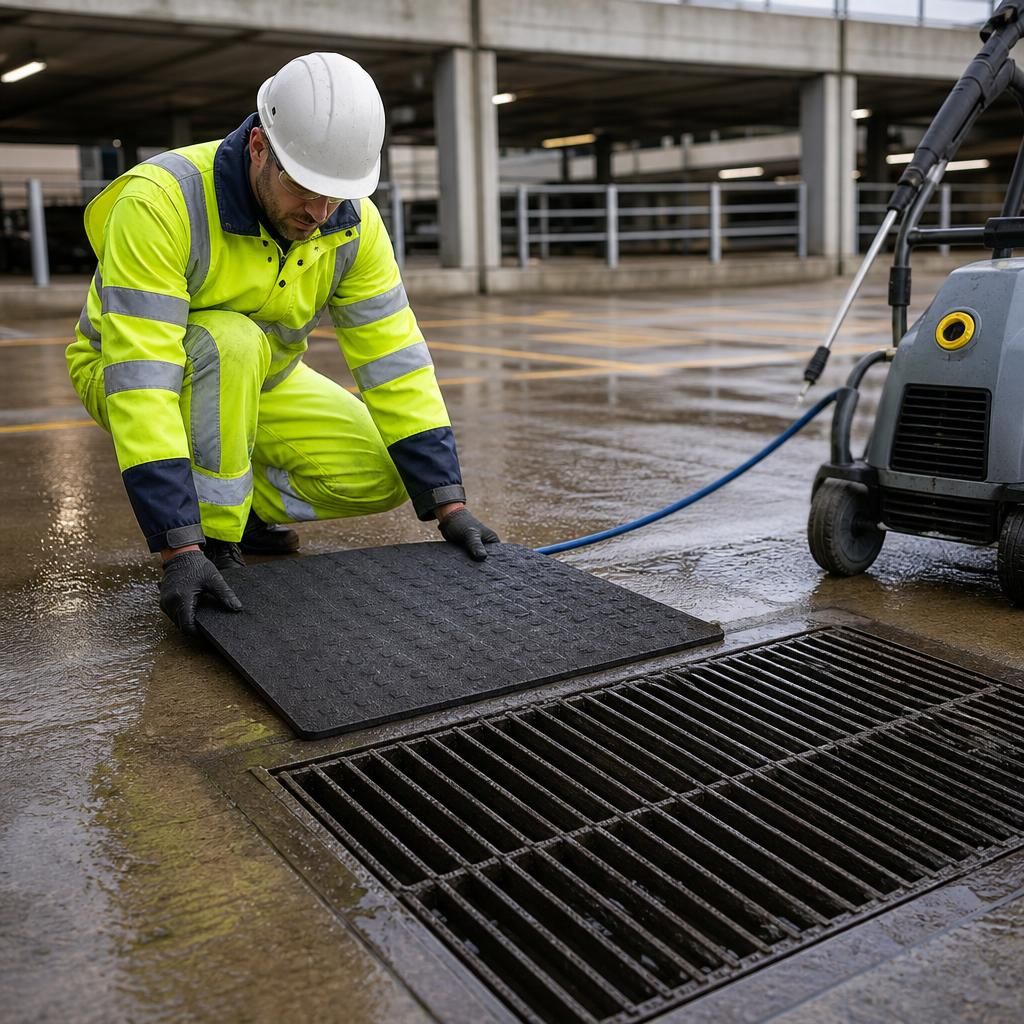
Protecting drainage systems is a central environmental consideration when selecting a car park cleaning service. Wash water can carry oil, fuel residues, silt, rubber particles and cleaning chemicals, so it must not be allowed to enter surface-water drains without suitable control or authorisation.
A competent contractor should identify the drainage layout before work begins and explain how contaminated water will be contained, recovered or directed to an appropriate disposal point. Depending on the site, this may involve drain covers, temporary bunding, wet vacuums, silt control and water-recovery equipment. The cleaning plan should also account for nearby soil, planting, watercourses and building entrances, particularly where pressure washing or chemical treatment is required.
Ask for these controls to be included in the method statement, together with spill-response arrangements and details of how recovered water and contaminated residues will be handled. This provides clearer assurance than a general claim that the service is environmentally friendly.
Request an Environmentally Responsible Car Park Cleaning Plan
Request an environmentally responsible car park cleaning plan covering water use, drainage protection, cleaning products, run-off control and waste disposal. Encanto Exterior Cleaning can tailor the method to your site’s surfaces, access arrangements and drainage system.