
How should you choose the right industrial cleaning equipment for car park surfaces?
Choose industrial cleaning equipment for car park surfaces according to the surface material, type of contamination, site size, drainage arrangements and access requirements. Pressure washing is effective for general dirt and oil residues, steam cleaning suits sensitive or heavily soiled areas, and specialist access equipment is needed for elevated structures or difficult-to-reach surfaces.
The right industrial cleaning equipment for car park surfaces should be selected according to the surface material, type of contamination, area to be cleaned, drainage arrangements, access restrictions and required finish. Pressure washing is generally suitable for loose dirt, algae, tyre marks and embedded grime; steam cleaning is useful where lower water consumption or more controlled treatment is needed; and specialist access equipment is required for elevated decks, ramps, façades and other difficult-to-reach areas.
Start with a site and surface assessment. Before choosing equipment, identify whether the car park is formed from concrete, asphalt, block paving, resin-bound surfacing, coated flooring or a combination of materials. Each surface has a different tolerance to pressure, heat and chemical treatment. A setting that is appropriate for robust concrete could damage a degraded asphalt surface, remove jointing material or lift a surface coating. The assessment should also record cracks, failed joints, loose aggregate, drainage channels, expansion joints, kerbs, protective coatings and areas where water could enter the building.
Consider the condition of the surface as well as its material. Older concrete, worn coatings and damaged asphalt may require lower-pressure cleaning, wider spray patterns or a staged approach. Test cleaning in an inconspicuous area before treating the full site. This confirms whether the selected method removes the contamination without marking the surface or altering its appearance.
Match the equipment to the contamination. Different deposits respond to different combinations of pressure, temperature, agitation and cleaning agents:
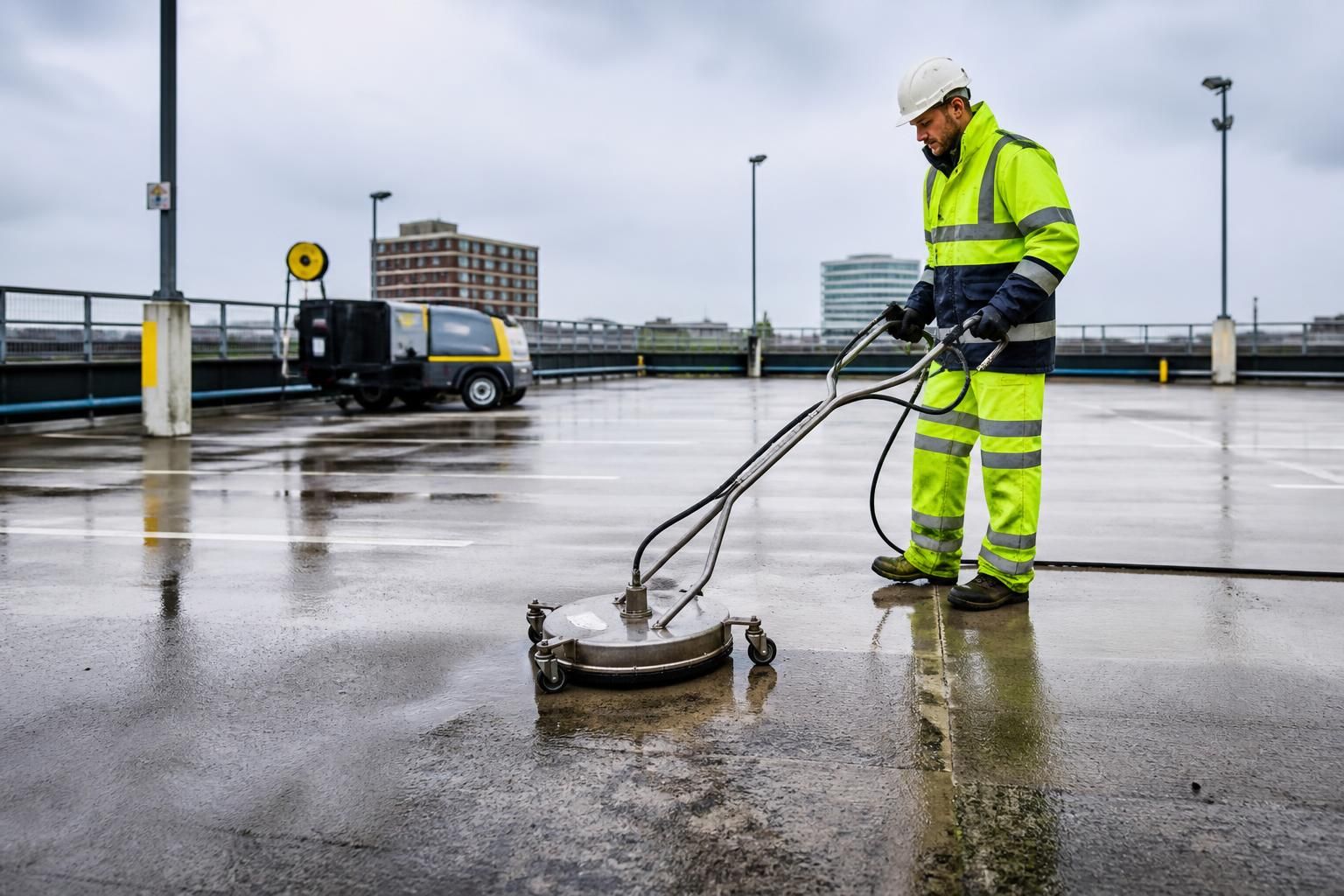
- Loose dirt, dust and general traffic film: A commercial pressure washer with a surface-cleaning attachment can provide consistent coverage across open areas while limiting overspray.
- Oil, diesel and grease: Hot-water pressure washing, suitable degreasers and mechanical agitation may be required. The equipment and cleaning method must be selected alongside a plan for containing and recovering contaminated wastewater.
- Algae, moss and biological growth: Controlled pressure, appropriate treatment and thorough rinsing can remove the growth while reducing the risk of damaging joints or coatings.
- Tyre marks and rubber deposits: These often need targeted treatment rather than maximum pressure. Heat and a suitable surface-safe cleaning agent can help loosen the deposit.
- Chewing gum, paint and localised residues: Steam equipment or specialist spot-cleaning tools can treat small areas with greater control than a large pressure-washing system.
- Dust and fine debris in covered or enclosed areas: Industrial sweepers, vacuum systems or pressure washers with effective water recovery may be more appropriate than unrestricted rinsing.
Choose pressure washing for broad, robust surfaces. Industrial pressure washers are effective for large car parks because they can remove surface dirt quickly and work with a range of accessories. Rotary surface cleaners help produce an even finish and reduce splash compared with a standard lance. However, the machine should offer adjustable pressure and flow rather than being operated at its highest setting as a default. Excessive pressure can erode concrete, strip coatings, damage asphalt and force water into joints or structures.
Equipment selection should also take account of water supply, hose length, power requirements, noise, manoeuvrability and the ability to work around parked vehicles, pedestrian routes and barriers. A compact machine may be preferable in a confined multi-storey car park, while a higher-capacity system may be more efficient on an open surface with suitable access and drainage.
Use steam cleaning where control is more important than speed. Steam cleaning can soften grease, chewing gum and other bonded residues with less water than conventional pressure washing. It can be useful in covered car parks, around sensitive fixtures and on areas where run-off must be restricted. The operator still needs to assess the surface, because heat can affect certain coatings, sealants and materials. Steam equipment is usually best suited to targeted treatment or sensitive areas rather than automatically replacing pressure washing across an entire site.
Include water recovery and pollution controls in the equipment choice. Run-off from a car park may contain oil, fuel residues, metals, detergents and fine sediment. It should not be allowed to enter surface-water drains unless the drainage arrangements and local requirements permit this. Depending on the site, suitable equipment may include drain covers, bunds, wet vacuums, recovery tanks, filtration units and pumping systems. Cleaning agents should be compatible with the surface and used only where they improve the result. The method statement should explain how wastewater will be contained, collected, treated or disposed of responsibly.
Water-recovery equipment is particularly important in multi-storey car parks, enclosed areas, sites near watercourses and locations with limited drainage capacity. It can also reduce slip risks by preventing standing water from being left on traffic lanes or pedestrian routes.
Assess access and working height. Cleaning equipment must reach every required surface without creating avoidable risks. For ramps, elevated decks, stair towers, retaining walls, soffits and façade areas, the contractor may need telescopic systems, extendable lances, powered access platforms or other specialist access equipment. The choice depends on working height, ground conditions, overhead obstructions, traffic movement and the position of drainage points.
Access equipment should be used only after a suitable site assessment and in accordance with the relevant safe system of work. Operators need appropriate training, and the work area may require exclusion zones, barriers, banksmen or temporary traffic management. Long lances can sometimes clean elevated areas from ground level, but they should not be used where recoil, overspray or loss of control could endanger people or damage property.
Check safety and operational requirements. The equipment should support safe working rather than simply deliver the highest cleaning output. Important considerations include:
- Automatic shut-off, secure hose connections and guards on moving components.
- Noise levels and exhaust ventilation, particularly in enclosed or covered car parks.
- Electrical safety where water is used near power supplies, lighting or charging points.
- Slip prevention through controlled water application, prompt recovery and clear signage.
- Safe separation of operatives, vehicles and pedestrians using barriers and a planned work zone.
- Compatibility with sensitive items such as vehicle barriers, ticket machines, electrical cabinets, lighting and ventilation equipment.
- Routine inspection, servicing and cleaning of the equipment before it is brought onto site.
Consider productivity without overlooking finish quality. A machine with high pressure or water flow is not necessarily the best option. The useful output depends on the surface-cleaning attachment, operator control, ability to recover wastewater, access to the work area and the time required for set-up and traffic management. For large open areas, a commercial pressure-washing system may provide efficient coverage. For oil spots, gum or sensitive finishes, a smaller steam or spot-cleaning system may produce a better result with less disruption.
For larger projects, a combination of equipment is often more effective than one machine. Industrial sweepers can remove loose debris before washing, pressure washers can clean the main traffic areas, steam equipment can treat bonded residues, and wet vacuums or recovery units can control water in restricted sections. This staged approach also reduces the likelihood of spreading oil or sediment across otherwise clean surfaces.
Ask for a method statement before work begins. The proposed method should identify the equipment, cleaning agents, pressure and temperature controls, test areas, access arrangements, traffic management, drainage protection, wastewater procedure and final inspection process. It should also explain how the work will be adapted if the surface is weaker than expected or if hidden drainage and access constraints are discovered.
The most appropriate equipment is therefore the equipment that cleans the contamination effectively while preserving the surface, controlling water and protecting people, vehicles and site infrastructure. A professional assessment of the car park will determine whether pressure washing, steam cleaning, mechanical sweeping, water recovery, specialist access equipment or a combination of methods is suitable for the particular site.
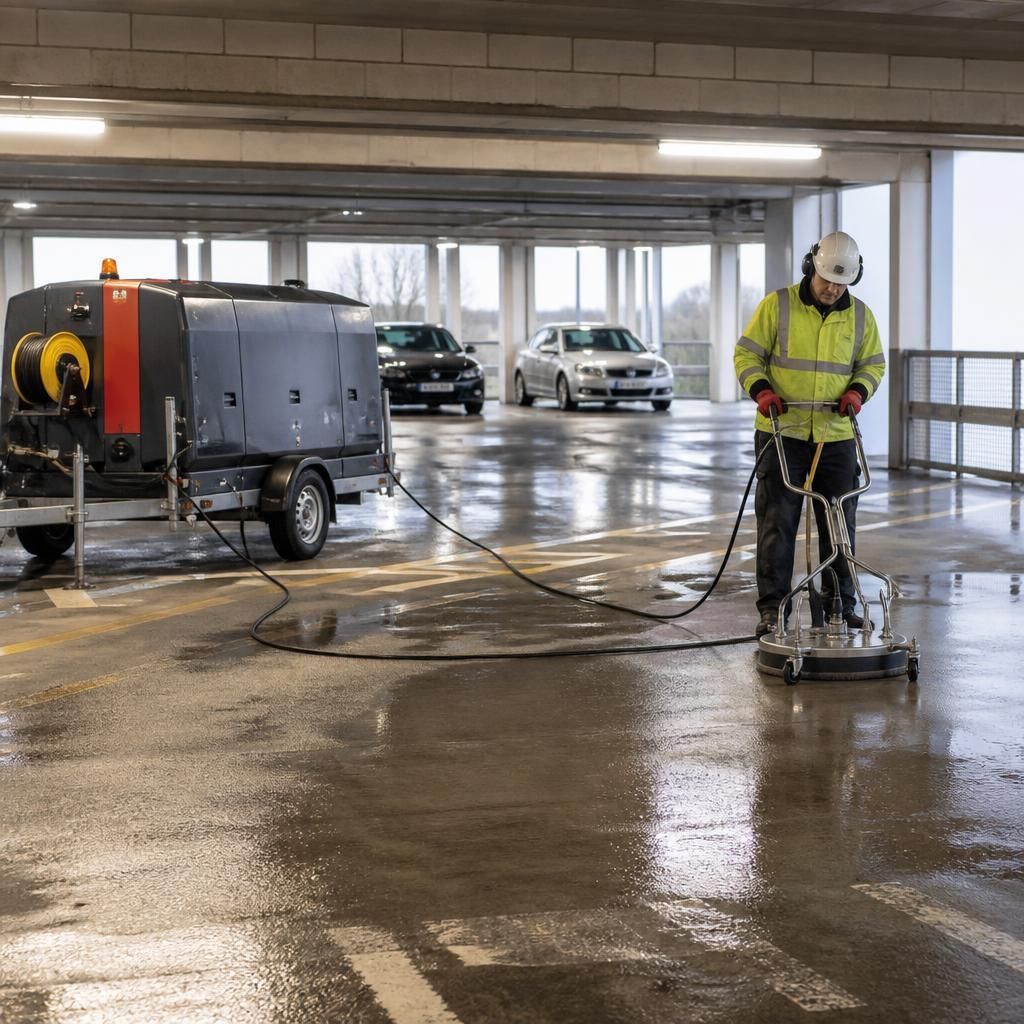
Match the cleaning equipment to both the surface and the contamination. Industrial pressure washing is usually effective for general dirt, algae, tyre marks and traffic film on robust concrete or asphalt, while steam cleaning gives greater control for chewing gum, grease and localised deposits. Water-recovery equipment should be included where contaminated run-off could enter drains or create slip hazards.
Before full-scale cleaning, test the chosen pressure, temperature and cleaning agent on an inconspicuous area. This helps confirm that the method will remove the deposit without damaging asphalt, coatings, jointing material, drainage channels or other car park features. For elevated decks, ramps and façades, specialist access equipment may also be needed to clean safely without relying on excessive pressure or uncontrolled overspray.