
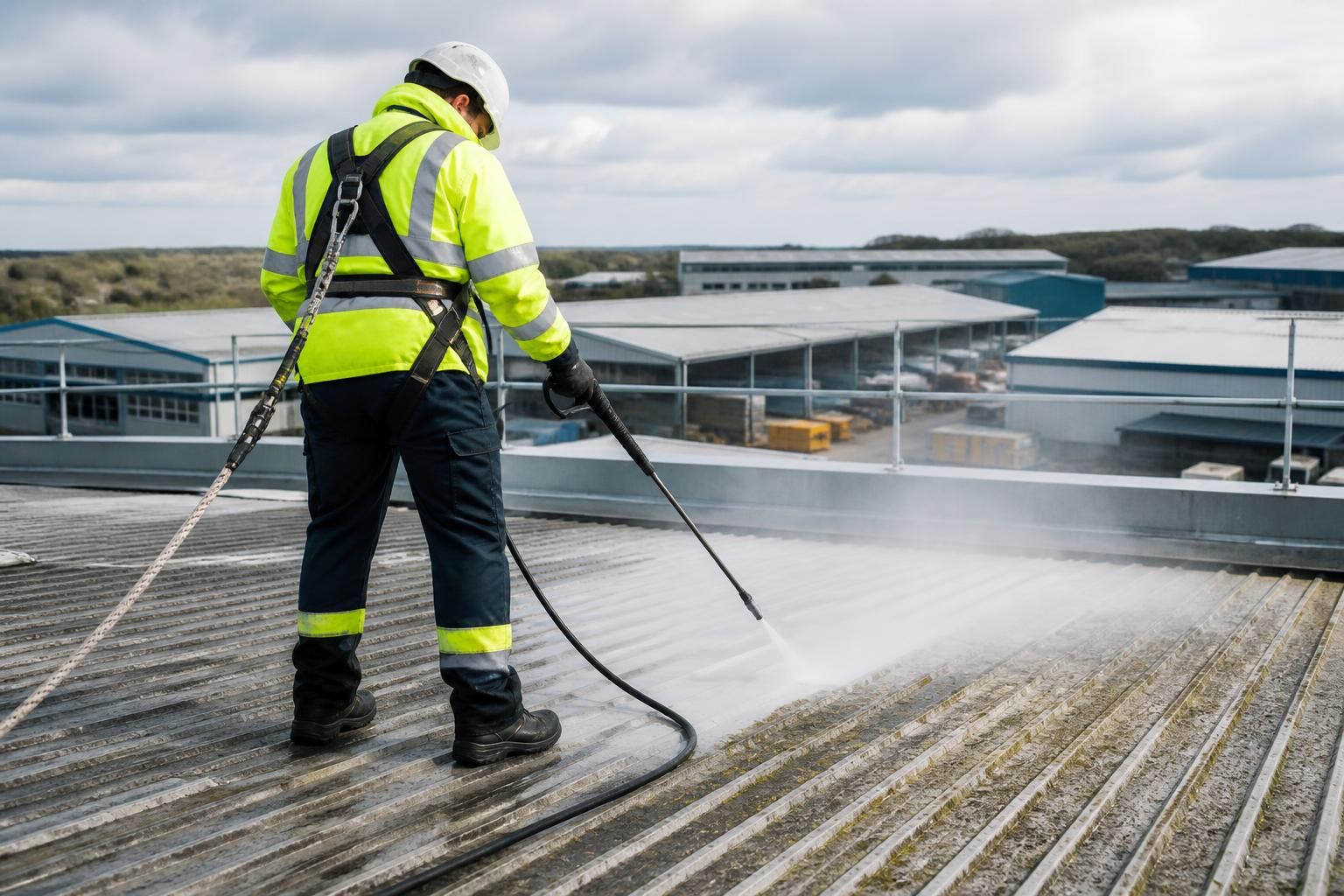
What specific safety measures are implemented during industrial roof washing?
Industrial roof washing is carried out using documented risk assessments, suitable access equipment, fall protection, controlled water and chemical use, and clear exclusion zones. These measures protect operatives, building occupants, the roof structure and surrounding areas throughout the work.
Industrial roof washing is managed through a documented risk assessment and method statement, competent operatives, suitable access equipment, fall protection, controlled cleaning chemicals and clearly defined exclusion zones. These controls are selected for the roof’s construction, condition, height, access arrangements and surrounding environment, protecting workers, building occupants, the roof itself and nearby drainage or watercourses.
Site assessment and planning
Before work starts, the roof and surrounding area are assessed for hazards that could affect the cleaning method or access arrangements. This typically includes checking:
- the roof covering, roof pitch, age and condition;
- fragile materials such as asbestos-containing cement, rooflights and deteriorated sheets;
- roof edges, openings, skylights, gutters, penetrations and areas with limited load-bearing capacity;
- access points, plant, overhead services, nearby traffic and pedestrian routes;
- weather conditions, wind exposure and the potential for surfaces to become slippery;
- drainage systems, discharge points and sensitive areas around the building.
The findings are recorded in site-specific risk assessments and method statements. These documents set out the proposed equipment, cleaning process, control measures, emergency arrangements and responsibilities. They are reviewed if conditions change, such as deteriorating weather, an unexpected roof defect or a change to the work area.
Safe access and fall protection
Access equipment is chosen according to the site rather than relying on a standard approach. Depending on the building, this may include mobile elevating work platforms, scaffolding, properly secured access ladders, temporary edge protection or other specialist systems. Equipment is inspected before use and operated only by people with the appropriate training and competence.
Where there is a risk of falling from an edge or through a fragile roof, collective protection such as guardrails and suitable working platforms is prioritised. Harnesses and lanyards may be used as part of a suitable fall-arrest or restraint system, but only where there are approved anchor points, compatible equipment and a planned rescue procedure. A harness is not a substitute for proper access planning, and operatives must not attach themselves to unsuitable roof components, pipes or plant.
Fragile roof areas, rooflights and openings are identified and protected or avoided. Operatives do not walk directly on unsupported or visibly damaged sheets. Crawling boards, staging or designated walkways may be required where the roof design permits access, with the final arrangement confirmed by the competent person responsible for the work.
Protecting the roof structure
Cleaning pressure and equipment are matched to the roofing material and its condition. Excessive pressure can lift coatings, drive water beneath laps, damage seals or worsen existing defects, so test areas are used where appropriate before the full clean begins. Operatives work from suitable positions and avoid concentrating loads or equipment on vulnerable sections.
Rooflights, flashings, vents, membrane details, solar equipment and other fittings are protected from impact and unsuitable cleaning methods. Water is directed away from openings and areas where it could enter the building. Any suspected structural defect, loose panel or unsafe surface is reported rather than being concealed by continuing the work.
Controlling people, vehicles and falling objects
Exclusion zones are established beneath and around the work area to prevent people or vehicles entering locations where water, debris, tools or cleaning equipment could fall. Barriers, warning signs and, where needed, a banksman or site marshal are used to control movement. The arrangement is coordinated with the site contact so that staff, contractors, deliveries and emergency routes remain separated from the operation.
Tools and hoses are managed to reduce trip, snagging and dropped-object risks. Equipment is not left unsecured at roof level, and materials are not stored close to unprotected edges. Where work takes place above entrances, walkways or operational areas, additional protection or temporary closure may be necessary.
Water, pressure and electrical controls
Hoses and pressure-washing equipment are checked before use, with couplings, guards and connections kept in good condition. Operatives maintain stable footing and position hoses so that they do not create additional fall or trip hazards. Water is controlled to prevent overspray affecting people, electrical installations, machinery, stock or adjacent properties.
Electrical risks are considered before water is introduced. Unnecessary electrical equipment is isolated or protected, and the work method accounts for overhead lines, rooftop electrical systems, lighting, cabling and plant. Electrical equipment used in wet conditions must be suitable for the environment and managed in accordance with the relevant site controls.
Chemical and biological safety
Where detergents, fungicides or biocides are needed, the product assessment and safety data information are reviewed before use. Control measures cover storage, dilution, application, personal protective equipment, contact with skin or eyes, inhalation and accidental release. Chemicals are not mixed unless the manufacturer’s instructions specifically permit it.
Operatives use appropriate gloves, eye or face protection, footwear and respiratory protection where the assessment requires it. Containers are labelled and kept secure, and only the necessary quantity is taken to the work area. The roof is rinsed or treated according to the agreed method, without allowing uncontrolled chemical discharge into soil, drains or watercourses.
Weather and surface conditions
Roof washing is postponed or suspended when weather creates an unacceptable risk. Strong winds can affect platforms, spray patterns and balance, while rain, ice or poor visibility can make access and roof surfaces unsafe. Sunlight and drying conditions may also affect the performance of cleaning products and the likelihood of slippery residues.
The supervisor monitors conditions throughout the work rather than relying only on the forecast made at the start of the day. Work areas are left in a safe condition if the operation has to stop, and access equipment is secured in accordance with the manufacturer’s instructions.
Run-off and surrounding-area protection
Water and cleaning residues are managed so that they do not create slip hazards or enter unsuitable drainage systems. Before washing begins, the team identifies relevant drains and discharge routes and uses collection, diversion, filtration or controlled discharge measures where required. Gutters and downpipes may be isolated or protected temporarily, provided this does not create a risk of water backing up into the building.
Overspray is controlled around doors, windows, air intakes, landscaping, vehicles and neighbouring premises. Waste, contaminated materials and used containers are removed and handled in line with the site’s procedures and applicable environmental requirements.
Personal protective equipment and communication
Personal protective equipment is selected after other controls have been considered. It may include slip-resistant safety footwear, head protection, gloves, eye protection, hearing protection, waterproof clothing and fall-arrest equipment. PPE is inspected, correctly fitted and used alongside, not instead of, safe access and work practices.
Everyone involved receives a site briefing covering the method statement, exclusion zone, communication signals, access route, chemical controls and emergency arrangements. Radio or direct communication is maintained where operatives are separated by the building layout, plant noise or height.
Emergency arrangements and final checks
The work plan includes procedures for falls, injury, chemical exposure, equipment failure, sudden weather changes, uncontrolled water ingress and contact with services. Rescue arrangements are established before work at height begins; relying solely on the emergency services is not an adequate substitute for a practical site-specific plan.
At completion, the roof and surrounding areas are checked for loose materials, blocked drainage, standing water, chemical residue, damaged components and remaining hazards. Access equipment and barriers are removed only when the area is safe to reopen. Any defect identified during washing is recorded and reported to the responsible client representative, with recommendations for inspection or repair where appropriate.
These measures are applied in line with the relevant UK requirements for work at height, equipment use, lifting equipment, chemical handling and site management. The exact controls vary between premises, so the final method should always be confirmed by a competent contractor following a site inspection rather than selected solely from the roof type or cleaning specification.
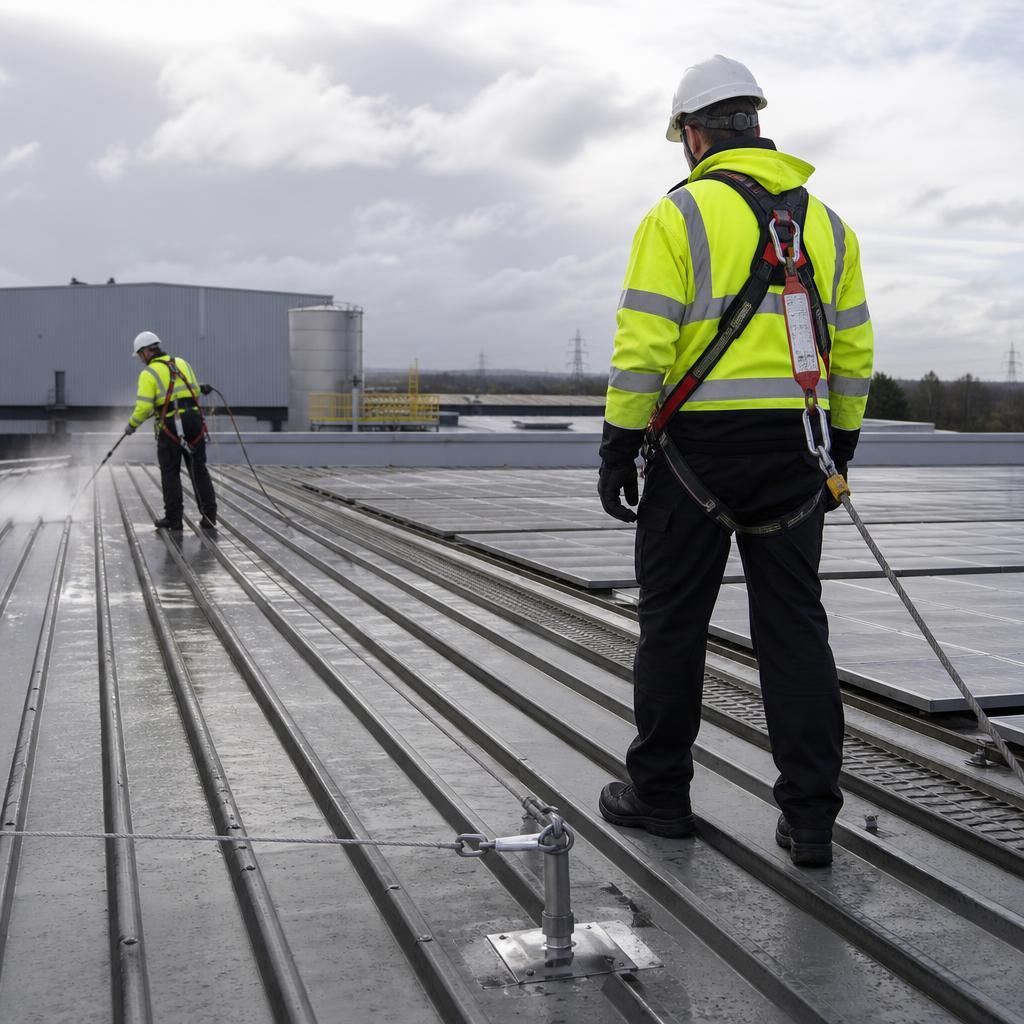
Fall protection during industrial roof washing combines safe access equipment, edge protection and a planned rescue procedure. Operatives do not rely on a harness alone: fragile roof areas, rooflights, openings and unprotected edges are identified before work begins, then protected or avoided.
Where harnesses are required, they are connected only to approved anchor points using compatible equipment, with trained operatives and a site-specific recovery plan in place. Guardrails, working platforms, secured ladders, scaffolding or mobile elevating work platforms may provide safer collective protection, depending on the roof layout and condition.